
Previous Shows
Early Edition
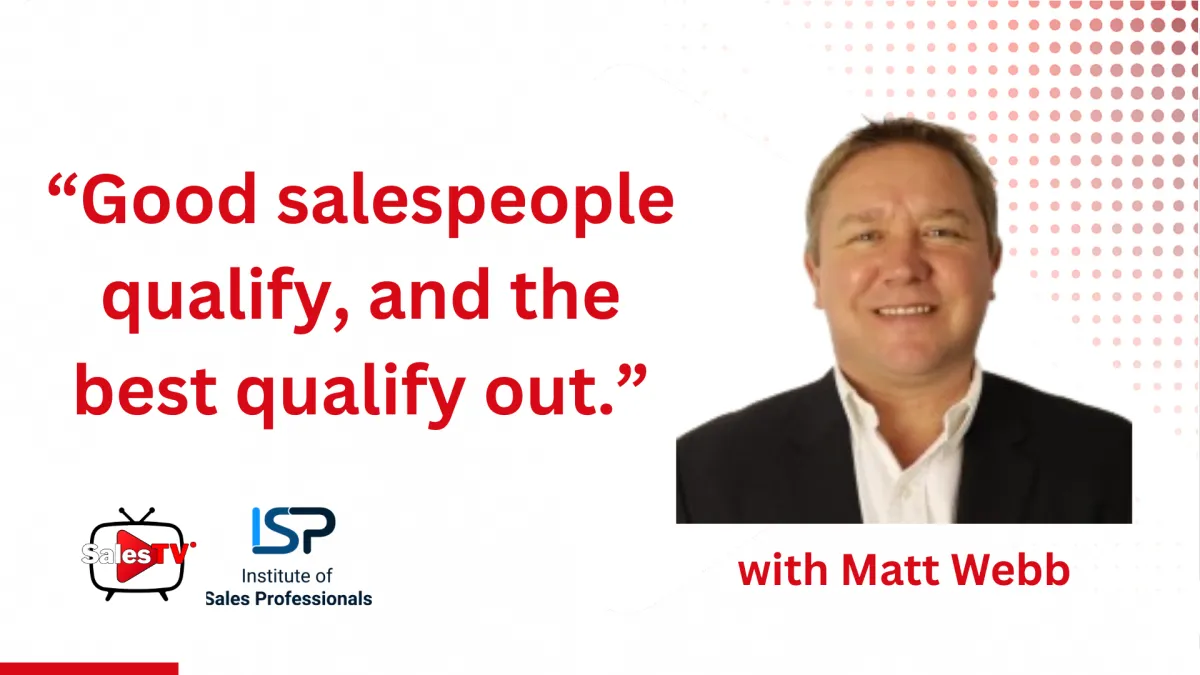
Why Great Salespeople Walk Away from Deals
Sales pipelines are full yet deals keep stalling in the middle. Many opportunities sit in the pipeline not because they’re lost, but because they were never truly qualified in the first place.
In this episode of SalesTV, we’re joined by Matt Webb, CEO of Mentor Group and co-author of Infinite Selling, to explain why great salespeople don’t just qualify deals - they qualify bad ones out. Over the years, he has worked with sales leaders and teams to diagnose one of the most common problems in B2B selling: opportunities that look promising in the pipeline but were never truly qualified. We explore why opportunities stall, how stronger buyer understanding improves qualification, and why walking away from weak deals is often the smartest move a seller can make.
We’ll ask questions like -
* Why do so many sales deals stall in the middle of the pipeline?
* How do you know if a sales deal is really qualified?
* When should a salesperson walk away from a deal?
* What questions should salespeople ask to truly qualify a deal?
Matt has spent nearly two decades helping global organizations build sustainable sales capability through training, practice environments, and enablement frameworks designed to embed real selling skills across teams. As CEO of Mentor Group - and a former sales leader at Vodafone - he has worked closely with enterprise sales teams around the world, helping them diagnose stalled pipeline and improve the way opportunities are qualified.
Join us Tuesday at Noon ET/ 9am PT.
This week's Guest was -
Matt Webb, CEO of Mentor Group and co-author of Infinite Selling
This week's Host was -
Rob Durant, CEO, ISP US
Transcript of SalesTV.live Mid-Day Edition 2026-03-31
Rob Durant [00:00:03]:
Hello and welcome to another edition of Sales TV. Today, we're discussing why great salespeople walk away from deals. We're joined by Matt Webb. Co-author of Infinite Selling, Matt has spent nearly two decades helping global organizations build sustainable sales capability through training, practice environments, and enablement frameworks designed to embed real skills across teams. As CEO of Mentor Group and a former sales leader at Vodafone, he has worked closely with enterprise sales teams around the world, helping them diagnose stalled pipeline and improve the way opportunities are qualified. Matt, welcome.
Matt Webb [00:00:52]:
Thank you very much. Good to see you.
Rob Durant [00:00:54]:
Good to see you as well. Glad to have you here. Matt, let's jump right into it. Why do so many sales deals stall in the middle of the pipeline?
Matt Webb [00:01:05]:
Oh, what a place to start as well. Well, a number of the ones that are in the middle of the pipeline should probably never be there in the first place. And you know what, one thing that I see a lot of today, which is something we need to address, is If you think back to the 3x or 4x pipeline coverage piece that we've heard about for many years, you know, prior to us getting very, very scientific on the data and the analytics of pipeline management, but we have this notion that you should have 3x or 4x within your pipeline and there's deals sitting in there which should never be there in the first place, but they're in there because if my manager taps me on the shoulder and says, what's your coverage? You go, yeah, I've got 3x, I'm going to be left alone. But the problem with that is it's a false narrative, because when you get to the end of the month or the end of the quarter or whatever your reporting period is, and then that deal slips— and we don't like that, nobody likes the deal slipping, it's quite unnerving— the manager says, well, you know, what happened? They weren't ready, or, you know, the competition had come in and we've been beaten on price. I'm sure you and I between us could write a big long list of all those excuses, right, that we've heard over the years. The reality is that sometimes some of the leadership behaviors are driving the wrong behaviors of the sellers. So those deals should never be there in the first place. That's the first thing.
Matt Webb [00:02:31]:
The second thing I'd say is we're not qualifying well enough. You know, people buy for a reason. Everybody buys for a reason, whether it's you or me, you know, go into a store somewhere or whatever it is, we're going for a reason. We have to find out why. And if we can get really great at qualifying— and thank you for the T in there, because qualifying means we qualify in as well as qualifying out— then we spend time doing the things we should be doing in our day-to-day sales roles. Does that make sense?
Rob Durant [00:03:04]:
Absolutely. But it begs the next question, which is, how do you know if a sales deal is really qualified?
Matt Webb [00:03:12]:
Yeah. So again, the constant dance that we have in a sales role between— there's so many people that can be involved in a sales pursuit now, from marketeers who are creating some of the stories at the beginning to initiate interest to maybe the AE, the account exec, or the pre-seller, or the overlay teams and everything else. How well are we collaborating as a team to make sure that as a, as a group, we really truly understand the customer needs? So there's so many qualification criteria methodologies out there. You've, you've heard them all over the years. What they're trying to do is they're saying, are we talking to the right people, understanding the people's challenges and problems, Can we create enough contrast that says from where you are to where you want to be, this is going to be the difference to you personally or your business? Do we understand what happens if you're going to choose somebody or move forward and then implement something? If we don't know some of those things, we're not qualifying properly, and that then runs the risk of deals either, either going away or being done internally. Which by the way is one of the big challenges that many organizations face at the moment, that the biggest competition is actually the in-house implementation of many things, or worse still, it's, as you rightly called out at the beginning, it stays in the pipeline forever. And I have to tell you, I saw a deal in a pipeline earlier this year that had been in there, and I'm not making this up, for 5,500 days. And I sit there and I'm like, are you sure that's a real opportunity? Oh yeah, absolutely.
Matt Webb [00:04:56]:
No, it really isn't in this guy. I've seen long sales cycles, but that is very long. So those sort of things, you know, qualify well and be brave enough to qualify out if there's a deal that is just not right for your organization or there's no urgency or no compelling event. It's okay to say to the customer, actually, this is not right for you or us. 'Oh, it's not the right time. Let's reconvene at a later date.' Otherwise, we really do use up that precious currency that we have in a sales role, which is time. And we only have so many key selling hours in a week, typically. So we've got to use it wisely.
Rob Durant [00:05:36]:
Another precious resource that salespeople have are leads. And If I walk away from a deal, that's one less lead I have to work. When should a salesperson walk away from a deal?
Matt Webb [00:05:53]:
Well, we change that paradigm for a moment because you're right in what you said there. We walk away from a deal, we've got one less lead in our pipeline and we go, oh, you know, but imagine if those are the 3 or 4 deals that we do have in our pipeline now afford me more time to go and qualify better, to go and understand the, you know, the personal and the business motivations of the buyers or the buyer or buyers that we're engaging. So we can be a lot more present in the opportunity pursuit. So yes, we might lose the one, but the other 3 or 4 that we've got now allow me to spend more time understanding the need, get greater velocity in moving them through towards a closed one than maybe I wouldn't have had the chance to if I'd have been spending all of my time on the 5. So it's just, it's just a subtle difference in the way of thinking where we have to be brave. We have to go, you know what, I'm chasing that one because it looks good on my pipeline metrics, but it's not going to look good in my closed won metrics. So I think that that's what I would say to that.
Rob Durant [00:07:02]:
Excellent. So along those lines then, What questions should salespeople ask to truly qualify a deal?
Matt Webb [00:07:11]:
Yeah, I love simplicity in any kind of sales pursuit. So the why change, why now, why us is the obvious answer to that. And of course, it's not always as simple as that. And it's not as simple as that because we're very rarely dealing with one buyer. In fact, you know, a lot of the research shows that in complex enterprise, deals, it's going to be 10+ and often plus many more than that. And of course, what my buyer motivation might be versus somebody who's an operational or technical is going to be very different. So we've got to spend time understanding the why change and the why now. So if we get to those points and the great, great point that you asked earlier, why would I walk away if the why change or why now are not really clear, that's a little alarm bell going off that says, okay, should we be spending our time with this? Indeed, should the customer be spending their time with this? Because how credible is it if we turn around to them and say, I'm not sure right now this problem is big enough for you to invest your time in? That's quite credible, isn't it, for a seller? Because it means we're no longer— or we shouldn't be focusing on ourselves anyway.
Matt Webb [00:08:23]:
We're focusing on the customer, always focus on the customer, and helping them in their decision-making, in their time management and prioritization as well. So, you know, and underneath those three things, Rob, the why change, there's a whole conversation there around who's creating the need for change in the first place. So, you know, you mentioned earlier, I've been in the sales role for let's just say a long time now, because it's getting to that point where it's starting to feel a bit uncomfortable. How long? It's been a long time. And if I go back to the early part of my career where there was probably a little bit more abundance than there is now, leads would come in more plentiful than perhaps they do. So in the absence of that, as professional sellers, what we need to do is go and create the change. We have to go and create the disruptive thinking with buyers Show them what's possible through the kind of value that we can bring. Sometimes they don't even know that there's a requirement there.
Matt Webb [00:09:22]:
The why now is, is it a big enough problem for you to really focus your time, energy, and resources on or not? And, you know, if you can say yes, you've got great answers to both of those, to use a Monopoly analogy, go pass go and collect your $200 or pounds or euros. Whatever it is, move forward. If the answer's no, slow down, slow down, do a bit more qualification, and either qualify out at that point, or make sure that you've done more to qualify in.
Rob Durant [00:09:56]:
Qualifying out can be quite difficult. I think back to the example you just gave, 5,500 days in the pipeline. So my question is, what are the warning signs that a deal is not truly qualified? I would contend 5,500 days is probably a good indicator, but at what point did that scale tip? Was it the 5,000th day? Was it the 2,000th day? Was there something that we were missing? Or ignoring. Again, the question is, what are the warning signs that a deal is not truly qualified?
Matt Webb [00:10:39]:
Yeah, and with experience, you also get a gut feel as you're going into a conversation with a customer, and you know what your value proposition is, you know what you're able to sell. And often you'll get that question, could you also do this, that, and the other? And sometimes in sales, we have happy ears and we go, wow, that sounds like a a buying signal to me, and you go, ah yeah, but actually they're asking for us to do something that we don't ordinarily do. Doesn't mean we can't innovate, of course we can, but sometimes the innovation and the requests are on the peripheral of what we really shouldn't be doing, and the gut is going, just no, just walk away here. It's not easy though, Rob, if you're a seller who's under pressure and you're behind the number and you go, well, you know, I tell you what, I'll find a way to make this work. It's risky. It's just so risky because I use the expression sometimes in sales, we sell the dream and then somebody else has to fix the nightmare. And you really want to avoid that because it's your gut saying we shouldn't be doing this because it's not what we do. But going back to the question, it's really about that qualification piece again that I was mentioning a moment ago.
Matt Webb [00:11:53]:
There will always be warning signs going off that we either choose to ignore or we just carry on. You know, if you're, you're a car driver and you see that engine warning light coming on, you go— or you're down to 5 miles of, um, of fuel in your car and you go, yeah, I know it's 10 miles, but I'm just going to risk it. And then you get to 7 and it conks out. The lights are there for a reason. The lights are there to go you probably should pull over and stop and fuel up. Sales is the same. So we get feedback from customers, we get feedback from data within our CRM, 5,500 days is a good data source, for example. We get feedback from gut and we get feedback from another thing.
Matt Webb [00:12:38]:
The challenge that we've got is we just sometimes choose to ignore them. And I like the expression, you know, we slow down for yellow lights. There was a methodology that I saw many years ago that had that exact expression in there and sort of playfully in working with salespeople, I say, well, what do you do if you're coming up to a traffic light and it starts to go yellow? What do you do? And the amount of times that people have said, well, you know, put my foot down a little bit to make sure I can get through. Okay, what's the risk of you doing that? Well, I might not get through and I might have an accident. So why would you do it? And then, and in sales, we do that far too often, whereas if we slow down we think about who we're engaging, we think about all the stakeholders that could be involved, we spend a bit more time qualifying, so we've got a quality pipeline rather than just a quantity pipeline, things might end up in a slightly different outcome when we look at our performance against target.
Rob Durant [00:13:43]:
Talk to me a little bit about the sales managers. Role in that scenario? What are the warning signs that a deal is not truly qualified that a sales manager should be aware of and more importantly act on?
Matt Webb [00:14:00]:
Yeah, that's a multi-layered question. And one of the earliest warning signs is if sales managers are not coaching at all. So, you know, I passionately believe that nobody comes to work to fail. In fact, most people don't do anything in life with a means to go, and I'm going to actively sabotage myself here and fail. People don't do that. And in sales, in all roles, people want to succeed. Now, a sales manager's role is to help them succeed, do a bit of gap analysis in the same way we do with customers, to find those one or two things that are going to help them either qualify better or engage a wider stakeholder group. If sales managers are not doing that, then they're not helping their team to succeed, to be successful.
Matt Webb [00:14:49]:
So sales managers must get into a rhythm of coaching because it really helps. And coaching and mentoring are quite different. Mentoring is, you know, your seller would come to you and say, what do I do? And you go, do that. And sometimes there is a place for that. Coaching is, you know, enabling and unlocking an individual's capability. Because, because I'd say probably 70-80% of the time people know the answer. They're just going to their manager for a bit of validation and reassurance that it is the right answer. That's where coaching comes in.
Matt Webb [00:15:21]:
So, and imagine if you're a coach and you're sitting down with your seller and they're going, right, we're in quarter one, and then you're in quarter two and you go, weren't all those opportunities in quarter one 'Oh yeah, the customer delayed and delayed.' And again, those excuses that I talked about right at the beginning of today really come to light. It's not about judgment from a sales manager's perspective. It's about spotting data, turning that data into an insight, and then helping the seller do the right actions and activities to change the situation. If the data stays the same, that's your warning signs, that's your engine warning light. And everything else. If they're not coaching, they're going to miss them. So those sort of things from a sales manager's perspective help. It goes back to everything that we said— key selling time, maximizing the time that you've got.
Matt Webb [00:16:16]:
The sales manager helps you do that by focusing on the right leading indicators or activities to then move that forward.
Rob Durant [00:16:26]:
Let's, um, pivot a little bit. What habits, uh, separate great qualifiers from average sellers?
Matt Webb [00:16:38]:
Oh, love that question. Okay, uh, the, the first word that comes to mind is curiosity, because people buy for a reason. So, so, so why is it? So if you're really curious about the conversation, then you're going to have a much better level of qualification. The second thing is not to move to solution too quickly. So, and this comes up all the time, by the way, when I'm talking to organizations that want to cross and upsell better, they find that their sales cycles are quite short because, you know, a customer will raise something and then they'll go, right, have we got a solution for you? And they moved straight to, to the answer. And imagine if you, if you didn't do that and you slowed down, you qualified a little bit more, and you got more curious about it and you think about what you've got to sell and all of a sudden the opportunity, the average order value becomes bigger because the actual need is far deeper than you originally thought. So the great ones have this sense of curiosity where they're curious about the why, they're curious about the who, by the who, not the band, just to be clear, or they could be, I mean, Why not? Are they curious about who's involved and navigating to have those different conversations? Because here's the thing, most people buy for emotional reasons and then they justify them for business reasons. So if you've got 5 different people to do some form of change, they're going to have this emotional driver and it can be values-based like trust, it could be recognition, it could be reward, it could be a number of things, but the best qualifiers seek to understand not only at a business level but a personal level, and at the personal level, not only at the business level for that person, i.e., their KPIs, but also at the 'so what does this mean for you' level.
Matt Webb [00:18:32]:
And that's what stands the best people out. They get, they get really under the, under the skin of what's going on for the organization, for the individual, and for the individual motivations. And they've got the bravery that I talked about earlier to go, do you know what, this is not right, or we're not the right partner for you. And that is so credible, Rob, to hear that say. And, and by the way, I would say 90% of the time that happens, an opportunity is created downstream. So you qualify out and say this is not right for us, and you get the credibility, and then, you know, I don't— there's no period of time necessarily. But they'll often come back and go, we know you didn't want to do this piece of work, or it wasn't right for you. Would you be interested in this piece of work? And then the cycle goes forward again.
Rob Durant [00:19:25]:
Is there one habit in particular we should start with?
Matt Webb [00:19:28]:
Yeah, move away from thinking about yourself.
Rob Durant [00:19:33]:
And that's easier said than done, isn't it?
Matt Webb [00:19:36]:
I know, because it's really hard because we've got quotas. We've got quarters, we've got all these other things. But as soon as you stop thinking about those things and you start thinking about the customer, their KPIs, their outcomes, you reduce the friction for a start in the conversation. And I won't mind sharing with you, actually, I remember years ago I was in a, I was in a conversation with a CEO, managing director, of a haulage company, and I made a golden mistake that I've never repeated since. I actually said, you know, we'd love to work with you. Don't worry about me, by the way, because I've already done my target for the quarter. And you know, when you say those words out loud and you want to just grab them back and pull them back, it's too late at that point. Straight away in that moment, as I walked out the room, I thought, well, I've lost this deal because I made it about me, even though I was trying not to make it about me.
Matt Webb [00:20:34]:
Make it not about you and things start to happen much, much better, much quicker. Be curious, understand them. It's always about the customer and things happen with much less friction, I would say.
Rob Durant [00:20:50]:
Matt, if you were to emphasize the one thing you would want our audience to take away from today's episode, what would that one thing be?
Matt Webb [00:20:58]:
Yeah, I'd say be brave, be brave enough to qualify out. Now, what I'm not suggesting is you look at your pipeline and go, no, no, no, no, no, that's not the point. Qualifying out is because we've qualified well. It's also having the honesty in your pipeline that says, if I've got— and I'll use the same example this morning, sorry, the same example— if I've got 5 deals and I'm pretty confident that 3 of them are really well qualified, one of them needs more qualification, but one is in there for vanity metrics. And by that I mean so I can get my 3x or 4x. Be brave enough to qualify out. So if you pull those two things into one, get really good at qualifying because you're curious and then know when to qualify out because it's credible. And if you do that with a customer, you'll be surprised at how often they'll come back to you and say, we trust you because you're transparent and you're honest.
Matt Webb [00:21:59]:
Fantastic.
Rob Durant [00:21:59]:
Matt, this has been great. On behalf of everyone at Sales TV, thank you for today's conversation. Yeah, a replay. Oh, absolutely. A replay and full transcript of today's episode along with contact information can be found at SalesTV.live/SalesQualification
Matt, to you and to our audience, thank you all for being a great part of today's episode, and we'll see you next time.
@SalesTVlive
#SalesQualification #InfiniteSales #QualifyOut #SalesPipeline #SalesStrategy #B2BSales #SalesProcess
#Sales #SalesLeadership #LinkedInLive #Podcast
________________________________________
About SalesTV: SalesTV is a weekly talk show created by salespeople, for salespeople. Each episode explores sales, sales training, sales enablement, and social selling, bringing together sales leaders, enablement professionals, and practitioners from across the globe.
About the Institute of Sales Professionals: The ISP is the only body worldwide dedicated to raising the standards of sales. Its Sales Capability Framework, certifications, and member community are designed to address their one goal: To Elevate the Profession of Sales.

Mid-Day Edition
Why Great Salespeople Walk Away from Deals
Sales pipelines are full yet deals keep stalling in the middle. Many opportunities sit in the pipeline not because they’re lost, but because they were never truly qualified in the first place.
In this episode of SalesTV, we’re joined by Matt Webb, CEO of Mentor Group and co-author of Infinite Selling, to explain why great salespeople don’t just qualify deals - they qualify bad ones out. Over the years, he has worked with sales leaders and teams to diagnose one of the most common problems in B2B selling: opportunities that look promising in the pipeline but were never truly qualified. We explore why opportunities stall, how stronger buyer understanding improves qualification, and why walking away from weak deals is often the smartest move a seller can make.
We’ll ask questions like -
* Why do so many sales deals stall in the middle of the pipeline?
* How do you know if a sales deal is really qualified?
* When should a salesperson walk away from a deal?
* What questions should salespeople ask to truly qualify a deal?
Matt has spent nearly two decades helping global organizations build sustainable sales capability through training, practice environments, and enablement frameworks designed to embed real selling skills across teams. As CEO of Mentor Group - and a former sales leader at Vodafone - he has worked closely with enterprise sales teams around the world, helping them diagnose stalled pipeline and improve the way opportunities are qualified.
Join us Tuesday at Noon ET/ 9am PT.
This week's Guest was -
Matt Webb, CEO of Mentor Group and co-author of Infinite Selling
This week's Host was -
Rob Durant, CEO, ISP US
Transcript of SalesTV.live Mid-Day Edition 2026-03-31
Rob Durant [00:00:03]:
Hello and welcome to another edition of Sales TV. Today, we're discussing why great salespeople walk away from deals. We're joined by Matt Webb. Co-author of Infinite Selling, Matt has spent nearly two decades helping global organizations build sustainable sales capability through training, practice environments, and enablement frameworks designed to embed real skills across teams. As CEO of Mentor Group and a former sales leader at Vodafone, he has worked closely with enterprise sales teams around the world, helping them diagnose stalled pipeline and improve the way opportunities are qualified. Matt, welcome.
Matt Webb [00:00:52]:
Thank you very much. Good to see you.
Rob Durant [00:00:54]:
Good to see you as well. Glad to have you here. Matt, let's jump right into it. Why do so many sales deals stall in the middle of the pipeline?
Matt Webb [00:01:05]:
Oh, what a place to start as well. Well, a number of the ones that are in the middle of the pipeline should probably never be there in the first place. And you know what, one thing that I see a lot of today, which is something we need to address, is If you think back to the 3x or 4x pipeline coverage piece that we've heard about for many years, you know, prior to us getting very, very scientific on the data and the analytics of pipeline management, but we have this notion that you should have 3x or 4x within your pipeline and there's deals sitting in there which should never be there in the first place, but they're in there because if my manager taps me on the shoulder and says, what's your coverage? You go, yeah, I've got 3x, I'm going to be left alone. But the problem with that is it's a false narrative, because when you get to the end of the month or the end of the quarter or whatever your reporting period is, and then that deal slips— and we don't like that, nobody likes the deal slipping, it's quite unnerving— the manager says, well, you know, what happened? They weren't ready, or, you know, the competition had come in and we've been beaten on price. I'm sure you and I between us could write a big long list of all those excuses, right, that we've heard over the years. The reality is that sometimes some of the leadership behaviors are driving the wrong behaviors of the sellers. So those deals should never be there in the first place. That's the first thing.
Matt Webb [00:02:31]:
The second thing I'd say is we're not qualifying well enough. You know, people buy for a reason. Everybody buys for a reason, whether it's you or me, you know, go into a store somewhere or whatever it is, we're going for a reason. We have to find out why. And if we can get really great at qualifying— and thank you for the T in there, because qualifying means we qualify in as well as qualifying out— then we spend time doing the things we should be doing in our day-to-day sales roles. Does that make sense?
Rob Durant [00:03:04]:
Absolutely. But it begs the next question, which is, how do you know if a sales deal is really qualified?
Matt Webb [00:03:12]:
Yeah. So again, the constant dance that we have in a sales role between— there's so many people that can be involved in a sales pursuit now, from marketeers who are creating some of the stories at the beginning to initiate interest to maybe the AE, the account exec, or the pre-seller, or the overlay teams and everything else. How well are we collaborating as a team to make sure that as a, as a group, we really truly understand the customer needs? So there's so many qualification criteria methodologies out there. You've, you've heard them all over the years. What they're trying to do is they're saying, are we talking to the right people, understanding the people's challenges and problems, Can we create enough contrast that says from where you are to where you want to be, this is going to be the difference to you personally or your business? Do we understand what happens if you're going to choose somebody or move forward and then implement something? If we don't know some of those things, we're not qualifying properly, and that then runs the risk of deals either, either going away or being done internally. Which by the way is one of the big challenges that many organizations face at the moment, that the biggest competition is actually the in-house implementation of many things, or worse still, it's, as you rightly called out at the beginning, it stays in the pipeline forever. And I have to tell you, I saw a deal in a pipeline earlier this year that had been in there, and I'm not making this up, for 5,500 days. And I sit there and I'm like, are you sure that's a real opportunity? Oh yeah, absolutely.
Matt Webb [00:04:56]:
No, it really isn't in this guy. I've seen long sales cycles, but that is very long. So those sort of things, you know, qualify well and be brave enough to qualify out if there's a deal that is just not right for your organization or there's no urgency or no compelling event. It's okay to say to the customer, actually, this is not right for you or us. 'Oh, it's not the right time. Let's reconvene at a later date.' Otherwise, we really do use up that precious currency that we have in a sales role, which is time. And we only have so many key selling hours in a week, typically. So we've got to use it wisely.
Rob Durant [00:05:36]:
Another precious resource that salespeople have are leads. And If I walk away from a deal, that's one less lead I have to work. When should a salesperson walk away from a deal?
Matt Webb [00:05:53]:
Well, we change that paradigm for a moment because you're right in what you said there. We walk away from a deal, we've got one less lead in our pipeline and we go, oh, you know, but imagine if those are the 3 or 4 deals that we do have in our pipeline now afford me more time to go and qualify better, to go and understand the, you know, the personal and the business motivations of the buyers or the buyer or buyers that we're engaging. So we can be a lot more present in the opportunity pursuit. So yes, we might lose the one, but the other 3 or 4 that we've got now allow me to spend more time understanding the need, get greater velocity in moving them through towards a closed one than maybe I wouldn't have had the chance to if I'd have been spending all of my time on the 5. So it's just, it's just a subtle difference in the way of thinking where we have to be brave. We have to go, you know what, I'm chasing that one because it looks good on my pipeline metrics, but it's not going to look good in my closed won metrics. So I think that that's what I would say to that.
Rob Durant [00:07:02]:
Excellent. So along those lines then, What questions should salespeople ask to truly qualify a deal?
Matt Webb [00:07:11]:
Yeah, I love simplicity in any kind of sales pursuit. So the why change, why now, why us is the obvious answer to that. And of course, it's not always as simple as that. And it's not as simple as that because we're very rarely dealing with one buyer. In fact, you know, a lot of the research shows that in complex enterprise, deals, it's going to be 10+ and often plus many more than that. And of course, what my buyer motivation might be versus somebody who's an operational or technical is going to be very different. So we've got to spend time understanding the why change and the why now. So if we get to those points and the great, great point that you asked earlier, why would I walk away if the why change or why now are not really clear, that's a little alarm bell going off that says, okay, should we be spending our time with this? Indeed, should the customer be spending their time with this? Because how credible is it if we turn around to them and say, I'm not sure right now this problem is big enough for you to invest your time in? That's quite credible, isn't it, for a seller? Because it means we're no longer— or we shouldn't be focusing on ourselves anyway.
Matt Webb [00:08:23]:
We're focusing on the customer, always focus on the customer, and helping them in their decision-making, in their time management and prioritization as well. So, you know, and underneath those three things, Rob, the why change, there's a whole conversation there around who's creating the need for change in the first place. So, you know, you mentioned earlier, I've been in the sales role for let's just say a long time now, because it's getting to that point where it's starting to feel a bit uncomfortable. How long? It's been a long time. And if I go back to the early part of my career where there was probably a little bit more abundance than there is now, leads would come in more plentiful than perhaps they do. So in the absence of that, as professional sellers, what we need to do is go and create the change. We have to go and create the disruptive thinking with buyers Show them what's possible through the kind of value that we can bring. Sometimes they don't even know that there's a requirement there.
Matt Webb [00:09:22]:
The why now is, is it a big enough problem for you to really focus your time, energy, and resources on or not? And, you know, if you can say yes, you've got great answers to both of those, to use a Monopoly analogy, go pass go and collect your $200 or pounds or euros. Whatever it is, move forward. If the answer's no, slow down, slow down, do a bit more qualification, and either qualify out at that point, or make sure that you've done more to qualify in.
Rob Durant [00:09:56]:
Qualifying out can be quite difficult. I think back to the example you just gave, 5,500 days in the pipeline. So my question is, what are the warning signs that a deal is not truly qualified? I would contend 5,500 days is probably a good indicator, but at what point did that scale tip? Was it the 5,000th day? Was it the 2,000th day? Was there something that we were missing? Or ignoring. Again, the question is, what are the warning signs that a deal is not truly qualified?
Matt Webb [00:10:39]:
Yeah, and with experience, you also get a gut feel as you're going into a conversation with a customer, and you know what your value proposition is, you know what you're able to sell. And often you'll get that question, could you also do this, that, and the other? And sometimes in sales, we have happy ears and we go, wow, that sounds like a a buying signal to me, and you go, ah yeah, but actually they're asking for us to do something that we don't ordinarily do. Doesn't mean we can't innovate, of course we can, but sometimes the innovation and the requests are on the peripheral of what we really shouldn't be doing, and the gut is going, just no, just walk away here. It's not easy though, Rob, if you're a seller who's under pressure and you're behind the number and you go, well, you know, I tell you what, I'll find a way to make this work. It's risky. It's just so risky because I use the expression sometimes in sales, we sell the dream and then somebody else has to fix the nightmare. And you really want to avoid that because it's your gut saying we shouldn't be doing this because it's not what we do. But going back to the question, it's really about that qualification piece again that I was mentioning a moment ago.
Matt Webb [00:11:53]:
There will always be warning signs going off that we either choose to ignore or we just carry on. You know, if you're, you're a car driver and you see that engine warning light coming on, you go— or you're down to 5 miles of, um, of fuel in your car and you go, yeah, I know it's 10 miles, but I'm just going to risk it. And then you get to 7 and it conks out. The lights are there for a reason. The lights are there to go you probably should pull over and stop and fuel up. Sales is the same. So we get feedback from customers, we get feedback from data within our CRM, 5,500 days is a good data source, for example. We get feedback from gut and we get feedback from another thing.
Matt Webb [00:12:38]:
The challenge that we've got is we just sometimes choose to ignore them. And I like the expression, you know, we slow down for yellow lights. There was a methodology that I saw many years ago that had that exact expression in there and sort of playfully in working with salespeople, I say, well, what do you do if you're coming up to a traffic light and it starts to go yellow? What do you do? And the amount of times that people have said, well, you know, put my foot down a little bit to make sure I can get through. Okay, what's the risk of you doing that? Well, I might not get through and I might have an accident. So why would you do it? And then, and in sales, we do that far too often, whereas if we slow down we think about who we're engaging, we think about all the stakeholders that could be involved, we spend a bit more time qualifying, so we've got a quality pipeline rather than just a quantity pipeline, things might end up in a slightly different outcome when we look at our performance against target.
Rob Durant [00:13:43]:
Talk to me a little bit about the sales managers. Role in that scenario? What are the warning signs that a deal is not truly qualified that a sales manager should be aware of and more importantly act on?
Matt Webb [00:14:00]:
Yeah, that's a multi-layered question. And one of the earliest warning signs is if sales managers are not coaching at all. So, you know, I passionately believe that nobody comes to work to fail. In fact, most people don't do anything in life with a means to go, and I'm going to actively sabotage myself here and fail. People don't do that. And in sales, in all roles, people want to succeed. Now, a sales manager's role is to help them succeed, do a bit of gap analysis in the same way we do with customers, to find those one or two things that are going to help them either qualify better or engage a wider stakeholder group. If sales managers are not doing that, then they're not helping their team to succeed, to be successful.
Matt Webb [00:14:49]:
So sales managers must get into a rhythm of coaching because it really helps. And coaching and mentoring are quite different. Mentoring is, you know, your seller would come to you and say, what do I do? And you go, do that. And sometimes there is a place for that. Coaching is, you know, enabling and unlocking an individual's capability. Because, because I'd say probably 70-80% of the time people know the answer. They're just going to their manager for a bit of validation and reassurance that it is the right answer. That's where coaching comes in.
Matt Webb [00:15:21]:
So, and imagine if you're a coach and you're sitting down with your seller and they're going, right, we're in quarter one, and then you're in quarter two and you go, weren't all those opportunities in quarter one 'Oh yeah, the customer delayed and delayed.' And again, those excuses that I talked about right at the beginning of today really come to light. It's not about judgment from a sales manager's perspective. It's about spotting data, turning that data into an insight, and then helping the seller do the right actions and activities to change the situation. If the data stays the same, that's your warning signs, that's your engine warning light. And everything else. If they're not coaching, they're going to miss them. So those sort of things from a sales manager's perspective help. It goes back to everything that we said— key selling time, maximizing the time that you've got.
Matt Webb [00:16:16]:
The sales manager helps you do that by focusing on the right leading indicators or activities to then move that forward.
Rob Durant [00:16:26]:
Let's, um, pivot a little bit. What habits, uh, separate great qualifiers from average sellers?
Matt Webb [00:16:38]:
Oh, love that question. Okay, uh, the, the first word that comes to mind is curiosity, because people buy for a reason. So, so, so why is it? So if you're really curious about the conversation, then you're going to have a much better level of qualification. The second thing is not to move to solution too quickly. So, and this comes up all the time, by the way, when I'm talking to organizations that want to cross and upsell better, they find that their sales cycles are quite short because, you know, a customer will raise something and then they'll go, right, have we got a solution for you? And they moved straight to, to the answer. And imagine if you, if you didn't do that and you slowed down, you qualified a little bit more, and you got more curious about it and you think about what you've got to sell and all of a sudden the opportunity, the average order value becomes bigger because the actual need is far deeper than you originally thought. So the great ones have this sense of curiosity where they're curious about the why, they're curious about the who, by the who, not the band, just to be clear, or they could be, I mean, Why not? Are they curious about who's involved and navigating to have those different conversations? Because here's the thing, most people buy for emotional reasons and then they justify them for business reasons. So if you've got 5 different people to do some form of change, they're going to have this emotional driver and it can be values-based like trust, it could be recognition, it could be reward, it could be a number of things, but the best qualifiers seek to understand not only at a business level but a personal level, and at the personal level, not only at the business level for that person, i.e., their KPIs, but also at the 'so what does this mean for you' level.
Matt Webb [00:18:32]:
And that's what stands the best people out. They get, they get really under the, under the skin of what's going on for the organization, for the individual, and for the individual motivations. And they've got the bravery that I talked about earlier to go, do you know what, this is not right, or we're not the right partner for you. And that is so credible, Rob, to hear that say. And, and by the way, I would say 90% of the time that happens, an opportunity is created downstream. So you qualify out and say this is not right for us, and you get the credibility, and then, you know, I don't— there's no period of time necessarily. But they'll often come back and go, we know you didn't want to do this piece of work, or it wasn't right for you. Would you be interested in this piece of work? And then the cycle goes forward again.
Rob Durant [00:19:25]:
Is there one habit in particular we should start with?
Matt Webb [00:19:28]:
Yeah, move away from thinking about yourself.
Rob Durant [00:19:33]:
And that's easier said than done, isn't it?
Matt Webb [00:19:36]:
I know, because it's really hard because we've got quotas. We've got quarters, we've got all these other things. But as soon as you stop thinking about those things and you start thinking about the customer, their KPIs, their outcomes, you reduce the friction for a start in the conversation. And I won't mind sharing with you, actually, I remember years ago I was in a, I was in a conversation with a CEO, managing director, of a haulage company, and I made a golden mistake that I've never repeated since. I actually said, you know, we'd love to work with you. Don't worry about me, by the way, because I've already done my target for the quarter. And you know, when you say those words out loud and you want to just grab them back and pull them back, it's too late at that point. Straight away in that moment, as I walked out the room, I thought, well, I've lost this deal because I made it about me, even though I was trying not to make it about me.
Matt Webb [00:20:34]:
Make it not about you and things start to happen much, much better, much quicker. Be curious, understand them. It's always about the customer and things happen with much less friction, I would say.
Rob Durant [00:20:50]:
Matt, if you were to emphasize the one thing you would want our audience to take away from today's episode, what would that one thing be?
Matt Webb [00:20:58]:
Yeah, I'd say be brave, be brave enough to qualify out. Now, what I'm not suggesting is you look at your pipeline and go, no, no, no, no, no, that's not the point. Qualifying out is because we've qualified well. It's also having the honesty in your pipeline that says, if I've got— and I'll use the same example this morning, sorry, the same example— if I've got 5 deals and I'm pretty confident that 3 of them are really well qualified, one of them needs more qualification, but one is in there for vanity metrics. And by that I mean so I can get my 3x or 4x. Be brave enough to qualify out. So if you pull those two things into one, get really good at qualifying because you're curious and then know when to qualify out because it's credible. And if you do that with a customer, you'll be surprised at how often they'll come back to you and say, we trust you because you're transparent and you're honest.
Matt Webb [00:21:59]:
Fantastic.
Rob Durant [00:21:59]:
Matt, this has been great. On behalf of everyone at Sales TV, thank you for today's conversation. Yeah, a replay. Oh, absolutely. A replay and full transcript of today's episode along with contact information can be found at SalesTV.live/SalesQualification
Matt, to you and to our audience, thank you all for being a great part of today's episode, and we'll see you next time.
@SalesTVlive
#SalesQualification #InfiniteSales #QualifyOut #SalesPipeline #SalesStrategy #B2BSales #SalesProcess
#Sales #SalesLeadership #LinkedInLive #Podcast
________________________________________
About SalesTV: SalesTV is a weekly talk show created by salespeople, for salespeople. Each episode explores sales, sales training, sales enablement, and social selling, bringing together sales leaders, enablement professionals, and practitioners from across the globe.
About the Institute of Sales Professionals: The ISP is the only body worldwide dedicated to raising the standards of sales. Its Sales Capability Framework, certifications, and member community are designed to address their one goal: To Elevate the Profession of Sales.
Other Editions
Why Great Salespeople Walk Away from Deals
Sales pipelines are full yet deals keep stalling in the middle. Many opportunities sit in the pipeline not because they’re lost, but because they were never truly qualified in the first place.
In this episode of SalesTV, we’re joined by Matt Webb, CEO of Mentor Group and co-author of Infinite Selling, to explain why great salespeople don’t just qualify deals - they qualify bad ones out. Over the years, he has worked with sales leaders and teams to diagnose one of the most common problems in B2B selling: opportunities that look promising in the pipeline but were never truly qualified. We explore why opportunities stall, how stronger buyer understanding improves qualification, and why walking away from weak deals is often the smartest move a seller can make.
We’ll ask questions like -
* Why do so many sales deals stall in the middle of the pipeline?
* How do you know if a sales deal is really qualified?
* When should a salesperson walk away from a deal?
* What questions should salespeople ask to truly qualify a deal?
Matt has spent nearly two decades helping global organizations build sustainable sales capability through training, practice environments, and enablement frameworks designed to embed real selling skills across teams. As CEO of Mentor Group - and a former sales leader at Vodafone - he has worked closely with enterprise sales teams around the world, helping them diagnose stalled pipeline and improve the way opportunities are qualified.
Join us Tuesday at Noon ET/ 9am PT.
This week's Guest was -
Matt Webb, CEO of Mentor Group and co-author of Infinite Selling
This week's Host was -
Rob Durant, CEO, ISP US
Transcript of SalesTV.live Mid-Day Edition 2026-03-31
Rob Durant [00:00:03]:
Hello and welcome to another edition of Sales TV. Today, we're discussing why great salespeople walk away from deals. We're joined by Matt Webb. Co-author of Infinite Selling, Matt has spent nearly two decades helping global organizations build sustainable sales capability through training, practice environments, and enablement frameworks designed to embed real skills across teams. As CEO of Mentor Group and a former sales leader at Vodafone, he has worked closely with enterprise sales teams around the world, helping them diagnose stalled pipeline and improve the way opportunities are qualified. Matt, welcome.
Matt Webb [00:00:52]:
Thank you very much. Good to see you.
Rob Durant [00:00:54]:
Good to see you as well. Glad to have you here. Matt, let's jump right into it. Why do so many sales deals stall in the middle of the pipeline?
Matt Webb [00:01:05]:
Oh, what a place to start as well. Well, a number of the ones that are in the middle of the pipeline should probably never be there in the first place. And you know what, one thing that I see a lot of today, which is something we need to address, is If you think back to the 3x or 4x pipeline coverage piece that we've heard about for many years, you know, prior to us getting very, very scientific on the data and the analytics of pipeline management, but we have this notion that you should have 3x or 4x within your pipeline and there's deals sitting in there which should never be there in the first place, but they're in there because if my manager taps me on the shoulder and says, what's your coverage? You go, yeah, I've got 3x, I'm going to be left alone. But the problem with that is it's a false narrative, because when you get to the end of the month or the end of the quarter or whatever your reporting period is, and then that deal slips— and we don't like that, nobody likes the deal slipping, it's quite unnerving— the manager says, well, you know, what happened? They weren't ready, or, you know, the competition had come in and we've been beaten on price. I'm sure you and I between us could write a big long list of all those excuses, right, that we've heard over the years. The reality is that sometimes some of the leadership behaviors are driving the wrong behaviors of the sellers. So those deals should never be there in the first place. That's the first thing.
Matt Webb [00:02:31]:
The second thing I'd say is we're not qualifying well enough. You know, people buy for a reason. Everybody buys for a reason, whether it's you or me, you know, go into a store somewhere or whatever it is, we're going for a reason. We have to find out why. And if we can get really great at qualifying— and thank you for the T in there, because qualifying means we qualify in as well as qualifying out— then we spend time doing the things we should be doing in our day-to-day sales roles. Does that make sense?
Rob Durant [00:03:04]:
Absolutely. But it begs the next question, which is, how do you know if a sales deal is really qualified?
Matt Webb [00:03:12]:
Yeah. So again, the constant dance that we have in a sales role between— there's so many people that can be involved in a sales pursuit now, from marketeers who are creating some of the stories at the beginning to initiate interest to maybe the AE, the account exec, or the pre-seller, or the overlay teams and everything else. How well are we collaborating as a team to make sure that as a, as a group, we really truly understand the customer needs? So there's so many qualification criteria methodologies out there. You've, you've heard them all over the years. What they're trying to do is they're saying, are we talking to the right people, understanding the people's challenges and problems, Can we create enough contrast that says from where you are to where you want to be, this is going to be the difference to you personally or your business? Do we understand what happens if you're going to choose somebody or move forward and then implement something? If we don't know some of those things, we're not qualifying properly, and that then runs the risk of deals either, either going away or being done internally. Which by the way is one of the big challenges that many organizations face at the moment, that the biggest competition is actually the in-house implementation of many things, or worse still, it's, as you rightly called out at the beginning, it stays in the pipeline forever. And I have to tell you, I saw a deal in a pipeline earlier this year that had been in there, and I'm not making this up, for 5,500 days. And I sit there and I'm like, are you sure that's a real opportunity? Oh yeah, absolutely.
Matt Webb [00:04:56]:
No, it really isn't in this guy. I've seen long sales cycles, but that is very long. So those sort of things, you know, qualify well and be brave enough to qualify out if there's a deal that is just not right for your organization or there's no urgency or no compelling event. It's okay to say to the customer, actually, this is not right for you or us. 'Oh, it's not the right time. Let's reconvene at a later date.' Otherwise, we really do use up that precious currency that we have in a sales role, which is time. And we only have so many key selling hours in a week, typically. So we've got to use it wisely.
Rob Durant [00:05:36]:
Another precious resource that salespeople have are leads. And If I walk away from a deal, that's one less lead I have to work. When should a salesperson walk away from a deal?
Matt Webb [00:05:53]:
Well, we change that paradigm for a moment because you're right in what you said there. We walk away from a deal, we've got one less lead in our pipeline and we go, oh, you know, but imagine if those are the 3 or 4 deals that we do have in our pipeline now afford me more time to go and qualify better, to go and understand the, you know, the personal and the business motivations of the buyers or the buyer or buyers that we're engaging. So we can be a lot more present in the opportunity pursuit. So yes, we might lose the one, but the other 3 or 4 that we've got now allow me to spend more time understanding the need, get greater velocity in moving them through towards a closed one than maybe I wouldn't have had the chance to if I'd have been spending all of my time on the 5. So it's just, it's just a subtle difference in the way of thinking where we have to be brave. We have to go, you know what, I'm chasing that one because it looks good on my pipeline metrics, but it's not going to look good in my closed won metrics. So I think that that's what I would say to that.
Rob Durant [00:07:02]:
Excellent. So along those lines then, What questions should salespeople ask to truly qualify a deal?
Matt Webb [00:07:11]:
Yeah, I love simplicity in any kind of sales pursuit. So the why change, why now, why us is the obvious answer to that. And of course, it's not always as simple as that. And it's not as simple as that because we're very rarely dealing with one buyer. In fact, you know, a lot of the research shows that in complex enterprise, deals, it's going to be 10+ and often plus many more than that. And of course, what my buyer motivation might be versus somebody who's an operational or technical is going to be very different. So we've got to spend time understanding the why change and the why now. So if we get to those points and the great, great point that you asked earlier, why would I walk away if the why change or why now are not really clear, that's a little alarm bell going off that says, okay, should we be spending our time with this? Indeed, should the customer be spending their time with this? Because how credible is it if we turn around to them and say, I'm not sure right now this problem is big enough for you to invest your time in? That's quite credible, isn't it, for a seller? Because it means we're no longer— or we shouldn't be focusing on ourselves anyway.
Matt Webb [00:08:23]:
We're focusing on the customer, always focus on the customer, and helping them in their decision-making, in their time management and prioritization as well. So, you know, and underneath those three things, Rob, the why change, there's a whole conversation there around who's creating the need for change in the first place. So, you know, you mentioned earlier, I've been in the sales role for let's just say a long time now, because it's getting to that point where it's starting to feel a bit uncomfortable. How long? It's been a long time. And if I go back to the early part of my career where there was probably a little bit more abundance than there is now, leads would come in more plentiful than perhaps they do. So in the absence of that, as professional sellers, what we need to do is go and create the change. We have to go and create the disruptive thinking with buyers Show them what's possible through the kind of value that we can bring. Sometimes they don't even know that there's a requirement there.
Matt Webb [00:09:22]:
The why now is, is it a big enough problem for you to really focus your time, energy, and resources on or not? And, you know, if you can say yes, you've got great answers to both of those, to use a Monopoly analogy, go pass go and collect your $200 or pounds or euros. Whatever it is, move forward. If the answer's no, slow down, slow down, do a bit more qualification, and either qualify out at that point, or make sure that you've done more to qualify in.
Rob Durant [00:09:56]:
Qualifying out can be quite difficult. I think back to the example you just gave, 5,500 days in the pipeline. So my question is, what are the warning signs that a deal is not truly qualified? I would contend 5,500 days is probably a good indicator, but at what point did that scale tip? Was it the 5,000th day? Was it the 2,000th day? Was there something that we were missing? Or ignoring. Again, the question is, what are the warning signs that a deal is not truly qualified?
Matt Webb [00:10:39]:
Yeah, and with experience, you also get a gut feel as you're going into a conversation with a customer, and you know what your value proposition is, you know what you're able to sell. And often you'll get that question, could you also do this, that, and the other? And sometimes in sales, we have happy ears and we go, wow, that sounds like a a buying signal to me, and you go, ah yeah, but actually they're asking for us to do something that we don't ordinarily do. Doesn't mean we can't innovate, of course we can, but sometimes the innovation and the requests are on the peripheral of what we really shouldn't be doing, and the gut is going, just no, just walk away here. It's not easy though, Rob, if you're a seller who's under pressure and you're behind the number and you go, well, you know, I tell you what, I'll find a way to make this work. It's risky. It's just so risky because I use the expression sometimes in sales, we sell the dream and then somebody else has to fix the nightmare. And you really want to avoid that because it's your gut saying we shouldn't be doing this because it's not what we do. But going back to the question, it's really about that qualification piece again that I was mentioning a moment ago.
Matt Webb [00:11:53]:
There will always be warning signs going off that we either choose to ignore or we just carry on. You know, if you're, you're a car driver and you see that engine warning light coming on, you go— or you're down to 5 miles of, um, of fuel in your car and you go, yeah, I know it's 10 miles, but I'm just going to risk it. And then you get to 7 and it conks out. The lights are there for a reason. The lights are there to go you probably should pull over and stop and fuel up. Sales is the same. So we get feedback from customers, we get feedback from data within our CRM, 5,500 days is a good data source, for example. We get feedback from gut and we get feedback from another thing.
Matt Webb [00:12:38]:
The challenge that we've got is we just sometimes choose to ignore them. And I like the expression, you know, we slow down for yellow lights. There was a methodology that I saw many years ago that had that exact expression in there and sort of playfully in working with salespeople, I say, well, what do you do if you're coming up to a traffic light and it starts to go yellow? What do you do? And the amount of times that people have said, well, you know, put my foot down a little bit to make sure I can get through. Okay, what's the risk of you doing that? Well, I might not get through and I might have an accident. So why would you do it? And then, and in sales, we do that far too often, whereas if we slow down we think about who we're engaging, we think about all the stakeholders that could be involved, we spend a bit more time qualifying, so we've got a quality pipeline rather than just a quantity pipeline, things might end up in a slightly different outcome when we look at our performance against target.
Rob Durant [00:13:43]:
Talk to me a little bit about the sales managers. Role in that scenario? What are the warning signs that a deal is not truly qualified that a sales manager should be aware of and more importantly act on?
Matt Webb [00:14:00]:
Yeah, that's a multi-layered question. And one of the earliest warning signs is if sales managers are not coaching at all. So, you know, I passionately believe that nobody comes to work to fail. In fact, most people don't do anything in life with a means to go, and I'm going to actively sabotage myself here and fail. People don't do that. And in sales, in all roles, people want to succeed. Now, a sales manager's role is to help them succeed, do a bit of gap analysis in the same way we do with customers, to find those one or two things that are going to help them either qualify better or engage a wider stakeholder group. If sales managers are not doing that, then they're not helping their team to succeed, to be successful.
Matt Webb [00:14:49]:
So sales managers must get into a rhythm of coaching because it really helps. And coaching and mentoring are quite different. Mentoring is, you know, your seller would come to you and say, what do I do? And you go, do that. And sometimes there is a place for that. Coaching is, you know, enabling and unlocking an individual's capability. Because, because I'd say probably 70-80% of the time people know the answer. They're just going to their manager for a bit of validation and reassurance that it is the right answer. That's where coaching comes in.
Matt Webb [00:15:21]:
So, and imagine if you're a coach and you're sitting down with your seller and they're going, right, we're in quarter one, and then you're in quarter two and you go, weren't all those opportunities in quarter one 'Oh yeah, the customer delayed and delayed.' And again, those excuses that I talked about right at the beginning of today really come to light. It's not about judgment from a sales manager's perspective. It's about spotting data, turning that data into an insight, and then helping the seller do the right actions and activities to change the situation. If the data stays the same, that's your warning signs, that's your engine warning light. And everything else. If they're not coaching, they're going to miss them. So those sort of things from a sales manager's perspective help. It goes back to everything that we said— key selling time, maximizing the time that you've got.
Matt Webb [00:16:16]:
The sales manager helps you do that by focusing on the right leading indicators or activities to then move that forward.
Rob Durant [00:16:26]:
Let's, um, pivot a little bit. What habits, uh, separate great qualifiers from average sellers?
Matt Webb [00:16:38]:
Oh, love that question. Okay, uh, the, the first word that comes to mind is curiosity, because people buy for a reason. So, so, so why is it? So if you're really curious about the conversation, then you're going to have a much better level of qualification. The second thing is not to move to solution too quickly. So, and this comes up all the time, by the way, when I'm talking to organizations that want to cross and upsell better, they find that their sales cycles are quite short because, you know, a customer will raise something and then they'll go, right, have we got a solution for you? And they moved straight to, to the answer. And imagine if you, if you didn't do that and you slowed down, you qualified a little bit more, and you got more curious about it and you think about what you've got to sell and all of a sudden the opportunity, the average order value becomes bigger because the actual need is far deeper than you originally thought. So the great ones have this sense of curiosity where they're curious about the why, they're curious about the who, by the who, not the band, just to be clear, or they could be, I mean, Why not? Are they curious about who's involved and navigating to have those different conversations? Because here's the thing, most people buy for emotional reasons and then they justify them for business reasons. So if you've got 5 different people to do some form of change, they're going to have this emotional driver and it can be values-based like trust, it could be recognition, it could be reward, it could be a number of things, but the best qualifiers seek to understand not only at a business level but a personal level, and at the personal level, not only at the business level for that person, i.e., their KPIs, but also at the 'so what does this mean for you' level.
Matt Webb [00:18:32]:
And that's what stands the best people out. They get, they get really under the, under the skin of what's going on for the organization, for the individual, and for the individual motivations. And they've got the bravery that I talked about earlier to go, do you know what, this is not right, or we're not the right partner for you. And that is so credible, Rob, to hear that say. And, and by the way, I would say 90% of the time that happens, an opportunity is created downstream. So you qualify out and say this is not right for us, and you get the credibility, and then, you know, I don't— there's no period of time necessarily. But they'll often come back and go, we know you didn't want to do this piece of work, or it wasn't right for you. Would you be interested in this piece of work? And then the cycle goes forward again.
Rob Durant [00:19:25]:
Is there one habit in particular we should start with?
Matt Webb [00:19:28]:
Yeah, move away from thinking about yourself.
Rob Durant [00:19:33]:
And that's easier said than done, isn't it?
Matt Webb [00:19:36]:
I know, because it's really hard because we've got quotas. We've got quarters, we've got all these other things. But as soon as you stop thinking about those things and you start thinking about the customer, their KPIs, their outcomes, you reduce the friction for a start in the conversation. And I won't mind sharing with you, actually, I remember years ago I was in a, I was in a conversation with a CEO, managing director, of a haulage company, and I made a golden mistake that I've never repeated since. I actually said, you know, we'd love to work with you. Don't worry about me, by the way, because I've already done my target for the quarter. And you know, when you say those words out loud and you want to just grab them back and pull them back, it's too late at that point. Straight away in that moment, as I walked out the room, I thought, well, I've lost this deal because I made it about me, even though I was trying not to make it about me.
Matt Webb [00:20:34]:
Make it not about you and things start to happen much, much better, much quicker. Be curious, understand them. It's always about the customer and things happen with much less friction, I would say.
Rob Durant [00:20:50]:
Matt, if you were to emphasize the one thing you would want our audience to take away from today's episode, what would that one thing be?
Matt Webb [00:20:58]:
Yeah, I'd say be brave, be brave enough to qualify out. Now, what I'm not suggesting is you look at your pipeline and go, no, no, no, no, no, that's not the point. Qualifying out is because we've qualified well. It's also having the honesty in your pipeline that says, if I've got— and I'll use the same example this morning, sorry, the same example— if I've got 5 deals and I'm pretty confident that 3 of them are really well qualified, one of them needs more qualification, but one is in there for vanity metrics. And by that I mean so I can get my 3x or 4x. Be brave enough to qualify out. So if you pull those two things into one, get really good at qualifying because you're curious and then know when to qualify out because it's credible. And if you do that with a customer, you'll be surprised at how often they'll come back to you and say, we trust you because you're transparent and you're honest.
Matt Webb [00:21:59]:
Fantastic.
Rob Durant [00:21:59]:
Matt, this has been great. On behalf of everyone at Sales TV, thank you for today's conversation. Yeah, a replay. Oh, absolutely. A replay and full transcript of today's episode along with contact information can be found at SalesTV.live/SalesQualification
Matt, to you and to our audience, thank you all for being a great part of today's episode, and we'll see you next time.
@SalesTVlive
#SalesQualification #InfiniteSales #QualifyOut #SalesPipeline #SalesStrategy #B2BSales #SalesProcess
#Sales #SalesLeadership #LinkedInLive #Podcast
________________________________________
About SalesTV: SalesTV is a weekly talk show created by salespeople, for salespeople. Each episode explores sales, sales training, sales enablement, and social selling, bringing together sales leaders, enablement professionals, and practitioners from across the globe.
About the Institute of Sales Professionals: The ISP is the only body worldwide dedicated to raising the standards of sales. Its Sales Capability Framework, certifications, and member community are designed to address their one goal: To Elevate the Profession of Sales.
Why Great Salespeople Walk Away from Deals
Sales pipelines are full yet deals keep stalling in the middle. Many opportunities sit in the pipeline not because they’re lost, but because they were never truly qualified in the first place.
In this episode of SalesTV, we’re joined by Matt Webb, CEO of Mentor Group and co-author of Infinite Selling, to explain why great salespeople don’t just qualify deals - they qualify bad ones out. Over the years, he has worked with sales leaders and teams to diagnose one of the most common problems in B2B selling: opportunities that look promising in the pipeline but were never truly qualified. We explore why opportunities stall, how stronger buyer understanding improves qualification, and why walking away from weak deals is often the smartest move a seller can make.
We’ll ask questions like -
* Why do so many sales deals stall in the middle of the pipeline?
* How do you know if a sales deal is really qualified?
* When should a salesperson walk away from a deal?
* What questions should salespeople ask to truly qualify a deal?
Matt has spent nearly two decades helping global organizations build sustainable sales capability through training, practice environments, and enablement frameworks designed to embed real selling skills across teams. As CEO of Mentor Group - and a former sales leader at Vodafone - he has worked closely with enterprise sales teams around the world, helping them diagnose stalled pipeline and improve the way opportunities are qualified.
Join us Tuesday at Noon ET/ 9am PT.
This week's Guest was -
Matt Webb, CEO of Mentor Group and co-author of Infinite Selling
This week's Host was -
Rob Durant, CEO, ISP US
Transcript of SalesTV.live Mid-Day Edition 2026-03-31
Rob Durant [00:00:03]:
Hello and welcome to another edition of Sales TV. Today, we're discussing why great salespeople walk away from deals. We're joined by Matt Webb. Co-author of Infinite Selling, Matt has spent nearly two decades helping global organizations build sustainable sales capability through training, practice environments, and enablement frameworks designed to embed real skills across teams. As CEO of Mentor Group and a former sales leader at Vodafone, he has worked closely with enterprise sales teams around the world, helping them diagnose stalled pipeline and improve the way opportunities are qualified. Matt, welcome.
Matt Webb [00:00:52]:
Thank you very much. Good to see you.
Rob Durant [00:00:54]:
Good to see you as well. Glad to have you here. Matt, let's jump right into it. Why do so many sales deals stall in the middle of the pipeline?
Matt Webb [00:01:05]:
Oh, what a place to start as well. Well, a number of the ones that are in the middle of the pipeline should probably never be there in the first place. And you know what, one thing that I see a lot of today, which is something we need to address, is If you think back to the 3x or 4x pipeline coverage piece that we've heard about for many years, you know, prior to us getting very, very scientific on the data and the analytics of pipeline management, but we have this notion that you should have 3x or 4x within your pipeline and there's deals sitting in there which should never be there in the first place, but they're in there because if my manager taps me on the shoulder and says, what's your coverage? You go, yeah, I've got 3x, I'm going to be left alone. But the problem with that is it's a false narrative, because when you get to the end of the month or the end of the quarter or whatever your reporting period is, and then that deal slips— and we don't like that, nobody likes the deal slipping, it's quite unnerving— the manager says, well, you know, what happened? They weren't ready, or, you know, the competition had come in and we've been beaten on price. I'm sure you and I between us could write a big long list of all those excuses, right, that we've heard over the years. The reality is that sometimes some of the leadership behaviors are driving the wrong behaviors of the sellers. So those deals should never be there in the first place. That's the first thing.
Matt Webb [00:02:31]:
The second thing I'd say is we're not qualifying well enough. You know, people buy for a reason. Everybody buys for a reason, whether it's you or me, you know, go into a store somewhere or whatever it is, we're going for a reason. We have to find out why. And if we can get really great at qualifying— and thank you for the T in there, because qualifying means we qualify in as well as qualifying out— then we spend time doing the things we should be doing in our day-to-day sales roles. Does that make sense?
Rob Durant [00:03:04]:
Absolutely. But it begs the next question, which is, how do you know if a sales deal is really qualified?
Matt Webb [00:03:12]:
Yeah. So again, the constant dance that we have in a sales role between— there's so many people that can be involved in a sales pursuit now, from marketeers who are creating some of the stories at the beginning to initiate interest to maybe the AE, the account exec, or the pre-seller, or the overlay teams and everything else. How well are we collaborating as a team to make sure that as a, as a group, we really truly understand the customer needs? So there's so many qualification criteria methodologies out there. You've, you've heard them all over the years. What they're trying to do is they're saying, are we talking to the right people, understanding the people's challenges and problems, Can we create enough contrast that says from where you are to where you want to be, this is going to be the difference to you personally or your business? Do we understand what happens if you're going to choose somebody or move forward and then implement something? If we don't know some of those things, we're not qualifying properly, and that then runs the risk of deals either, either going away or being done internally. Which by the way is one of the big challenges that many organizations face at the moment, that the biggest competition is actually the in-house implementation of many things, or worse still, it's, as you rightly called out at the beginning, it stays in the pipeline forever. And I have to tell you, I saw a deal in a pipeline earlier this year that had been in there, and I'm not making this up, for 5,500 days. And I sit there and I'm like, are you sure that's a real opportunity? Oh yeah, absolutely.
Matt Webb [00:04:56]:
No, it really isn't in this guy. I've seen long sales cycles, but that is very long. So those sort of things, you know, qualify well and be brave enough to qualify out if there's a deal that is just not right for your organization or there's no urgency or no compelling event. It's okay to say to the customer, actually, this is not right for you or us. 'Oh, it's not the right time. Let's reconvene at a later date.' Otherwise, we really do use up that precious currency that we have in a sales role, which is time. And we only have so many key selling hours in a week, typically. So we've got to use it wisely.
Rob Durant [00:05:36]:
Another precious resource that salespeople have are leads. And If I walk away from a deal, that's one less lead I have to work. When should a salesperson walk away from a deal?
Matt Webb [00:05:53]:
Well, we change that paradigm for a moment because you're right in what you said there. We walk away from a deal, we've got one less lead in our pipeline and we go, oh, you know, but imagine if those are the 3 or 4 deals that we do have in our pipeline now afford me more time to go and qualify better, to go and understand the, you know, the personal and the business motivations of the buyers or the buyer or buyers that we're engaging. So we can be a lot more present in the opportunity pursuit. So yes, we might lose the one, but the other 3 or 4 that we've got now allow me to spend more time understanding the need, get greater velocity in moving them through towards a closed one than maybe I wouldn't have had the chance to if I'd have been spending all of my time on the 5. So it's just, it's just a subtle difference in the way of thinking where we have to be brave. We have to go, you know what, I'm chasing that one because it looks good on my pipeline metrics, but it's not going to look good in my closed won metrics. So I think that that's what I would say to that.
Rob Durant [00:07:02]:
Excellent. So along those lines then, What questions should salespeople ask to truly qualify a deal?
Matt Webb [00:07:11]:
Yeah, I love simplicity in any kind of sales pursuit. So the why change, why now, why us is the obvious answer to that. And of course, it's not always as simple as that. And it's not as simple as that because we're very rarely dealing with one buyer. In fact, you know, a lot of the research shows that in complex enterprise, deals, it's going to be 10+ and often plus many more than that. And of course, what my buyer motivation might be versus somebody who's an operational or technical is going to be very different. So we've got to spend time understanding the why change and the why now. So if we get to those points and the great, great point that you asked earlier, why would I walk away if the why change or why now are not really clear, that's a little alarm bell going off that says, okay, should we be spending our time with this? Indeed, should the customer be spending their time with this? Because how credible is it if we turn around to them and say, I'm not sure right now this problem is big enough for you to invest your time in? That's quite credible, isn't it, for a seller? Because it means we're no longer— or we shouldn't be focusing on ourselves anyway.
Matt Webb [00:08:23]:
We're focusing on the customer, always focus on the customer, and helping them in their decision-making, in their time management and prioritization as well. So, you know, and underneath those three things, Rob, the why change, there's a whole conversation there around who's creating the need for change in the first place. So, you know, you mentioned earlier, I've been in the sales role for let's just say a long time now, because it's getting to that point where it's starting to feel a bit uncomfortable. How long? It's been a long time. And if I go back to the early part of my career where there was probably a little bit more abundance than there is now, leads would come in more plentiful than perhaps they do. So in the absence of that, as professional sellers, what we need to do is go and create the change. We have to go and create the disruptive thinking with buyers Show them what's possible through the kind of value that we can bring. Sometimes they don't even know that there's a requirement there.
Matt Webb [00:09:22]:
The why now is, is it a big enough problem for you to really focus your time, energy, and resources on or not? And, you know, if you can say yes, you've got great answers to both of those, to use a Monopoly analogy, go pass go and collect your $200 or pounds or euros. Whatever it is, move forward. If the answer's no, slow down, slow down, do a bit more qualification, and either qualify out at that point, or make sure that you've done more to qualify in.
Rob Durant [00:09:56]:
Qualifying out can be quite difficult. I think back to the example you just gave, 5,500 days in the pipeline. So my question is, what are the warning signs that a deal is not truly qualified? I would contend 5,500 days is probably a good indicator, but at what point did that scale tip? Was it the 5,000th day? Was it the 2,000th day? Was there something that we were missing? Or ignoring. Again, the question is, what are the warning signs that a deal is not truly qualified?
Matt Webb [00:10:39]:
Yeah, and with experience, you also get a gut feel as you're going into a conversation with a customer, and you know what your value proposition is, you know what you're able to sell. And often you'll get that question, could you also do this, that, and the other? And sometimes in sales, we have happy ears and we go, wow, that sounds like a a buying signal to me, and you go, ah yeah, but actually they're asking for us to do something that we don't ordinarily do. Doesn't mean we can't innovate, of course we can, but sometimes the innovation and the requests are on the peripheral of what we really shouldn't be doing, and the gut is going, just no, just walk away here. It's not easy though, Rob, if you're a seller who's under pressure and you're behind the number and you go, well, you know, I tell you what, I'll find a way to make this work. It's risky. It's just so risky because I use the expression sometimes in sales, we sell the dream and then somebody else has to fix the nightmare. And you really want to avoid that because it's your gut saying we shouldn't be doing this because it's not what we do. But going back to the question, it's really about that qualification piece again that I was mentioning a moment ago.
Matt Webb [00:11:53]:
There will always be warning signs going off that we either choose to ignore or we just carry on. You know, if you're, you're a car driver and you see that engine warning light coming on, you go— or you're down to 5 miles of, um, of fuel in your car and you go, yeah, I know it's 10 miles, but I'm just going to risk it. And then you get to 7 and it conks out. The lights are there for a reason. The lights are there to go you probably should pull over and stop and fuel up. Sales is the same. So we get feedback from customers, we get feedback from data within our CRM, 5,500 days is a good data source, for example. We get feedback from gut and we get feedback from another thing.
Matt Webb [00:12:38]:
The challenge that we've got is we just sometimes choose to ignore them. And I like the expression, you know, we slow down for yellow lights. There was a methodology that I saw many years ago that had that exact expression in there and sort of playfully in working with salespeople, I say, well, what do you do if you're coming up to a traffic light and it starts to go yellow? What do you do? And the amount of times that people have said, well, you know, put my foot down a little bit to make sure I can get through. Okay, what's the risk of you doing that? Well, I might not get through and I might have an accident. So why would you do it? And then, and in sales, we do that far too often, whereas if we slow down we think about who we're engaging, we think about all the stakeholders that could be involved, we spend a bit more time qualifying, so we've got a quality pipeline rather than just a quantity pipeline, things might end up in a slightly different outcome when we look at our performance against target.
Rob Durant [00:13:43]:
Talk to me a little bit about the sales managers. Role in that scenario? What are the warning signs that a deal is not truly qualified that a sales manager should be aware of and more importantly act on?
Matt Webb [00:14:00]:
Yeah, that's a multi-layered question. And one of the earliest warning signs is if sales managers are not coaching at all. So, you know, I passionately believe that nobody comes to work to fail. In fact, most people don't do anything in life with a means to go, and I'm going to actively sabotage myself here and fail. People don't do that. And in sales, in all roles, people want to succeed. Now, a sales manager's role is to help them succeed, do a bit of gap analysis in the same way we do with customers, to find those one or two things that are going to help them either qualify better or engage a wider stakeholder group. If sales managers are not doing that, then they're not helping their team to succeed, to be successful.
Matt Webb [00:14:49]:
So sales managers must get into a rhythm of coaching because it really helps. And coaching and mentoring are quite different. Mentoring is, you know, your seller would come to you and say, what do I do? And you go, do that. And sometimes there is a place for that. Coaching is, you know, enabling and unlocking an individual's capability. Because, because I'd say probably 70-80% of the time people know the answer. They're just going to their manager for a bit of validation and reassurance that it is the right answer. That's where coaching comes in.
Matt Webb [00:15:21]:
So, and imagine if you're a coach and you're sitting down with your seller and they're going, right, we're in quarter one, and then you're in quarter two and you go, weren't all those opportunities in quarter one 'Oh yeah, the customer delayed and delayed.' And again, those excuses that I talked about right at the beginning of today really come to light. It's not about judgment from a sales manager's perspective. It's about spotting data, turning that data into an insight, and then helping the seller do the right actions and activities to change the situation. If the data stays the same, that's your warning signs, that's your engine warning light. And everything else. If they're not coaching, they're going to miss them. So those sort of things from a sales manager's perspective help. It goes back to everything that we said— key selling time, maximizing the time that you've got.
Matt Webb [00:16:16]:
The sales manager helps you do that by focusing on the right leading indicators or activities to then move that forward.
Rob Durant [00:16:26]:
Let's, um, pivot a little bit. What habits, uh, separate great qualifiers from average sellers?
Matt Webb [00:16:38]:
Oh, love that question. Okay, uh, the, the first word that comes to mind is curiosity, because people buy for a reason. So, so, so why is it? So if you're really curious about the conversation, then you're going to have a much better level of qualification. The second thing is not to move to solution too quickly. So, and this comes up all the time, by the way, when I'm talking to organizations that want to cross and upsell better, they find that their sales cycles are quite short because, you know, a customer will raise something and then they'll go, right, have we got a solution for you? And they moved straight to, to the answer. And imagine if you, if you didn't do that and you slowed down, you qualified a little bit more, and you got more curious about it and you think about what you've got to sell and all of a sudden the opportunity, the average order value becomes bigger because the actual need is far deeper than you originally thought. So the great ones have this sense of curiosity where they're curious about the why, they're curious about the who, by the who, not the band, just to be clear, or they could be, I mean, Why not? Are they curious about who's involved and navigating to have those different conversations? Because here's the thing, most people buy for emotional reasons and then they justify them for business reasons. So if you've got 5 different people to do some form of change, they're going to have this emotional driver and it can be values-based like trust, it could be recognition, it could be reward, it could be a number of things, but the best qualifiers seek to understand not only at a business level but a personal level, and at the personal level, not only at the business level for that person, i.e., their KPIs, but also at the 'so what does this mean for you' level.
Matt Webb [00:18:32]:
And that's what stands the best people out. They get, they get really under the, under the skin of what's going on for the organization, for the individual, and for the individual motivations. And they've got the bravery that I talked about earlier to go, do you know what, this is not right, or we're not the right partner for you. And that is so credible, Rob, to hear that say. And, and by the way, I would say 90% of the time that happens, an opportunity is created downstream. So you qualify out and say this is not right for us, and you get the credibility, and then, you know, I don't— there's no period of time necessarily. But they'll often come back and go, we know you didn't want to do this piece of work, or it wasn't right for you. Would you be interested in this piece of work? And then the cycle goes forward again.
Rob Durant [00:19:25]:
Is there one habit in particular we should start with?
Matt Webb [00:19:28]:
Yeah, move away from thinking about yourself.
Rob Durant [00:19:33]:
And that's easier said than done, isn't it?
Matt Webb [00:19:36]:
I know, because it's really hard because we've got quotas. We've got quarters, we've got all these other things. But as soon as you stop thinking about those things and you start thinking about the customer, their KPIs, their outcomes, you reduce the friction for a start in the conversation. And I won't mind sharing with you, actually, I remember years ago I was in a, I was in a conversation with a CEO, managing director, of a haulage company, and I made a golden mistake that I've never repeated since. I actually said, you know, we'd love to work with you. Don't worry about me, by the way, because I've already done my target for the quarter. And you know, when you say those words out loud and you want to just grab them back and pull them back, it's too late at that point. Straight away in that moment, as I walked out the room, I thought, well, I've lost this deal because I made it about me, even though I was trying not to make it about me.
Matt Webb [00:20:34]:
Make it not about you and things start to happen much, much better, much quicker. Be curious, understand them. It's always about the customer and things happen with much less friction, I would say.
Rob Durant [00:20:50]:
Matt, if you were to emphasize the one thing you would want our audience to take away from today's episode, what would that one thing be?
Matt Webb [00:20:58]:
Yeah, I'd say be brave, be brave enough to qualify out. Now, what I'm not suggesting is you look at your pipeline and go, no, no, no, no, no, that's not the point. Qualifying out is because we've qualified well. It's also having the honesty in your pipeline that says, if I've got— and I'll use the same example this morning, sorry, the same example— if I've got 5 deals and I'm pretty confident that 3 of them are really well qualified, one of them needs more qualification, but one is in there for vanity metrics. And by that I mean so I can get my 3x or 4x. Be brave enough to qualify out. So if you pull those two things into one, get really good at qualifying because you're curious and then know when to qualify out because it's credible. And if you do that with a customer, you'll be surprised at how often they'll come back to you and say, we trust you because you're transparent and you're honest.
Matt Webb [00:21:59]:
Fantastic.
Rob Durant [00:21:59]:
Matt, this has been great. On behalf of everyone at Sales TV, thank you for today's conversation. Yeah, a replay. Oh, absolutely. A replay and full transcript of today's episode along with contact information can be found at SalesTV.live/SalesQualification
Matt, to you and to our audience, thank you all for being a great part of today's episode, and we'll see you next time.
@SalesTVlive
#SalesQualification #InfiniteSales #QualifyOut #SalesPipeline #SalesStrategy #B2BSales #SalesProcess
#Sales #SalesLeadership #LinkedInLive #Podcast
________________________________________
About SalesTV: SalesTV is a weekly talk show created by salespeople, for salespeople. Each episode explores sales, sales training, sales enablement, and social selling, bringing together sales leaders, enablement professionals, and practitioners from across the globe.
About the Institute of Sales Professionals: The ISP is the only body worldwide dedicated to raising the standards of sales. Its Sales Capability Framework, certifications, and member community are designed to address their one goal: To Elevate the Profession of Sales.