
Previous Shows
Early Edition
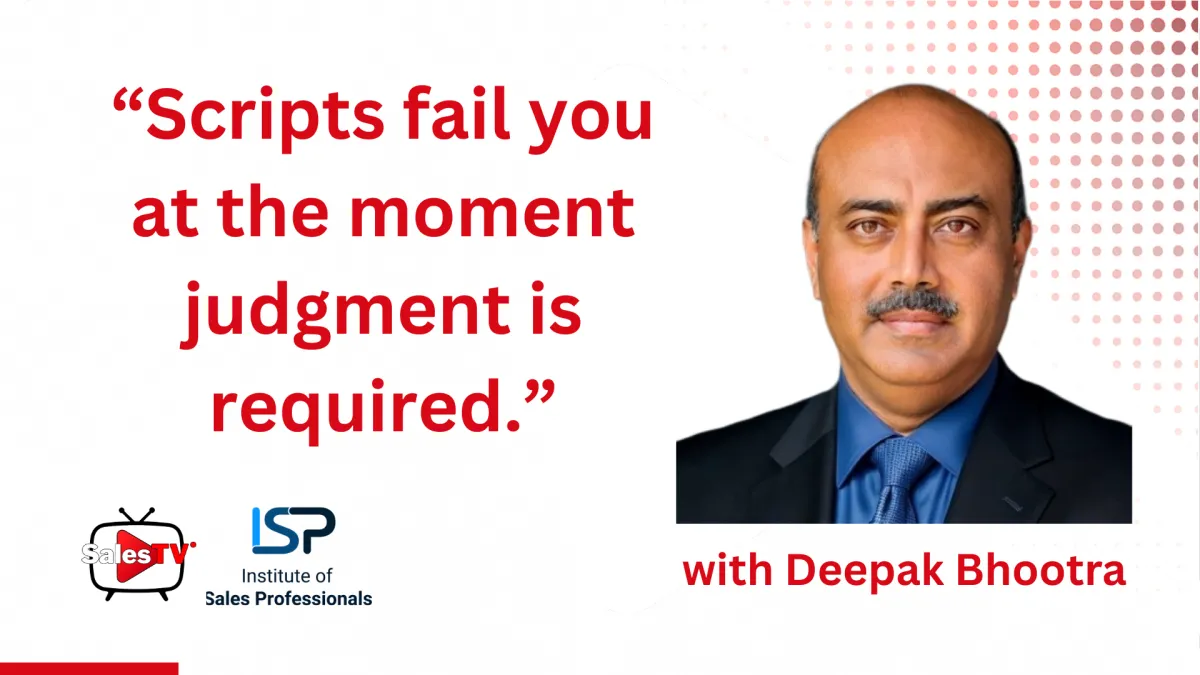
Why Over Reliance on Sales Scripts and Automation Erodes Judgment
Sales leaders planning for the future of sales must reclaim judgment and behavior-first decision-making as overreliance on scripts, automation, and quota math quietly erodes sales effectiveness.
In this episode of SalesTV, we are joined by Deepak Bhootra, who brings over 30 years of global sales and sales operations experience, including senior leadership roles at HP and Capgemini. Together we dig into why even experienced sales professionals and leaders often lose judgment by relying too heavily on scripts, tools, and numbers - and how that quietly undermines performance in the plan for what’s next.
We’ll ask questions like -
* At what point does automation stop helping salespeople and start replacing their judgment?
* How can we tell when tools are supporting performance versus quietly undermining it?
* Why does sales effectiveness sometimes decline even as teams add more tools?
* Why are experienced Sales Leaders are more at risk of losing judgment today?
With a career spanning global sales leadership, sales operations, and executive coaching, Deepak Bhootra has spent decades helping experienced sales professionals understand how behavior, decision-making, and judgment shape results long before automation or tactics do. Having led and advised sales teams across multiple regions and industries, he focuses on how experienced sales leaders sustain performance by strengthening judgment, self-awareness, and behavior rather than relying solely on process or automation.
Join us live and be part of the conversation.
This week's Guest was -
Deepak Bhootra, global sales leader and executive coach.
This week's Host was -
Rob Durant, CEO of US Operations at The Institute of Sales Professionals
Transcript of SalesTV.live Mid-Day Edition 2025-12-23
Rob Durant [00:00:03]:
Hello and welcome to another edition of Sales TV Live. Today, we're examining how to over. Excuse me.
Rob Durant [00:00:13]:
We're examining how over-reliance on sales scripts and automation erode trust and judgment. See, that's where I was relying on a script and it eroded the trust and judgment of my audience. Right off the bat.. We're joined by Deepak Bhootra. With a career spanning global sales leadership, sales operations, and executive coaching. Deepak has spent decades helping experienced sales professionals understand how behavior, decision making and judgment shape results long before automation or tactics do. Deepak, welcome.
Deepak Bhootra [00:00:54]:
Rob. Thanks for the warm welcome, sir. I'm so excited about this topic. Scripts. Yes, you're right. Scripts. As my wife says, your mouth will get you into trouble all the time, Deepak.
Deepak Bhootra [00:01:02]:
And that's exactly what we're going to discuss today.
Rob Durant [00:01:04]:
Right, Exactly. So let's jump right into it. In our conversation preparing for this show, you said scripts fail you at the moment. Judgment is required. Can you explain why scripts fail, feel helpful at first, but actually make experienced people worse over time?
Deepak Bhootra [00:01:25]:
Here's how I would want to explain that. Right? Is first of all, this illusion of a script, right? Rob, let's just talk about scripts for one second. This term script actually comes from plays and drama, right? And I've been big in that type of stuff. A script is actually a great tool. The script is perfect. The script actually gives you and your fellow participant an understanding of what's going on. In the same way that when you're in a stage, you see X marks the spot. You know, if you stand there, the light's perfect on you.
Deepak Bhootra [00:01:52]:
Right? Now here's the bad news. What happens when electricity goes? What happens when someone decides to move that X to another position? What happens if there's a leak and the audience has to move from the left to the right of the. Things fall apart at that point, right? And that's the fun that I've realized with scripts. Scripts are great. So if you are in a script and you forget your lines, the other person knows you forgot your lines, so they ad lib, they step in for you, right? But in the real world, your buyer is sitting there. He's on the other side of the equation. He doesn't know your script. He doesn't know what you're getting at.
Deepak Bhootra [00:02:23]:
He's listening intently. And you have to be in the moment because you need to listen to what's happening with him at that point. Scripts are, you know, and this is just cognitive sense, right? Scripts force you into a lull, they force you into a rhythm. And sometimes that judgment that you need to make in the sales environment needs you to be out of rhythm. You need to be in touch with. And I think this is a very important point, Rob. Body language, where you are in the moment, these are judgment skills, right? And this is what I tell salespeople. You can have the AI onslaught, but if you control that judgment in that moment, you therefore will suddenly realize the value of not having a script.
Deepak Bhootra [00:02:58]:
Having a script, a certain point is great, but beyond a certain point, you got to watch out. And that's when you get tripped over because that's when you end up with that little, what's that? The goldfish moment, right? Drop. Your mouth is open.
Rob Durant [00:03:12]:
Fantastic. So at what point does automation stop helping salespeople and start replacing their judgment?
Deepak Bhootra [00:03:21]:
Here's the interesting thing, right? Let's just pause for a second. Because I'm a process guy, Rob, right? So I was a salesperson who then went into sales ops. So I bring a very unique conversation to this table. And I always tell people one simple thing. Just forget the word automation for one second. Let's just forget it. If you have a fundamental problem in how you communicate with your children, no amount of walkie talkies or expensive gear is going to improve your communication style with your kids. Same thing in business as well.
Deepak Bhootra [00:03:52]:
If you have a system or a process that cannot, scale is broken. If you have behavioral issues where salespeople consider CRM to be the enemy and, and no one cares about sales stage 1, 2, 3, 4, 5, 6 definitions, right? And every time you run a million dollar system to get a piece of paper which you then write on the back of a cigarette box and then you give it to someone who then writes it into a forecast, you have a problem. Now let's put automation on top of that. Automation is what. I actually love this, and I'm very careful how I want to say this to Rob, but automation has the power to scale stupidity. So before you scale stupidity, just hang in there, slow down. Let's first go back and do the most fundamental of things. How do I need to communicate to my child? Do I treat him like an adult? If I treat him like an adult, what are those parameters? And then get the expensive walkie talkies on top.
Deepak Bhootra [00:04:45]:
And I'm sure a lot of people are sitting there wondering what is walkie talkie? But you know what? Anyone that's got an 8 or 10 year old out there will know what we're talking about. And we're not talking about tin cans with a string in it, though. I can be honest with you, Rob, if you have a simple process, sometimes a tin can and a string can actually deliver far more benefit to you than a walkie talkie or major automation. So I always tell people automation is like a. I don't know how to say this to Rob without again using bad language, but you know, you buy a cake which is eight years stale, but then you put on fresh icing on top, it looks so cool, but you take a bite and you're in hospital for seven days. That's why I ask people to just watch out. That's what automation does to you. Automation scales you.
Deepak Bhootra [00:05:26]:
Automation can do so many wonderful things, but the fundamentals have to be there for that scaling to happen. That's how I like to position this conversation. I hope that helps sense.
Rob Durant [00:05:35]:
So another thing you said when we talked before was you said the best salespeople don't start with numbers. All right, so what did they start with instead? And why does that matter?
Deepak Bhootra [00:05:50]:
You know, Rob, let's, let's be human for one second, right? I will bet you top dollar, Rob, that most of the people listening in have always been either on a diet or trying to build muscle or both or one of them, right? So let's, let's take a simple example here, right? So I've been overweight all of my life and my doctor keeps telling me, highly encourage that you lose weight. And I keep telling him, highly encourage you just build me quickly and let me leave this place fast. And here's the reality with this, right? The notion that we need to do something or we need to change comes from something very different. It comes from respect for numeracy, numbers. You know, there has to be some discipline and understanding what you're doing. So, Rob, for me, if I want to change or if I want to do something different, I need to be sold something in a different way. So the way that I look at it is as follows. You are not selling to the moment, you're selling to a solution to the future.
Deepak Bhootra [00:06:46]:
In the same way that if I want to motivate myself about losing weight, then the way I would picture it as follows. So, Rob, I have a 26 year old and if someone said to me, hey, your son is dating one day you're going to have a grandson, how is that going to make you feel? And I'm going to say, wow, that would make me excited. Now that's selling the future, right, Rob? You see where I'm going with this. So when you sell me the future, Rob, that's how I'm going to change my discipline and my process. Because now what I'm doing is I suddenly realize I actually would like to extend my life. I actually would like to add a few more years because I would like to play with my grandson or my grandchild, right? And I think that's that I would position over here, is that how you need to balance this, is to sketch the future, show people the future, show people the gain and then work it backwards. That's how you typically going to get the right behaviors when you're selling or anything in life, right? Even when you're trying to diet to lose weight. A bit of a long winded journey there.
Deepak Bhootra [00:07:37]:
I hope you got something out of that.
Rob Durant [00:07:39]:
Absolutely. So along those lines then, why does starting with the quota often lead even experienced sellers to repeat the same mistakes year over year?
Deepak Bhootra [00:07:52]:
It's like telling someone, I need you to lose 20 kilos and that's it. And instead of saying to someone that I need you to lose a kilo per week and I'm using kilos because that's the Asian in me, right? Let's talk pounds, right? You need to lose £20. Now, I give you a number like that, you're going to freak out, right? But if I tell you that I need you to lose a pound a week, you kind of will breathe easier. And I think this is the challenge with quotas, right? Quotas are supposed to excite, quotas are supposed to motivate, you know, the old carrot and stick approach. Now, in the 80s and 90s, when I was learning how to sell, I honestly used to feel as if the carrot and the stick were used exactly the same way. I just always felt it was being hurting me all the time. So for me, I think it's about balance. A quota is a number.
Deepak Bhootra [00:08:36]:
A quota also encourages bad behavior. And I'll tell you when that bad behavior occurs, Rob, it's when you're not making a quota. Think about it. We're human, right? We are experienced. We're supposed to sell at the same time we have in the back of our mind, oh, I might have a clawback. Oh, I need to pay money back. Oh, I just bought a car. What happens now? Stuff like that.
Deepak Bhootra [00:08:56]:
That's human of us, right? So your quota then becomes, and this is typically why people are what I say, you know, in common language, my wife calls it, that's why you guys are so salesy all the time. And that's the problem. The quota Setting quota bearing and why quotas are important. Why these numbers are important is because they have a huge pressure they create in you, and it requires. And I would say that the best salespeople, the rockstar salespeople, are very smart. They disassociate the quota and the burden cost from that. Now, you know what's really cool is that, Rob, when you are making your quota, you have a swag, right? When you're not making quota, that swag's gone. And that's the challenge.
Deepak Bhootra [00:09:32]:
Not many people are trained to absorb or, you know, mitigate for the absence of that swag. It's like being fired at home looking for a job. But having a job and looking for a job, there is two emotional states there. And I think that's what quotas do. So numbers can be very powerful. They can motivate, but at the same time, numbers can also. And this is where I think sales leaders need to actually step up. The way you talk about numbers is also important.
Deepak Bhootra [00:09:58]:
And I'll give you an example, Rob, and I'm sorry if this is a bit of a lengthy one, but this is a true story. In March, April this year, I had the most engaging coaching session with a SaaS B2B salesperson. His OTE is 280k. And I have to say that, Rob, because I want to give context to the size of the package, right? And he's at 93%. And this is why he called me. He said to me, I didn't need your services. I've been watching you on LinkedIn. But I'm calling because I'm really upset.
Deepak Bhootra [00:10:27]:
Upset. This is what they said to me today. Seven percent, Dude, Pip. And I'm listening to this guy and I'm saying, what do you mean, pip? Performance improvement plan at 7%. That is the biggest, weirdest use of the stick approach that I could think of. Whereas the approach should be, you're only 7% off. How can I help you? Let's sit down. Tell me the top three deals that I need to help you close.
Deepak Bhootra [00:10:53]:
And, buddy, you're not going to close at 7%. We're going to close at 17%. Because I just saw your pipeline. There's tremendous opportunity there. Can you imagine how this person is going to feel going into a room because of this number in the back of his mind now, he's not thinking of quota, he's thinking about the minus 7% that he's earning at. And I think this is the time for sales leaders to actually understand there has to be a Change in how we approach things. Post Covid I've also noticed the way that my clients talk to me, that my clients work with me. Rob the very different.
Deepak Bhootra [00:11:20]:
There is a general feeling that if, if a salesperson says he's going to work for a company for three or five years, that's excessive. Honestly speaking, the amount of churn you're going to see, the amount of turnover you're going to see is not going to happen because they are desperate. It's going to happen because they have different value systems and they will keep running after those value systems and the market is going to enable that. That's just the reality. Back to you, sir. I want to pick up on what.
Rob Durant [00:11:43]:
You were talking about with the sales leaders, but before I do, I want to stick with the individual contributor and the quota. Before someone plans next year's goals, what question should they be asking themselves that have nothing to do with their numbers?
Deepak Bhootra [00:12:03]:
You know, here's, here's the fun part about this, right? The Philip Kotler, I think, was the guy that keeps talking about, you know, culture, eat, strategy for breakfast and all that type of stuff, right? So here you are setting up your quotas and you're talking about, here's what I always tell people when you do quotas and stuff, I said, just step back for a second there. First, look at the structure that you had in place for this year. How did that structure enable things for you? Now look at that and ask yourself, if the structure held you back, how much did it hold you back by? Now look at your performance. And now ask yourself, if I were to improve this structure so that my strategy is executed cleaner, what would my quota setting look like? And I think this is where people make a big mistake. Most quota setting happens based on share of wallet. How much did we make last year? How much more can we make this year? No one ever asks a simple question, where did we have coefficient of drag? Where did things slow us down? If we were to fix those and if you were to bring some structure and discipline into it. Look, at the end of the day, whether you like it or not, Rob, sales can be as difficult as you want it to be. But I've noticed one thing about the top rock star salespeople, right? They actually have a structure and a rhythm to the madness.
Deepak Bhootra [00:13:12]:
You may think that they're constantly working, working, working, but they're actually working with a particular rhythm. They also have a very smart sense of how to do quota, you know, discussions as well. They focus on the signal, they eliminate the noise in quota setting, there is so much noise that can occur. These are factors and things that are completely out of whack. I'll give an example. So, salesperson comes up and says, I need a higher discount. Why? Because I've got five more deals in the pipeline. So I'm like, I hear you, but how sure are you that those five will happen? And he gives you some estimates and some understanding, right, Rob? And based on that, you then decide whether you want to give a bigger discount or not.
Deepak Bhootra [00:13:50]:
And here's the fun part, Rob. Six months later, the guy comes back with a totally different story. And you accept that also, and you keep moving on. Ask yourself a simple question. How disciplined are you in holding your salespeople's feet to the fire when they make these assertions? What systems do you have in place to actually track those assertions? And right there, you'll realize you have all the expensive CRMs, all of the stuff, and you have this value proposition business case analysis. You have a back office that does, you know, commercial pricing and stuff, but there's no ways that anyone can track actually the assertions made by salespeople. When they say that they're going to do something, then do they do it, yes or no? And if they don't do it, then go back and ask, now, what bearing does that have on the quota process? Because you can have all the fancy quotas and all the numbers and all the mathematics, right? People tell me I have a mathematical model that creates this 5% overhang, and then I have this shadow component to my quota. Therefore, I have a 99% probability of this and 120% probability of this happening.
Deepak Bhootra [00:14:46]:
And at the end of the year, it doesn't happen, because at the end of the day, as an example, raw people tell me, Deepak, the average American family is 2.4. I look around me, I've still not seen 0.4 of a human being living next to me. So that's the problem. So I ask people, you know, when you look at a number, when you look at this, you know, you got 25 sales people, you're going to do quota setting. And you start letting me about variation and standard deviations and mathematics, and I'm like, nodding my head, wow, that is a complete misjudgment. Just because you have eight numbers adding up to 110% of quota doesn't mean you're going to make 110% of quota. It just. Just not.
Deepak Bhootra [00:15:22]:
That's not going to be it. It's. It's just One of those things. So for me, it's a very long winded thing. But always ask people, start from a basis of understanding. What did you do? Well, how did you do it for the past year? And now ask yourself a simple question. If I did things the same way, can it scale? Can I make 105%, 110%? The answer is always no. Most likely because you're not putting in the effort.
Deepak Bhootra [00:15:45]:
You're looking at the number to excite you, not looking at the effort that is required to make the number to excite you. And that's the only thing I would say as a caution to people right there. And to me, you know, culture eats strategy for breakfast. And I'll tell you what structure eats strategy and culture for breakfast. Structure, structure, structure. That's what I tell salespeople. You know, a lot of people tell me, deepak, you know, why I won't work with you? Because you're Sandler and I prefer, let's say spin or, you know, Miller Hyman or whatever, whatever. And my answer is very simple.
Deepak Bhootra [00:16:14]:
You know, it's, I can be a good Hindu, I can be a bad Hindu, I can move to another religion. The reality is that if you cannot be faithful to one religion, they're probably going to faithful to another religion will depend totally on your emotional state or some interesting something that's happened to you. It's the same thing. Methodologies are there, and you can't believe methodologies. At the end of the day, selling is B2B and B2B stands belly to belly. That's how I define it, Rob. Right now, as a human being, you need to be belly to belly all the time. Whether it's Sandler, whether it's any other technique, that's irrelevant.
Deepak Bhootra [00:16:45]:
So you can't blame the technique. So when I say structure, I'm actually talking about the systems, the methodology, the mindset and attitude that you bring to your job and your work. That is what makes the difference. And I can tell you one thing, it's like, you know, you know, Rob, you and I are old timers and we always say this, you know, this dude can sell ice to an Eskimo. The same dude most likely also sell nice pick to that same Eskimo. I guarantee he'll also sell them solar panels and he's also going to sell them dried fish, and he's also going to sell them, you know, anything. And I think that's attribute widgets. And the capability to sell widgets is, is, is.
Deepak Bhootra [00:17:19]:
I don't want to say It's God given. It's earned by process. It's earned by experience. And I think that's what a lot of people discard. That's why scripting is awesome. It gets you going. And that's why when you walk into Barnes and Noble, Rob, you're going to find 10 books on how to break 30 objections. In fact, I don't want to name anyone, but someone that I know and I really appreciate makes millions of dollars by selling a simple book on, on objection, Handling, right? And I think you've heard of it, the Black book of objection, handling and so on, right? I don't want to.
Deepak Bhootra [00:17:47]:
I'm not baiting anyone. What I'm stating though is that 75 or 100 questions memorized is awesome for the novice, it is a disaster for the experienced person. The experienced person needs to act like a novice on purpose. And to do that, you need to have a fluidity of and a judgment with your customer. Trust from scripts. Trust building happens from making the right judgment call at the right moment, at the right time and doing it consistently. That's why there's an Amazon principle, right, Rob, which talks about successful leaders typically are right most of the time. And when I initially read that, I was like, what? That's so presumptuous.
Deepak Bhootra [00:18:24]:
But no, it's right. A successful salesperson usually is right with their customers. And over time, his being consistently right is actually what gets him this trusted advisor moniker. And that moniker is what gets repeat sales. And that's how you get to 50 million portfolio, 100 million portfolio. And that's my message that I would, you know, give in my long winded way, Rob.
Rob Durant [00:18:46]:
So I want to come back to the sales leaders and that 7% that we were talking about. How can sales leaders tell when tools and processes are supporting performance versus quietly undermining it?
Deepak Bhootra [00:19:03]:
You know, Rob, that is. Wow, that's million dollar question. Here's the reality. This is what happens with us as human beings, right? Show me the data, show me the data. And we show him a pipeline and he sees a number and he's. Then what happens? You know, the seasoned guy walks in and says, I see the numbers, but just a question for you. Where are you exactly? And who are the decision makers? Do you know those names? And the guy says, yeah, and he rattles off three names. And then the sales manager says, yeah, hold on, I used to sell in this account six years ago.
Deepak Bhootra [00:19:34]:
Those aren't the decision makers, they are part of the system. But the decision maker, if I recall, is Ralph Ferreira. Have you met him yet?
Rob Durant [00:19:41]:
No.
Deepak Bhootra [00:19:41]:
Wait, wait, wait, wait. What's happening here? Now you have all this data, you have all these tools, you have all this insight of all this AI running, you have all these personalized DMs going out, but a person came in and actually told you that your basic circle of inference and coverage model is broken. And I think this is what we need to understand. You can get all the tools in the world. And Rob, I'll give you an example. It just blew my mind. I'm sitting with the salesperson, he says to me, deepak, I have this tool that analyzes a person's LinkedIn profile and actually tells me if he's a D or an I or S or a C so that I can moderate my approach. And I said, hey, congratulations, but can I give you bad news? He says, yes, go ahead.
Deepak Bhootra [00:20:16]:
I says, I don't know specifically if this person does or not, but most VPs of sales most likely have paid someone 200, 300, $400 to help them with the LinkedIn profile. And if they didn't pay the money, I bet you they went to ChatGPT and said, hey, here's a sample of couple of good ones. Generate one for me. So you are basing your entire perspective on someone who's cut and paste a couple of placeholders from here and there. And I think that's the problem with tools. At the end of the day, like I said, belly to belly selling, right, Rob, you can have all these tools and here's what tools actually do. In my opinion, tools add what I call microfiction. Tools also become problematic because there's no one unified tool, right? You got a CRM on this window, then you got your little custom GPT on this window, and then you have your little clay and your whole setup running over your scraping like crazy to give you access to all this data.
Deepak Bhootra [00:21:06]:
You are always what I call context swiveling. Now you keep shifting gears. Human brain is not designed for that. We keep bragging to the whole world that we're multi threading and so on. You're not. And you got to understand that you need to retain your cognition for buyers, but you're already burning your cognition with all this stuff all the day. All the data does is gives an illusion. And here's another human thing, Rob, that I can just challenge you on.
Deepak Bhootra [00:21:28]:
I go to any human being and I tell him, hey, tell me what, what do you hear? 9, 12, 22, 56, 99, 108, 220 and 100% of the time, the salesperson says to me, wait, they're all odd. No, wait, wait, are they prime numbers? You know what, Rob? They're not. They're just random numbers. The problem with human beings is that we look at data and we try to find patterns and we do this consistently. And then when we find a pattern, we latch on to it and guess what, it's the wrong pattern. Look, I don't know how to say this too, but I always look at it this way. You know, focus not on tool progression or stage progression in a CRM. You know, rather focus on human progression.
Deepak Bhootra [00:22:08]:
Where am I exactly with this customer? Use language which is in their context. Your customers don't talk tools. Why are you talking tools? Your customers talk process. And you know, that's why this buyer seller dance is so important. And I think tools are problematic in the way that when you nowadays you could go for a dance with the customer, right? And you're spending so much time on deciding which shoes to wear and what trousers to wear. And you know, because one says your shoes should be elevated at this degree and should the heels should be like this so that your calf muscles get. That's over engineering. And that's what tools do.
Deepak Bhootra [00:22:41]:
They give a sense of comfort. It's like this. My ex boss used to tell me about tools. I love it that you enjoy inputting into CRM. But here's what we did, and I'm not going to tell you the name of the company where we did this work, Rob, because it's, it's, it's a big name. It'll blow, it'll blow your mind when I say this to you. But there is a U curve of efficiency beyond a certain point. The more work you do in a CRM, the, the worse off you are in selling, believe it or not.
Deepak Bhootra [00:23:08]:
And that number that we kind of found, and I'm not saying it's a magic number, was that at 40 minutes on CRM for 25 accounts with a 10 million portfolio, seems to be the right amount of time. But if a salesperson was going beyond 40, what was happening to this curve was that the utility curve drops rapidly. That's why it's called an inverted U. And Rob, that blew my mind. And here we are giving tools upon tools upon tools. I need to close by saying one more thing to you, Rob. Here's my challenge with tools. Tools 10 years, 5 years ago were at least discreet and they were at least understood what they were trying to do.
Deepak Bhootra [00:23:41]:
Today with AI, you have tools, but you don't call them tools because you don't think of them as tools, right? But at the end of the day, AI is just a tool. Now, can you imagine Rob a person and I interviewed eight of the top rockstar salesperson that I've been coaching this year. And Rob, guess what? Blew my mind. Each one of them spends nearly 300 $400 a month on every ancillary shadow AI. And the company has its own set of AI. They have their own set of AI. Why? Because I want to create my own proprietary understanding of who I am and of my accounts and doesn't want to share it with the company. So any person listening in, any sales leader listening in, I like to give you a heads up here.
Deepak Bhootra [00:24:20]:
You better be worried about all this data leakage that's happening right now. While you were so busy worrying about phishing attacks and so on, you've got your sales guys taking all this data and just creating so much stuff out of it now. It's magic. I get it.
Rob Durant [00:24:32]:
But.
Deepak Bhootra [00:24:32]:
But Daubi, you gotta understand when you are trying to create a team of eight people that are, you know, helping each other, but now everyone's got their own silo and understanding all you're doing is making people good at what they do, but you're not making the team more effective. And in sales, making the team effective is also a very important attribute or dynamic for a sales leader. That's all I want to say at this point on tools, sir.
Rob Durant [00:24:54]:
Absolutely. So Deepak, if you were to emphasize the one thing you would want the audience to take away from today's episode, what would that one thing be?
Deepak Bhootra [00:25:06]:
You know what I would say? Here's what I want people to understand. I am not anti automation. I'm pro judgment. Right? I am asking human beings to do one thing for me with the AI onslaught. I want you to understand one thing. That AI is not going to take your job. It's your colleague using AI who will take your job. So I also don't want you to be the proverbial head in the sand.
Deepak Bhootra [00:25:29]:
I think AI is an awesome thing. Let AI help you propose to a customer, but let your ability help the customer decide, not the AI. When you are automating your tasks, just make sure that you're not automating your thinking when you're automating a task. Make sure automating the right tasks, not the broken tasks. Fix the broken task first. Right? In my opinion, the word I like to use, and I keep banging on about this Robin, I'll bang on one Last time on your show is I want sales leaders to look at AI as augmented intelligence, not artificial intelligence. Because artificial intelligence is a label about the AI. What I'm saying when I say augmented intelligence is that I'm saying put yourself in the center of it.
Deepak Bhootra [00:26:12]:
You are the human and AI is in the loop, not the human in the loop. And this human in the loop nonsense has actually created chaos because it makes a lot of sense. When you're using AI, you want to make sure that fact checking is done with a human being. But in sales, AI is not. You're not the human in the loop. You are the human. AI is the satellite that orbits you. Augmented intelligence is how you make the cloud.
Deepak Bhootra [00:26:35]:
You see the clouds with AI but the rain that falls is your effort, your work. And that delta, that mind shift is what I'm trying to get out to people. And I would say that's now the purpose of my life is actually to make sure that people understand to me AI When I first bumped into AI Rob, I honestly speaking, I was, oh, I don't understand this. What is this all about? But then it started improving leaps and bounds. Two years ago is the first time when I turned across and I looked at my son who was working estimate, I said to him, dude, I think your job is gone as a software engineer. I think you're just dead. And guess what? In two years, my son was at Microsoft. And I can tell you right now what's happening in the big IT companies.
Deepak Bhootra [00:27:16]:
30% of the low level work coding quality is now all AI. They were hiring tons of people from campus. That's going to fall. Look, sales, if you have a team of eight, potentially, you only need a team of six. That's true. That is going to happen. But Rob, those six can achieve so much with AI. So I don't want people to be threatened by the reduction in the numbers.
Deepak Bhootra [00:27:38]:
I want people to get excited by the value you can add. I add value with AI because my rate has improved and the work I do for my customers is now so insightful that even I'm in awe of my own work at times. And I'm sorry if it sounds like one of the seven deadly sins, but you sit there sometimes asking yourself, could you have thought of that, Deepak? No, I couldn't have. Let's be human and admit it. With AI Rob, I actually use AI as a devil's advocate. And that's how I'm going to close this conversation with you. Use AI as a devil's advocate. Ask AI AI have I thought this through.
Deepak Bhootra [00:28:09]:
Are there any loopholes in my thinking? Can you go back into time in history and look at the 25 proposals we've written and tell me a strategy that I may have missed in this conversation? Now, that is where you're using AI to the. To the core, not using AI to write. Hey, AI, I'm meeting the cfo. Tell me how to write an email. Oh, my God. Rob, Rob, Rob, Rob, Rob. What are we doing here? That's like, you know, walking up to an Olympian and saying. And I actually did this.
Deepak Bhootra [00:28:35]:
I was in Jim Robb, and I actually walked up to an Olympian, and I didn't know he was an Olympian. I said to him, hey, could you explain to me this. This chest press that I'm doing? Am I holding the bar? Right? The guy looked at me and he walked away. And then I said to someone, what's with him? And he said, are you insane? You just walked up to this guy, then went on to win three times a triathlon also. And I'm asking out of some silly bench press, this guy is at a different level. So it's just one of those things, right? So AI is at a different level. I'm not asking you to rise to its level. I'm simply asking you to help AI make it, make you rise in higher level of consciousness, decision making and authoritativeness and knowledge.
Deepak Bhootra [00:29:15]:
What I'm learning, I could not have learned, boss. I could not have learned. The amount of learning I've done is, like, learn six languages, which I didn't do, by the way, because I already knew six languages. But that's not the point, right, Rob? The point is, can we interrogate things better? Yes. Can we understand things better? Yes. Can I do it at my own pace? Yes. That is my message to everyone. Sorry, Rob.
Deepak Bhootra [00:29:34]:
Again, you're going to shoot me, dude. I asked for a closing comment and you gave me a lecture.
Rob Durant [00:29:40]:
No. No worries at all. This has been great. So, on behalf of everyone here at Sales TV Live, to you and to our audience, I want to thank you for being an active part in today's conversation. If you liked what you heard today, please take a moment to leave a review on Apple Podcast, Spotify, Substack or YouTube. Let us know what you learned and what you'd like to learn more about. Your feedback helps us reach more people like you and fulfill our mission of elevating the profession of sales. Thank you, and we'll see you next time.
Deepak Bhootra [00:30:19]:
Goodbye. Thank you, Rob.
@SalesTVlive
#Riseup #ModernSelling #SalesEffectiveness #FutureOfSales
#Sales #SalesLeadership #LinkedInLive #Podcast
________________________________________
About SalesTV: SalesTV is a weekly talk show created by salespeople, for salespeople. Each episode explores sales, sales training, sales enablement, and social selling, bringing together sales leaders, enablement professionals, and practitioners from across the globe.
About the Institute of Sales Professionals: The ISP is the only body worldwide dedicated to raising the standards of sales. Its Sales Capability Framework, certifications, and member community are designed to address their one goal: To Elevate the Profession of Sales.

Mid-Day Edition
Why Over Reliance on Sales Scripts and Automation Erodes Judgment
Sales leaders planning for the future of sales must reclaim judgment and behavior-first decision-making as overreliance on scripts, automation, and quota math quietly erodes sales effectiveness.
In this episode of SalesTV, we are joined by Deepak Bhootra, who brings over 30 years of global sales and sales operations experience, including senior leadership roles at HP and Capgemini. Together we dig into why even experienced sales professionals and leaders often lose judgment by relying too heavily on scripts, tools, and numbers - and how that quietly undermines performance in the plan for what’s next.
We’ll ask questions like -
* At what point does automation stop helping salespeople and start replacing their judgment?
* How can we tell when tools are supporting performance versus quietly undermining it?
* Why does sales effectiveness sometimes decline even as teams add more tools?
* Why are experienced Sales Leaders are more at risk of losing judgment today?
With a career spanning global sales leadership, sales operations, and executive coaching, Deepak Bhootra has spent decades helping experienced sales professionals understand how behavior, decision-making, and judgment shape results long before automation or tactics do. Having led and advised sales teams across multiple regions and industries, he focuses on how experienced sales leaders sustain performance by strengthening judgment, self-awareness, and behavior rather than relying solely on process or automation.
Join us live and be part of the conversation.
This week's Guest was -
Deepak Bhootra, global sales leader and executive coach.
This week's Host was -
Rob Durant, CEO of US Operations at The Institute of Sales Professionals
Transcript of SalesTV.live Mid-Day Edition 2025-12-23
Rob Durant [00:00:03]:
Hello and welcome to another edition of Sales TV Live. Today, we're examining how to over. Excuse me.
Rob Durant [00:00:13]:
We're examining how over-reliance on sales scripts and automation erode trust and judgment. See, that's where I was relying on a script and it eroded the trust and judgment of my audience. Right off the bat.. We're joined by Deepak Bhootra. With a career spanning global sales leadership, sales operations, and executive coaching. Deepak has spent decades helping experienced sales professionals understand how behavior, decision making and judgment shape results long before automation or tactics do. Deepak, welcome.
Deepak Bhootra [00:00:54]:
Rob. Thanks for the warm welcome, sir. I'm so excited about this topic. Scripts. Yes, you're right. Scripts. As my wife says, your mouth will get you into trouble all the time, Deepak.
Deepak Bhootra [00:01:02]:
And that's exactly what we're going to discuss today.
Rob Durant [00:01:04]:
Right, Exactly. So let's jump right into it. In our conversation preparing for this show, you said scripts fail you at the moment. Judgment is required. Can you explain why scripts fail, feel helpful at first, but actually make experienced people worse over time?
Deepak Bhootra [00:01:25]:
Here's how I would want to explain that. Right? Is first of all, this illusion of a script, right? Rob, let's just talk about scripts for one second. This term script actually comes from plays and drama, right? And I've been big in that type of stuff. A script is actually a great tool. The script is perfect. The script actually gives you and your fellow participant an understanding of what's going on. In the same way that when you're in a stage, you see X marks the spot. You know, if you stand there, the light's perfect on you.
Deepak Bhootra [00:01:52]:
Right? Now here's the bad news. What happens when electricity goes? What happens when someone decides to move that X to another position? What happens if there's a leak and the audience has to move from the left to the right of the. Things fall apart at that point, right? And that's the fun that I've realized with scripts. Scripts are great. So if you are in a script and you forget your lines, the other person knows you forgot your lines, so they ad lib, they step in for you, right? But in the real world, your buyer is sitting there. He's on the other side of the equation. He doesn't know your script. He doesn't know what you're getting at.
Deepak Bhootra [00:02:23]:
He's listening intently. And you have to be in the moment because you need to listen to what's happening with him at that point. Scripts are, you know, and this is just cognitive sense, right? Scripts force you into a lull, they force you into a rhythm. And sometimes that judgment that you need to make in the sales environment needs you to be out of rhythm. You need to be in touch with. And I think this is a very important point, Rob. Body language, where you are in the moment, these are judgment skills, right? And this is what I tell salespeople. You can have the AI onslaught, but if you control that judgment in that moment, you therefore will suddenly realize the value of not having a script.
Deepak Bhootra [00:02:58]:
Having a script, a certain point is great, but beyond a certain point, you got to watch out. And that's when you get tripped over because that's when you end up with that little, what's that? The goldfish moment, right? Drop. Your mouth is open.
Rob Durant [00:03:12]:
Fantastic. So at what point does automation stop helping salespeople and start replacing their judgment?
Deepak Bhootra [00:03:21]:
Here's the interesting thing, right? Let's just pause for a second. Because I'm a process guy, Rob, right? So I was a salesperson who then went into sales ops. So I bring a very unique conversation to this table. And I always tell people one simple thing. Just forget the word automation for one second. Let's just forget it. If you have a fundamental problem in how you communicate with your children, no amount of walkie talkies or expensive gear is going to improve your communication style with your kids. Same thing in business as well.
Deepak Bhootra [00:03:52]:
If you have a system or a process that cannot, scale is broken. If you have behavioral issues where salespeople consider CRM to be the enemy and, and no one cares about sales stage 1, 2, 3, 4, 5, 6 definitions, right? And every time you run a million dollar system to get a piece of paper which you then write on the back of a cigarette box and then you give it to someone who then writes it into a forecast, you have a problem. Now let's put automation on top of that. Automation is what. I actually love this, and I'm very careful how I want to say this to Rob, but automation has the power to scale stupidity. So before you scale stupidity, just hang in there, slow down. Let's first go back and do the most fundamental of things. How do I need to communicate to my child? Do I treat him like an adult? If I treat him like an adult, what are those parameters? And then get the expensive walkie talkies on top.
Deepak Bhootra [00:04:45]:
And I'm sure a lot of people are sitting there wondering what is walkie talkie? But you know what? Anyone that's got an 8 or 10 year old out there will know what we're talking about. And we're not talking about tin cans with a string in it, though. I can be honest with you, Rob, if you have a simple process, sometimes a tin can and a string can actually deliver far more benefit to you than a walkie talkie or major automation. So I always tell people automation is like a. I don't know how to say this to Rob without again using bad language, but you know, you buy a cake which is eight years stale, but then you put on fresh icing on top, it looks so cool, but you take a bite and you're in hospital for seven days. That's why I ask people to just watch out. That's what automation does to you. Automation scales you.
Deepak Bhootra [00:05:26]:
Automation can do so many wonderful things, but the fundamentals have to be there for that scaling to happen. That's how I like to position this conversation. I hope that helps sense.
Rob Durant [00:05:35]:
So another thing you said when we talked before was you said the best salespeople don't start with numbers. All right, so what did they start with instead? And why does that matter?
Deepak Bhootra [00:05:50]:
You know, Rob, let's, let's be human for one second, right? I will bet you top dollar, Rob, that most of the people listening in have always been either on a diet or trying to build muscle or both or one of them, right? So let's, let's take a simple example here, right? So I've been overweight all of my life and my doctor keeps telling me, highly encourage that you lose weight. And I keep telling him, highly encourage you just build me quickly and let me leave this place fast. And here's the reality with this, right? The notion that we need to do something or we need to change comes from something very different. It comes from respect for numeracy, numbers. You know, there has to be some discipline and understanding what you're doing. So, Rob, for me, if I want to change or if I want to do something different, I need to be sold something in a different way. So the way that I look at it is as follows. You are not selling to the moment, you're selling to a solution to the future.
Deepak Bhootra [00:06:46]:
In the same way that if I want to motivate myself about losing weight, then the way I would picture it as follows. So, Rob, I have a 26 year old and if someone said to me, hey, your son is dating one day you're going to have a grandson, how is that going to make you feel? And I'm going to say, wow, that would make me excited. Now that's selling the future, right, Rob? You see where I'm going with this. So when you sell me the future, Rob, that's how I'm going to change my discipline and my process. Because now what I'm doing is I suddenly realize I actually would like to extend my life. I actually would like to add a few more years because I would like to play with my grandson or my grandchild, right? And I think that's that I would position over here, is that how you need to balance this, is to sketch the future, show people the future, show people the gain and then work it backwards. That's how you typically going to get the right behaviors when you're selling or anything in life, right? Even when you're trying to diet to lose weight. A bit of a long winded journey there.
Deepak Bhootra [00:07:37]:
I hope you got something out of that.
Rob Durant [00:07:39]:
Absolutely. So along those lines then, why does starting with the quota often lead even experienced sellers to repeat the same mistakes year over year?
Deepak Bhootra [00:07:52]:
It's like telling someone, I need you to lose 20 kilos and that's it. And instead of saying to someone that I need you to lose a kilo per week and I'm using kilos because that's the Asian in me, right? Let's talk pounds, right? You need to lose £20. Now, I give you a number like that, you're going to freak out, right? But if I tell you that I need you to lose a pound a week, you kind of will breathe easier. And I think this is the challenge with quotas, right? Quotas are supposed to excite, quotas are supposed to motivate, you know, the old carrot and stick approach. Now, in the 80s and 90s, when I was learning how to sell, I honestly used to feel as if the carrot and the stick were used exactly the same way. I just always felt it was being hurting me all the time. So for me, I think it's about balance. A quota is a number.
Deepak Bhootra [00:08:36]:
A quota also encourages bad behavior. And I'll tell you when that bad behavior occurs, Rob, it's when you're not making a quota. Think about it. We're human, right? We are experienced. We're supposed to sell at the same time we have in the back of our mind, oh, I might have a clawback. Oh, I need to pay money back. Oh, I just bought a car. What happens now? Stuff like that.
Deepak Bhootra [00:08:56]:
That's human of us, right? So your quota then becomes, and this is typically why people are what I say, you know, in common language, my wife calls it, that's why you guys are so salesy all the time. And that's the problem. The quota Setting quota bearing and why quotas are important. Why these numbers are important is because they have a huge pressure they create in you, and it requires. And I would say that the best salespeople, the rockstar salespeople, are very smart. They disassociate the quota and the burden cost from that. Now, you know what's really cool is that, Rob, when you are making your quota, you have a swag, right? When you're not making quota, that swag's gone. And that's the challenge.
Deepak Bhootra [00:09:32]:
Not many people are trained to absorb or, you know, mitigate for the absence of that swag. It's like being fired at home looking for a job. But having a job and looking for a job, there is two emotional states there. And I think that's what quotas do. So numbers can be very powerful. They can motivate, but at the same time, numbers can also. And this is where I think sales leaders need to actually step up. The way you talk about numbers is also important.
Deepak Bhootra [00:09:58]:
And I'll give you an example, Rob, and I'm sorry if this is a bit of a lengthy one, but this is a true story. In March, April this year, I had the most engaging coaching session with a SaaS B2B salesperson. His OTE is 280k. And I have to say that, Rob, because I want to give context to the size of the package, right? And he's at 93%. And this is why he called me. He said to me, I didn't need your services. I've been watching you on LinkedIn. But I'm calling because I'm really upset.
Deepak Bhootra [00:10:27]:
Upset. This is what they said to me today. Seven percent, Dude, Pip. And I'm listening to this guy and I'm saying, what do you mean, pip? Performance improvement plan at 7%. That is the biggest, weirdest use of the stick approach that I could think of. Whereas the approach should be, you're only 7% off. How can I help you? Let's sit down. Tell me the top three deals that I need to help you close.
Deepak Bhootra [00:10:53]:
And, buddy, you're not going to close at 7%. We're going to close at 17%. Because I just saw your pipeline. There's tremendous opportunity there. Can you imagine how this person is going to feel going into a room because of this number in the back of his mind now, he's not thinking of quota, he's thinking about the minus 7% that he's earning at. And I think this is the time for sales leaders to actually understand there has to be a Change in how we approach things. Post Covid I've also noticed the way that my clients talk to me, that my clients work with me. Rob the very different.
Deepak Bhootra [00:11:20]:
There is a general feeling that if, if a salesperson says he's going to work for a company for three or five years, that's excessive. Honestly speaking, the amount of churn you're going to see, the amount of turnover you're going to see is not going to happen because they are desperate. It's going to happen because they have different value systems and they will keep running after those value systems and the market is going to enable that. That's just the reality. Back to you, sir. I want to pick up on what.
Rob Durant [00:11:43]:
You were talking about with the sales leaders, but before I do, I want to stick with the individual contributor and the quota. Before someone plans next year's goals, what question should they be asking themselves that have nothing to do with their numbers?
Deepak Bhootra [00:12:03]:
You know, here's, here's the fun part about this, right? The Philip Kotler, I think, was the guy that keeps talking about, you know, culture, eat, strategy for breakfast and all that type of stuff, right? So here you are setting up your quotas and you're talking about, here's what I always tell people when you do quotas and stuff, I said, just step back for a second there. First, look at the structure that you had in place for this year. How did that structure enable things for you? Now look at that and ask yourself, if the structure held you back, how much did it hold you back by? Now look at your performance. And now ask yourself, if I were to improve this structure so that my strategy is executed cleaner, what would my quota setting look like? And I think this is where people make a big mistake. Most quota setting happens based on share of wallet. How much did we make last year? How much more can we make this year? No one ever asks a simple question, where did we have coefficient of drag? Where did things slow us down? If we were to fix those and if you were to bring some structure and discipline into it. Look, at the end of the day, whether you like it or not, Rob, sales can be as difficult as you want it to be. But I've noticed one thing about the top rock star salespeople, right? They actually have a structure and a rhythm to the madness.
Deepak Bhootra [00:13:12]:
You may think that they're constantly working, working, working, but they're actually working with a particular rhythm. They also have a very smart sense of how to do quota, you know, discussions as well. They focus on the signal, they eliminate the noise in quota setting, there is so much noise that can occur. These are factors and things that are completely out of whack. I'll give an example. So, salesperson comes up and says, I need a higher discount. Why? Because I've got five more deals in the pipeline. So I'm like, I hear you, but how sure are you that those five will happen? And he gives you some estimates and some understanding, right, Rob? And based on that, you then decide whether you want to give a bigger discount or not.
Deepak Bhootra [00:13:50]:
And here's the fun part, Rob. Six months later, the guy comes back with a totally different story. And you accept that also, and you keep moving on. Ask yourself a simple question. How disciplined are you in holding your salespeople's feet to the fire when they make these assertions? What systems do you have in place to actually track those assertions? And right there, you'll realize you have all the expensive CRMs, all of the stuff, and you have this value proposition business case analysis. You have a back office that does, you know, commercial pricing and stuff, but there's no ways that anyone can track actually the assertions made by salespeople. When they say that they're going to do something, then do they do it, yes or no? And if they don't do it, then go back and ask, now, what bearing does that have on the quota process? Because you can have all the fancy quotas and all the numbers and all the mathematics, right? People tell me I have a mathematical model that creates this 5% overhang, and then I have this shadow component to my quota. Therefore, I have a 99% probability of this and 120% probability of this happening.
Deepak Bhootra [00:14:46]:
And at the end of the year, it doesn't happen, because at the end of the day, as an example, raw people tell me, Deepak, the average American family is 2.4. I look around me, I've still not seen 0.4 of a human being living next to me. So that's the problem. So I ask people, you know, when you look at a number, when you look at this, you know, you got 25 sales people, you're going to do quota setting. And you start letting me about variation and standard deviations and mathematics, and I'm like, nodding my head, wow, that is a complete misjudgment. Just because you have eight numbers adding up to 110% of quota doesn't mean you're going to make 110% of quota. It just. Just not.
Deepak Bhootra [00:15:22]:
That's not going to be it. It's. It's just One of those things. So for me, it's a very long winded thing. But always ask people, start from a basis of understanding. What did you do? Well, how did you do it for the past year? And now ask yourself a simple question. If I did things the same way, can it scale? Can I make 105%, 110%? The answer is always no. Most likely because you're not putting in the effort.
Deepak Bhootra [00:15:45]:
You're looking at the number to excite you, not looking at the effort that is required to make the number to excite you. And that's the only thing I would say as a caution to people right there. And to me, you know, culture eats strategy for breakfast. And I'll tell you what structure eats strategy and culture for breakfast. Structure, structure, structure. That's what I tell salespeople. You know, a lot of people tell me, deepak, you know, why I won't work with you? Because you're Sandler and I prefer, let's say spin or, you know, Miller Hyman or whatever, whatever. And my answer is very simple.
Deepak Bhootra [00:16:14]:
You know, it's, I can be a good Hindu, I can be a bad Hindu, I can move to another religion. The reality is that if you cannot be faithful to one religion, they're probably going to faithful to another religion will depend totally on your emotional state or some interesting something that's happened to you. It's the same thing. Methodologies are there, and you can't believe methodologies. At the end of the day, selling is B2B and B2B stands belly to belly. That's how I define it, Rob. Right now, as a human being, you need to be belly to belly all the time. Whether it's Sandler, whether it's any other technique, that's irrelevant.
Deepak Bhootra [00:16:45]:
So you can't blame the technique. So when I say structure, I'm actually talking about the systems, the methodology, the mindset and attitude that you bring to your job and your work. That is what makes the difference. And I can tell you one thing, it's like, you know, you know, Rob, you and I are old timers and we always say this, you know, this dude can sell ice to an Eskimo. The same dude most likely also sell nice pick to that same Eskimo. I guarantee he'll also sell them solar panels and he's also going to sell them dried fish, and he's also going to sell them, you know, anything. And I think that's attribute widgets. And the capability to sell widgets is, is, is.
Deepak Bhootra [00:17:19]:
I don't want to say It's God given. It's earned by process. It's earned by experience. And I think that's what a lot of people discard. That's why scripting is awesome. It gets you going. And that's why when you walk into Barnes and Noble, Rob, you're going to find 10 books on how to break 30 objections. In fact, I don't want to name anyone, but someone that I know and I really appreciate makes millions of dollars by selling a simple book on, on objection, Handling, right? And I think you've heard of it, the Black book of objection, handling and so on, right? I don't want to.
Deepak Bhootra [00:17:47]:
I'm not baiting anyone. What I'm stating though is that 75 or 100 questions memorized is awesome for the novice, it is a disaster for the experienced person. The experienced person needs to act like a novice on purpose. And to do that, you need to have a fluidity of and a judgment with your customer. Trust from scripts. Trust building happens from making the right judgment call at the right moment, at the right time and doing it consistently. That's why there's an Amazon principle, right, Rob, which talks about successful leaders typically are right most of the time. And when I initially read that, I was like, what? That's so presumptuous.
Deepak Bhootra [00:18:24]:
But no, it's right. A successful salesperson usually is right with their customers. And over time, his being consistently right is actually what gets him this trusted advisor moniker. And that moniker is what gets repeat sales. And that's how you get to 50 million portfolio, 100 million portfolio. And that's my message that I would, you know, give in my long winded way, Rob.
Rob Durant [00:18:46]:
So I want to come back to the sales leaders and that 7% that we were talking about. How can sales leaders tell when tools and processes are supporting performance versus quietly undermining it?
Deepak Bhootra [00:19:03]:
You know, Rob, that is. Wow, that's million dollar question. Here's the reality. This is what happens with us as human beings, right? Show me the data, show me the data. And we show him a pipeline and he sees a number and he's. Then what happens? You know, the seasoned guy walks in and says, I see the numbers, but just a question for you. Where are you exactly? And who are the decision makers? Do you know those names? And the guy says, yeah, and he rattles off three names. And then the sales manager says, yeah, hold on, I used to sell in this account six years ago.
Deepak Bhootra [00:19:34]:
Those aren't the decision makers, they are part of the system. But the decision maker, if I recall, is Ralph Ferreira. Have you met him yet?
Rob Durant [00:19:41]:
No.
Deepak Bhootra [00:19:41]:
Wait, wait, wait, wait. What's happening here? Now you have all this data, you have all these tools, you have all this insight of all this AI running, you have all these personalized DMs going out, but a person came in and actually told you that your basic circle of inference and coverage model is broken. And I think this is what we need to understand. You can get all the tools in the world. And Rob, I'll give you an example. It just blew my mind. I'm sitting with the salesperson, he says to me, deepak, I have this tool that analyzes a person's LinkedIn profile and actually tells me if he's a D or an I or S or a C so that I can moderate my approach. And I said, hey, congratulations, but can I give you bad news? He says, yes, go ahead.
Deepak Bhootra [00:20:16]:
I says, I don't know specifically if this person does or not, but most VPs of sales most likely have paid someone 200, 300, $400 to help them with the LinkedIn profile. And if they didn't pay the money, I bet you they went to ChatGPT and said, hey, here's a sample of couple of good ones. Generate one for me. So you are basing your entire perspective on someone who's cut and paste a couple of placeholders from here and there. And I think that's the problem with tools. At the end of the day, like I said, belly to belly selling, right, Rob, you can have all these tools and here's what tools actually do. In my opinion, tools add what I call microfiction. Tools also become problematic because there's no one unified tool, right? You got a CRM on this window, then you got your little custom GPT on this window, and then you have your little clay and your whole setup running over your scraping like crazy to give you access to all this data.
Deepak Bhootra [00:21:06]:
You are always what I call context swiveling. Now you keep shifting gears. Human brain is not designed for that. We keep bragging to the whole world that we're multi threading and so on. You're not. And you got to understand that you need to retain your cognition for buyers, but you're already burning your cognition with all this stuff all the day. All the data does is gives an illusion. And here's another human thing, Rob, that I can just challenge you on.
Deepak Bhootra [00:21:28]:
I go to any human being and I tell him, hey, tell me what, what do you hear? 9, 12, 22, 56, 99, 108, 220 and 100% of the time, the salesperson says to me, wait, they're all odd. No, wait, wait, are they prime numbers? You know what, Rob? They're not. They're just random numbers. The problem with human beings is that we look at data and we try to find patterns and we do this consistently. And then when we find a pattern, we latch on to it and guess what, it's the wrong pattern. Look, I don't know how to say this too, but I always look at it this way. You know, focus not on tool progression or stage progression in a CRM. You know, rather focus on human progression.
Deepak Bhootra [00:22:08]:
Where am I exactly with this customer? Use language which is in their context. Your customers don't talk tools. Why are you talking tools? Your customers talk process. And you know, that's why this buyer seller dance is so important. And I think tools are problematic in the way that when you nowadays you could go for a dance with the customer, right? And you're spending so much time on deciding which shoes to wear and what trousers to wear. And you know, because one says your shoes should be elevated at this degree and should the heels should be like this so that your calf muscles get. That's over engineering. And that's what tools do.
Deepak Bhootra [00:22:41]:
They give a sense of comfort. It's like this. My ex boss used to tell me about tools. I love it that you enjoy inputting into CRM. But here's what we did, and I'm not going to tell you the name of the company where we did this work, Rob, because it's, it's, it's a big name. It'll blow, it'll blow your mind when I say this to you. But there is a U curve of efficiency beyond a certain point. The more work you do in a CRM, the, the worse off you are in selling, believe it or not.
Deepak Bhootra [00:23:08]:
And that number that we kind of found, and I'm not saying it's a magic number, was that at 40 minutes on CRM for 25 accounts with a 10 million portfolio, seems to be the right amount of time. But if a salesperson was going beyond 40, what was happening to this curve was that the utility curve drops rapidly. That's why it's called an inverted U. And Rob, that blew my mind. And here we are giving tools upon tools upon tools. I need to close by saying one more thing to you, Rob. Here's my challenge with tools. Tools 10 years, 5 years ago were at least discreet and they were at least understood what they were trying to do.
Deepak Bhootra [00:23:41]:
Today with AI, you have tools, but you don't call them tools because you don't think of them as tools, right? But at the end of the day, AI is just a tool. Now, can you imagine Rob a person and I interviewed eight of the top rockstar salesperson that I've been coaching this year. And Rob, guess what? Blew my mind. Each one of them spends nearly 300 $400 a month on every ancillary shadow AI. And the company has its own set of AI. They have their own set of AI. Why? Because I want to create my own proprietary understanding of who I am and of my accounts and doesn't want to share it with the company. So any person listening in, any sales leader listening in, I like to give you a heads up here.
Deepak Bhootra [00:24:20]:
You better be worried about all this data leakage that's happening right now. While you were so busy worrying about phishing attacks and so on, you've got your sales guys taking all this data and just creating so much stuff out of it now. It's magic. I get it.
Rob Durant [00:24:32]:
But.
Deepak Bhootra [00:24:32]:
But Daubi, you gotta understand when you are trying to create a team of eight people that are, you know, helping each other, but now everyone's got their own silo and understanding all you're doing is making people good at what they do, but you're not making the team more effective. And in sales, making the team effective is also a very important attribute or dynamic for a sales leader. That's all I want to say at this point on tools, sir.
Rob Durant [00:24:54]:
Absolutely. So Deepak, if you were to emphasize the one thing you would want the audience to take away from today's episode, what would that one thing be?
Deepak Bhootra [00:25:06]:
You know what I would say? Here's what I want people to understand. I am not anti automation. I'm pro judgment. Right? I am asking human beings to do one thing for me with the AI onslaught. I want you to understand one thing. That AI is not going to take your job. It's your colleague using AI who will take your job. So I also don't want you to be the proverbial head in the sand.
Deepak Bhootra [00:25:29]:
I think AI is an awesome thing. Let AI help you propose to a customer, but let your ability help the customer decide, not the AI. When you are automating your tasks, just make sure that you're not automating your thinking when you're automating a task. Make sure automating the right tasks, not the broken tasks. Fix the broken task first. Right? In my opinion, the word I like to use, and I keep banging on about this Robin, I'll bang on one Last time on your show is I want sales leaders to look at AI as augmented intelligence, not artificial intelligence. Because artificial intelligence is a label about the AI. What I'm saying when I say augmented intelligence is that I'm saying put yourself in the center of it.
Deepak Bhootra [00:26:12]:
You are the human and AI is in the loop, not the human in the loop. And this human in the loop nonsense has actually created chaos because it makes a lot of sense. When you're using AI, you want to make sure that fact checking is done with a human being. But in sales, AI is not. You're not the human in the loop. You are the human. AI is the satellite that orbits you. Augmented intelligence is how you make the cloud.
Deepak Bhootra [00:26:35]:
You see the clouds with AI but the rain that falls is your effort, your work. And that delta, that mind shift is what I'm trying to get out to people. And I would say that's now the purpose of my life is actually to make sure that people understand to me AI When I first bumped into AI Rob, I honestly speaking, I was, oh, I don't understand this. What is this all about? But then it started improving leaps and bounds. Two years ago is the first time when I turned across and I looked at my son who was working estimate, I said to him, dude, I think your job is gone as a software engineer. I think you're just dead. And guess what? In two years, my son was at Microsoft. And I can tell you right now what's happening in the big IT companies.
Deepak Bhootra [00:27:16]:
30% of the low level work coding quality is now all AI. They were hiring tons of people from campus. That's going to fall. Look, sales, if you have a team of eight, potentially, you only need a team of six. That's true. That is going to happen. But Rob, those six can achieve so much with AI. So I don't want people to be threatened by the reduction in the numbers.
Deepak Bhootra [00:27:38]:
I want people to get excited by the value you can add. I add value with AI because my rate has improved and the work I do for my customers is now so insightful that even I'm in awe of my own work at times. And I'm sorry if it sounds like one of the seven deadly sins, but you sit there sometimes asking yourself, could you have thought of that, Deepak? No, I couldn't have. Let's be human and admit it. With AI Rob, I actually use AI as a devil's advocate. And that's how I'm going to close this conversation with you. Use AI as a devil's advocate. Ask AI AI have I thought this through.
Deepak Bhootra [00:28:09]:
Are there any loopholes in my thinking? Can you go back into time in history and look at the 25 proposals we've written and tell me a strategy that I may have missed in this conversation? Now, that is where you're using AI to the. To the core, not using AI to write. Hey, AI, I'm meeting the cfo. Tell me how to write an email. Oh, my God. Rob, Rob, Rob, Rob, Rob. What are we doing here? That's like, you know, walking up to an Olympian and saying. And I actually did this.
Deepak Bhootra [00:28:35]:
I was in Jim Robb, and I actually walked up to an Olympian, and I didn't know he was an Olympian. I said to him, hey, could you explain to me this. This chest press that I'm doing? Am I holding the bar? Right? The guy looked at me and he walked away. And then I said to someone, what's with him? And he said, are you insane? You just walked up to this guy, then went on to win three times a triathlon also. And I'm asking out of some silly bench press, this guy is at a different level. So it's just one of those things, right? So AI is at a different level. I'm not asking you to rise to its level. I'm simply asking you to help AI make it, make you rise in higher level of consciousness, decision making and authoritativeness and knowledge.
Deepak Bhootra [00:29:15]:
What I'm learning, I could not have learned, boss. I could not have learned. The amount of learning I've done is, like, learn six languages, which I didn't do, by the way, because I already knew six languages. But that's not the point, right, Rob? The point is, can we interrogate things better? Yes. Can we understand things better? Yes. Can I do it at my own pace? Yes. That is my message to everyone. Sorry, Rob.
Deepak Bhootra [00:29:34]:
Again, you're going to shoot me, dude. I asked for a closing comment and you gave me a lecture.
Rob Durant [00:29:40]:
No. No worries at all. This has been great. So, on behalf of everyone here at Sales TV Live, to you and to our audience, I want to thank you for being an active part in today's conversation. If you liked what you heard today, please take a moment to leave a review on Apple Podcast, Spotify, Substack or YouTube. Let us know what you learned and what you'd like to learn more about. Your feedback helps us reach more people like you and fulfill our mission of elevating the profession of sales. Thank you, and we'll see you next time.
Deepak Bhootra [00:30:19]:
Goodbye. Thank you, Rob.
@SalesTVlive
#Riseup #ModernSelling #SalesEffectiveness #FutureOfSales
#Sales #SalesLeadership #LinkedInLive #Podcast
________________________________________
About SalesTV: SalesTV is a weekly talk show created by salespeople, for salespeople. Each episode explores sales, sales training, sales enablement, and social selling, bringing together sales leaders, enablement professionals, and practitioners from across the globe.
About the Institute of Sales Professionals: The ISP is the only body worldwide dedicated to raising the standards of sales. Its Sales Capability Framework, certifications, and member community are designed to address their one goal: To Elevate the Profession of Sales.
Other Editions
Why Over Reliance on Sales Scripts and Automation Erodes Judgment
Sales leaders planning for the future of sales must reclaim judgment and behavior-first decision-making as overreliance on scripts, automation, and quota math quietly erodes sales effectiveness.
In this episode of SalesTV, we are joined by Deepak Bhootra, who brings over 30 years of global sales and sales operations experience, including senior leadership roles at HP and Capgemini. Together we dig into why even experienced sales professionals and leaders often lose judgment by relying too heavily on scripts, tools, and numbers - and how that quietly undermines performance in the plan for what’s next.
We’ll ask questions like -
* At what point does automation stop helping salespeople and start replacing their judgment?
* How can we tell when tools are supporting performance versus quietly undermining it?
* Why does sales effectiveness sometimes decline even as teams add more tools?
* Why are experienced Sales Leaders are more at risk of losing judgment today?
With a career spanning global sales leadership, sales operations, and executive coaching, Deepak Bhootra has spent decades helping experienced sales professionals understand how behavior, decision-making, and judgment shape results long before automation or tactics do. Having led and advised sales teams across multiple regions and industries, he focuses on how experienced sales leaders sustain performance by strengthening judgment, self-awareness, and behavior rather than relying solely on process or automation.
Join us live and be part of the conversation.
This week's Guest was -
Deepak Bhootra, global sales leader and executive coach.
This week's Host was -
Rob Durant, CEO of US Operations at The Institute of Sales Professionals
Transcript of SalesTV.live Mid-Day Edition 2025-12-23
Rob Durant [00:00:03]:
Hello and welcome to another edition of Sales TV Live. Today, we're examining how to over. Excuse me.
Rob Durant [00:00:13]:
We're examining how over-reliance on sales scripts and automation erode trust and judgment. See, that's where I was relying on a script and it eroded the trust and judgment of my audience. Right off the bat.. We're joined by Deepak Bhootra. With a career spanning global sales leadership, sales operations, and executive coaching. Deepak has spent decades helping experienced sales professionals understand how behavior, decision making and judgment shape results long before automation or tactics do. Deepak, welcome.
Deepak Bhootra [00:00:54]:
Rob. Thanks for the warm welcome, sir. I'm so excited about this topic. Scripts. Yes, you're right. Scripts. As my wife says, your mouth will get you into trouble all the time, Deepak.
Deepak Bhootra [00:01:02]:
And that's exactly what we're going to discuss today.
Rob Durant [00:01:04]:
Right, Exactly. So let's jump right into it. In our conversation preparing for this show, you said scripts fail you at the moment. Judgment is required. Can you explain why scripts fail, feel helpful at first, but actually make experienced people worse over time?
Deepak Bhootra [00:01:25]:
Here's how I would want to explain that. Right? Is first of all, this illusion of a script, right? Rob, let's just talk about scripts for one second. This term script actually comes from plays and drama, right? And I've been big in that type of stuff. A script is actually a great tool. The script is perfect. The script actually gives you and your fellow participant an understanding of what's going on. In the same way that when you're in a stage, you see X marks the spot. You know, if you stand there, the light's perfect on you.
Deepak Bhootra [00:01:52]:
Right? Now here's the bad news. What happens when electricity goes? What happens when someone decides to move that X to another position? What happens if there's a leak and the audience has to move from the left to the right of the. Things fall apart at that point, right? And that's the fun that I've realized with scripts. Scripts are great. So if you are in a script and you forget your lines, the other person knows you forgot your lines, so they ad lib, they step in for you, right? But in the real world, your buyer is sitting there. He's on the other side of the equation. He doesn't know your script. He doesn't know what you're getting at.
Deepak Bhootra [00:02:23]:
He's listening intently. And you have to be in the moment because you need to listen to what's happening with him at that point. Scripts are, you know, and this is just cognitive sense, right? Scripts force you into a lull, they force you into a rhythm. And sometimes that judgment that you need to make in the sales environment needs you to be out of rhythm. You need to be in touch with. And I think this is a very important point, Rob. Body language, where you are in the moment, these are judgment skills, right? And this is what I tell salespeople. You can have the AI onslaught, but if you control that judgment in that moment, you therefore will suddenly realize the value of not having a script.
Deepak Bhootra [00:02:58]:
Having a script, a certain point is great, but beyond a certain point, you got to watch out. And that's when you get tripped over because that's when you end up with that little, what's that? The goldfish moment, right? Drop. Your mouth is open.
Rob Durant [00:03:12]:
Fantastic. So at what point does automation stop helping salespeople and start replacing their judgment?
Deepak Bhootra [00:03:21]:
Here's the interesting thing, right? Let's just pause for a second. Because I'm a process guy, Rob, right? So I was a salesperson who then went into sales ops. So I bring a very unique conversation to this table. And I always tell people one simple thing. Just forget the word automation for one second. Let's just forget it. If you have a fundamental problem in how you communicate with your children, no amount of walkie talkies or expensive gear is going to improve your communication style with your kids. Same thing in business as well.
Deepak Bhootra [00:03:52]:
If you have a system or a process that cannot, scale is broken. If you have behavioral issues where salespeople consider CRM to be the enemy and, and no one cares about sales stage 1, 2, 3, 4, 5, 6 definitions, right? And every time you run a million dollar system to get a piece of paper which you then write on the back of a cigarette box and then you give it to someone who then writes it into a forecast, you have a problem. Now let's put automation on top of that. Automation is what. I actually love this, and I'm very careful how I want to say this to Rob, but automation has the power to scale stupidity. So before you scale stupidity, just hang in there, slow down. Let's first go back and do the most fundamental of things. How do I need to communicate to my child? Do I treat him like an adult? If I treat him like an adult, what are those parameters? And then get the expensive walkie talkies on top.
Deepak Bhootra [00:04:45]:
And I'm sure a lot of people are sitting there wondering what is walkie talkie? But you know what? Anyone that's got an 8 or 10 year old out there will know what we're talking about. And we're not talking about tin cans with a string in it, though. I can be honest with you, Rob, if you have a simple process, sometimes a tin can and a string can actually deliver far more benefit to you than a walkie talkie or major automation. So I always tell people automation is like a. I don't know how to say this to Rob without again using bad language, but you know, you buy a cake which is eight years stale, but then you put on fresh icing on top, it looks so cool, but you take a bite and you're in hospital for seven days. That's why I ask people to just watch out. That's what automation does to you. Automation scales you.
Deepak Bhootra [00:05:26]:
Automation can do so many wonderful things, but the fundamentals have to be there for that scaling to happen. That's how I like to position this conversation. I hope that helps sense.
Rob Durant [00:05:35]:
So another thing you said when we talked before was you said the best salespeople don't start with numbers. All right, so what did they start with instead? And why does that matter?
Deepak Bhootra [00:05:50]:
You know, Rob, let's, let's be human for one second, right? I will bet you top dollar, Rob, that most of the people listening in have always been either on a diet or trying to build muscle or both or one of them, right? So let's, let's take a simple example here, right? So I've been overweight all of my life and my doctor keeps telling me, highly encourage that you lose weight. And I keep telling him, highly encourage you just build me quickly and let me leave this place fast. And here's the reality with this, right? The notion that we need to do something or we need to change comes from something very different. It comes from respect for numeracy, numbers. You know, there has to be some discipline and understanding what you're doing. So, Rob, for me, if I want to change or if I want to do something different, I need to be sold something in a different way. So the way that I look at it is as follows. You are not selling to the moment, you're selling to a solution to the future.
Deepak Bhootra [00:06:46]:
In the same way that if I want to motivate myself about losing weight, then the way I would picture it as follows. So, Rob, I have a 26 year old and if someone said to me, hey, your son is dating one day you're going to have a grandson, how is that going to make you feel? And I'm going to say, wow, that would make me excited. Now that's selling the future, right, Rob? You see where I'm going with this. So when you sell me the future, Rob, that's how I'm going to change my discipline and my process. Because now what I'm doing is I suddenly realize I actually would like to extend my life. I actually would like to add a few more years because I would like to play with my grandson or my grandchild, right? And I think that's that I would position over here, is that how you need to balance this, is to sketch the future, show people the future, show people the gain and then work it backwards. That's how you typically going to get the right behaviors when you're selling or anything in life, right? Even when you're trying to diet to lose weight. A bit of a long winded journey there.
Deepak Bhootra [00:07:37]:
I hope you got something out of that.
Rob Durant [00:07:39]:
Absolutely. So along those lines then, why does starting with the quota often lead even experienced sellers to repeat the same mistakes year over year?
Deepak Bhootra [00:07:52]:
It's like telling someone, I need you to lose 20 kilos and that's it. And instead of saying to someone that I need you to lose a kilo per week and I'm using kilos because that's the Asian in me, right? Let's talk pounds, right? You need to lose £20. Now, I give you a number like that, you're going to freak out, right? But if I tell you that I need you to lose a pound a week, you kind of will breathe easier. And I think this is the challenge with quotas, right? Quotas are supposed to excite, quotas are supposed to motivate, you know, the old carrot and stick approach. Now, in the 80s and 90s, when I was learning how to sell, I honestly used to feel as if the carrot and the stick were used exactly the same way. I just always felt it was being hurting me all the time. So for me, I think it's about balance. A quota is a number.
Deepak Bhootra [00:08:36]:
A quota also encourages bad behavior. And I'll tell you when that bad behavior occurs, Rob, it's when you're not making a quota. Think about it. We're human, right? We are experienced. We're supposed to sell at the same time we have in the back of our mind, oh, I might have a clawback. Oh, I need to pay money back. Oh, I just bought a car. What happens now? Stuff like that.
Deepak Bhootra [00:08:56]:
That's human of us, right? So your quota then becomes, and this is typically why people are what I say, you know, in common language, my wife calls it, that's why you guys are so salesy all the time. And that's the problem. The quota Setting quota bearing and why quotas are important. Why these numbers are important is because they have a huge pressure they create in you, and it requires. And I would say that the best salespeople, the rockstar salespeople, are very smart. They disassociate the quota and the burden cost from that. Now, you know what's really cool is that, Rob, when you are making your quota, you have a swag, right? When you're not making quota, that swag's gone. And that's the challenge.
Deepak Bhootra [00:09:32]:
Not many people are trained to absorb or, you know, mitigate for the absence of that swag. It's like being fired at home looking for a job. But having a job and looking for a job, there is two emotional states there. And I think that's what quotas do. So numbers can be very powerful. They can motivate, but at the same time, numbers can also. And this is where I think sales leaders need to actually step up. The way you talk about numbers is also important.
Deepak Bhootra [00:09:58]:
And I'll give you an example, Rob, and I'm sorry if this is a bit of a lengthy one, but this is a true story. In March, April this year, I had the most engaging coaching session with a SaaS B2B salesperson. His OTE is 280k. And I have to say that, Rob, because I want to give context to the size of the package, right? And he's at 93%. And this is why he called me. He said to me, I didn't need your services. I've been watching you on LinkedIn. But I'm calling because I'm really upset.
Deepak Bhootra [00:10:27]:
Upset. This is what they said to me today. Seven percent, Dude, Pip. And I'm listening to this guy and I'm saying, what do you mean, pip? Performance improvement plan at 7%. That is the biggest, weirdest use of the stick approach that I could think of. Whereas the approach should be, you're only 7% off. How can I help you? Let's sit down. Tell me the top three deals that I need to help you close.
Deepak Bhootra [00:10:53]:
And, buddy, you're not going to close at 7%. We're going to close at 17%. Because I just saw your pipeline. There's tremendous opportunity there. Can you imagine how this person is going to feel going into a room because of this number in the back of his mind now, he's not thinking of quota, he's thinking about the minus 7% that he's earning at. And I think this is the time for sales leaders to actually understand there has to be a Change in how we approach things. Post Covid I've also noticed the way that my clients talk to me, that my clients work with me. Rob the very different.
Deepak Bhootra [00:11:20]:
There is a general feeling that if, if a salesperson says he's going to work for a company for three or five years, that's excessive. Honestly speaking, the amount of churn you're going to see, the amount of turnover you're going to see is not going to happen because they are desperate. It's going to happen because they have different value systems and they will keep running after those value systems and the market is going to enable that. That's just the reality. Back to you, sir. I want to pick up on what.
Rob Durant [00:11:43]:
You were talking about with the sales leaders, but before I do, I want to stick with the individual contributor and the quota. Before someone plans next year's goals, what question should they be asking themselves that have nothing to do with their numbers?
Deepak Bhootra [00:12:03]:
You know, here's, here's the fun part about this, right? The Philip Kotler, I think, was the guy that keeps talking about, you know, culture, eat, strategy for breakfast and all that type of stuff, right? So here you are setting up your quotas and you're talking about, here's what I always tell people when you do quotas and stuff, I said, just step back for a second there. First, look at the structure that you had in place for this year. How did that structure enable things for you? Now look at that and ask yourself, if the structure held you back, how much did it hold you back by? Now look at your performance. And now ask yourself, if I were to improve this structure so that my strategy is executed cleaner, what would my quota setting look like? And I think this is where people make a big mistake. Most quota setting happens based on share of wallet. How much did we make last year? How much more can we make this year? No one ever asks a simple question, where did we have coefficient of drag? Where did things slow us down? If we were to fix those and if you were to bring some structure and discipline into it. Look, at the end of the day, whether you like it or not, Rob, sales can be as difficult as you want it to be. But I've noticed one thing about the top rock star salespeople, right? They actually have a structure and a rhythm to the madness.
Deepak Bhootra [00:13:12]:
You may think that they're constantly working, working, working, but they're actually working with a particular rhythm. They also have a very smart sense of how to do quota, you know, discussions as well. They focus on the signal, they eliminate the noise in quota setting, there is so much noise that can occur. These are factors and things that are completely out of whack. I'll give an example. So, salesperson comes up and says, I need a higher discount. Why? Because I've got five more deals in the pipeline. So I'm like, I hear you, but how sure are you that those five will happen? And he gives you some estimates and some understanding, right, Rob? And based on that, you then decide whether you want to give a bigger discount or not.
Deepak Bhootra [00:13:50]:
And here's the fun part, Rob. Six months later, the guy comes back with a totally different story. And you accept that also, and you keep moving on. Ask yourself a simple question. How disciplined are you in holding your salespeople's feet to the fire when they make these assertions? What systems do you have in place to actually track those assertions? And right there, you'll realize you have all the expensive CRMs, all of the stuff, and you have this value proposition business case analysis. You have a back office that does, you know, commercial pricing and stuff, but there's no ways that anyone can track actually the assertions made by salespeople. When they say that they're going to do something, then do they do it, yes or no? And if they don't do it, then go back and ask, now, what bearing does that have on the quota process? Because you can have all the fancy quotas and all the numbers and all the mathematics, right? People tell me I have a mathematical model that creates this 5% overhang, and then I have this shadow component to my quota. Therefore, I have a 99% probability of this and 120% probability of this happening.
Deepak Bhootra [00:14:46]:
And at the end of the year, it doesn't happen, because at the end of the day, as an example, raw people tell me, Deepak, the average American family is 2.4. I look around me, I've still not seen 0.4 of a human being living next to me. So that's the problem. So I ask people, you know, when you look at a number, when you look at this, you know, you got 25 sales people, you're going to do quota setting. And you start letting me about variation and standard deviations and mathematics, and I'm like, nodding my head, wow, that is a complete misjudgment. Just because you have eight numbers adding up to 110% of quota doesn't mean you're going to make 110% of quota. It just. Just not.
Deepak Bhootra [00:15:22]:
That's not going to be it. It's. It's just One of those things. So for me, it's a very long winded thing. But always ask people, start from a basis of understanding. What did you do? Well, how did you do it for the past year? And now ask yourself a simple question. If I did things the same way, can it scale? Can I make 105%, 110%? The answer is always no. Most likely because you're not putting in the effort.
Deepak Bhootra [00:15:45]:
You're looking at the number to excite you, not looking at the effort that is required to make the number to excite you. And that's the only thing I would say as a caution to people right there. And to me, you know, culture eats strategy for breakfast. And I'll tell you what structure eats strategy and culture for breakfast. Structure, structure, structure. That's what I tell salespeople. You know, a lot of people tell me, deepak, you know, why I won't work with you? Because you're Sandler and I prefer, let's say spin or, you know, Miller Hyman or whatever, whatever. And my answer is very simple.
Deepak Bhootra [00:16:14]:
You know, it's, I can be a good Hindu, I can be a bad Hindu, I can move to another religion. The reality is that if you cannot be faithful to one religion, they're probably going to faithful to another religion will depend totally on your emotional state or some interesting something that's happened to you. It's the same thing. Methodologies are there, and you can't believe methodologies. At the end of the day, selling is B2B and B2B stands belly to belly. That's how I define it, Rob. Right now, as a human being, you need to be belly to belly all the time. Whether it's Sandler, whether it's any other technique, that's irrelevant.
Deepak Bhootra [00:16:45]:
So you can't blame the technique. So when I say structure, I'm actually talking about the systems, the methodology, the mindset and attitude that you bring to your job and your work. That is what makes the difference. And I can tell you one thing, it's like, you know, you know, Rob, you and I are old timers and we always say this, you know, this dude can sell ice to an Eskimo. The same dude most likely also sell nice pick to that same Eskimo. I guarantee he'll also sell them solar panels and he's also going to sell them dried fish, and he's also going to sell them, you know, anything. And I think that's attribute widgets. And the capability to sell widgets is, is, is.
Deepak Bhootra [00:17:19]:
I don't want to say It's God given. It's earned by process. It's earned by experience. And I think that's what a lot of people discard. That's why scripting is awesome. It gets you going. And that's why when you walk into Barnes and Noble, Rob, you're going to find 10 books on how to break 30 objections. In fact, I don't want to name anyone, but someone that I know and I really appreciate makes millions of dollars by selling a simple book on, on objection, Handling, right? And I think you've heard of it, the Black book of objection, handling and so on, right? I don't want to.
Deepak Bhootra [00:17:47]:
I'm not baiting anyone. What I'm stating though is that 75 or 100 questions memorized is awesome for the novice, it is a disaster for the experienced person. The experienced person needs to act like a novice on purpose. And to do that, you need to have a fluidity of and a judgment with your customer. Trust from scripts. Trust building happens from making the right judgment call at the right moment, at the right time and doing it consistently. That's why there's an Amazon principle, right, Rob, which talks about successful leaders typically are right most of the time. And when I initially read that, I was like, what? That's so presumptuous.
Deepak Bhootra [00:18:24]:
But no, it's right. A successful salesperson usually is right with their customers. And over time, his being consistently right is actually what gets him this trusted advisor moniker. And that moniker is what gets repeat sales. And that's how you get to 50 million portfolio, 100 million portfolio. And that's my message that I would, you know, give in my long winded way, Rob.
Rob Durant [00:18:46]:
So I want to come back to the sales leaders and that 7% that we were talking about. How can sales leaders tell when tools and processes are supporting performance versus quietly undermining it?
Deepak Bhootra [00:19:03]:
You know, Rob, that is. Wow, that's million dollar question. Here's the reality. This is what happens with us as human beings, right? Show me the data, show me the data. And we show him a pipeline and he sees a number and he's. Then what happens? You know, the seasoned guy walks in and says, I see the numbers, but just a question for you. Where are you exactly? And who are the decision makers? Do you know those names? And the guy says, yeah, and he rattles off three names. And then the sales manager says, yeah, hold on, I used to sell in this account six years ago.
Deepak Bhootra [00:19:34]:
Those aren't the decision makers, they are part of the system. But the decision maker, if I recall, is Ralph Ferreira. Have you met him yet?
Rob Durant [00:19:41]:
No.
Deepak Bhootra [00:19:41]:
Wait, wait, wait, wait. What's happening here? Now you have all this data, you have all these tools, you have all this insight of all this AI running, you have all these personalized DMs going out, but a person came in and actually told you that your basic circle of inference and coverage model is broken. And I think this is what we need to understand. You can get all the tools in the world. And Rob, I'll give you an example. It just blew my mind. I'm sitting with the salesperson, he says to me, deepak, I have this tool that analyzes a person's LinkedIn profile and actually tells me if he's a D or an I or S or a C so that I can moderate my approach. And I said, hey, congratulations, but can I give you bad news? He says, yes, go ahead.
Deepak Bhootra [00:20:16]:
I says, I don't know specifically if this person does or not, but most VPs of sales most likely have paid someone 200, 300, $400 to help them with the LinkedIn profile. And if they didn't pay the money, I bet you they went to ChatGPT and said, hey, here's a sample of couple of good ones. Generate one for me. So you are basing your entire perspective on someone who's cut and paste a couple of placeholders from here and there. And I think that's the problem with tools. At the end of the day, like I said, belly to belly selling, right, Rob, you can have all these tools and here's what tools actually do. In my opinion, tools add what I call microfiction. Tools also become problematic because there's no one unified tool, right? You got a CRM on this window, then you got your little custom GPT on this window, and then you have your little clay and your whole setup running over your scraping like crazy to give you access to all this data.
Deepak Bhootra [00:21:06]:
You are always what I call context swiveling. Now you keep shifting gears. Human brain is not designed for that. We keep bragging to the whole world that we're multi threading and so on. You're not. And you got to understand that you need to retain your cognition for buyers, but you're already burning your cognition with all this stuff all the day. All the data does is gives an illusion. And here's another human thing, Rob, that I can just challenge you on.
Deepak Bhootra [00:21:28]:
I go to any human being and I tell him, hey, tell me what, what do you hear? 9, 12, 22, 56, 99, 108, 220 and 100% of the time, the salesperson says to me, wait, they're all odd. No, wait, wait, are they prime numbers? You know what, Rob? They're not. They're just random numbers. The problem with human beings is that we look at data and we try to find patterns and we do this consistently. And then when we find a pattern, we latch on to it and guess what, it's the wrong pattern. Look, I don't know how to say this too, but I always look at it this way. You know, focus not on tool progression or stage progression in a CRM. You know, rather focus on human progression.
Deepak Bhootra [00:22:08]:
Where am I exactly with this customer? Use language which is in their context. Your customers don't talk tools. Why are you talking tools? Your customers talk process. And you know, that's why this buyer seller dance is so important. And I think tools are problematic in the way that when you nowadays you could go for a dance with the customer, right? And you're spending so much time on deciding which shoes to wear and what trousers to wear. And you know, because one says your shoes should be elevated at this degree and should the heels should be like this so that your calf muscles get. That's over engineering. And that's what tools do.
Deepak Bhootra [00:22:41]:
They give a sense of comfort. It's like this. My ex boss used to tell me about tools. I love it that you enjoy inputting into CRM. But here's what we did, and I'm not going to tell you the name of the company where we did this work, Rob, because it's, it's, it's a big name. It'll blow, it'll blow your mind when I say this to you. But there is a U curve of efficiency beyond a certain point. The more work you do in a CRM, the, the worse off you are in selling, believe it or not.
Deepak Bhootra [00:23:08]:
And that number that we kind of found, and I'm not saying it's a magic number, was that at 40 minutes on CRM for 25 accounts with a 10 million portfolio, seems to be the right amount of time. But if a salesperson was going beyond 40, what was happening to this curve was that the utility curve drops rapidly. That's why it's called an inverted U. And Rob, that blew my mind. And here we are giving tools upon tools upon tools. I need to close by saying one more thing to you, Rob. Here's my challenge with tools. Tools 10 years, 5 years ago were at least discreet and they were at least understood what they were trying to do.
Deepak Bhootra [00:23:41]:
Today with AI, you have tools, but you don't call them tools because you don't think of them as tools, right? But at the end of the day, AI is just a tool. Now, can you imagine Rob a person and I interviewed eight of the top rockstar salesperson that I've been coaching this year. And Rob, guess what? Blew my mind. Each one of them spends nearly 300 $400 a month on every ancillary shadow AI. And the company has its own set of AI. They have their own set of AI. Why? Because I want to create my own proprietary understanding of who I am and of my accounts and doesn't want to share it with the company. So any person listening in, any sales leader listening in, I like to give you a heads up here.
Deepak Bhootra [00:24:20]:
You better be worried about all this data leakage that's happening right now. While you were so busy worrying about phishing attacks and so on, you've got your sales guys taking all this data and just creating so much stuff out of it now. It's magic. I get it.
Rob Durant [00:24:32]:
But.
Deepak Bhootra [00:24:32]:
But Daubi, you gotta understand when you are trying to create a team of eight people that are, you know, helping each other, but now everyone's got their own silo and understanding all you're doing is making people good at what they do, but you're not making the team more effective. And in sales, making the team effective is also a very important attribute or dynamic for a sales leader. That's all I want to say at this point on tools, sir.
Rob Durant [00:24:54]:
Absolutely. So Deepak, if you were to emphasize the one thing you would want the audience to take away from today's episode, what would that one thing be?
Deepak Bhootra [00:25:06]:
You know what I would say? Here's what I want people to understand. I am not anti automation. I'm pro judgment. Right? I am asking human beings to do one thing for me with the AI onslaught. I want you to understand one thing. That AI is not going to take your job. It's your colleague using AI who will take your job. So I also don't want you to be the proverbial head in the sand.
Deepak Bhootra [00:25:29]:
I think AI is an awesome thing. Let AI help you propose to a customer, but let your ability help the customer decide, not the AI. When you are automating your tasks, just make sure that you're not automating your thinking when you're automating a task. Make sure automating the right tasks, not the broken tasks. Fix the broken task first. Right? In my opinion, the word I like to use, and I keep banging on about this Robin, I'll bang on one Last time on your show is I want sales leaders to look at AI as augmented intelligence, not artificial intelligence. Because artificial intelligence is a label about the AI. What I'm saying when I say augmented intelligence is that I'm saying put yourself in the center of it.
Deepak Bhootra [00:26:12]:
You are the human and AI is in the loop, not the human in the loop. And this human in the loop nonsense has actually created chaos because it makes a lot of sense. When you're using AI, you want to make sure that fact checking is done with a human being. But in sales, AI is not. You're not the human in the loop. You are the human. AI is the satellite that orbits you. Augmented intelligence is how you make the cloud.
Deepak Bhootra [00:26:35]:
You see the clouds with AI but the rain that falls is your effort, your work. And that delta, that mind shift is what I'm trying to get out to people. And I would say that's now the purpose of my life is actually to make sure that people understand to me AI When I first bumped into AI Rob, I honestly speaking, I was, oh, I don't understand this. What is this all about? But then it started improving leaps and bounds. Two years ago is the first time when I turned across and I looked at my son who was working estimate, I said to him, dude, I think your job is gone as a software engineer. I think you're just dead. And guess what? In two years, my son was at Microsoft. And I can tell you right now what's happening in the big IT companies.
Deepak Bhootra [00:27:16]:
30% of the low level work coding quality is now all AI. They were hiring tons of people from campus. That's going to fall. Look, sales, if you have a team of eight, potentially, you only need a team of six. That's true. That is going to happen. But Rob, those six can achieve so much with AI. So I don't want people to be threatened by the reduction in the numbers.
Deepak Bhootra [00:27:38]:
I want people to get excited by the value you can add. I add value with AI because my rate has improved and the work I do for my customers is now so insightful that even I'm in awe of my own work at times. And I'm sorry if it sounds like one of the seven deadly sins, but you sit there sometimes asking yourself, could you have thought of that, Deepak? No, I couldn't have. Let's be human and admit it. With AI Rob, I actually use AI as a devil's advocate. And that's how I'm going to close this conversation with you. Use AI as a devil's advocate. Ask AI AI have I thought this through.
Deepak Bhootra [00:28:09]:
Are there any loopholes in my thinking? Can you go back into time in history and look at the 25 proposals we've written and tell me a strategy that I may have missed in this conversation? Now, that is where you're using AI to the. To the core, not using AI to write. Hey, AI, I'm meeting the cfo. Tell me how to write an email. Oh, my God. Rob, Rob, Rob, Rob, Rob. What are we doing here? That's like, you know, walking up to an Olympian and saying. And I actually did this.
Deepak Bhootra [00:28:35]:
I was in Jim Robb, and I actually walked up to an Olympian, and I didn't know he was an Olympian. I said to him, hey, could you explain to me this. This chest press that I'm doing? Am I holding the bar? Right? The guy looked at me and he walked away. And then I said to someone, what's with him? And he said, are you insane? You just walked up to this guy, then went on to win three times a triathlon also. And I'm asking out of some silly bench press, this guy is at a different level. So it's just one of those things, right? So AI is at a different level. I'm not asking you to rise to its level. I'm simply asking you to help AI make it, make you rise in higher level of consciousness, decision making and authoritativeness and knowledge.
Deepak Bhootra [00:29:15]:
What I'm learning, I could not have learned, boss. I could not have learned. The amount of learning I've done is, like, learn six languages, which I didn't do, by the way, because I already knew six languages. But that's not the point, right, Rob? The point is, can we interrogate things better? Yes. Can we understand things better? Yes. Can I do it at my own pace? Yes. That is my message to everyone. Sorry, Rob.
Deepak Bhootra [00:29:34]:
Again, you're going to shoot me, dude. I asked for a closing comment and you gave me a lecture.
Rob Durant [00:29:40]:
No. No worries at all. This has been great. So, on behalf of everyone here at Sales TV Live, to you and to our audience, I want to thank you for being an active part in today's conversation. If you liked what you heard today, please take a moment to leave a review on Apple Podcast, Spotify, Substack or YouTube. Let us know what you learned and what you'd like to learn more about. Your feedback helps us reach more people like you and fulfill our mission of elevating the profession of sales. Thank you, and we'll see you next time.
Deepak Bhootra [00:30:19]:
Goodbye. Thank you, Rob.
@SalesTVlive
#Riseup #ModernSelling #SalesEffectiveness #FutureOfSales
#Sales #SalesLeadership #LinkedInLive #Podcast
________________________________________
About SalesTV: SalesTV is a weekly talk show created by salespeople, for salespeople. Each episode explores sales, sales training, sales enablement, and social selling, bringing together sales leaders, enablement professionals, and practitioners from across the globe.
About the Institute of Sales Professionals: The ISP is the only body worldwide dedicated to raising the standards of sales. Its Sales Capability Framework, certifications, and member community are designed to address their one goal: To Elevate the Profession of Sales.
Why Over Reliance on Sales Scripts and Automation Erodes Judgment
Sales leaders planning for the future of sales must reclaim judgment and behavior-first decision-making as overreliance on scripts, automation, and quota math quietly erodes sales effectiveness.
In this episode of SalesTV, we are joined by Deepak Bhootra, who brings over 30 years of global sales and sales operations experience, including senior leadership roles at HP and Capgemini. Together we dig into why even experienced sales professionals and leaders often lose judgment by relying too heavily on scripts, tools, and numbers - and how that quietly undermines performance in the plan for what’s next.
We’ll ask questions like -
* At what point does automation stop helping salespeople and start replacing their judgment?
* How can we tell when tools are supporting performance versus quietly undermining it?
* Why does sales effectiveness sometimes decline even as teams add more tools?
* Why are experienced Sales Leaders are more at risk of losing judgment today?
With a career spanning global sales leadership, sales operations, and executive coaching, Deepak Bhootra has spent decades helping experienced sales professionals understand how behavior, decision-making, and judgment shape results long before automation or tactics do. Having led and advised sales teams across multiple regions and industries, he focuses on how experienced sales leaders sustain performance by strengthening judgment, self-awareness, and behavior rather than relying solely on process or automation.
Join us live and be part of the conversation.
This week's Guest was -
Deepak Bhootra, global sales leader and executive coach.
This week's Host was -
Rob Durant, CEO of US Operations at The Institute of Sales Professionals
Transcript of SalesTV.live Mid-Day Edition 2025-12-23
Rob Durant [00:00:03]:
Hello and welcome to another edition of Sales TV Live. Today, we're examining how to over. Excuse me.
Rob Durant [00:00:13]:
We're examining how over-reliance on sales scripts and automation erode trust and judgment. See, that's where I was relying on a script and it eroded the trust and judgment of my audience. Right off the bat.. We're joined by Deepak Bhootra. With a career spanning global sales leadership, sales operations, and executive coaching. Deepak has spent decades helping experienced sales professionals understand how behavior, decision making and judgment shape results long before automation or tactics do. Deepak, welcome.
Deepak Bhootra [00:00:54]:
Rob. Thanks for the warm welcome, sir. I'm so excited about this topic. Scripts. Yes, you're right. Scripts. As my wife says, your mouth will get you into trouble all the time, Deepak.
Deepak Bhootra [00:01:02]:
And that's exactly what we're going to discuss today.
Rob Durant [00:01:04]:
Right, Exactly. So let's jump right into it. In our conversation preparing for this show, you said scripts fail you at the moment. Judgment is required. Can you explain why scripts fail, feel helpful at first, but actually make experienced people worse over time?
Deepak Bhootra [00:01:25]:
Here's how I would want to explain that. Right? Is first of all, this illusion of a script, right? Rob, let's just talk about scripts for one second. This term script actually comes from plays and drama, right? And I've been big in that type of stuff. A script is actually a great tool. The script is perfect. The script actually gives you and your fellow participant an understanding of what's going on. In the same way that when you're in a stage, you see X marks the spot. You know, if you stand there, the light's perfect on you.
Deepak Bhootra [00:01:52]:
Right? Now here's the bad news. What happens when electricity goes? What happens when someone decides to move that X to another position? What happens if there's a leak and the audience has to move from the left to the right of the. Things fall apart at that point, right? And that's the fun that I've realized with scripts. Scripts are great. So if you are in a script and you forget your lines, the other person knows you forgot your lines, so they ad lib, they step in for you, right? But in the real world, your buyer is sitting there. He's on the other side of the equation. He doesn't know your script. He doesn't know what you're getting at.
Deepak Bhootra [00:02:23]:
He's listening intently. And you have to be in the moment because you need to listen to what's happening with him at that point. Scripts are, you know, and this is just cognitive sense, right? Scripts force you into a lull, they force you into a rhythm. And sometimes that judgment that you need to make in the sales environment needs you to be out of rhythm. You need to be in touch with. And I think this is a very important point, Rob. Body language, where you are in the moment, these are judgment skills, right? And this is what I tell salespeople. You can have the AI onslaught, but if you control that judgment in that moment, you therefore will suddenly realize the value of not having a script.
Deepak Bhootra [00:02:58]:
Having a script, a certain point is great, but beyond a certain point, you got to watch out. And that's when you get tripped over because that's when you end up with that little, what's that? The goldfish moment, right? Drop. Your mouth is open.
Rob Durant [00:03:12]:
Fantastic. So at what point does automation stop helping salespeople and start replacing their judgment?
Deepak Bhootra [00:03:21]:
Here's the interesting thing, right? Let's just pause for a second. Because I'm a process guy, Rob, right? So I was a salesperson who then went into sales ops. So I bring a very unique conversation to this table. And I always tell people one simple thing. Just forget the word automation for one second. Let's just forget it. If you have a fundamental problem in how you communicate with your children, no amount of walkie talkies or expensive gear is going to improve your communication style with your kids. Same thing in business as well.
Deepak Bhootra [00:03:52]:
If you have a system or a process that cannot, scale is broken. If you have behavioral issues where salespeople consider CRM to be the enemy and, and no one cares about sales stage 1, 2, 3, 4, 5, 6 definitions, right? And every time you run a million dollar system to get a piece of paper which you then write on the back of a cigarette box and then you give it to someone who then writes it into a forecast, you have a problem. Now let's put automation on top of that. Automation is what. I actually love this, and I'm very careful how I want to say this to Rob, but automation has the power to scale stupidity. So before you scale stupidity, just hang in there, slow down. Let's first go back and do the most fundamental of things. How do I need to communicate to my child? Do I treat him like an adult? If I treat him like an adult, what are those parameters? And then get the expensive walkie talkies on top.
Deepak Bhootra [00:04:45]:
And I'm sure a lot of people are sitting there wondering what is walkie talkie? But you know what? Anyone that's got an 8 or 10 year old out there will know what we're talking about. And we're not talking about tin cans with a string in it, though. I can be honest with you, Rob, if you have a simple process, sometimes a tin can and a string can actually deliver far more benefit to you than a walkie talkie or major automation. So I always tell people automation is like a. I don't know how to say this to Rob without again using bad language, but you know, you buy a cake which is eight years stale, but then you put on fresh icing on top, it looks so cool, but you take a bite and you're in hospital for seven days. That's why I ask people to just watch out. That's what automation does to you. Automation scales you.
Deepak Bhootra [00:05:26]:
Automation can do so many wonderful things, but the fundamentals have to be there for that scaling to happen. That's how I like to position this conversation. I hope that helps sense.
Rob Durant [00:05:35]:
So another thing you said when we talked before was you said the best salespeople don't start with numbers. All right, so what did they start with instead? And why does that matter?
Deepak Bhootra [00:05:50]:
You know, Rob, let's, let's be human for one second, right? I will bet you top dollar, Rob, that most of the people listening in have always been either on a diet or trying to build muscle or both or one of them, right? So let's, let's take a simple example here, right? So I've been overweight all of my life and my doctor keeps telling me, highly encourage that you lose weight. And I keep telling him, highly encourage you just build me quickly and let me leave this place fast. And here's the reality with this, right? The notion that we need to do something or we need to change comes from something very different. It comes from respect for numeracy, numbers. You know, there has to be some discipline and understanding what you're doing. So, Rob, for me, if I want to change or if I want to do something different, I need to be sold something in a different way. So the way that I look at it is as follows. You are not selling to the moment, you're selling to a solution to the future.
Deepak Bhootra [00:06:46]:
In the same way that if I want to motivate myself about losing weight, then the way I would picture it as follows. So, Rob, I have a 26 year old and if someone said to me, hey, your son is dating one day you're going to have a grandson, how is that going to make you feel? And I'm going to say, wow, that would make me excited. Now that's selling the future, right, Rob? You see where I'm going with this. So when you sell me the future, Rob, that's how I'm going to change my discipline and my process. Because now what I'm doing is I suddenly realize I actually would like to extend my life. I actually would like to add a few more years because I would like to play with my grandson or my grandchild, right? And I think that's that I would position over here, is that how you need to balance this, is to sketch the future, show people the future, show people the gain and then work it backwards. That's how you typically going to get the right behaviors when you're selling or anything in life, right? Even when you're trying to diet to lose weight. A bit of a long winded journey there.
Deepak Bhootra [00:07:37]:
I hope you got something out of that.
Rob Durant [00:07:39]:
Absolutely. So along those lines then, why does starting with the quota often lead even experienced sellers to repeat the same mistakes year over year?
Deepak Bhootra [00:07:52]:
It's like telling someone, I need you to lose 20 kilos and that's it. And instead of saying to someone that I need you to lose a kilo per week and I'm using kilos because that's the Asian in me, right? Let's talk pounds, right? You need to lose £20. Now, I give you a number like that, you're going to freak out, right? But if I tell you that I need you to lose a pound a week, you kind of will breathe easier. And I think this is the challenge with quotas, right? Quotas are supposed to excite, quotas are supposed to motivate, you know, the old carrot and stick approach. Now, in the 80s and 90s, when I was learning how to sell, I honestly used to feel as if the carrot and the stick were used exactly the same way. I just always felt it was being hurting me all the time. So for me, I think it's about balance. A quota is a number.
Deepak Bhootra [00:08:36]:
A quota also encourages bad behavior. And I'll tell you when that bad behavior occurs, Rob, it's when you're not making a quota. Think about it. We're human, right? We are experienced. We're supposed to sell at the same time we have in the back of our mind, oh, I might have a clawback. Oh, I need to pay money back. Oh, I just bought a car. What happens now? Stuff like that.
Deepak Bhootra [00:08:56]:
That's human of us, right? So your quota then becomes, and this is typically why people are what I say, you know, in common language, my wife calls it, that's why you guys are so salesy all the time. And that's the problem. The quota Setting quota bearing and why quotas are important. Why these numbers are important is because they have a huge pressure they create in you, and it requires. And I would say that the best salespeople, the rockstar salespeople, are very smart. They disassociate the quota and the burden cost from that. Now, you know what's really cool is that, Rob, when you are making your quota, you have a swag, right? When you're not making quota, that swag's gone. And that's the challenge.
Deepak Bhootra [00:09:32]:
Not many people are trained to absorb or, you know, mitigate for the absence of that swag. It's like being fired at home looking for a job. But having a job and looking for a job, there is two emotional states there. And I think that's what quotas do. So numbers can be very powerful. They can motivate, but at the same time, numbers can also. And this is where I think sales leaders need to actually step up. The way you talk about numbers is also important.
Deepak Bhootra [00:09:58]:
And I'll give you an example, Rob, and I'm sorry if this is a bit of a lengthy one, but this is a true story. In March, April this year, I had the most engaging coaching session with a SaaS B2B salesperson. His OTE is 280k. And I have to say that, Rob, because I want to give context to the size of the package, right? And he's at 93%. And this is why he called me. He said to me, I didn't need your services. I've been watching you on LinkedIn. But I'm calling because I'm really upset.
Deepak Bhootra [00:10:27]:
Upset. This is what they said to me today. Seven percent, Dude, Pip. And I'm listening to this guy and I'm saying, what do you mean, pip? Performance improvement plan at 7%. That is the biggest, weirdest use of the stick approach that I could think of. Whereas the approach should be, you're only 7% off. How can I help you? Let's sit down. Tell me the top three deals that I need to help you close.
Deepak Bhootra [00:10:53]:
And, buddy, you're not going to close at 7%. We're going to close at 17%. Because I just saw your pipeline. There's tremendous opportunity there. Can you imagine how this person is going to feel going into a room because of this number in the back of his mind now, he's not thinking of quota, he's thinking about the minus 7% that he's earning at. And I think this is the time for sales leaders to actually understand there has to be a Change in how we approach things. Post Covid I've also noticed the way that my clients talk to me, that my clients work with me. Rob the very different.
Deepak Bhootra [00:11:20]:
There is a general feeling that if, if a salesperson says he's going to work for a company for three or five years, that's excessive. Honestly speaking, the amount of churn you're going to see, the amount of turnover you're going to see is not going to happen because they are desperate. It's going to happen because they have different value systems and they will keep running after those value systems and the market is going to enable that. That's just the reality. Back to you, sir. I want to pick up on what.
Rob Durant [00:11:43]:
You were talking about with the sales leaders, but before I do, I want to stick with the individual contributor and the quota. Before someone plans next year's goals, what question should they be asking themselves that have nothing to do with their numbers?
Deepak Bhootra [00:12:03]:
You know, here's, here's the fun part about this, right? The Philip Kotler, I think, was the guy that keeps talking about, you know, culture, eat, strategy for breakfast and all that type of stuff, right? So here you are setting up your quotas and you're talking about, here's what I always tell people when you do quotas and stuff, I said, just step back for a second there. First, look at the structure that you had in place for this year. How did that structure enable things for you? Now look at that and ask yourself, if the structure held you back, how much did it hold you back by? Now look at your performance. And now ask yourself, if I were to improve this structure so that my strategy is executed cleaner, what would my quota setting look like? And I think this is where people make a big mistake. Most quota setting happens based on share of wallet. How much did we make last year? How much more can we make this year? No one ever asks a simple question, where did we have coefficient of drag? Where did things slow us down? If we were to fix those and if you were to bring some structure and discipline into it. Look, at the end of the day, whether you like it or not, Rob, sales can be as difficult as you want it to be. But I've noticed one thing about the top rock star salespeople, right? They actually have a structure and a rhythm to the madness.
Deepak Bhootra [00:13:12]:
You may think that they're constantly working, working, working, but they're actually working with a particular rhythm. They also have a very smart sense of how to do quota, you know, discussions as well. They focus on the signal, they eliminate the noise in quota setting, there is so much noise that can occur. These are factors and things that are completely out of whack. I'll give an example. So, salesperson comes up and says, I need a higher discount. Why? Because I've got five more deals in the pipeline. So I'm like, I hear you, but how sure are you that those five will happen? And he gives you some estimates and some understanding, right, Rob? And based on that, you then decide whether you want to give a bigger discount or not.
Deepak Bhootra [00:13:50]:
And here's the fun part, Rob. Six months later, the guy comes back with a totally different story. And you accept that also, and you keep moving on. Ask yourself a simple question. How disciplined are you in holding your salespeople's feet to the fire when they make these assertions? What systems do you have in place to actually track those assertions? And right there, you'll realize you have all the expensive CRMs, all of the stuff, and you have this value proposition business case analysis. You have a back office that does, you know, commercial pricing and stuff, but there's no ways that anyone can track actually the assertions made by salespeople. When they say that they're going to do something, then do they do it, yes or no? And if they don't do it, then go back and ask, now, what bearing does that have on the quota process? Because you can have all the fancy quotas and all the numbers and all the mathematics, right? People tell me I have a mathematical model that creates this 5% overhang, and then I have this shadow component to my quota. Therefore, I have a 99% probability of this and 120% probability of this happening.
Deepak Bhootra [00:14:46]:
And at the end of the year, it doesn't happen, because at the end of the day, as an example, raw people tell me, Deepak, the average American family is 2.4. I look around me, I've still not seen 0.4 of a human being living next to me. So that's the problem. So I ask people, you know, when you look at a number, when you look at this, you know, you got 25 sales people, you're going to do quota setting. And you start letting me about variation and standard deviations and mathematics, and I'm like, nodding my head, wow, that is a complete misjudgment. Just because you have eight numbers adding up to 110% of quota doesn't mean you're going to make 110% of quota. It just. Just not.
Deepak Bhootra [00:15:22]:
That's not going to be it. It's. It's just One of those things. So for me, it's a very long winded thing. But always ask people, start from a basis of understanding. What did you do? Well, how did you do it for the past year? And now ask yourself a simple question. If I did things the same way, can it scale? Can I make 105%, 110%? The answer is always no. Most likely because you're not putting in the effort.
Deepak Bhootra [00:15:45]:
You're looking at the number to excite you, not looking at the effort that is required to make the number to excite you. And that's the only thing I would say as a caution to people right there. And to me, you know, culture eats strategy for breakfast. And I'll tell you what structure eats strategy and culture for breakfast. Structure, structure, structure. That's what I tell salespeople. You know, a lot of people tell me, deepak, you know, why I won't work with you? Because you're Sandler and I prefer, let's say spin or, you know, Miller Hyman or whatever, whatever. And my answer is very simple.
Deepak Bhootra [00:16:14]:
You know, it's, I can be a good Hindu, I can be a bad Hindu, I can move to another religion. The reality is that if you cannot be faithful to one religion, they're probably going to faithful to another religion will depend totally on your emotional state or some interesting something that's happened to you. It's the same thing. Methodologies are there, and you can't believe methodologies. At the end of the day, selling is B2B and B2B stands belly to belly. That's how I define it, Rob. Right now, as a human being, you need to be belly to belly all the time. Whether it's Sandler, whether it's any other technique, that's irrelevant.
Deepak Bhootra [00:16:45]:
So you can't blame the technique. So when I say structure, I'm actually talking about the systems, the methodology, the mindset and attitude that you bring to your job and your work. That is what makes the difference. And I can tell you one thing, it's like, you know, you know, Rob, you and I are old timers and we always say this, you know, this dude can sell ice to an Eskimo. The same dude most likely also sell nice pick to that same Eskimo. I guarantee he'll also sell them solar panels and he's also going to sell them dried fish, and he's also going to sell them, you know, anything. And I think that's attribute widgets. And the capability to sell widgets is, is, is.
Deepak Bhootra [00:17:19]:
I don't want to say It's God given. It's earned by process. It's earned by experience. And I think that's what a lot of people discard. That's why scripting is awesome. It gets you going. And that's why when you walk into Barnes and Noble, Rob, you're going to find 10 books on how to break 30 objections. In fact, I don't want to name anyone, but someone that I know and I really appreciate makes millions of dollars by selling a simple book on, on objection, Handling, right? And I think you've heard of it, the Black book of objection, handling and so on, right? I don't want to.
Deepak Bhootra [00:17:47]:
I'm not baiting anyone. What I'm stating though is that 75 or 100 questions memorized is awesome for the novice, it is a disaster for the experienced person. The experienced person needs to act like a novice on purpose. And to do that, you need to have a fluidity of and a judgment with your customer. Trust from scripts. Trust building happens from making the right judgment call at the right moment, at the right time and doing it consistently. That's why there's an Amazon principle, right, Rob, which talks about successful leaders typically are right most of the time. And when I initially read that, I was like, what? That's so presumptuous.
Deepak Bhootra [00:18:24]:
But no, it's right. A successful salesperson usually is right with their customers. And over time, his being consistently right is actually what gets him this trusted advisor moniker. And that moniker is what gets repeat sales. And that's how you get to 50 million portfolio, 100 million portfolio. And that's my message that I would, you know, give in my long winded way, Rob.
Rob Durant [00:18:46]:
So I want to come back to the sales leaders and that 7% that we were talking about. How can sales leaders tell when tools and processes are supporting performance versus quietly undermining it?
Deepak Bhootra [00:19:03]:
You know, Rob, that is. Wow, that's million dollar question. Here's the reality. This is what happens with us as human beings, right? Show me the data, show me the data. And we show him a pipeline and he sees a number and he's. Then what happens? You know, the seasoned guy walks in and says, I see the numbers, but just a question for you. Where are you exactly? And who are the decision makers? Do you know those names? And the guy says, yeah, and he rattles off three names. And then the sales manager says, yeah, hold on, I used to sell in this account six years ago.
Deepak Bhootra [00:19:34]:
Those aren't the decision makers, they are part of the system. But the decision maker, if I recall, is Ralph Ferreira. Have you met him yet?
Rob Durant [00:19:41]:
No.
Deepak Bhootra [00:19:41]:
Wait, wait, wait, wait. What's happening here? Now you have all this data, you have all these tools, you have all this insight of all this AI running, you have all these personalized DMs going out, but a person came in and actually told you that your basic circle of inference and coverage model is broken. And I think this is what we need to understand. You can get all the tools in the world. And Rob, I'll give you an example. It just blew my mind. I'm sitting with the salesperson, he says to me, deepak, I have this tool that analyzes a person's LinkedIn profile and actually tells me if he's a D or an I or S or a C so that I can moderate my approach. And I said, hey, congratulations, but can I give you bad news? He says, yes, go ahead.
Deepak Bhootra [00:20:16]:
I says, I don't know specifically if this person does or not, but most VPs of sales most likely have paid someone 200, 300, $400 to help them with the LinkedIn profile. And if they didn't pay the money, I bet you they went to ChatGPT and said, hey, here's a sample of couple of good ones. Generate one for me. So you are basing your entire perspective on someone who's cut and paste a couple of placeholders from here and there. And I think that's the problem with tools. At the end of the day, like I said, belly to belly selling, right, Rob, you can have all these tools and here's what tools actually do. In my opinion, tools add what I call microfiction. Tools also become problematic because there's no one unified tool, right? You got a CRM on this window, then you got your little custom GPT on this window, and then you have your little clay and your whole setup running over your scraping like crazy to give you access to all this data.
Deepak Bhootra [00:21:06]:
You are always what I call context swiveling. Now you keep shifting gears. Human brain is not designed for that. We keep bragging to the whole world that we're multi threading and so on. You're not. And you got to understand that you need to retain your cognition for buyers, but you're already burning your cognition with all this stuff all the day. All the data does is gives an illusion. And here's another human thing, Rob, that I can just challenge you on.
Deepak Bhootra [00:21:28]:
I go to any human being and I tell him, hey, tell me what, what do you hear? 9, 12, 22, 56, 99, 108, 220 and 100% of the time, the salesperson says to me, wait, they're all odd. No, wait, wait, are they prime numbers? You know what, Rob? They're not. They're just random numbers. The problem with human beings is that we look at data and we try to find patterns and we do this consistently. And then when we find a pattern, we latch on to it and guess what, it's the wrong pattern. Look, I don't know how to say this too, but I always look at it this way. You know, focus not on tool progression or stage progression in a CRM. You know, rather focus on human progression.
Deepak Bhootra [00:22:08]:
Where am I exactly with this customer? Use language which is in their context. Your customers don't talk tools. Why are you talking tools? Your customers talk process. And you know, that's why this buyer seller dance is so important. And I think tools are problematic in the way that when you nowadays you could go for a dance with the customer, right? And you're spending so much time on deciding which shoes to wear and what trousers to wear. And you know, because one says your shoes should be elevated at this degree and should the heels should be like this so that your calf muscles get. That's over engineering. And that's what tools do.
Deepak Bhootra [00:22:41]:
They give a sense of comfort. It's like this. My ex boss used to tell me about tools. I love it that you enjoy inputting into CRM. But here's what we did, and I'm not going to tell you the name of the company where we did this work, Rob, because it's, it's, it's a big name. It'll blow, it'll blow your mind when I say this to you. But there is a U curve of efficiency beyond a certain point. The more work you do in a CRM, the, the worse off you are in selling, believe it or not.
Deepak Bhootra [00:23:08]:
And that number that we kind of found, and I'm not saying it's a magic number, was that at 40 minutes on CRM for 25 accounts with a 10 million portfolio, seems to be the right amount of time. But if a salesperson was going beyond 40, what was happening to this curve was that the utility curve drops rapidly. That's why it's called an inverted U. And Rob, that blew my mind. And here we are giving tools upon tools upon tools. I need to close by saying one more thing to you, Rob. Here's my challenge with tools. Tools 10 years, 5 years ago were at least discreet and they were at least understood what they were trying to do.
Deepak Bhootra [00:23:41]:
Today with AI, you have tools, but you don't call them tools because you don't think of them as tools, right? But at the end of the day, AI is just a tool. Now, can you imagine Rob a person and I interviewed eight of the top rockstar salesperson that I've been coaching this year. And Rob, guess what? Blew my mind. Each one of them spends nearly 300 $400 a month on every ancillary shadow AI. And the company has its own set of AI. They have their own set of AI. Why? Because I want to create my own proprietary understanding of who I am and of my accounts and doesn't want to share it with the company. So any person listening in, any sales leader listening in, I like to give you a heads up here.
Deepak Bhootra [00:24:20]:
You better be worried about all this data leakage that's happening right now. While you were so busy worrying about phishing attacks and so on, you've got your sales guys taking all this data and just creating so much stuff out of it now. It's magic. I get it.
Rob Durant [00:24:32]:
But.
Deepak Bhootra [00:24:32]:
But Daubi, you gotta understand when you are trying to create a team of eight people that are, you know, helping each other, but now everyone's got their own silo and understanding all you're doing is making people good at what they do, but you're not making the team more effective. And in sales, making the team effective is also a very important attribute or dynamic for a sales leader. That's all I want to say at this point on tools, sir.
Rob Durant [00:24:54]:
Absolutely. So Deepak, if you were to emphasize the one thing you would want the audience to take away from today's episode, what would that one thing be?
Deepak Bhootra [00:25:06]:
You know what I would say? Here's what I want people to understand. I am not anti automation. I'm pro judgment. Right? I am asking human beings to do one thing for me with the AI onslaught. I want you to understand one thing. That AI is not going to take your job. It's your colleague using AI who will take your job. So I also don't want you to be the proverbial head in the sand.
Deepak Bhootra [00:25:29]:
I think AI is an awesome thing. Let AI help you propose to a customer, but let your ability help the customer decide, not the AI. When you are automating your tasks, just make sure that you're not automating your thinking when you're automating a task. Make sure automating the right tasks, not the broken tasks. Fix the broken task first. Right? In my opinion, the word I like to use, and I keep banging on about this Robin, I'll bang on one Last time on your show is I want sales leaders to look at AI as augmented intelligence, not artificial intelligence. Because artificial intelligence is a label about the AI. What I'm saying when I say augmented intelligence is that I'm saying put yourself in the center of it.
Deepak Bhootra [00:26:12]:
You are the human and AI is in the loop, not the human in the loop. And this human in the loop nonsense has actually created chaos because it makes a lot of sense. When you're using AI, you want to make sure that fact checking is done with a human being. But in sales, AI is not. You're not the human in the loop. You are the human. AI is the satellite that orbits you. Augmented intelligence is how you make the cloud.
Deepak Bhootra [00:26:35]:
You see the clouds with AI but the rain that falls is your effort, your work. And that delta, that mind shift is what I'm trying to get out to people. And I would say that's now the purpose of my life is actually to make sure that people understand to me AI When I first bumped into AI Rob, I honestly speaking, I was, oh, I don't understand this. What is this all about? But then it started improving leaps and bounds. Two years ago is the first time when I turned across and I looked at my son who was working estimate, I said to him, dude, I think your job is gone as a software engineer. I think you're just dead. And guess what? In two years, my son was at Microsoft. And I can tell you right now what's happening in the big IT companies.
Deepak Bhootra [00:27:16]:
30% of the low level work coding quality is now all AI. They were hiring tons of people from campus. That's going to fall. Look, sales, if you have a team of eight, potentially, you only need a team of six. That's true. That is going to happen. But Rob, those six can achieve so much with AI. So I don't want people to be threatened by the reduction in the numbers.
Deepak Bhootra [00:27:38]:
I want people to get excited by the value you can add. I add value with AI because my rate has improved and the work I do for my customers is now so insightful that even I'm in awe of my own work at times. And I'm sorry if it sounds like one of the seven deadly sins, but you sit there sometimes asking yourself, could you have thought of that, Deepak? No, I couldn't have. Let's be human and admit it. With AI Rob, I actually use AI as a devil's advocate. And that's how I'm going to close this conversation with you. Use AI as a devil's advocate. Ask AI AI have I thought this through.
Deepak Bhootra [00:28:09]:
Are there any loopholes in my thinking? Can you go back into time in history and look at the 25 proposals we've written and tell me a strategy that I may have missed in this conversation? Now, that is where you're using AI to the. To the core, not using AI to write. Hey, AI, I'm meeting the cfo. Tell me how to write an email. Oh, my God. Rob, Rob, Rob, Rob, Rob. What are we doing here? That's like, you know, walking up to an Olympian and saying. And I actually did this.
Deepak Bhootra [00:28:35]:
I was in Jim Robb, and I actually walked up to an Olympian, and I didn't know he was an Olympian. I said to him, hey, could you explain to me this. This chest press that I'm doing? Am I holding the bar? Right? The guy looked at me and he walked away. And then I said to someone, what's with him? And he said, are you insane? You just walked up to this guy, then went on to win three times a triathlon also. And I'm asking out of some silly bench press, this guy is at a different level. So it's just one of those things, right? So AI is at a different level. I'm not asking you to rise to its level. I'm simply asking you to help AI make it, make you rise in higher level of consciousness, decision making and authoritativeness and knowledge.
Deepak Bhootra [00:29:15]:
What I'm learning, I could not have learned, boss. I could not have learned. The amount of learning I've done is, like, learn six languages, which I didn't do, by the way, because I already knew six languages. But that's not the point, right, Rob? The point is, can we interrogate things better? Yes. Can we understand things better? Yes. Can I do it at my own pace? Yes. That is my message to everyone. Sorry, Rob.
Deepak Bhootra [00:29:34]:
Again, you're going to shoot me, dude. I asked for a closing comment and you gave me a lecture.
Rob Durant [00:29:40]:
No. No worries at all. This has been great. So, on behalf of everyone here at Sales TV Live, to you and to our audience, I want to thank you for being an active part in today's conversation. If you liked what you heard today, please take a moment to leave a review on Apple Podcast, Spotify, Substack or YouTube. Let us know what you learned and what you'd like to learn more about. Your feedback helps us reach more people like you and fulfill our mission of elevating the profession of sales. Thank you, and we'll see you next time.
Deepak Bhootra [00:30:19]:
Goodbye. Thank you, Rob.
@SalesTVlive
#Riseup #ModernSelling #SalesEffectiveness #FutureOfSales
#Sales #SalesLeadership #LinkedInLive #Podcast
________________________________________
About SalesTV: SalesTV is a weekly talk show created by salespeople, for salespeople. Each episode explores sales, sales training, sales enablement, and social selling, bringing together sales leaders, enablement professionals, and practitioners from across the globe.
About the Institute of Sales Professionals: The ISP is the only body worldwide dedicated to raising the standards of sales. Its Sales Capability Framework, certifications, and member community are designed to address their one goal: To Elevate the Profession of Sales.