
Previous Shows
Early Edition
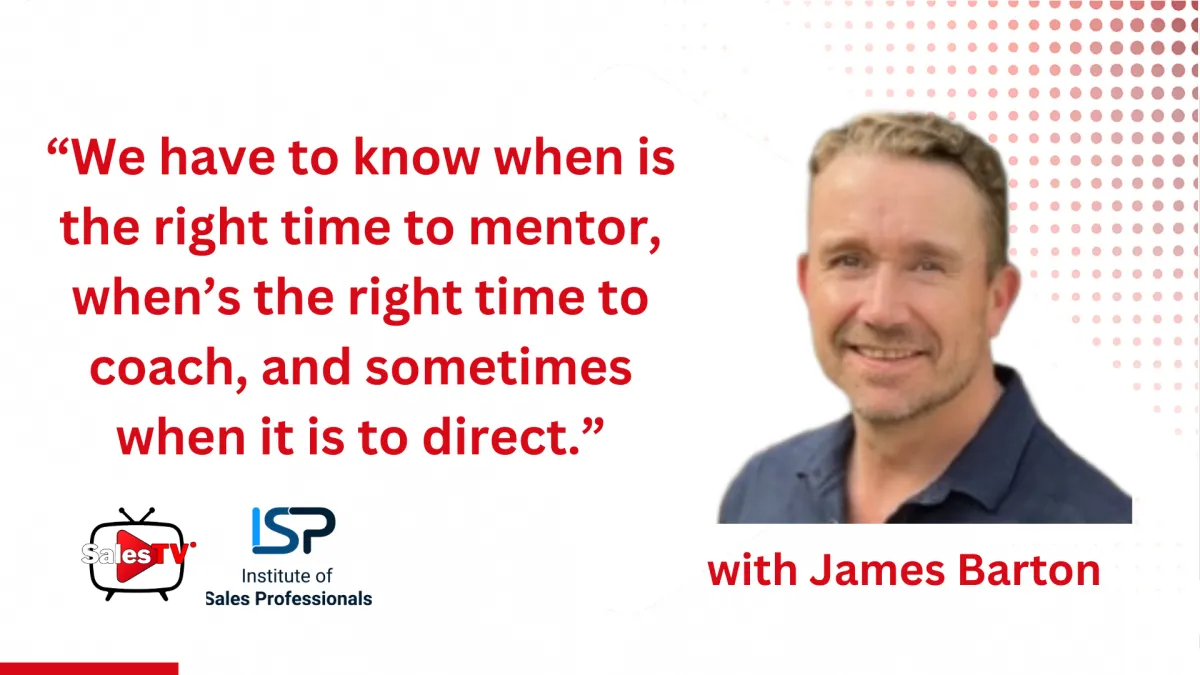
Most Sales Leaders Confuse Coaching and Mentoring
Many sales leaders are mentoring when they think they are coaching. Effective sales leaders know the difference and understand when to use sales coaching, sales mentoring, or direct guidance.
In this episode of SalesTV, James Barton, Chief Solutions Officer at Mentor Group and co-author of Infinite Selling, joins us to help address a persistent challenge for sales leadership: Sales coaching and sales mentoring are often used interchangeably in conversations, yet they represent fundamentally different leadership approaches. As frontline sales managers are expected to develop talent while also driving pipeline performance, the distinction between coaching, mentoring, and direct guidance becomes critical.
We’ll ask questions like -
* What is the difference between coaching and mentoring in sales?
* What is the biggest mistake sales leaders make when trying to coach their teams?
* When should a sales leader coach versus mentor a salesperson?
* How can technology help sales leaders become better sales coaches?
James has spent more than 25 years working at the intersection of sales, technology, and learning development. At Mentor Group and its innovation arm, he has helped organizations implement scalable sales training ecosystems that combine methodology, practice, and performance analytics to improve win rates, shorten ramp time, and embed sustainable selling behaviors across large sales organizations.
Join us Tuesday at Noon ET/ 9am PT.
This week's Guest was -
James Barton, Chief Solutions Officer of Mentor Group and co-author of Infinite Selling
This week's Host was -
Rob Durant, CEO, ISP US
Transcript of SalesTV.live Mid-Day Edition 2026-04-07
Rob Durant [00:00:02]:
Hello and welcome to another edition of Sales TV. Today we're exploring why most sales leaders confuse coaching and mentoring. We're joined by James Barton as the Chief Solutions Officer at Mentor Group and co-author of Infinite Selling. James has helped organizations implement scalable sales training ecosystems that combine methodology, practice, and performance analytics to improve win rates, shorten ramp time, and embed sustainable selling behaviors across large sales organizations. James, welcome.
James Barton [00:00:42]:
Thank you very much. Real pleasure to be here, Rob.
Rob Durant [00:00:45]:
Happy to have you here, James. James, let's jump right into it. What is the difference between coaching and mentoring in sales? And why do so many sales leaders confuse the two?
James Barton [00:00:57]:
That's a really great question. Get me on the front foot to start with. Okay, so you think about what we're trying to achieve here. The idea and the concept has always been that you as a senior sales leader need to help your junior leaders to do better through performance. And what we can see very clearly through all the metrics that we've done is those sellers that have been coached do better than those that aren't because there is something around sharing the wisdom, having the support around them to do well. However, if you look at what true coaching is, and I'm an official qualified trained coach, and in that they state that true coaching never ever needs to know the context. All you do is you ask questions and you're there, you're purely, it's the John Whitmore model around GROW, and you're there to ask great questions and then the seller will have the answers. And that is true coaching.
James Barton [00:02:05]:
Now, I'm yet to meet a sales leader that does coaching because they are pretty bad at not giving their opinion. It's the nature of the beast, right? You're the most senior seller there normally, and you go in and you want to say, hey, look, I've got a great idea. What I've done before is X. And that's why it's not true coaching. And we have conflated the terms to mean something that it's not. I 100% believe that coaching is the right answer. But actually, what most people are doing, and I appreciate there's a pun because the company name is Mentor, but what they're doing is mentoring. Okay, that's the truth of what they're doing.
James Barton [00:02:46]:
But we are using the word coaching because it is common parlance. Mentoring is something not necessarily seen in sales, but they are different skills for different reasons. Does that answer your question?
Rob Durant [00:02:58]:
Absolutely. So what's the biggest mistake sales leaders make when trying to coach their teams?
James Barton [00:03:06]:
So if you've got coaching and you've got mentoring. There's another one which is dictating. And so there's 3 different modes. And the biggest mistake that any sales leader will do will have— they'll only have one mode. They will not recognize that in one conversation you can dictate, you can mentor, and you can coach. So it's not— it's not— these are not mutually exclusive ideas. The conversation needs to flow depending on the need of the seller. So there's no reason why you can't ask great coaching questions to get started.
James Barton [00:03:42]:
Use the GROW model, but right in the middle, you might want to share some mentoring, some of the skills that you've got to say, in my experience, maybe try this. Not true coaching, but it is exactly what the person needs. And when I was doing my coaching training, I was— it explained to me that there's sometimes— if your child fell in a swimming pool, you would not try and coach them out. You wouldn't say, as they're drowning, what is the reality of your situation? What options do you have? You would pick them up, you'd grab them, you'd take them out of the pool, you'd put them on the side, right? You save them. That is the same thing in some coaching conversations. Sometimes you need to jump right in and you need to get right to the point with them.
Rob Durant [00:04:24]:
So here's what I heard. Coaching is about asking questions. You don't even necessarily need to know the context to start a coaching conversation.
James Barton [00:04:38]:
Correct.
Rob Durant [00:04:39]:
Mentoring is about the concepts, the high level, not necessarily specific to any one sales transaction, but more along the lines of the activities and behaviors in general. And directing is basically telling them specifically what to do in a given situation. Do I have that right?
James Barton [00:05:07]:
Yeah, close. I think you've got the two bookends right. The mentoring piece is around the sharing of your own personal wisdom, so, and experience. So you see, you're there and you're saying, what's worked for me before is— if I was you, I would do X. So you're not telling them you should do— you're exploring with them your experience. You're giving them the benefit of maybe your years of selling to help them try and find an answer. Different to coaching, where you don't have to have any of that experience. The best coaches in the world don't have any subject matter expertise.
James Barton [00:05:43]:
They just ask really great questions on the belief that you have the answers.
Rob Durant [00:05:47]:
Fantastic. So I've encountered a few sales managers in my time whose, well, for lack of an understanding of the definition still, I will say management style is, well, just do what I used to do. Is that coaching, mentoring, dictating? What is that?
James Barton [00:06:12]:
It's certainly not coaching. That one I can tell you. It would fall depending on, obviously, the conversations. It sounds like it would fall between somewhere between directing, dictating, and the whole mentoring concept. It sounds more leaning over to the directing style than even the mentoring, because the mentoring is, this is what I would do. Again, it's not telling you this is what you should do. The would and the should are two very similar words but have very different implications and meanings.
Rob Durant [00:06:42]:
Why do you think sales leaders often find themselves in a directing or dictating role?
James Barton [00:06:52]:
Well, there's two elements to that to answer. Number one is most sales leaders like to be the superhero. You see it all the time, you see it in calls, you know, I can't get the deal done, don't worry, I'll come in and save the day, says the sales leader. They like to be seen as the person that closes the deal. Secondly, I think it just comes down to a lack of proper training and understanding of how to coach, what coaching really means, because I said we've conflated coaching to just have a conversation with a seller without truly understanding those three different modes. I mean, you could look at situational leadership, which has four models, which again, depending on where the conversation goes, you have to choose how you direct to coach, to let them go and do their own thing. So these things are very similar. I don't believe that most people have ever actually been trained on how to coach, how to mentor, and know when to do it, because there's an art to know when to do it as well.
James Barton [00:07:59]:
And I guess I said there was two, but probably the third thing is most sales leaders were promoted because they were the best seller, not the best manager. And so they get this management title and/or leadership title, and then they don't— they're actually not a good fit from a true, from a leadership perspective. If you put the capabilities and characteristics of a sales leader versus the best seller, there would be a big delta between those two things. And that's a really interesting one because our culture in sales is when you get to be the best seller, you then lead a team because the belief is that you will be able to send your experience out and teach all these people to be just like you. And the reality is it just doesn't work that way.
Rob Durant [00:08:51]:
Those who can do, those who can't coach, So what are you saying about me?
James Barton [00:08:59]:
I teach and coach all the time. Thanks, Rob.
Rob Durant [00:09:03]:
Right back at you. That is one that I balk at all the time, right? It's just a different set of skills is what I'm hearing.
James Barton [00:09:13]:
Absolutely. Yeah. And as I said, the best sales leaders that I've met don't or haven't been on the field. They are people that know how to manage and lead a team, not necessarily having the best sales. But what they do know, this is back to Henry Ford's quotation about, you don't have to be the brightest person in the room, you need to know where the brightest person is so you can go get them, right? And if that sales leader knows where to get great coaches from, then you don't need to be the best person in the room. What you can do is say, hey, go and speak to Rob. Rob knows his stuff about that. Rob can coach you on that deal.
Rob Durant [00:09:52]:
I want to pick up on something you said earlier. You used the word when. So when is direct instruction better than sales coaching or mentoring?
James Barton [00:10:04]:
So I think, again, two dimensions to that. And I'll be using generalizations here early in someone's sales career. They've got no experience. They don't know what they're doing. They need to be told. You will tell them what to do. There's much more that directing style needs to come out as they mature through their experience. Mentoring could be good because then you can give them the benefit of your experience.
James Barton [00:10:31]:
And then coaching for people who are probably longer in their sales career, where they've got the experience, they've had the scars, and what you're doing is asking to think about What options do you have? Well, you've got to have options in the first place to be able to answer that question. So you've got to have that experience. The other time is depending on the situation. If you've got a very big deal you've been working on for months and months and months, it's going to fail, you can see why it's going to fail, you're not going to try and coach them through the problem. You're going to say, hey, this is where the nub of the problem is, fix that and that sale will go through. Back to my analogy about, someone drowning in a swimming pool, you won't let them fail. You will have to direct to get it right because sometimes it's so obvious you can just deal with it, but it depends on the impact. I've been in situations where I could have told someone what to do, but I chose to coach them because I could see the value in them learning for themselves.
James Barton [00:11:31]:
And of course, when we direct, when we tell, we rob the individual of that learning pathway and that learning experience for themselves. But if you use it correctly, it's so powerful. So knowing when to do any one of those three styles is really important. And again, what I said right at the beginning was you don't have to have a coaching conversation, a mentoring conversation, a directing conversation. It can be one conversation and just you can flick between all three of them. And that, I guess, is the art and skill of what we're talking about here.
Rob Durant [00:12:04]:
There you go. One of the things that you said about directing was that's especially useful early in someone's career. Isn't that training?
James Barton [00:12:18]:
Yes and no. So training, if you go to the Kirkpatrick model of training evaluation, That training probably picks up levels 1 and 2, sometimes 3, immature organizations. But you will never know the impact until they're actually on the field and they're actually in front of a client doing the right thing. So, yes, there's an element of training that you tell them what to do. But in a situation where you're doing a deal review or you're about to go pick up the phone and you want to coach them, That's not training. Sometimes you have to tell them, stop doing that and do this. Training is sometimes about best practice. Often, telling is about redirecting their effort.
Rob Durant [00:13:08]:
Let's talk a little bit about the sales leaders. In particular, I want to start by looking at the frontline sales leaders. What skills do frontline sales leaders need to become better sales coaches?
James Barton [00:13:27]:
Primarily, they need to have very good active listening skills. They need to use the same skills that they use to listen to their clients, to listen to their sellers, because often they don't. They have this one mode and they tell. And they don't actually listen to the problem. And these guys, because they're the best sellers, are normally the most skilled, and with the sales skills comes great active listening skills. I'm not sure it's something that will fit in here, but I'll say it anyway. It's being humble. It's trying not to be the superhero, to let the seller be the superhero.
James Barton [00:14:15]:
To not try and take credit to rescue the deal, but to help them do it themselves. So I think those would be the two things that I would see. I think being humble is a skill, but I think it is a characteristic.
Rob Durant [00:14:29]:
Okay, so I would agree with you that there are a lot of great sellers that are promoted into management and they're not necessarily cut out for it. I would also agree that good listening skills are applicable both at the individual contributor level and for those leading people. But as you make that transition, especially that first transition from individual contributor to leader of others, are there new skills that you need to learn to be effective in that role?
James Barton [00:15:09]:
Well, I mean, what you're asking there is what are the characteristics of a modern sales leader? And that's probably an episode in itself, Rob, because in there you're talking about data analytics, analysis, critical thinking, strategy. There are the people skills. And if you I know most sellers are really, really good individual contributors. They don't tend to work well as a team, as a rule, because it's their way or no way. And I know that's a generalization, right? I get that, it's a stereotype. So there's a whole bunch of stuff there. You've got these technical skills that you need to be a really great sales leader, with these human skills that you need to be a real good sales leader. And then you've got the bestseller in the room.
James Barton [00:16:02]:
And those are often not compatible, not without significant change.
Rob Durant [00:16:09]:
So as we think about moving up in the career, going from the leader of individual contributors to leader of leaders, is it more of the same, or are there yet additional skills that we need to develop?
James Barton [00:16:29]:
Well, when you start to manage managers, you're dealing with a whole bunch of new egos which need to be managed nicely. I think you also change your view. Now, if you look at most sales leaders, they are having to deal with weekly, monthly, quarterly, have you hit the number, have you hit the number, have you hit the number, these sort of conversations. When you go up to the next tier, your strategic vision is much wider because you're no longer looking at this quarter. You're looking at 2, 3, 4 quarters ahead just to make sure that you have got the strategy, the team, the resources, the sales stack, the whatever else you need to make this work. So again, is the best seller the best person for that? I would argue probably not, but the ones that are, are the ones that have had really strong and good leadership beforehand, because what they're then doing is kind of mentoring the mentors so they can see, well, this is how I saw my leader work and it worked really well. So again, there's also an even bigger need to let go. You cannot control everything at that level, and you have to trust the people below you to have that, that power to do what you would do.
James Barton [00:17:55]:
So not jumping down. And again, it's back to that humility piece. Don't try and step on their toes. Don't go down a level below them and undermine them. It happens all the time. So you've got to blend that in. You want to make sure they're empowered at every level.
Rob Durant [00:18:11]:
Excellent. Let's pivot the conversation and talk about technology for a moment. How can technology help sales leaders become better sales coaches?
James Barton [00:18:20]:
Oh my goodness, what a question. Again, there's another episode there and a white paper on this, on this very topic. So if my belief is about particularly around AI and AI in selling is that we need to use the technology to do the things that we're not very good at, to allow us to be better at the things we're really good at. Okay. And what I mean by that is that selling is a human skill, and we need to make sure that we maintain that level of relationship with individuals so that we can sell and that we can use it to coach. However, what technology can do AI, data analytics, whatever flavor of technology you want, it can provide you with the data and sometimes the insights, but what you have to do is the action. So we call that DIA: data to insight to action. Now, previously, you might be given a spreadsheet, that's the data, there was no insights available, okay? So you would have to work out what those insights are through whatever means and your own skill or competence or experience.
James Barton [00:19:37]:
Now with technology, that insight can be brought to you so then you can go and take the action. What you can't do is allow that action— in many cases, I'll say, there are a few cases, but many cases— you can't allow that to be taken over by technology. So use the technology to do the things that we are not great at, that frees us up to be really very, very good at the things we excel at.
Rob Durant [00:20:00]:
So along those same lines, And maybe you already answered this. Where does technology fall short in sales coaching?
James Barton [00:20:09]:
Okay. It falls short when it's used without an infrastructure and coverage of support or coaching. So I'll give you a good example. We do a lot of AI coaching. So we have this technology, it's an avatar, a bit like you and I are talking now, but you would be an AI. Actually, I'm not sure, are you real? Maybe you are. And we'd have a conversation very naturally like this. And at the end of the conversation, the AI would give you a whole bunch of coaching tips.
James Barton [00:20:42]:
And some sales leaders go, job done, I don't need to coach now, the technology has done the coaching for me. Absolute garbage. You will never ever be able to take yourself away from Kirkpatrick's 1 and 2 if you leave it there. To be able to start to evidence the impact, the business impact of what that trading is, you need to get involved as well because you need to be able to sift through and make sure the one, the AI isn't hallucinating because it does, we know that, and makes stuff up. But secondly, there's so much more wisdom that you can bring in that situation. Again, the coaching is one thing, but mentoring has got so much power. And so don't think that I was— I guess maybe I didn't explain. There's no hierarchy.
James Barton [00:21:31]:
Coaching isn't better than mentoring. Mentoring is not better than directing. It depends where you are. And mentoring, if you've got 30 years' worth of sales experience, sellers are desperate for that knowledge. But don't pretend it's coaching. So again, don't let the technology just give you or remove the responsibility from you as a leader. Get involved because evidence shows we've got data that shows the best sellers are those that are being coached. So why would you give that away to somebody and relieve your responsibility of something so powerful?
Rob Durant [00:22:10]:
That's a great thought. James, if you were to emphasize the one thing you would want our audience to take away from today's episode, what would that one thing be?
James Barton [00:22:24]:
Know when to coach, know when to mentor, know when to direct. Don't ever think it's one thing. That would be the one thing that I would let them go away with. Understand the power of mentoring, understand the power of coaching, and use it. It is a superpower when you know how to do it well, and it will transform your sales org, transform it, no question.
Rob Durant [00:22:51]:
Excellent. James, this has been great. On behalf of everyone at Sales TV, thank you for today's conversation. To our audience, a full replay and full transcript of today's episode along with contact information can be found at SalesTV.live/SalesCoaching.
Thank you all for being a part of today's episode, and we'll see you next time. Bye.
@SalesTVlive
#SalesCoaching #InfiniteSales #SalesMentoring #SalesManagement #SalesEnablement
#Sales #SalesLeadership #LinkedInLive #Podcast
________________________________________
About SalesTV: SalesTV is a weekly talk show created by salespeople, for salespeople. Each episode explores sales, sales training, sales enablement, and social selling, bringing together sales leaders, enablement professionals, and practitioners from across the globe.
About the Institute of Sales Professionals: The ISP is the only body worldwide dedicated to raising the standards of sales. Its Sales Capability Framework, certifications, and member community are designed to address their one goal: To Elevate the Profession of Sales.

Mid-Day Edition
Most Sales Leaders Confuse Coaching and Mentoring
Many sales leaders are mentoring when they think they are coaching. Effective sales leaders know the difference and understand when to use sales coaching, sales mentoring, or direct guidance.
In this episode of SalesTV, James Barton, Chief Solutions Officer at Mentor Group and co-author of Infinite Selling, joins us to help address a persistent challenge for sales leadership: Sales coaching and sales mentoring are often used interchangeably in conversations, yet they represent fundamentally different leadership approaches. As frontline sales managers are expected to develop talent while also driving pipeline performance, the distinction between coaching, mentoring, and direct guidance becomes critical.
We’ll ask questions like -
* What is the difference between coaching and mentoring in sales?
* What is the biggest mistake sales leaders make when trying to coach their teams?
* When should a sales leader coach versus mentor a salesperson?
* How can technology help sales leaders become better sales coaches?
James has spent more than 25 years working at the intersection of sales, technology, and learning development. At Mentor Group and its innovation arm, he has helped organizations implement scalable sales training ecosystems that combine methodology, practice, and performance analytics to improve win rates, shorten ramp time, and embed sustainable selling behaviors across large sales organizations.
Join us Tuesday at Noon ET/ 9am PT.
This week's Guest was -
James Barton, Chief Solutions Officer of Mentor Group and co-author of Infinite Selling
This week's Host was -
Rob Durant, CEO, ISP US
Transcript of SalesTV.live Mid-Day Edition 2026-04-07
Rob Durant [00:00:02]:
Hello and welcome to another edition of Sales TV. Today we're exploring why most sales leaders confuse coaching and mentoring. We're joined by James Barton as the Chief Solutions Officer at Mentor Group and co-author of Infinite Selling. James has helped organizations implement scalable sales training ecosystems that combine methodology, practice, and performance analytics to improve win rates, shorten ramp time, and embed sustainable selling behaviors across large sales organizations. James, welcome.
James Barton [00:00:42]:
Thank you very much. Real pleasure to be here, Rob.
Rob Durant [00:00:45]:
Happy to have you here, James. James, let's jump right into it. What is the difference between coaching and mentoring in sales? And why do so many sales leaders confuse the two?
James Barton [00:00:57]:
That's a really great question. Get me on the front foot to start with. Okay, so you think about what we're trying to achieve here. The idea and the concept has always been that you as a senior sales leader need to help your junior leaders to do better through performance. And what we can see very clearly through all the metrics that we've done is those sellers that have been coached do better than those that aren't because there is something around sharing the wisdom, having the support around them to do well. However, if you look at what true coaching is, and I'm an official qualified trained coach, and in that they state that true coaching never ever needs to know the context. All you do is you ask questions and you're there, you're purely, it's the John Whitmore model around GROW, and you're there to ask great questions and then the seller will have the answers. And that is true coaching.
James Barton [00:02:05]:
Now, I'm yet to meet a sales leader that does coaching because they are pretty bad at not giving their opinion. It's the nature of the beast, right? You're the most senior seller there normally, and you go in and you want to say, hey, look, I've got a great idea. What I've done before is X. And that's why it's not true coaching. And we have conflated the terms to mean something that it's not. I 100% believe that coaching is the right answer. But actually, what most people are doing, and I appreciate there's a pun because the company name is Mentor, but what they're doing is mentoring. Okay, that's the truth of what they're doing.
James Barton [00:02:46]:
But we are using the word coaching because it is common parlance. Mentoring is something not necessarily seen in sales, but they are different skills for different reasons. Does that answer your question?
Rob Durant [00:02:58]:
Absolutely. So what's the biggest mistake sales leaders make when trying to coach their teams?
James Barton [00:03:06]:
So if you've got coaching and you've got mentoring. There's another one which is dictating. And so there's 3 different modes. And the biggest mistake that any sales leader will do will have— they'll only have one mode. They will not recognize that in one conversation you can dictate, you can mentor, and you can coach. So it's not— it's not— these are not mutually exclusive ideas. The conversation needs to flow depending on the need of the seller. So there's no reason why you can't ask great coaching questions to get started.
James Barton [00:03:42]:
Use the GROW model, but right in the middle, you might want to share some mentoring, some of the skills that you've got to say, in my experience, maybe try this. Not true coaching, but it is exactly what the person needs. And when I was doing my coaching training, I was— it explained to me that there's sometimes— if your child fell in a swimming pool, you would not try and coach them out. You wouldn't say, as they're drowning, what is the reality of your situation? What options do you have? You would pick them up, you'd grab them, you'd take them out of the pool, you'd put them on the side, right? You save them. That is the same thing in some coaching conversations. Sometimes you need to jump right in and you need to get right to the point with them.
Rob Durant [00:04:24]:
So here's what I heard. Coaching is about asking questions. You don't even necessarily need to know the context to start a coaching conversation.
James Barton [00:04:38]:
Correct.
Rob Durant [00:04:39]:
Mentoring is about the concepts, the high level, not necessarily specific to any one sales transaction, but more along the lines of the activities and behaviors in general. And directing is basically telling them specifically what to do in a given situation. Do I have that right?
James Barton [00:05:07]:
Yeah, close. I think you've got the two bookends right. The mentoring piece is around the sharing of your own personal wisdom, so, and experience. So you see, you're there and you're saying, what's worked for me before is— if I was you, I would do X. So you're not telling them you should do— you're exploring with them your experience. You're giving them the benefit of maybe your years of selling to help them try and find an answer. Different to coaching, where you don't have to have any of that experience. The best coaches in the world don't have any subject matter expertise.
James Barton [00:05:43]:
They just ask really great questions on the belief that you have the answers.
Rob Durant [00:05:47]:
Fantastic. So I've encountered a few sales managers in my time whose, well, for lack of an understanding of the definition still, I will say management style is, well, just do what I used to do. Is that coaching, mentoring, dictating? What is that?
James Barton [00:06:12]:
It's certainly not coaching. That one I can tell you. It would fall depending on, obviously, the conversations. It sounds like it would fall between somewhere between directing, dictating, and the whole mentoring concept. It sounds more leaning over to the directing style than even the mentoring, because the mentoring is, this is what I would do. Again, it's not telling you this is what you should do. The would and the should are two very similar words but have very different implications and meanings.
Rob Durant [00:06:42]:
Why do you think sales leaders often find themselves in a directing or dictating role?
James Barton [00:06:52]:
Well, there's two elements to that to answer. Number one is most sales leaders like to be the superhero. You see it all the time, you see it in calls, you know, I can't get the deal done, don't worry, I'll come in and save the day, says the sales leader. They like to be seen as the person that closes the deal. Secondly, I think it just comes down to a lack of proper training and understanding of how to coach, what coaching really means, because I said we've conflated coaching to just have a conversation with a seller without truly understanding those three different modes. I mean, you could look at situational leadership, which has four models, which again, depending on where the conversation goes, you have to choose how you direct to coach, to let them go and do their own thing. So these things are very similar. I don't believe that most people have ever actually been trained on how to coach, how to mentor, and know when to do it, because there's an art to know when to do it as well.
James Barton [00:07:59]:
And I guess I said there was two, but probably the third thing is most sales leaders were promoted because they were the best seller, not the best manager. And so they get this management title and/or leadership title, and then they don't— they're actually not a good fit from a true, from a leadership perspective. If you put the capabilities and characteristics of a sales leader versus the best seller, there would be a big delta between those two things. And that's a really interesting one because our culture in sales is when you get to be the best seller, you then lead a team because the belief is that you will be able to send your experience out and teach all these people to be just like you. And the reality is it just doesn't work that way.
Rob Durant [00:08:51]:
Those who can do, those who can't coach, So what are you saying about me?
James Barton [00:08:59]:
I teach and coach all the time. Thanks, Rob.
Rob Durant [00:09:03]:
Right back at you. That is one that I balk at all the time, right? It's just a different set of skills is what I'm hearing.
James Barton [00:09:13]:
Absolutely. Yeah. And as I said, the best sales leaders that I've met don't or haven't been on the field. They are people that know how to manage and lead a team, not necessarily having the best sales. But what they do know, this is back to Henry Ford's quotation about, you don't have to be the brightest person in the room, you need to know where the brightest person is so you can go get them, right? And if that sales leader knows where to get great coaches from, then you don't need to be the best person in the room. What you can do is say, hey, go and speak to Rob. Rob knows his stuff about that. Rob can coach you on that deal.
Rob Durant [00:09:52]:
I want to pick up on something you said earlier. You used the word when. So when is direct instruction better than sales coaching or mentoring?
James Barton [00:10:04]:
So I think, again, two dimensions to that. And I'll be using generalizations here early in someone's sales career. They've got no experience. They don't know what they're doing. They need to be told. You will tell them what to do. There's much more that directing style needs to come out as they mature through their experience. Mentoring could be good because then you can give them the benefit of your experience.
James Barton [00:10:31]:
And then coaching for people who are probably longer in their sales career, where they've got the experience, they've had the scars, and what you're doing is asking to think about What options do you have? Well, you've got to have options in the first place to be able to answer that question. So you've got to have that experience. The other time is depending on the situation. If you've got a very big deal you've been working on for months and months and months, it's going to fail, you can see why it's going to fail, you're not going to try and coach them through the problem. You're going to say, hey, this is where the nub of the problem is, fix that and that sale will go through. Back to my analogy about, someone drowning in a swimming pool, you won't let them fail. You will have to direct to get it right because sometimes it's so obvious you can just deal with it, but it depends on the impact. I've been in situations where I could have told someone what to do, but I chose to coach them because I could see the value in them learning for themselves.
James Barton [00:11:31]:
And of course, when we direct, when we tell, we rob the individual of that learning pathway and that learning experience for themselves. But if you use it correctly, it's so powerful. So knowing when to do any one of those three styles is really important. And again, what I said right at the beginning was you don't have to have a coaching conversation, a mentoring conversation, a directing conversation. It can be one conversation and just you can flick between all three of them. And that, I guess, is the art and skill of what we're talking about here.
Rob Durant [00:12:04]:
There you go. One of the things that you said about directing was that's especially useful early in someone's career. Isn't that training?
James Barton [00:12:18]:
Yes and no. So training, if you go to the Kirkpatrick model of training evaluation, That training probably picks up levels 1 and 2, sometimes 3, immature organizations. But you will never know the impact until they're actually on the field and they're actually in front of a client doing the right thing. So, yes, there's an element of training that you tell them what to do. But in a situation where you're doing a deal review or you're about to go pick up the phone and you want to coach them, That's not training. Sometimes you have to tell them, stop doing that and do this. Training is sometimes about best practice. Often, telling is about redirecting their effort.
Rob Durant [00:13:08]:
Let's talk a little bit about the sales leaders. In particular, I want to start by looking at the frontline sales leaders. What skills do frontline sales leaders need to become better sales coaches?
James Barton [00:13:27]:
Primarily, they need to have very good active listening skills. They need to use the same skills that they use to listen to their clients, to listen to their sellers, because often they don't. They have this one mode and they tell. And they don't actually listen to the problem. And these guys, because they're the best sellers, are normally the most skilled, and with the sales skills comes great active listening skills. I'm not sure it's something that will fit in here, but I'll say it anyway. It's being humble. It's trying not to be the superhero, to let the seller be the superhero.
James Barton [00:14:15]:
To not try and take credit to rescue the deal, but to help them do it themselves. So I think those would be the two things that I would see. I think being humble is a skill, but I think it is a characteristic.
Rob Durant [00:14:29]:
Okay, so I would agree with you that there are a lot of great sellers that are promoted into management and they're not necessarily cut out for it. I would also agree that good listening skills are applicable both at the individual contributor level and for those leading people. But as you make that transition, especially that first transition from individual contributor to leader of others, are there new skills that you need to learn to be effective in that role?
James Barton [00:15:09]:
Well, I mean, what you're asking there is what are the characteristics of a modern sales leader? And that's probably an episode in itself, Rob, because in there you're talking about data analytics, analysis, critical thinking, strategy. There are the people skills. And if you I know most sellers are really, really good individual contributors. They don't tend to work well as a team, as a rule, because it's their way or no way. And I know that's a generalization, right? I get that, it's a stereotype. So there's a whole bunch of stuff there. You've got these technical skills that you need to be a really great sales leader, with these human skills that you need to be a real good sales leader. And then you've got the bestseller in the room.
James Barton [00:16:02]:
And those are often not compatible, not without significant change.
Rob Durant [00:16:09]:
So as we think about moving up in the career, going from the leader of individual contributors to leader of leaders, is it more of the same, or are there yet additional skills that we need to develop?
James Barton [00:16:29]:
Well, when you start to manage managers, you're dealing with a whole bunch of new egos which need to be managed nicely. I think you also change your view. Now, if you look at most sales leaders, they are having to deal with weekly, monthly, quarterly, have you hit the number, have you hit the number, have you hit the number, these sort of conversations. When you go up to the next tier, your strategic vision is much wider because you're no longer looking at this quarter. You're looking at 2, 3, 4 quarters ahead just to make sure that you have got the strategy, the team, the resources, the sales stack, the whatever else you need to make this work. So again, is the best seller the best person for that? I would argue probably not, but the ones that are, are the ones that have had really strong and good leadership beforehand, because what they're then doing is kind of mentoring the mentors so they can see, well, this is how I saw my leader work and it worked really well. So again, there's also an even bigger need to let go. You cannot control everything at that level, and you have to trust the people below you to have that, that power to do what you would do.
James Barton [00:17:55]:
So not jumping down. And again, it's back to that humility piece. Don't try and step on their toes. Don't go down a level below them and undermine them. It happens all the time. So you've got to blend that in. You want to make sure they're empowered at every level.
Rob Durant [00:18:11]:
Excellent. Let's pivot the conversation and talk about technology for a moment. How can technology help sales leaders become better sales coaches?
James Barton [00:18:20]:
Oh my goodness, what a question. Again, there's another episode there and a white paper on this, on this very topic. So if my belief is about particularly around AI and AI in selling is that we need to use the technology to do the things that we're not very good at, to allow us to be better at the things we're really good at. Okay. And what I mean by that is that selling is a human skill, and we need to make sure that we maintain that level of relationship with individuals so that we can sell and that we can use it to coach. However, what technology can do AI, data analytics, whatever flavor of technology you want, it can provide you with the data and sometimes the insights, but what you have to do is the action. So we call that DIA: data to insight to action. Now, previously, you might be given a spreadsheet, that's the data, there was no insights available, okay? So you would have to work out what those insights are through whatever means and your own skill or competence or experience.
James Barton [00:19:37]:
Now with technology, that insight can be brought to you so then you can go and take the action. What you can't do is allow that action— in many cases, I'll say, there are a few cases, but many cases— you can't allow that to be taken over by technology. So use the technology to do the things that we are not great at, that frees us up to be really very, very good at the things we excel at.
Rob Durant [00:20:00]:
So along those same lines, And maybe you already answered this. Where does technology fall short in sales coaching?
James Barton [00:20:09]:
Okay. It falls short when it's used without an infrastructure and coverage of support or coaching. So I'll give you a good example. We do a lot of AI coaching. So we have this technology, it's an avatar, a bit like you and I are talking now, but you would be an AI. Actually, I'm not sure, are you real? Maybe you are. And we'd have a conversation very naturally like this. And at the end of the conversation, the AI would give you a whole bunch of coaching tips.
James Barton [00:20:42]:
And some sales leaders go, job done, I don't need to coach now, the technology has done the coaching for me. Absolute garbage. You will never ever be able to take yourself away from Kirkpatrick's 1 and 2 if you leave it there. To be able to start to evidence the impact, the business impact of what that trading is, you need to get involved as well because you need to be able to sift through and make sure the one, the AI isn't hallucinating because it does, we know that, and makes stuff up. But secondly, there's so much more wisdom that you can bring in that situation. Again, the coaching is one thing, but mentoring has got so much power. And so don't think that I was— I guess maybe I didn't explain. There's no hierarchy.
James Barton [00:21:31]:
Coaching isn't better than mentoring. Mentoring is not better than directing. It depends where you are. And mentoring, if you've got 30 years' worth of sales experience, sellers are desperate for that knowledge. But don't pretend it's coaching. So again, don't let the technology just give you or remove the responsibility from you as a leader. Get involved because evidence shows we've got data that shows the best sellers are those that are being coached. So why would you give that away to somebody and relieve your responsibility of something so powerful?
Rob Durant [00:22:10]:
That's a great thought. James, if you were to emphasize the one thing you would want our audience to take away from today's episode, what would that one thing be?
James Barton [00:22:24]:
Know when to coach, know when to mentor, know when to direct. Don't ever think it's one thing. That would be the one thing that I would let them go away with. Understand the power of mentoring, understand the power of coaching, and use it. It is a superpower when you know how to do it well, and it will transform your sales org, transform it, no question.
Rob Durant [00:22:51]:
Excellent. James, this has been great. On behalf of everyone at Sales TV, thank you for today's conversation. To our audience, a full replay and full transcript of today's episode along with contact information can be found at SalesTV.live/SalesCoaching.
Thank you all for being a part of today's episode, and we'll see you next time. Bye.
@SalesTVlive
#SalesCoaching #InfiniteSales #SalesMentoring #SalesManagement #SalesEnablement
#Sales #SalesLeadership #LinkedInLive #Podcast
________________________________________
About SalesTV: SalesTV is a weekly talk show created by salespeople, for salespeople. Each episode explores sales, sales training, sales enablement, and social selling, bringing together sales leaders, enablement professionals, and practitioners from across the globe.
About the Institute of Sales Professionals: The ISP is the only body worldwide dedicated to raising the standards of sales. Its Sales Capability Framework, certifications, and member community are designed to address their one goal: To Elevate the Profession of Sales.
Other Editions
Most Sales Leaders Confuse Coaching and Mentoring
Many sales leaders are mentoring when they think they are coaching. Effective sales leaders know the difference and understand when to use sales coaching, sales mentoring, or direct guidance.
In this episode of SalesTV, James Barton, Chief Solutions Officer at Mentor Group and co-author of Infinite Selling, joins us to help address a persistent challenge for sales leadership: Sales coaching and sales mentoring are often used interchangeably in conversations, yet they represent fundamentally different leadership approaches. As frontline sales managers are expected to develop talent while also driving pipeline performance, the distinction between coaching, mentoring, and direct guidance becomes critical.
We’ll ask questions like -
* What is the difference between coaching and mentoring in sales?
* What is the biggest mistake sales leaders make when trying to coach their teams?
* When should a sales leader coach versus mentor a salesperson?
* How can technology help sales leaders become better sales coaches?
James has spent more than 25 years working at the intersection of sales, technology, and learning development. At Mentor Group and its innovation arm, he has helped organizations implement scalable sales training ecosystems that combine methodology, practice, and performance analytics to improve win rates, shorten ramp time, and embed sustainable selling behaviors across large sales organizations.
Join us Tuesday at Noon ET/ 9am PT.
This week's Guest was -
James Barton, Chief Solutions Officer of Mentor Group and co-author of Infinite Selling
This week's Host was -
Rob Durant, CEO, ISP US
Transcript of SalesTV.live Mid-Day Edition 2026-04-07
Rob Durant [00:00:02]:
Hello and welcome to another edition of Sales TV. Today we're exploring why most sales leaders confuse coaching and mentoring. We're joined by James Barton as the Chief Solutions Officer at Mentor Group and co-author of Infinite Selling. James has helped organizations implement scalable sales training ecosystems that combine methodology, practice, and performance analytics to improve win rates, shorten ramp time, and embed sustainable selling behaviors across large sales organizations. James, welcome.
James Barton [00:00:42]:
Thank you very much. Real pleasure to be here, Rob.
Rob Durant [00:00:45]:
Happy to have you here, James. James, let's jump right into it. What is the difference between coaching and mentoring in sales? And why do so many sales leaders confuse the two?
James Barton [00:00:57]:
That's a really great question. Get me on the front foot to start with. Okay, so you think about what we're trying to achieve here. The idea and the concept has always been that you as a senior sales leader need to help your junior leaders to do better through performance. And what we can see very clearly through all the metrics that we've done is those sellers that have been coached do better than those that aren't because there is something around sharing the wisdom, having the support around them to do well. However, if you look at what true coaching is, and I'm an official qualified trained coach, and in that they state that true coaching never ever needs to know the context. All you do is you ask questions and you're there, you're purely, it's the John Whitmore model around GROW, and you're there to ask great questions and then the seller will have the answers. And that is true coaching.
James Barton [00:02:05]:
Now, I'm yet to meet a sales leader that does coaching because they are pretty bad at not giving their opinion. It's the nature of the beast, right? You're the most senior seller there normally, and you go in and you want to say, hey, look, I've got a great idea. What I've done before is X. And that's why it's not true coaching. And we have conflated the terms to mean something that it's not. I 100% believe that coaching is the right answer. But actually, what most people are doing, and I appreciate there's a pun because the company name is Mentor, but what they're doing is mentoring. Okay, that's the truth of what they're doing.
James Barton [00:02:46]:
But we are using the word coaching because it is common parlance. Mentoring is something not necessarily seen in sales, but they are different skills for different reasons. Does that answer your question?
Rob Durant [00:02:58]:
Absolutely. So what's the biggest mistake sales leaders make when trying to coach their teams?
James Barton [00:03:06]:
So if you've got coaching and you've got mentoring. There's another one which is dictating. And so there's 3 different modes. And the biggest mistake that any sales leader will do will have— they'll only have one mode. They will not recognize that in one conversation you can dictate, you can mentor, and you can coach. So it's not— it's not— these are not mutually exclusive ideas. The conversation needs to flow depending on the need of the seller. So there's no reason why you can't ask great coaching questions to get started.
James Barton [00:03:42]:
Use the GROW model, but right in the middle, you might want to share some mentoring, some of the skills that you've got to say, in my experience, maybe try this. Not true coaching, but it is exactly what the person needs. And when I was doing my coaching training, I was— it explained to me that there's sometimes— if your child fell in a swimming pool, you would not try and coach them out. You wouldn't say, as they're drowning, what is the reality of your situation? What options do you have? You would pick them up, you'd grab them, you'd take them out of the pool, you'd put them on the side, right? You save them. That is the same thing in some coaching conversations. Sometimes you need to jump right in and you need to get right to the point with them.
Rob Durant [00:04:24]:
So here's what I heard. Coaching is about asking questions. You don't even necessarily need to know the context to start a coaching conversation.
James Barton [00:04:38]:
Correct.
Rob Durant [00:04:39]:
Mentoring is about the concepts, the high level, not necessarily specific to any one sales transaction, but more along the lines of the activities and behaviors in general. And directing is basically telling them specifically what to do in a given situation. Do I have that right?
James Barton [00:05:07]:
Yeah, close. I think you've got the two bookends right. The mentoring piece is around the sharing of your own personal wisdom, so, and experience. So you see, you're there and you're saying, what's worked for me before is— if I was you, I would do X. So you're not telling them you should do— you're exploring with them your experience. You're giving them the benefit of maybe your years of selling to help them try and find an answer. Different to coaching, where you don't have to have any of that experience. The best coaches in the world don't have any subject matter expertise.
James Barton [00:05:43]:
They just ask really great questions on the belief that you have the answers.
Rob Durant [00:05:47]:
Fantastic. So I've encountered a few sales managers in my time whose, well, for lack of an understanding of the definition still, I will say management style is, well, just do what I used to do. Is that coaching, mentoring, dictating? What is that?
James Barton [00:06:12]:
It's certainly not coaching. That one I can tell you. It would fall depending on, obviously, the conversations. It sounds like it would fall between somewhere between directing, dictating, and the whole mentoring concept. It sounds more leaning over to the directing style than even the mentoring, because the mentoring is, this is what I would do. Again, it's not telling you this is what you should do. The would and the should are two very similar words but have very different implications and meanings.
Rob Durant [00:06:42]:
Why do you think sales leaders often find themselves in a directing or dictating role?
James Barton [00:06:52]:
Well, there's two elements to that to answer. Number one is most sales leaders like to be the superhero. You see it all the time, you see it in calls, you know, I can't get the deal done, don't worry, I'll come in and save the day, says the sales leader. They like to be seen as the person that closes the deal. Secondly, I think it just comes down to a lack of proper training and understanding of how to coach, what coaching really means, because I said we've conflated coaching to just have a conversation with a seller without truly understanding those three different modes. I mean, you could look at situational leadership, which has four models, which again, depending on where the conversation goes, you have to choose how you direct to coach, to let them go and do their own thing. So these things are very similar. I don't believe that most people have ever actually been trained on how to coach, how to mentor, and know when to do it, because there's an art to know when to do it as well.
James Barton [00:07:59]:
And I guess I said there was two, but probably the third thing is most sales leaders were promoted because they were the best seller, not the best manager. And so they get this management title and/or leadership title, and then they don't— they're actually not a good fit from a true, from a leadership perspective. If you put the capabilities and characteristics of a sales leader versus the best seller, there would be a big delta between those two things. And that's a really interesting one because our culture in sales is when you get to be the best seller, you then lead a team because the belief is that you will be able to send your experience out and teach all these people to be just like you. And the reality is it just doesn't work that way.
Rob Durant [00:08:51]:
Those who can do, those who can't coach, So what are you saying about me?
James Barton [00:08:59]:
I teach and coach all the time. Thanks, Rob.
Rob Durant [00:09:03]:
Right back at you. That is one that I balk at all the time, right? It's just a different set of skills is what I'm hearing.
James Barton [00:09:13]:
Absolutely. Yeah. And as I said, the best sales leaders that I've met don't or haven't been on the field. They are people that know how to manage and lead a team, not necessarily having the best sales. But what they do know, this is back to Henry Ford's quotation about, you don't have to be the brightest person in the room, you need to know where the brightest person is so you can go get them, right? And if that sales leader knows where to get great coaches from, then you don't need to be the best person in the room. What you can do is say, hey, go and speak to Rob. Rob knows his stuff about that. Rob can coach you on that deal.
Rob Durant [00:09:52]:
I want to pick up on something you said earlier. You used the word when. So when is direct instruction better than sales coaching or mentoring?
James Barton [00:10:04]:
So I think, again, two dimensions to that. And I'll be using generalizations here early in someone's sales career. They've got no experience. They don't know what they're doing. They need to be told. You will tell them what to do. There's much more that directing style needs to come out as they mature through their experience. Mentoring could be good because then you can give them the benefit of your experience.
James Barton [00:10:31]:
And then coaching for people who are probably longer in their sales career, where they've got the experience, they've had the scars, and what you're doing is asking to think about What options do you have? Well, you've got to have options in the first place to be able to answer that question. So you've got to have that experience. The other time is depending on the situation. If you've got a very big deal you've been working on for months and months and months, it's going to fail, you can see why it's going to fail, you're not going to try and coach them through the problem. You're going to say, hey, this is where the nub of the problem is, fix that and that sale will go through. Back to my analogy about, someone drowning in a swimming pool, you won't let them fail. You will have to direct to get it right because sometimes it's so obvious you can just deal with it, but it depends on the impact. I've been in situations where I could have told someone what to do, but I chose to coach them because I could see the value in them learning for themselves.
James Barton [00:11:31]:
And of course, when we direct, when we tell, we rob the individual of that learning pathway and that learning experience for themselves. But if you use it correctly, it's so powerful. So knowing when to do any one of those three styles is really important. And again, what I said right at the beginning was you don't have to have a coaching conversation, a mentoring conversation, a directing conversation. It can be one conversation and just you can flick between all three of them. And that, I guess, is the art and skill of what we're talking about here.
Rob Durant [00:12:04]:
There you go. One of the things that you said about directing was that's especially useful early in someone's career. Isn't that training?
James Barton [00:12:18]:
Yes and no. So training, if you go to the Kirkpatrick model of training evaluation, That training probably picks up levels 1 and 2, sometimes 3, immature organizations. But you will never know the impact until they're actually on the field and they're actually in front of a client doing the right thing. So, yes, there's an element of training that you tell them what to do. But in a situation where you're doing a deal review or you're about to go pick up the phone and you want to coach them, That's not training. Sometimes you have to tell them, stop doing that and do this. Training is sometimes about best practice. Often, telling is about redirecting their effort.
Rob Durant [00:13:08]:
Let's talk a little bit about the sales leaders. In particular, I want to start by looking at the frontline sales leaders. What skills do frontline sales leaders need to become better sales coaches?
James Barton [00:13:27]:
Primarily, they need to have very good active listening skills. They need to use the same skills that they use to listen to their clients, to listen to their sellers, because often they don't. They have this one mode and they tell. And they don't actually listen to the problem. And these guys, because they're the best sellers, are normally the most skilled, and with the sales skills comes great active listening skills. I'm not sure it's something that will fit in here, but I'll say it anyway. It's being humble. It's trying not to be the superhero, to let the seller be the superhero.
James Barton [00:14:15]:
To not try and take credit to rescue the deal, but to help them do it themselves. So I think those would be the two things that I would see. I think being humble is a skill, but I think it is a characteristic.
Rob Durant [00:14:29]:
Okay, so I would agree with you that there are a lot of great sellers that are promoted into management and they're not necessarily cut out for it. I would also agree that good listening skills are applicable both at the individual contributor level and for those leading people. But as you make that transition, especially that first transition from individual contributor to leader of others, are there new skills that you need to learn to be effective in that role?
James Barton [00:15:09]:
Well, I mean, what you're asking there is what are the characteristics of a modern sales leader? And that's probably an episode in itself, Rob, because in there you're talking about data analytics, analysis, critical thinking, strategy. There are the people skills. And if you I know most sellers are really, really good individual contributors. They don't tend to work well as a team, as a rule, because it's their way or no way. And I know that's a generalization, right? I get that, it's a stereotype. So there's a whole bunch of stuff there. You've got these technical skills that you need to be a really great sales leader, with these human skills that you need to be a real good sales leader. And then you've got the bestseller in the room.
James Barton [00:16:02]:
And those are often not compatible, not without significant change.
Rob Durant [00:16:09]:
So as we think about moving up in the career, going from the leader of individual contributors to leader of leaders, is it more of the same, or are there yet additional skills that we need to develop?
James Barton [00:16:29]:
Well, when you start to manage managers, you're dealing with a whole bunch of new egos which need to be managed nicely. I think you also change your view. Now, if you look at most sales leaders, they are having to deal with weekly, monthly, quarterly, have you hit the number, have you hit the number, have you hit the number, these sort of conversations. When you go up to the next tier, your strategic vision is much wider because you're no longer looking at this quarter. You're looking at 2, 3, 4 quarters ahead just to make sure that you have got the strategy, the team, the resources, the sales stack, the whatever else you need to make this work. So again, is the best seller the best person for that? I would argue probably not, but the ones that are, are the ones that have had really strong and good leadership beforehand, because what they're then doing is kind of mentoring the mentors so they can see, well, this is how I saw my leader work and it worked really well. So again, there's also an even bigger need to let go. You cannot control everything at that level, and you have to trust the people below you to have that, that power to do what you would do.
James Barton [00:17:55]:
So not jumping down. And again, it's back to that humility piece. Don't try and step on their toes. Don't go down a level below them and undermine them. It happens all the time. So you've got to blend that in. You want to make sure they're empowered at every level.
Rob Durant [00:18:11]:
Excellent. Let's pivot the conversation and talk about technology for a moment. How can technology help sales leaders become better sales coaches?
James Barton [00:18:20]:
Oh my goodness, what a question. Again, there's another episode there and a white paper on this, on this very topic. So if my belief is about particularly around AI and AI in selling is that we need to use the technology to do the things that we're not very good at, to allow us to be better at the things we're really good at. Okay. And what I mean by that is that selling is a human skill, and we need to make sure that we maintain that level of relationship with individuals so that we can sell and that we can use it to coach. However, what technology can do AI, data analytics, whatever flavor of technology you want, it can provide you with the data and sometimes the insights, but what you have to do is the action. So we call that DIA: data to insight to action. Now, previously, you might be given a spreadsheet, that's the data, there was no insights available, okay? So you would have to work out what those insights are through whatever means and your own skill or competence or experience.
James Barton [00:19:37]:
Now with technology, that insight can be brought to you so then you can go and take the action. What you can't do is allow that action— in many cases, I'll say, there are a few cases, but many cases— you can't allow that to be taken over by technology. So use the technology to do the things that we are not great at, that frees us up to be really very, very good at the things we excel at.
Rob Durant [00:20:00]:
So along those same lines, And maybe you already answered this. Where does technology fall short in sales coaching?
James Barton [00:20:09]:
Okay. It falls short when it's used without an infrastructure and coverage of support or coaching. So I'll give you a good example. We do a lot of AI coaching. So we have this technology, it's an avatar, a bit like you and I are talking now, but you would be an AI. Actually, I'm not sure, are you real? Maybe you are. And we'd have a conversation very naturally like this. And at the end of the conversation, the AI would give you a whole bunch of coaching tips.
James Barton [00:20:42]:
And some sales leaders go, job done, I don't need to coach now, the technology has done the coaching for me. Absolute garbage. You will never ever be able to take yourself away from Kirkpatrick's 1 and 2 if you leave it there. To be able to start to evidence the impact, the business impact of what that trading is, you need to get involved as well because you need to be able to sift through and make sure the one, the AI isn't hallucinating because it does, we know that, and makes stuff up. But secondly, there's so much more wisdom that you can bring in that situation. Again, the coaching is one thing, but mentoring has got so much power. And so don't think that I was— I guess maybe I didn't explain. There's no hierarchy.
James Barton [00:21:31]:
Coaching isn't better than mentoring. Mentoring is not better than directing. It depends where you are. And mentoring, if you've got 30 years' worth of sales experience, sellers are desperate for that knowledge. But don't pretend it's coaching. So again, don't let the technology just give you or remove the responsibility from you as a leader. Get involved because evidence shows we've got data that shows the best sellers are those that are being coached. So why would you give that away to somebody and relieve your responsibility of something so powerful?
Rob Durant [00:22:10]:
That's a great thought. James, if you were to emphasize the one thing you would want our audience to take away from today's episode, what would that one thing be?
James Barton [00:22:24]:
Know when to coach, know when to mentor, know when to direct. Don't ever think it's one thing. That would be the one thing that I would let them go away with. Understand the power of mentoring, understand the power of coaching, and use it. It is a superpower when you know how to do it well, and it will transform your sales org, transform it, no question.
Rob Durant [00:22:51]:
Excellent. James, this has been great. On behalf of everyone at Sales TV, thank you for today's conversation. To our audience, a full replay and full transcript of today's episode along with contact information can be found at SalesTV.live/SalesCoaching.
Thank you all for being a part of today's episode, and we'll see you next time. Bye.
@SalesTVlive
#SalesCoaching #InfiniteSales #SalesMentoring #SalesManagement #SalesEnablement
#Sales #SalesLeadership #LinkedInLive #Podcast
________________________________________
About SalesTV: SalesTV is a weekly talk show created by salespeople, for salespeople. Each episode explores sales, sales training, sales enablement, and social selling, bringing together sales leaders, enablement professionals, and practitioners from across the globe.
About the Institute of Sales Professionals: The ISP is the only body worldwide dedicated to raising the standards of sales. Its Sales Capability Framework, certifications, and member community are designed to address their one goal: To Elevate the Profession of Sales.
Most Sales Leaders Confuse Coaching and Mentoring
Many sales leaders are mentoring when they think they are coaching. Effective sales leaders know the difference and understand when to use sales coaching, sales mentoring, or direct guidance.
In this episode of SalesTV, James Barton, Chief Solutions Officer at Mentor Group and co-author of Infinite Selling, joins us to help address a persistent challenge for sales leadership: Sales coaching and sales mentoring are often used interchangeably in conversations, yet they represent fundamentally different leadership approaches. As frontline sales managers are expected to develop talent while also driving pipeline performance, the distinction between coaching, mentoring, and direct guidance becomes critical.
We’ll ask questions like -
* What is the difference between coaching and mentoring in sales?
* What is the biggest mistake sales leaders make when trying to coach their teams?
* When should a sales leader coach versus mentor a salesperson?
* How can technology help sales leaders become better sales coaches?
James has spent more than 25 years working at the intersection of sales, technology, and learning development. At Mentor Group and its innovation arm, he has helped organizations implement scalable sales training ecosystems that combine methodology, practice, and performance analytics to improve win rates, shorten ramp time, and embed sustainable selling behaviors across large sales organizations.
Join us Tuesday at Noon ET/ 9am PT.
This week's Guest was -
James Barton, Chief Solutions Officer of Mentor Group and co-author of Infinite Selling
This week's Host was -
Rob Durant, CEO, ISP US
Transcript of SalesTV.live Mid-Day Edition 2026-04-07
Rob Durant [00:00:02]:
Hello and welcome to another edition of Sales TV. Today we're exploring why most sales leaders confuse coaching and mentoring. We're joined by James Barton as the Chief Solutions Officer at Mentor Group and co-author of Infinite Selling. James has helped organizations implement scalable sales training ecosystems that combine methodology, practice, and performance analytics to improve win rates, shorten ramp time, and embed sustainable selling behaviors across large sales organizations. James, welcome.
James Barton [00:00:42]:
Thank you very much. Real pleasure to be here, Rob.
Rob Durant [00:00:45]:
Happy to have you here, James. James, let's jump right into it. What is the difference between coaching and mentoring in sales? And why do so many sales leaders confuse the two?
James Barton [00:00:57]:
That's a really great question. Get me on the front foot to start with. Okay, so you think about what we're trying to achieve here. The idea and the concept has always been that you as a senior sales leader need to help your junior leaders to do better through performance. And what we can see very clearly through all the metrics that we've done is those sellers that have been coached do better than those that aren't because there is something around sharing the wisdom, having the support around them to do well. However, if you look at what true coaching is, and I'm an official qualified trained coach, and in that they state that true coaching never ever needs to know the context. All you do is you ask questions and you're there, you're purely, it's the John Whitmore model around GROW, and you're there to ask great questions and then the seller will have the answers. And that is true coaching.
James Barton [00:02:05]:
Now, I'm yet to meet a sales leader that does coaching because they are pretty bad at not giving their opinion. It's the nature of the beast, right? You're the most senior seller there normally, and you go in and you want to say, hey, look, I've got a great idea. What I've done before is X. And that's why it's not true coaching. And we have conflated the terms to mean something that it's not. I 100% believe that coaching is the right answer. But actually, what most people are doing, and I appreciate there's a pun because the company name is Mentor, but what they're doing is mentoring. Okay, that's the truth of what they're doing.
James Barton [00:02:46]:
But we are using the word coaching because it is common parlance. Mentoring is something not necessarily seen in sales, but they are different skills for different reasons. Does that answer your question?
Rob Durant [00:02:58]:
Absolutely. So what's the biggest mistake sales leaders make when trying to coach their teams?
James Barton [00:03:06]:
So if you've got coaching and you've got mentoring. There's another one which is dictating. And so there's 3 different modes. And the biggest mistake that any sales leader will do will have— they'll only have one mode. They will not recognize that in one conversation you can dictate, you can mentor, and you can coach. So it's not— it's not— these are not mutually exclusive ideas. The conversation needs to flow depending on the need of the seller. So there's no reason why you can't ask great coaching questions to get started.
James Barton [00:03:42]:
Use the GROW model, but right in the middle, you might want to share some mentoring, some of the skills that you've got to say, in my experience, maybe try this. Not true coaching, but it is exactly what the person needs. And when I was doing my coaching training, I was— it explained to me that there's sometimes— if your child fell in a swimming pool, you would not try and coach them out. You wouldn't say, as they're drowning, what is the reality of your situation? What options do you have? You would pick them up, you'd grab them, you'd take them out of the pool, you'd put them on the side, right? You save them. That is the same thing in some coaching conversations. Sometimes you need to jump right in and you need to get right to the point with them.
Rob Durant [00:04:24]:
So here's what I heard. Coaching is about asking questions. You don't even necessarily need to know the context to start a coaching conversation.
James Barton [00:04:38]:
Correct.
Rob Durant [00:04:39]:
Mentoring is about the concepts, the high level, not necessarily specific to any one sales transaction, but more along the lines of the activities and behaviors in general. And directing is basically telling them specifically what to do in a given situation. Do I have that right?
James Barton [00:05:07]:
Yeah, close. I think you've got the two bookends right. The mentoring piece is around the sharing of your own personal wisdom, so, and experience. So you see, you're there and you're saying, what's worked for me before is— if I was you, I would do X. So you're not telling them you should do— you're exploring with them your experience. You're giving them the benefit of maybe your years of selling to help them try and find an answer. Different to coaching, where you don't have to have any of that experience. The best coaches in the world don't have any subject matter expertise.
James Barton [00:05:43]:
They just ask really great questions on the belief that you have the answers.
Rob Durant [00:05:47]:
Fantastic. So I've encountered a few sales managers in my time whose, well, for lack of an understanding of the definition still, I will say management style is, well, just do what I used to do. Is that coaching, mentoring, dictating? What is that?
James Barton [00:06:12]:
It's certainly not coaching. That one I can tell you. It would fall depending on, obviously, the conversations. It sounds like it would fall between somewhere between directing, dictating, and the whole mentoring concept. It sounds more leaning over to the directing style than even the mentoring, because the mentoring is, this is what I would do. Again, it's not telling you this is what you should do. The would and the should are two very similar words but have very different implications and meanings.
Rob Durant [00:06:42]:
Why do you think sales leaders often find themselves in a directing or dictating role?
James Barton [00:06:52]:
Well, there's two elements to that to answer. Number one is most sales leaders like to be the superhero. You see it all the time, you see it in calls, you know, I can't get the deal done, don't worry, I'll come in and save the day, says the sales leader. They like to be seen as the person that closes the deal. Secondly, I think it just comes down to a lack of proper training and understanding of how to coach, what coaching really means, because I said we've conflated coaching to just have a conversation with a seller without truly understanding those three different modes. I mean, you could look at situational leadership, which has four models, which again, depending on where the conversation goes, you have to choose how you direct to coach, to let them go and do their own thing. So these things are very similar. I don't believe that most people have ever actually been trained on how to coach, how to mentor, and know when to do it, because there's an art to know when to do it as well.
James Barton [00:07:59]:
And I guess I said there was two, but probably the third thing is most sales leaders were promoted because they were the best seller, not the best manager. And so they get this management title and/or leadership title, and then they don't— they're actually not a good fit from a true, from a leadership perspective. If you put the capabilities and characteristics of a sales leader versus the best seller, there would be a big delta between those two things. And that's a really interesting one because our culture in sales is when you get to be the best seller, you then lead a team because the belief is that you will be able to send your experience out and teach all these people to be just like you. And the reality is it just doesn't work that way.
Rob Durant [00:08:51]:
Those who can do, those who can't coach, So what are you saying about me?
James Barton [00:08:59]:
I teach and coach all the time. Thanks, Rob.
Rob Durant [00:09:03]:
Right back at you. That is one that I balk at all the time, right? It's just a different set of skills is what I'm hearing.
James Barton [00:09:13]:
Absolutely. Yeah. And as I said, the best sales leaders that I've met don't or haven't been on the field. They are people that know how to manage and lead a team, not necessarily having the best sales. But what they do know, this is back to Henry Ford's quotation about, you don't have to be the brightest person in the room, you need to know where the brightest person is so you can go get them, right? And if that sales leader knows where to get great coaches from, then you don't need to be the best person in the room. What you can do is say, hey, go and speak to Rob. Rob knows his stuff about that. Rob can coach you on that deal.
Rob Durant [00:09:52]:
I want to pick up on something you said earlier. You used the word when. So when is direct instruction better than sales coaching or mentoring?
James Barton [00:10:04]:
So I think, again, two dimensions to that. And I'll be using generalizations here early in someone's sales career. They've got no experience. They don't know what they're doing. They need to be told. You will tell them what to do. There's much more that directing style needs to come out as they mature through their experience. Mentoring could be good because then you can give them the benefit of your experience.
James Barton [00:10:31]:
And then coaching for people who are probably longer in their sales career, where they've got the experience, they've had the scars, and what you're doing is asking to think about What options do you have? Well, you've got to have options in the first place to be able to answer that question. So you've got to have that experience. The other time is depending on the situation. If you've got a very big deal you've been working on for months and months and months, it's going to fail, you can see why it's going to fail, you're not going to try and coach them through the problem. You're going to say, hey, this is where the nub of the problem is, fix that and that sale will go through. Back to my analogy about, someone drowning in a swimming pool, you won't let them fail. You will have to direct to get it right because sometimes it's so obvious you can just deal with it, but it depends on the impact. I've been in situations where I could have told someone what to do, but I chose to coach them because I could see the value in them learning for themselves.
James Barton [00:11:31]:
And of course, when we direct, when we tell, we rob the individual of that learning pathway and that learning experience for themselves. But if you use it correctly, it's so powerful. So knowing when to do any one of those three styles is really important. And again, what I said right at the beginning was you don't have to have a coaching conversation, a mentoring conversation, a directing conversation. It can be one conversation and just you can flick between all three of them. And that, I guess, is the art and skill of what we're talking about here.
Rob Durant [00:12:04]:
There you go. One of the things that you said about directing was that's especially useful early in someone's career. Isn't that training?
James Barton [00:12:18]:
Yes and no. So training, if you go to the Kirkpatrick model of training evaluation, That training probably picks up levels 1 and 2, sometimes 3, immature organizations. But you will never know the impact until they're actually on the field and they're actually in front of a client doing the right thing. So, yes, there's an element of training that you tell them what to do. But in a situation where you're doing a deal review or you're about to go pick up the phone and you want to coach them, That's not training. Sometimes you have to tell them, stop doing that and do this. Training is sometimes about best practice. Often, telling is about redirecting their effort.
Rob Durant [00:13:08]:
Let's talk a little bit about the sales leaders. In particular, I want to start by looking at the frontline sales leaders. What skills do frontline sales leaders need to become better sales coaches?
James Barton [00:13:27]:
Primarily, they need to have very good active listening skills. They need to use the same skills that they use to listen to their clients, to listen to their sellers, because often they don't. They have this one mode and they tell. And they don't actually listen to the problem. And these guys, because they're the best sellers, are normally the most skilled, and with the sales skills comes great active listening skills. I'm not sure it's something that will fit in here, but I'll say it anyway. It's being humble. It's trying not to be the superhero, to let the seller be the superhero.
James Barton [00:14:15]:
To not try and take credit to rescue the deal, but to help them do it themselves. So I think those would be the two things that I would see. I think being humble is a skill, but I think it is a characteristic.
Rob Durant [00:14:29]:
Okay, so I would agree with you that there are a lot of great sellers that are promoted into management and they're not necessarily cut out for it. I would also agree that good listening skills are applicable both at the individual contributor level and for those leading people. But as you make that transition, especially that first transition from individual contributor to leader of others, are there new skills that you need to learn to be effective in that role?
James Barton [00:15:09]:
Well, I mean, what you're asking there is what are the characteristics of a modern sales leader? And that's probably an episode in itself, Rob, because in there you're talking about data analytics, analysis, critical thinking, strategy. There are the people skills. And if you I know most sellers are really, really good individual contributors. They don't tend to work well as a team, as a rule, because it's their way or no way. And I know that's a generalization, right? I get that, it's a stereotype. So there's a whole bunch of stuff there. You've got these technical skills that you need to be a really great sales leader, with these human skills that you need to be a real good sales leader. And then you've got the bestseller in the room.
James Barton [00:16:02]:
And those are often not compatible, not without significant change.
Rob Durant [00:16:09]:
So as we think about moving up in the career, going from the leader of individual contributors to leader of leaders, is it more of the same, or are there yet additional skills that we need to develop?
James Barton [00:16:29]:
Well, when you start to manage managers, you're dealing with a whole bunch of new egos which need to be managed nicely. I think you also change your view. Now, if you look at most sales leaders, they are having to deal with weekly, monthly, quarterly, have you hit the number, have you hit the number, have you hit the number, these sort of conversations. When you go up to the next tier, your strategic vision is much wider because you're no longer looking at this quarter. You're looking at 2, 3, 4 quarters ahead just to make sure that you have got the strategy, the team, the resources, the sales stack, the whatever else you need to make this work. So again, is the best seller the best person for that? I would argue probably not, but the ones that are, are the ones that have had really strong and good leadership beforehand, because what they're then doing is kind of mentoring the mentors so they can see, well, this is how I saw my leader work and it worked really well. So again, there's also an even bigger need to let go. You cannot control everything at that level, and you have to trust the people below you to have that, that power to do what you would do.
James Barton [00:17:55]:
So not jumping down. And again, it's back to that humility piece. Don't try and step on their toes. Don't go down a level below them and undermine them. It happens all the time. So you've got to blend that in. You want to make sure they're empowered at every level.
Rob Durant [00:18:11]:
Excellent. Let's pivot the conversation and talk about technology for a moment. How can technology help sales leaders become better sales coaches?
James Barton [00:18:20]:
Oh my goodness, what a question. Again, there's another episode there and a white paper on this, on this very topic. So if my belief is about particularly around AI and AI in selling is that we need to use the technology to do the things that we're not very good at, to allow us to be better at the things we're really good at. Okay. And what I mean by that is that selling is a human skill, and we need to make sure that we maintain that level of relationship with individuals so that we can sell and that we can use it to coach. However, what technology can do AI, data analytics, whatever flavor of technology you want, it can provide you with the data and sometimes the insights, but what you have to do is the action. So we call that DIA: data to insight to action. Now, previously, you might be given a spreadsheet, that's the data, there was no insights available, okay? So you would have to work out what those insights are through whatever means and your own skill or competence or experience.
James Barton [00:19:37]:
Now with technology, that insight can be brought to you so then you can go and take the action. What you can't do is allow that action— in many cases, I'll say, there are a few cases, but many cases— you can't allow that to be taken over by technology. So use the technology to do the things that we are not great at, that frees us up to be really very, very good at the things we excel at.
Rob Durant [00:20:00]:
So along those same lines, And maybe you already answered this. Where does technology fall short in sales coaching?
James Barton [00:20:09]:
Okay. It falls short when it's used without an infrastructure and coverage of support or coaching. So I'll give you a good example. We do a lot of AI coaching. So we have this technology, it's an avatar, a bit like you and I are talking now, but you would be an AI. Actually, I'm not sure, are you real? Maybe you are. And we'd have a conversation very naturally like this. And at the end of the conversation, the AI would give you a whole bunch of coaching tips.
James Barton [00:20:42]:
And some sales leaders go, job done, I don't need to coach now, the technology has done the coaching for me. Absolute garbage. You will never ever be able to take yourself away from Kirkpatrick's 1 and 2 if you leave it there. To be able to start to evidence the impact, the business impact of what that trading is, you need to get involved as well because you need to be able to sift through and make sure the one, the AI isn't hallucinating because it does, we know that, and makes stuff up. But secondly, there's so much more wisdom that you can bring in that situation. Again, the coaching is one thing, but mentoring has got so much power. And so don't think that I was— I guess maybe I didn't explain. There's no hierarchy.
James Barton [00:21:31]:
Coaching isn't better than mentoring. Mentoring is not better than directing. It depends where you are. And mentoring, if you've got 30 years' worth of sales experience, sellers are desperate for that knowledge. But don't pretend it's coaching. So again, don't let the technology just give you or remove the responsibility from you as a leader. Get involved because evidence shows we've got data that shows the best sellers are those that are being coached. So why would you give that away to somebody and relieve your responsibility of something so powerful?
Rob Durant [00:22:10]:
That's a great thought. James, if you were to emphasize the one thing you would want our audience to take away from today's episode, what would that one thing be?
James Barton [00:22:24]:
Know when to coach, know when to mentor, know when to direct. Don't ever think it's one thing. That would be the one thing that I would let them go away with. Understand the power of mentoring, understand the power of coaching, and use it. It is a superpower when you know how to do it well, and it will transform your sales org, transform it, no question.
Rob Durant [00:22:51]:
Excellent. James, this has been great. On behalf of everyone at Sales TV, thank you for today's conversation. To our audience, a full replay and full transcript of today's episode along with contact information can be found at SalesTV.live/SalesCoaching.
Thank you all for being a part of today's episode, and we'll see you next time. Bye.
@SalesTVlive
#SalesCoaching #InfiniteSales #SalesMentoring #SalesManagement #SalesEnablement
#Sales #SalesLeadership #LinkedInLive #Podcast
________________________________________
About SalesTV: SalesTV is a weekly talk show created by salespeople, for salespeople. Each episode explores sales, sales training, sales enablement, and social selling, bringing together sales leaders, enablement professionals, and practitioners from across the globe.
About the Institute of Sales Professionals: The ISP is the only body worldwide dedicated to raising the standards of sales. Its Sales Capability Framework, certifications, and member community are designed to address their one goal: To Elevate the Profession of Sales.