
Previous Shows
Early Edition
Why Over Reliance on Sales Scripts and Automation Erodes Judgment - Copy
Trust is one of the most discussed yet least quantified elements in sales negotiation. Often treated simply as a soft skill, research increasingly shows that trust has direct economic consequences.
In this episode of SalesTV, we explore how trust fundamentally changes negotiation outcomes - not in theory, but in measurable results. Dr. Keld Jensen, one of the world’s most awarded negotiation strategists, shares evidence showing how high-trust negotiations consistently outperform low-trust ones.
Drawing on decades of research and real-world negotiation data, we examine why traditional win-lose approaches persist, what they cost sales professionals over time, and how emerging tools like AI are reshaping preparation and transparency, without sacrificing rigor, preparation, or commercial discipline. This conversation reframes trust as a practical lever for creating more value at the table, especially in professional sales contexts where long-term relationships and credibility matter.
We’ll ask questions like -
* How do we build trust without weakening our negotiating position?
* How early in the sales process is trust really formed?
* How should sales leaders coach trust-based negotiation skills?
* How does AI influence transparency and trust in negotiations?
Dr. Keld Jensen is a globally recognized negotiation expert, researcher, and author with more than 30 years of experience in international negotiation, leadership, and education. He holds a doctorate focused on negotiation, trust, and AI. Author of 27 books published worldwide, including his most recent release, “The Smart Negotiator: Unlocking the Power of AI and Human Insight in Effective Deal-Making,” he has advised organizations across more than 50 countries on trust-based value creation in complex negotiations.
Join us Tuesday at Noon ET/ 9am PT.
This week's Guest was -
Dr. Keld Jensen, one of the world’s most awarded negotiation strategists and author of The Smart Negotiator
This week's Host was -
Rob Durant, CEO of US Operations at The Institute of Sales Professionals
Transcript of SalesTV.live Mid-Day Edition 2026-01-20
Rob Durant [00:00:02]:
Hello and welcome to another edition of SalesTV. Today we're exploring the true value of trust in sales negotiations. We're joined by Dr. Keld Jensen. Keld is a globally recognized negotiation expert and researcher with more than 30 years experience in international negotiation, leadership and education. Author of 27 books, his most recent book is entitled "The Smart Negotiator: Unlocking the Power of AI and Human Insight in Effective Deal Making". Keld. Welcome.
Dr. Keld Jensen [00:00:45]:
Thank you for having me.
Rob Durant [00:00:49]:
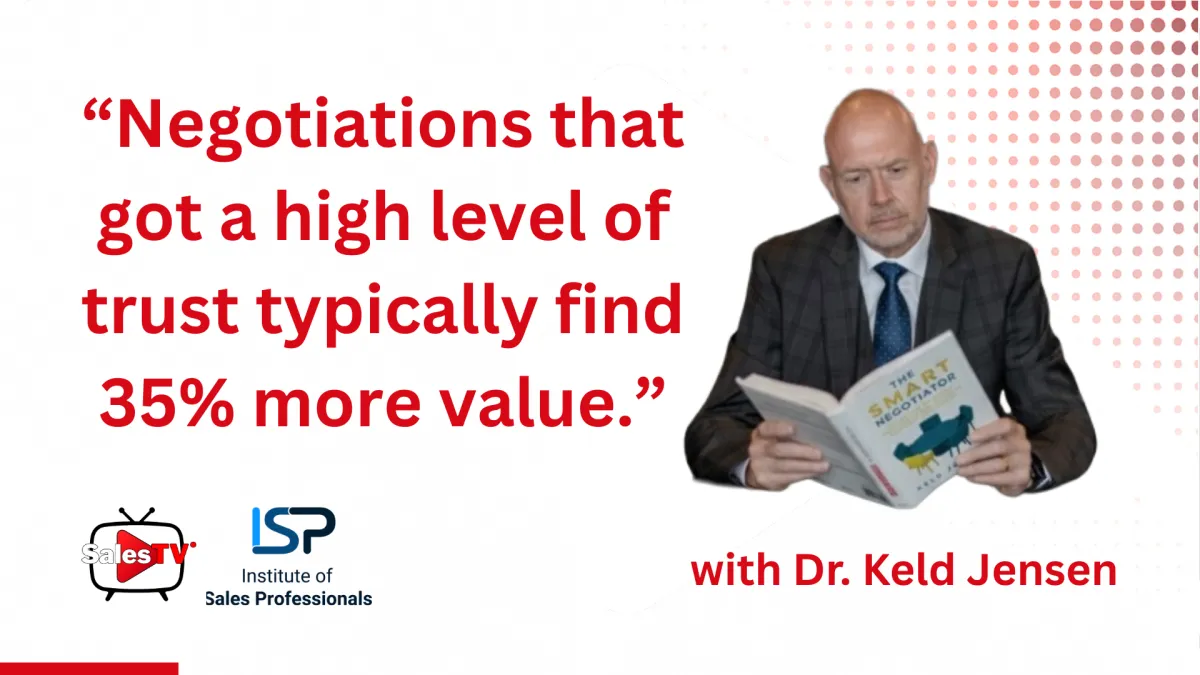
Absolutely. So I want to jump right into it. You recently told me negotiations that got a high level of Trust typically find 35% more value. Honestly, that sounds too good to be true. Can you tell us more? Can you explain what you mean by that?
Dr. Keld Jensen [00:01:10]:
Absolutely, I would love to. It's one of my favorite topics, Rob. Well, let's go back about eight years. Eight years ago, I woke up one morning and I got a weird stomach sensation. I felt that trust in the Western world had dropped. I felt you and I, Rob, we trust each other less than ever before. I felt that consumers and corporations had less trust in each other. I felt that companies doing business with companies had less trust in each other than ever before.
Dr. Keld Jensen [00:01:35]:
And I felt government and citizen had less trust in each other than before. Now, my stomach sensation was so strong, so I wanted to write a book about this topic. But, you know, you just can't write a book on a stomach sensation because that's very subjective. Right? You need some data to back it up. So I teamed up with an organization that went out and they interviewed 20,000 people in 15 different countries. And then they came back to me and said, you know what, Keld, your stomach sensation was absolutely right. Trust has dropped by - and listen carefully - by 55% in the last 20 years. Now, some of our listeners here right now, Rob, might be thinking, "Oh, that sounds like a lot, I need another cup of coffee."
Dr. Keld Jensen [00:02:12]:
But that's probably the worst news I can share with anybody - because, listen very carefully - if we have a low level of trust in any kind of negotiation, transaction cost goes up and profit declines. On the other hand, if we have a high level of trust in any business relationship, transaction cost actually goes down and profits increase. So I did my doctorate specifically studying trust and AI in negotiations. Those two things actually, funny enough, connected as well. But we can get back to that. And what I was trying to do in my research was to monetize trust, which is not easy. And, you know, sometimes when you start research, you're not sure that you're going to succeed.
Dr. Keld Jensen [00:02:49]:
But, but we did. We were able to measure trust. Back to what you said, that if you have negotiation with a high level trust, you're capitalizing more than 30% more value compared to negotiations with a low level of trust. So trust is not a nice thing to have, it's a need thing to have because it makes money. You create money by being trusted, right? And what is interesting, Rob, I often meet audience that are skeptical and say nah, that can't be the case. And when, when I meet people that are saying that, then I usually grab a glass, for instance, a bottle, and give them the following example. I'll make this very short. So I hold up this glass. Let's assume I have a glass right here. And I say so you're a procurement director now from a major corporations and your main responsibility is buying a million of these glasses every year.
Dr. Keld Jensen [00:03:39]:
Why? I don't know. But that's your assignment, right? And you've been working for six years with this supplier that you like and trust. And this supplier has always fulfilled what they promised. And so everything is good. But here comes the challenge. A new supplier arrived in the market who got the exact same class, same product, same content, same everything. But the challenge is that when you meet this new supplier, you don't really like him or her. There's something that tells you something is fishy.
Dr. Keld Jensen [00:04:04]:
I don't really like that individual. We don't have the same chemistry and things not really working out. But here's the challenge, Rob: The new supplier they don't like and don't trust is 1% cheaper than the old one. Who do you want to buy from? You know, 100% says the existing one because I like and trust this one. All right? And then I start to create this difference here. Then I say let's assume the price difference is 3%; still majority goes for the existing one. Okay, let's jump to 10%.
Dr. Keld Jensen [00:04:30]:
Here we go. The first one will now jump ship and say, "I'll try the the new one because now he's cheaper." And when I go up to 18, 20, 25% then most people will will actually change and try the new one. And then I stop my, my, my example and say, "Here we go, we just priced trust. didn't we. On a simple stupid product like a glass, we're willing to pay 10% more plus plus from a supplier we like and trust for the same product compared to a supplier we don't like and don't trust. And what is interesting in my study - now I'll stop talking Rob - but what is interesting my study is that this was a very simple stupid product, right? If we move into more high tech technology, complicated products, then that price difference that we accept on the same product just based on likability, trust is all the way up to 38%.
Dr. Keld Jensen [00:05:21]:
I think that's interesting.
Rob Durant [00:05:24]:
I think that's very interesting as well. I like to say, and I've heard others say it as well, "People like to buy from people they know like and trust." But that was really more of anecdotal. And just in our gut we know this. It's incredible that you went out and you proved that with data. So my next question then is when people talk about trust based negotiation in sales, what do they actually mean?
Dr. Keld Jensen [00:05:57]:
Well, this is also a cultural thing because you know, certain societies, cultural groups in the world base their business on trust first and then transaction afterwards. If we talk about North America, it's actually often the case that trust is coming as a result of the first transaction. North America and the US - and I'm generalizing, obviously, as we have to do with culture - but the US is a little bit different than majority of the world. So the majority of the world would actually appreciate having a relationship first - create trust and then do business. In the US there's a tendency - and I'm generalizing again - that we can create business with somebody we actually don't really know. And then trust may come as a result of that business. Whether that's good or bad, that's, that's not important.
Dr. Keld Jensen [00:06:45]:
It's just important to understand that slight difference there might be. So when you're working internationally - outside the US - trust is even more important than when you work within the U.S. Now, trust is still important right there, but it may come in a little bit different step and a different stage than you would see in the majority of the rest of the world. So there's a little bit of difference there have to understand. Now one of the things that I advise my students and clients to do, Rob, all the time, and I know this is really something that people think is weird, but I recommend that we put trust on the agenda. So even before we start negotiating, we have actually been verbalizing trust. So, you know, on the agenda you might have Introduction, Who's who, Have we got the mandate to negotiate, What is it we want to negotiate, What are the variables, blah blah, blah, so on and so forth. And then there's agenda item that is called Trust.
Dr. Keld Jensen [00:07:36]:
But now we have to talk about trust. And what I mean by that is actually, Rob, we have an open dialogue about what happens if trust declines. You are very welcome to tell me, Rob, if you feel that you are losing trust in me, and please tell me why. And hopefully I will be allowed to do the same to you, because then we are talking about the elephant in the room. There's no need to make it a taboo since we know that trust is this important financially. It's something that has to be on the agenda. It's something we have to talk about as well.
Dr. Keld Jensen [00:08:06]:
And the funny part is that when I mentioned that to a lot of people, I meet individuals and professional who actually look at me and say, "We, we can't do that. We can't talk about trust." And I said, "Why can't we talk about trust?" Since it's so important for success, I, I think we should, we should talk about it.
Rob Durant [00:08:22]:
Absolutely. So if ethical negotiation, if trust outperforms win lose tactics, why are people still using these outdated tactics?
Dr. Keld Jensen [00:08:38]:
Well, I don't want to be rude, because I meet a lot of very skilled professionals, great negotiators out there, but I also meet a lot, Rob, who is what I would call unconsciously incompetent. And that means it's not their fault because they don't know what they don't know. There is unfortunately a lot of professionals who have had little or no formal training in negotiation, which is, in my world, a bit scary. I mean, you would not send a legal professional out and deal with a contract without having necessary training. You wouldn't have a engineer going out and designing a bridge without having the formal training. But I actually experience every week that somebody is sitting negotiating for millions of dollars without having any formal training. And a lot of people are coming to me and saying, "Well, I have 23 years of experience negotiating." And they are right, they have been negotiating for 23 years.
Dr. Keld Jensen [00:09:35]:
But what they in reality have been doing is they had one year of experience, they just copied 23 times. And that's not 23 years of experience. That is just repeating the same mistake over and over again. So unfortunately, Rob, there's a lot of people who are basing their knowledge in negotiation just by watching more experienced older colleagues and then do what they're doing. And perhaps they're lucky that they are great negotiators, but perhaps they are unlucky that they're actually horrible negotiators. And then I would say something else. And that is, in the world of negotiation, we talk about positional negotiation or collaborative negotiation. And there's always a discussion about is one better than the other? And I don't think the discussion is important.
Dr. Keld Jensen [00:10:17]:
Whether positional or collaborative negotiation is if one is better than the other. It's really knowing when and how you should use each of them, because each of them could have a place and a time. But I often ask this question to my audience. That is, "Why do two companies negotiate?" There's only one reason, really, and that is they want to create and distribute value. That's the only reason two commercial organizations ever negotiated - to create and distribute value. And you can only really create and distribute value in a collaborative negotiation. In a positional negotiation, I win $100 at your expense, or you win $100 at my expense. Right? So if I want to be successful, you have to pay for it. And if you want to be successful, I have to pay for it.
Dr. Keld Jensen [00:11:02]:
And I'm sure we can all acknowledge that that is not happening easily. It's not like if I come to you and negotiate with you, Rob, and say, "I want $100," I'm pretty sure you're not going, "That seems fair. Here you go, Keld. Here's the hundred dollars." You know, it's not happening that way. So there will be a lot of argumentation and struggle and what have you. And there is certain negotiation trainers out there who embrace the philosophy of manipulation and being tactical and trying to outmaneuver the counterpart playing a game. And to me, negotiation is really not a game. It's a collaborative process.
Dr. Keld Jensen [00:11:33]:
It's basically brainstorming where you and I are sitting down to solve this riddle, to figure out how can we make two plus two equal more than four. That's really the exercise. It's more collaborative process, why we are trying to create that value and then negotiate about distributing that value. So I perceive negotiation slightly different than what you see a lot of professional advisors out there do.
Rob Durant [00:12:00]:
I've got to admit, something is nagging at me, and maybe it's that old school 23 years of one year of negotiating. How do we build trust without weakening our negotiating position?
Dr. Keld Jensen [00:12:19]:
Yeah, that's an excellent, excellent question. I have a colleague in the U.S., Jason Myrowitz, and he has one of my partners I've been working with for a long time now, and he has this wonderful saying. He's saying," I would rather lose in collaborative negotiation than winning in zero sum." And it's a wonderful quote if you're actually a little bit into the details and content of negotiation. Because if I am open and honest without becoming naive - we shouldn't become naive, right - but if I'm open and honest in a negotiation, I will help develop the value.
Dr. Keld Jensen [00:12:57]:
Look at it as a pie. The pie gets bigger. There's more of us to share. If I'm negotiating in a positional negotiation, we're negotiating about a fixed size of that pie. We're not expanding it, so we are not creating additional value. His sentence is actually, his quote is really brilliant because we should start trying to expand that value. And let me give you a very great example. I coined the term NegoEconomics, which is really just short for negotiation economics. It's an award winning mathematical model that claims that up to 42% of the value in a negotiation are being left on the table after the two parties have agreed, been shaking hands and signing the contract.
Dr. Keld Jensen [00:13:38]:
And where are these NegoEconomics coming from? Because it's obviously not magic. It's the asymmetric value between your cost and my value or my cost and your value. So let's say, let's take a simple example: Cost of transportation. I might be buying a product from you. And as a buyer, I might say, "Rob, you're in charge of all transportation." And we are not developing and understanding each other's cost. Because let's assume that your cost of transportation is $10,000, but my cost of transportation is only $6,000. But without exchanging that cost we have on each side of the table, I might just be requesting or demanding that you have to be in charge of transportation.
Dr. Keld Jensen [00:14:18]:
And that's kind of unintelligent because if your cost of doing it is higher than mine, then obviously I should do it. And you could compensate me for my cost, right? So NegoEconomics, it's about investigating that asymmetric value. And you know what's interesting, Rob? We have more than 380 variables in a typical commercial negotiation that could generate NegoEconomics. It could be in terms of payment, delivery time, warranty, transportation, education, service, you name it. The list goes on and on and on. And in order to identify that value, we have to be open, we have to be transparent, and we have to be honest. Now. We have to avoid being naive.
Dr. Keld Jensen [00:14:56]:
Let me give you a very quick example. I'm sorry about all the talking. I just get inspired, Rob. But the difference between being naive and open in a negotiation is the following. If I step into a negotiation and saying, "Rob, you know what, I have a huge financial benefit if we could change delivery time." That's openness but not naivety. If I step into a negotiation and say, "Rob, I'm going to capitalize a value of $15 million if we could change delivery time," that's naivety. Because now I'm giving away the value, right? The way we have to look at it in what we call SMARTnership.
Dr. Keld Jensen [00:15:28]:
That's our concept of collaborative negotiation, is that when I was a kid. Let me give you this illustration. I'm not doing it anymore. I think that's important to emphasize. But when I was a kid, young kid at the playground, I was playing this game with the girls: I'll show you mine if you show me yours. I'm not doing it anymore. Very important to emphasize.
Dr. Keld Jensen [00:15:45]:
But I'm saying this because that's basically what a professional negotiator should do. I'm willing to share my cost of benefit, Rob, if you would do the same. And in order to do that, we have to take a step back even before we start negotiating, because now we have to agree in role and engagement. We have to negotiate on how to negotiate. Otherwise one side may be confused about we're doing. And the reason I'm saying that is because, you know, there's never been an international standard for what negotiation is and isn't. So you may perceive negotiation like playing tennis. I may perceive negotiation like playing chess.
Dr. Keld Jensen [00:16:18]:
And you could imagine, Rob, it's going to be a fascinating game if you are sitting there with a racket, I'm sitting, moving the pieces around on the chessboard, right? And that is happening every day in commercial negotiations because we haven't agreed and discussed how we should negotiate. So one of the things to be successful in a collaborative negotiation, creating NegoEconomics and creating trust currency, as we call the value and trust, is actually to discuss how to negotiate before we start negotiating. And it's actually fairly simple. It's just we really have to reset our mindset on what negotiation is and isn't.
Dr. Keld Jensen [00:16:53]:
So often when we start a lecture or workshop, we often start warning people, saying, "This is not your classical workshop and just getting some techniques and tools. This is actually changing the way you view negotiation and helping you make the counterpart understand that we're going to negotiate in a very different way and we shouldn't just do it because we want to be nice to each other. We want to do it because we can increase the value to the counterpart and we can increase our own profit." I don't know if that was an answer to your question, Rob. It was a very long one, but.
Rob Durant [00:17:20]:
It was a great answer. I appreciate it.
Rob Durant [00:17:24]:
Let's pivot to the topic that's on everyone's mind these days: AI. How does AI influence transparency and trust in negotiations?
Dr. Keld Jensen [00:17:39]:
I think I'm going to surprise you and the audience right now, Rob, because I surprised myself. Because last year we did a huge study together with a nonprofit organization called World Commerce and Contracting, where we repeated the same negotiation, simulated negotiation, 340 something times around the world. And what happened was we had one team of two people negotiating with another team of two people. And they got this simulated negotiation. They had a certain amount of time to prepare and a certain amount of time to negotiate. Same for everybody. And then we compared three different negotiations. One negotiation was called the classical old school negotiation where none of the parties were using AI. Then we had one simulation where one side was using AI and the counterpart wasn't.
Dr. Keld Jensen [00:18:25]:
And then we had the third negotiation where both sides were using AI. And then we simply just compared the outcome of all these negotiations. And what was really interesting was, Rob, that there was a significant difference between negotiations where both parties were using AI compared to old school negotiations where nobody was using AI. So just to give you a highlight, in negotiation, first and foremost, where they were not using AI, neither of them, they ran out of time. They rarely managed to reach a deal within the time they were allowed to negotiate. In the negotiations where both sides were using AI, they always managed to reach a deal and reach an agreement before time ran out. That was one step. The other step we also saw, perhaps less surprising, was that preparation was way better in the negotiation with both sides were using AI compared to negotiations where nobody was using AI.
Dr. Keld Jensen [00:19:18]:
And here comes the most important part for me, almost, and that was that in negotiations where both parties were using AI, they almost captured all the value in the asymmetric world as we call NegoEconomics, where traditional old school negotiation only captured about half of it. And the most important part of all of them, I think, are the most interesting at least, was that - and I can't even explain that, Rob, so don't ask me - but we saw the trust, transparency and honesty went through the roof when both parties were using AI, where in a classical human versus human without the use of AI, trust was so-so, openness was so-so, transparency was so-so. So conclusion was AI actually help humans become more honest, more transparent and more collaborative. And that was a complete surprise to me because I would have expected, like most people, that most people claim that AI is creating a distance between us and we have less communication. And our study, which was published by the way, as a peer reviewed paper called Friend or Foe, you can download it for free online, actually proved quite opposite. AI was supporting collaborative negotiation and honesty.
Rob Durant [00:20:31]:
That is fantastic. You said that paper is what again? Friend or Foe?
Dr. Keld Jensen [00:20:36]:
It's called Friend or Foe. If you just search Friend and Foe by Keld Jensen It will pop up by the publisher, so you can download it for free. So all the data is out there.
Rob Durant [00:20:47]:
Fantastic. Keld, if you were to emphasize the one thing you would want our audience to take away from today's episode, what would that one thing be?
Dr. Keld Jensen [00:20:58]:
Great question. Rethink what negotiation is and isn't. Remember, negotiation is not what Hollywood often try and present it. It's not a fun game that looks interesting to sit and watch. You know, a lot of people come to me and say, "Well, I was watching Suits and my God, he's a great negotiator." And I say, "Well, yeah, it's very entertaining. I love Suits myself, but completely unrealistic." I mean, no real negotiation happens that way.
Dr. Keld Jensen [00:21:25]:
So, you know, commercial negotiation is not a hostage negotiation. It's not a situation that looks funny, sounds funny, is entertaining at a party at home. It's a process where we're trying to create value. And I hate to say this, I know that this is something that some people don't like, but commercial negotiation is really about mathematics. It's an economical process, as I said earlier, create and distribute value. So we have to get into the nitty gritty of numbers and data. And I love data, Rob, because they all tell the truth. It's not about opinions or feelings or being subjective.
Dr. Keld Jensen [00:22:02]:
It's about data that can prove which direction we should go. Back to my example about transportation. If your cost of transportation is higher than mine, well, that tells us immediately who should be responsible for that. So, again, sorry, long question to answer. My takeaway to everybody is rethink what negotiation is. We have to change the mindset, and not just because I'm saying it, but because it will. It will make you wealthier with. With a guarantee.
Rob Durant [00:22:28]:
Keld, this has been great. So many more things we could dig into. We'll have to have you back sometime as well. I want to say on behalf of everyone here at SalesTV, to you and to our audience, thank you for being a part of today's conversation. If you like what you heard today, please take a moment to leave a review on Apple Podcasts, Spotify, Substack, or YouTube. Let us know what you learned and what you'd like to learn more about. Your feedback helps us reach more people like you and fulfill our mission of elevating the profession of sales. Thank you all, and we'll see you next time.
@SalesTVlive
#SmartNegotiator #SalesNegotiation #NegotiationSkills #NegotiationSkills
#Sales #SalesLeadership #LinkedInLive #Podcast
________________________________________
About SalesTV: SalesTV is a weekly talk show created by salespeople, for salespeople. Each episode explores sales, sales training, sales enablement, and social selling, bringing together sales leaders, enablement professionals, and practitioners from across the globe.
About the Institute of Sales Professionals: The ISP is the only body worldwide dedicated to raising the standards of sales. Its Sales Capability Framework, certifications, and member community are designed to address their one goal: To Elevate the Profession of Sales.

Mid-Day Edition
Why Over Reliance on Sales Scripts and Automation Erodes Judgment - Copy
Trust is one of the most discussed yet least quantified elements in sales negotiation. Often treated simply as a soft skill, research increasingly shows that trust has direct economic consequences.
In this episode of SalesTV, we explore how trust fundamentally changes negotiation outcomes - not in theory, but in measurable results. Dr. Keld Jensen, one of the world’s most awarded negotiation strategists, shares evidence showing how high-trust negotiations consistently outperform low-trust ones.
Drawing on decades of research and real-world negotiation data, we examine why traditional win-lose approaches persist, what they cost sales professionals over time, and how emerging tools like AI are reshaping preparation and transparency, without sacrificing rigor, preparation, or commercial discipline. This conversation reframes trust as a practical lever for creating more value at the table, especially in professional sales contexts where long-term relationships and credibility matter.
We’ll ask questions like -
* How do we build trust without weakening our negotiating position?
* How early in the sales process is trust really formed?
* How should sales leaders coach trust-based negotiation skills?
* How does AI influence transparency and trust in negotiations?
Dr. Keld Jensen is a globally recognized negotiation expert, researcher, and author with more than 30 years of experience in international negotiation, leadership, and education. He holds a doctorate focused on negotiation, trust, and AI. Author of 27 books published worldwide, including his most recent release, “The Smart Negotiator: Unlocking the Power of AI and Human Insight in Effective Deal-Making,” he has advised organizations across more than 50 countries on trust-based value creation in complex negotiations.
Join us Tuesday at Noon ET/ 9am PT.
This week's Guest was -
Dr. Keld Jensen, one of the world’s most awarded negotiation strategists and author of The Smart Negotiator
This week's Host was -
Rob Durant, CEO of US Operations at The Institute of Sales Professionals
Transcript of SalesTV.live Mid-Day Edition 2026-01-20
Rob Durant [00:00:02]:
Hello and welcome to another edition of SalesTV. Today we're exploring the true value of trust in sales negotiations. We're joined by Dr. Keld Jensen. Keld is a globally recognized negotiation expert and researcher with more than 30 years experience in international negotiation, leadership and education. Author of 27 books, his most recent book is entitled "The Smart Negotiator: Unlocking the Power of AI and Human Insight in Effective Deal Making". Keld. Welcome.
Dr. Keld Jensen [00:00:45]:
Thank you for having me.
Rob Durant [00:00:49]:
Absolutely. So I want to jump right into it. You recently told me negotiations that got a high level of Trust typically find 35% more value. Honestly, that sounds too good to be true. Can you tell us more? Can you explain what you mean by that?
Dr. Keld Jensen [00:01:10]:
Absolutely, I would love to. It's one of my favorite topics, Rob. Well, let's go back about eight years. Eight years ago, I woke up one morning and I got a weird stomach sensation. I felt that trust in the Western world had dropped. I felt you and I, Rob, we trust each other less than ever before. I felt that consumers and corporations had less trust in each other. I felt that companies doing business with companies had less trust in each other than ever before.
Dr. Keld Jensen [00:01:35]:
And I felt government and citizen had less trust in each other than before. Now, my stomach sensation was so strong, so I wanted to write a book about this topic. But, you know, you just can't write a book on a stomach sensation because that's very subjective. Right? You need some data to back it up. So I teamed up with an organization that went out and they interviewed 20,000 people in 15 different countries. And then they came back to me and said, you know what, Keld, your stomach sensation was absolutely right. Trust has dropped by - and listen carefully - by 55% in the last 20 years. Now, some of our listeners here right now, Rob, might be thinking, "Oh, that sounds like a lot, I need another cup of coffee."
Dr. Keld Jensen [00:02:12]:
But that's probably the worst news I can share with anybody - because, listen very carefully - if we have a low level of trust in any kind of negotiation, transaction cost goes up and profit declines. On the other hand, if we have a high level of trust in any business relationship, transaction cost actually goes down and profits increase. So I did my doctorate specifically studying trust and AI in negotiations. Those two things actually, funny enough, connected as well. But we can get back to that. And what I was trying to do in my research was to monetize trust, which is not easy. And, you know, sometimes when you start research, you're not sure that you're going to succeed.
Dr. Keld Jensen [00:02:49]:
But, but we did. We were able to measure trust. Back to what you said, that if you have negotiation with a high level trust, you're capitalizing more than 30% more value compared to negotiations with a low level of trust. So trust is not a nice thing to have, it's a need thing to have because it makes money. You create money by being trusted, right? And what is interesting, Rob, I often meet audience that are skeptical and say nah, that can't be the case. And when, when I meet people that are saying that, then I usually grab a glass, for instance, a bottle, and give them the following example. I'll make this very short. So I hold up this glass. Let's assume I have a glass right here. And I say so you're a procurement director now from a major corporations and your main responsibility is buying a million of these glasses every year.
Dr. Keld Jensen [00:03:39]:
Why? I don't know. But that's your assignment, right? And you've been working for six years with this supplier that you like and trust. And this supplier has always fulfilled what they promised. And so everything is good. But here comes the challenge. A new supplier arrived in the market who got the exact same class, same product, same content, same everything. But the challenge is that when you meet this new supplier, you don't really like him or her. There's something that tells you something is fishy.
Dr. Keld Jensen [00:04:04]:
I don't really like that individual. We don't have the same chemistry and things not really working out. But here's the challenge, Rob: The new supplier they don't like and don't trust is 1% cheaper than the old one. Who do you want to buy from? You know, 100% says the existing one because I like and trust this one. All right? And then I start to create this difference here. Then I say let's assume the price difference is 3%; still majority goes for the existing one. Okay, let's jump to 10%.
Dr. Keld Jensen [00:04:30]:
Here we go. The first one will now jump ship and say, "I'll try the the new one because now he's cheaper." And when I go up to 18, 20, 25% then most people will will actually change and try the new one. And then I stop my, my, my example and say, "Here we go, we just priced trust. didn't we. On a simple stupid product like a glass, we're willing to pay 10% more plus plus from a supplier we like and trust for the same product compared to a supplier we don't like and don't trust. And what is interesting in my study - now I'll stop talking Rob - but what is interesting my study is that this was a very simple stupid product, right? If we move into more high tech technology, complicated products, then that price difference that we accept on the same product just based on likability, trust is all the way up to 38%.
Dr. Keld Jensen [00:05:21]:
I think that's interesting.
Rob Durant [00:05:24]:
I think that's very interesting as well. I like to say, and I've heard others say it as well, "People like to buy from people they know like and trust." But that was really more of anecdotal. And just in our gut we know this. It's incredible that you went out and you proved that with data. So my next question then is when people talk about trust based negotiation in sales, what do they actually mean?
Dr. Keld Jensen [00:05:57]:
Well, this is also a cultural thing because you know, certain societies, cultural groups in the world base their business on trust first and then transaction afterwards. If we talk about North America, it's actually often the case that trust is coming as a result of the first transaction. North America and the US - and I'm generalizing, obviously, as we have to do with culture - but the US is a little bit different than majority of the world. So the majority of the world would actually appreciate having a relationship first - create trust and then do business. In the US there's a tendency - and I'm generalizing again - that we can create business with somebody we actually don't really know. And then trust may come as a result of that business. Whether that's good or bad, that's, that's not important.
Dr. Keld Jensen [00:06:45]:
It's just important to understand that slight difference there might be. So when you're working internationally - outside the US - trust is even more important than when you work within the U.S. Now, trust is still important right there, but it may come in a little bit different step and a different stage than you would see in the majority of the rest of the world. So there's a little bit of difference there have to understand. Now one of the things that I advise my students and clients to do, Rob, all the time, and I know this is really something that people think is weird, but I recommend that we put trust on the agenda. So even before we start negotiating, we have actually been verbalizing trust. So, you know, on the agenda you might have Introduction, Who's who, Have we got the mandate to negotiate, What is it we want to negotiate, What are the variables, blah blah, blah, so on and so forth. And then there's agenda item that is called Trust.
Dr. Keld Jensen [00:07:36]:
But now we have to talk about trust. And what I mean by that is actually, Rob, we have an open dialogue about what happens if trust declines. You are very welcome to tell me, Rob, if you feel that you are losing trust in me, and please tell me why. And hopefully I will be allowed to do the same to you, because then we are talking about the elephant in the room. There's no need to make it a taboo since we know that trust is this important financially. It's something that has to be on the agenda. It's something we have to talk about as well.
Dr. Keld Jensen [00:08:06]:
And the funny part is that when I mentioned that to a lot of people, I meet individuals and professional who actually look at me and say, "We, we can't do that. We can't talk about trust." And I said, "Why can't we talk about trust?" Since it's so important for success, I, I think we should, we should talk about it.
Rob Durant [00:08:22]:
Absolutely. So if ethical negotiation, if trust outperforms win lose tactics, why are people still using these outdated tactics?
Dr. Keld Jensen [00:08:38]:
Well, I don't want to be rude, because I meet a lot of very skilled professionals, great negotiators out there, but I also meet a lot, Rob, who is what I would call unconsciously incompetent. And that means it's not their fault because they don't know what they don't know. There is unfortunately a lot of professionals who have had little or no formal training in negotiation, which is, in my world, a bit scary. I mean, you would not send a legal professional out and deal with a contract without having necessary training. You wouldn't have a engineer going out and designing a bridge without having the formal training. But I actually experience every week that somebody is sitting negotiating for millions of dollars without having any formal training. And a lot of people are coming to me and saying, "Well, I have 23 years of experience negotiating." And they are right, they have been negotiating for 23 years.
Dr. Keld Jensen [00:09:35]:
But what they in reality have been doing is they had one year of experience, they just copied 23 times. And that's not 23 years of experience. That is just repeating the same mistake over and over again. So unfortunately, Rob, there's a lot of people who are basing their knowledge in negotiation just by watching more experienced older colleagues and then do what they're doing. And perhaps they're lucky that they are great negotiators, but perhaps they are unlucky that they're actually horrible negotiators. And then I would say something else. And that is, in the world of negotiation, we talk about positional negotiation or collaborative negotiation. And there's always a discussion about is one better than the other? And I don't think the discussion is important.
Dr. Keld Jensen [00:10:17]:
Whether positional or collaborative negotiation is if one is better than the other. It's really knowing when and how you should use each of them, because each of them could have a place and a time. But I often ask this question to my audience. That is, "Why do two companies negotiate?" There's only one reason, really, and that is they want to create and distribute value. That's the only reason two commercial organizations ever negotiated - to create and distribute value. And you can only really create and distribute value in a collaborative negotiation. In a positional negotiation, I win $100 at your expense, or you win $100 at my expense. Right? So if I want to be successful, you have to pay for it. And if you want to be successful, I have to pay for it.
Dr. Keld Jensen [00:11:02]:
And I'm sure we can all acknowledge that that is not happening easily. It's not like if I come to you and negotiate with you, Rob, and say, "I want $100," I'm pretty sure you're not going, "That seems fair. Here you go, Keld. Here's the hundred dollars." You know, it's not happening that way. So there will be a lot of argumentation and struggle and what have you. And there is certain negotiation trainers out there who embrace the philosophy of manipulation and being tactical and trying to outmaneuver the counterpart playing a game. And to me, negotiation is really not a game. It's a collaborative process.
Dr. Keld Jensen [00:11:33]:
It's basically brainstorming where you and I are sitting down to solve this riddle, to figure out how can we make two plus two equal more than four. That's really the exercise. It's more collaborative process, why we are trying to create that value and then negotiate about distributing that value. So I perceive negotiation slightly different than what you see a lot of professional advisors out there do.
Rob Durant [00:12:00]:
I've got to admit, something is nagging at me, and maybe it's that old school 23 years of one year of negotiating. How do we build trust without weakening our negotiating position?
Dr. Keld Jensen [00:12:19]:
Yeah, that's an excellent, excellent question. I have a colleague in the U.S., Jason Myrowitz, and he has one of my partners I've been working with for a long time now, and he has this wonderful saying. He's saying," I would rather lose in collaborative negotiation than winning in zero sum." And it's a wonderful quote if you're actually a little bit into the details and content of negotiation. Because if I am open and honest without becoming naive - we shouldn't become naive, right - but if I'm open and honest in a negotiation, I will help develop the value.
Dr. Keld Jensen [00:12:57]:
Look at it as a pie. The pie gets bigger. There's more of us to share. If I'm negotiating in a positional negotiation, we're negotiating about a fixed size of that pie. We're not expanding it, so we are not creating additional value. His sentence is actually, his quote is really brilliant because we should start trying to expand that value. And let me give you a very great example. I coined the term NegoEconomics, which is really just short for negotiation economics. It's an award winning mathematical model that claims that up to 42% of the value in a negotiation are being left on the table after the two parties have agreed, been shaking hands and signing the contract.
Dr. Keld Jensen [00:13:38]:
And where are these NegoEconomics coming from? Because it's obviously not magic. It's the asymmetric value between your cost and my value or my cost and your value. So let's say, let's take a simple example: Cost of transportation. I might be buying a product from you. And as a buyer, I might say, "Rob, you're in charge of all transportation." And we are not developing and understanding each other's cost. Because let's assume that your cost of transportation is $10,000, but my cost of transportation is only $6,000. But without exchanging that cost we have on each side of the table, I might just be requesting or demanding that you have to be in charge of transportation.
Dr. Keld Jensen [00:14:18]:
And that's kind of unintelligent because if your cost of doing it is higher than mine, then obviously I should do it. And you could compensate me for my cost, right? So NegoEconomics, it's about investigating that asymmetric value. And you know what's interesting, Rob? We have more than 380 variables in a typical commercial negotiation that could generate NegoEconomics. It could be in terms of payment, delivery time, warranty, transportation, education, service, you name it. The list goes on and on and on. And in order to identify that value, we have to be open, we have to be transparent, and we have to be honest. Now. We have to avoid being naive.
Dr. Keld Jensen [00:14:56]:
Let me give you a very quick example. I'm sorry about all the talking. I just get inspired, Rob. But the difference between being naive and open in a negotiation is the following. If I step into a negotiation and saying, "Rob, you know what, I have a huge financial benefit if we could change delivery time." That's openness but not naivety. If I step into a negotiation and say, "Rob, I'm going to capitalize a value of $15 million if we could change delivery time," that's naivety. Because now I'm giving away the value, right? The way we have to look at it in what we call SMARTnership.
Dr. Keld Jensen [00:15:28]:
That's our concept of collaborative negotiation, is that when I was a kid. Let me give you this illustration. I'm not doing it anymore. I think that's important to emphasize. But when I was a kid, young kid at the playground, I was playing this game with the girls: I'll show you mine if you show me yours. I'm not doing it anymore. Very important to emphasize.
Dr. Keld Jensen [00:15:45]:
But I'm saying this because that's basically what a professional negotiator should do. I'm willing to share my cost of benefit, Rob, if you would do the same. And in order to do that, we have to take a step back even before we start negotiating, because now we have to agree in role and engagement. We have to negotiate on how to negotiate. Otherwise one side may be confused about we're doing. And the reason I'm saying that is because, you know, there's never been an international standard for what negotiation is and isn't. So you may perceive negotiation like playing tennis. I may perceive negotiation like playing chess.
Dr. Keld Jensen [00:16:18]:
And you could imagine, Rob, it's going to be a fascinating game if you are sitting there with a racket, I'm sitting, moving the pieces around on the chessboard, right? And that is happening every day in commercial negotiations because we haven't agreed and discussed how we should negotiate. So one of the things to be successful in a collaborative negotiation, creating NegoEconomics and creating trust currency, as we call the value and trust, is actually to discuss how to negotiate before we start negotiating. And it's actually fairly simple. It's just we really have to reset our mindset on what negotiation is and isn't.
Dr. Keld Jensen [00:16:53]:
So often when we start a lecture or workshop, we often start warning people, saying, "This is not your classical workshop and just getting some techniques and tools. This is actually changing the way you view negotiation and helping you make the counterpart understand that we're going to negotiate in a very different way and we shouldn't just do it because we want to be nice to each other. We want to do it because we can increase the value to the counterpart and we can increase our own profit." I don't know if that was an answer to your question, Rob. It was a very long one, but.
Rob Durant [00:17:20]:
It was a great answer. I appreciate it.
Rob Durant [00:17:24]:
Let's pivot to the topic that's on everyone's mind these days: AI. How does AI influence transparency and trust in negotiations?
Dr. Keld Jensen [00:17:39]:
I think I'm going to surprise you and the audience right now, Rob, because I surprised myself. Because last year we did a huge study together with a nonprofit organization called World Commerce and Contracting, where we repeated the same negotiation, simulated negotiation, 340 something times around the world. And what happened was we had one team of two people negotiating with another team of two people. And they got this simulated negotiation. They had a certain amount of time to prepare and a certain amount of time to negotiate. Same for everybody. And then we compared three different negotiations. One negotiation was called the classical old school negotiation where none of the parties were using AI. Then we had one simulation where one side was using AI and the counterpart wasn't.
Dr. Keld Jensen [00:18:25]:
And then we had the third negotiation where both sides were using AI. And then we simply just compared the outcome of all these negotiations. And what was really interesting was, Rob, that there was a significant difference between negotiations where both parties were using AI compared to old school negotiations where nobody was using AI. So just to give you a highlight, in negotiation, first and foremost, where they were not using AI, neither of them, they ran out of time. They rarely managed to reach a deal within the time they were allowed to negotiate. In the negotiations where both sides were using AI, they always managed to reach a deal and reach an agreement before time ran out. That was one step. The other step we also saw, perhaps less surprising, was that preparation was way better in the negotiation with both sides were using AI compared to negotiations where nobody was using AI.
Dr. Keld Jensen [00:19:18]:
And here comes the most important part for me, almost, and that was that in negotiations where both parties were using AI, they almost captured all the value in the asymmetric world as we call NegoEconomics, where traditional old school negotiation only captured about half of it. And the most important part of all of them, I think, are the most interesting at least, was that - and I can't even explain that, Rob, so don't ask me - but we saw the trust, transparency and honesty went through the roof when both parties were using AI, where in a classical human versus human without the use of AI, trust was so-so, openness was so-so, transparency was so-so. So conclusion was AI actually help humans become more honest, more transparent and more collaborative. And that was a complete surprise to me because I would have expected, like most people, that most people claim that AI is creating a distance between us and we have less communication. And our study, which was published by the way, as a peer reviewed paper called Friend or Foe, you can download it for free online, actually proved quite opposite. AI was supporting collaborative negotiation and honesty.
Rob Durant [00:20:31]:
That is fantastic. You said that paper is what again? Friend or Foe?
Dr. Keld Jensen [00:20:36]:
It's called Friend or Foe. If you just search Friend and Foe by Keld Jensen It will pop up by the publisher, so you can download it for free. So all the data is out there.
Rob Durant [00:20:47]:
Fantastic. Keld, if you were to emphasize the one thing you would want our audience to take away from today's episode, what would that one thing be?
Dr. Keld Jensen [00:20:58]:
Great question. Rethink what negotiation is and isn't. Remember, negotiation is not what Hollywood often try and present it. It's not a fun game that looks interesting to sit and watch. You know, a lot of people come to me and say, "Well, I was watching Suits and my God, he's a great negotiator." And I say, "Well, yeah, it's very entertaining. I love Suits myself, but completely unrealistic." I mean, no real negotiation happens that way.
Dr. Keld Jensen [00:21:25]:
So, you know, commercial negotiation is not a hostage negotiation. It's not a situation that looks funny, sounds funny, is entertaining at a party at home. It's a process where we're trying to create value. And I hate to say this, I know that this is something that some people don't like, but commercial negotiation is really about mathematics. It's an economical process, as I said earlier, create and distribute value. So we have to get into the nitty gritty of numbers and data. And I love data, Rob, because they all tell the truth. It's not about opinions or feelings or being subjective.
Dr. Keld Jensen [00:22:02]:
It's about data that can prove which direction we should go. Back to my example about transportation. If your cost of transportation is higher than mine, well, that tells us immediately who should be responsible for that. So, again, sorry, long question to answer. My takeaway to everybody is rethink what negotiation is. We have to change the mindset, and not just because I'm saying it, but because it will. It will make you wealthier with. With a guarantee.
Rob Durant [00:22:28]:
Keld, this has been great. So many more things we could dig into. We'll have to have you back sometime as well. I want to say on behalf of everyone here at SalesTV, to you and to our audience, thank you for being a part of today's conversation. If you like what you heard today, please take a moment to leave a review on Apple Podcasts, Spotify, Substack, or YouTube. Let us know what you learned and what you'd like to learn more about. Your feedback helps us reach more people like you and fulfill our mission of elevating the profession of sales. Thank you all, and we'll see you next time.
@SalesTVlive
#SmartNegotiator #SalesNegotiation #NegotiationSkills #NegotiationSkills
#Sales #SalesLeadership #LinkedInLive #Podcast
________________________________________
About SalesTV: SalesTV is a weekly talk show created by salespeople, for salespeople. Each episode explores sales, sales training, sales enablement, and social selling, bringing together sales leaders, enablement professionals, and practitioners from across the globe.
About the Institute of Sales Professionals: The ISP is the only body worldwide dedicated to raising the standards of sales. Its Sales Capability Framework, certifications, and member community are designed to address their one goal: To Elevate the Profession of Sales.
Other Editions
Why Over Reliance on Sales Scripts and Automation Erodes Judgment - Copy
Trust is one of the most discussed yet least quantified elements in sales negotiation. Often treated simply as a soft skill, research increasingly shows that trust has direct economic consequences.
In this episode of SalesTV, we explore how trust fundamentally changes negotiation outcomes - not in theory, but in measurable results. Dr. Keld Jensen, one of the world’s most awarded negotiation strategists, shares evidence showing how high-trust negotiations consistently outperform low-trust ones.
Drawing on decades of research and real-world negotiation data, we examine why traditional win-lose approaches persist, what they cost sales professionals over time, and how emerging tools like AI are reshaping preparation and transparency, without sacrificing rigor, preparation, or commercial discipline. This conversation reframes trust as a practical lever for creating more value at the table, especially in professional sales contexts where long-term relationships and credibility matter.
We’ll ask questions like -
* How do we build trust without weakening our negotiating position?
* How early in the sales process is trust really formed?
* How should sales leaders coach trust-based negotiation skills?
* How does AI influence transparency and trust in negotiations?
Dr. Keld Jensen is a globally recognized negotiation expert, researcher, and author with more than 30 years of experience in international negotiation, leadership, and education. He holds a doctorate focused on negotiation, trust, and AI. Author of 27 books published worldwide, including his most recent release, “The Smart Negotiator: Unlocking the Power of AI and Human Insight in Effective Deal-Making,” he has advised organizations across more than 50 countries on trust-based value creation in complex negotiations.
Join us Tuesday at Noon ET/ 9am PT.
This week's Guest was -
Dr. Keld Jensen, one of the world’s most awarded negotiation strategists and author of The Smart Negotiator
This week's Host was -
Rob Durant, CEO of US Operations at The Institute of Sales Professionals
Transcript of SalesTV.live Mid-Day Edition 2026-01-20
Rob Durant [00:00:02]:
Hello and welcome to another edition of SalesTV. Today we're exploring the true value of trust in sales negotiations. We're joined by Dr. Keld Jensen. Keld is a globally recognized negotiation expert and researcher with more than 30 years experience in international negotiation, leadership and education. Author of 27 books, his most recent book is entitled "The Smart Negotiator: Unlocking the Power of AI and Human Insight in Effective Deal Making". Keld. Welcome.
Dr. Keld Jensen [00:00:45]:
Thank you for having me.
Rob Durant [00:00:49]:
Absolutely. So I want to jump right into it. You recently told me negotiations that got a high level of Trust typically find 35% more value. Honestly, that sounds too good to be true. Can you tell us more? Can you explain what you mean by that?
Dr. Keld Jensen [00:01:10]:
Absolutely, I would love to. It's one of my favorite topics, Rob. Well, let's go back about eight years. Eight years ago, I woke up one morning and I got a weird stomach sensation. I felt that trust in the Western world had dropped. I felt you and I, Rob, we trust each other less than ever before. I felt that consumers and corporations had less trust in each other. I felt that companies doing business with companies had less trust in each other than ever before.
Dr. Keld Jensen [00:01:35]:
And I felt government and citizen had less trust in each other than before. Now, my stomach sensation was so strong, so I wanted to write a book about this topic. But, you know, you just can't write a book on a stomach sensation because that's very subjective. Right? You need some data to back it up. So I teamed up with an organization that went out and they interviewed 20,000 people in 15 different countries. And then they came back to me and said, you know what, Keld, your stomach sensation was absolutely right. Trust has dropped by - and listen carefully - by 55% in the last 20 years. Now, some of our listeners here right now, Rob, might be thinking, "Oh, that sounds like a lot, I need another cup of coffee."
Dr. Keld Jensen [00:02:12]:
But that's probably the worst news I can share with anybody - because, listen very carefully - if we have a low level of trust in any kind of negotiation, transaction cost goes up and profit declines. On the other hand, if we have a high level of trust in any business relationship, transaction cost actually goes down and profits increase. So I did my doctorate specifically studying trust and AI in negotiations. Those two things actually, funny enough, connected as well. But we can get back to that. And what I was trying to do in my research was to monetize trust, which is not easy. And, you know, sometimes when you start research, you're not sure that you're going to succeed.
Dr. Keld Jensen [00:02:49]:
But, but we did. We were able to measure trust. Back to what you said, that if you have negotiation with a high level trust, you're capitalizing more than 30% more value compared to negotiations with a low level of trust. So trust is not a nice thing to have, it's a need thing to have because it makes money. You create money by being trusted, right? And what is interesting, Rob, I often meet audience that are skeptical and say nah, that can't be the case. And when, when I meet people that are saying that, then I usually grab a glass, for instance, a bottle, and give them the following example. I'll make this very short. So I hold up this glass. Let's assume I have a glass right here. And I say so you're a procurement director now from a major corporations and your main responsibility is buying a million of these glasses every year.
Dr. Keld Jensen [00:03:39]:
Why? I don't know. But that's your assignment, right? And you've been working for six years with this supplier that you like and trust. And this supplier has always fulfilled what they promised. And so everything is good. But here comes the challenge. A new supplier arrived in the market who got the exact same class, same product, same content, same everything. But the challenge is that when you meet this new supplier, you don't really like him or her. There's something that tells you something is fishy.
Dr. Keld Jensen [00:04:04]:
I don't really like that individual. We don't have the same chemistry and things not really working out. But here's the challenge, Rob: The new supplier they don't like and don't trust is 1% cheaper than the old one. Who do you want to buy from? You know, 100% says the existing one because I like and trust this one. All right? And then I start to create this difference here. Then I say let's assume the price difference is 3%; still majority goes for the existing one. Okay, let's jump to 10%.
Dr. Keld Jensen [00:04:30]:
Here we go. The first one will now jump ship and say, "I'll try the the new one because now he's cheaper." And when I go up to 18, 20, 25% then most people will will actually change and try the new one. And then I stop my, my, my example and say, "Here we go, we just priced trust. didn't we. On a simple stupid product like a glass, we're willing to pay 10% more plus plus from a supplier we like and trust for the same product compared to a supplier we don't like and don't trust. And what is interesting in my study - now I'll stop talking Rob - but what is interesting my study is that this was a very simple stupid product, right? If we move into more high tech technology, complicated products, then that price difference that we accept on the same product just based on likability, trust is all the way up to 38%.
Dr. Keld Jensen [00:05:21]:
I think that's interesting.
Rob Durant [00:05:24]:
I think that's very interesting as well. I like to say, and I've heard others say it as well, "People like to buy from people they know like and trust." But that was really more of anecdotal. And just in our gut we know this. It's incredible that you went out and you proved that with data. So my next question then is when people talk about trust based negotiation in sales, what do they actually mean?
Dr. Keld Jensen [00:05:57]:
Well, this is also a cultural thing because you know, certain societies, cultural groups in the world base their business on trust first and then transaction afterwards. If we talk about North America, it's actually often the case that trust is coming as a result of the first transaction. North America and the US - and I'm generalizing, obviously, as we have to do with culture - but the US is a little bit different than majority of the world. So the majority of the world would actually appreciate having a relationship first - create trust and then do business. In the US there's a tendency - and I'm generalizing again - that we can create business with somebody we actually don't really know. And then trust may come as a result of that business. Whether that's good or bad, that's, that's not important.
Dr. Keld Jensen [00:06:45]:
It's just important to understand that slight difference there might be. So when you're working internationally - outside the US - trust is even more important than when you work within the U.S. Now, trust is still important right there, but it may come in a little bit different step and a different stage than you would see in the majority of the rest of the world. So there's a little bit of difference there have to understand. Now one of the things that I advise my students and clients to do, Rob, all the time, and I know this is really something that people think is weird, but I recommend that we put trust on the agenda. So even before we start negotiating, we have actually been verbalizing trust. So, you know, on the agenda you might have Introduction, Who's who, Have we got the mandate to negotiate, What is it we want to negotiate, What are the variables, blah blah, blah, so on and so forth. And then there's agenda item that is called Trust.
Dr. Keld Jensen [00:07:36]:
But now we have to talk about trust. And what I mean by that is actually, Rob, we have an open dialogue about what happens if trust declines. You are very welcome to tell me, Rob, if you feel that you are losing trust in me, and please tell me why. And hopefully I will be allowed to do the same to you, because then we are talking about the elephant in the room. There's no need to make it a taboo since we know that trust is this important financially. It's something that has to be on the agenda. It's something we have to talk about as well.
Dr. Keld Jensen [00:08:06]:
And the funny part is that when I mentioned that to a lot of people, I meet individuals and professional who actually look at me and say, "We, we can't do that. We can't talk about trust." And I said, "Why can't we talk about trust?" Since it's so important for success, I, I think we should, we should talk about it.
Rob Durant [00:08:22]:
Absolutely. So if ethical negotiation, if trust outperforms win lose tactics, why are people still using these outdated tactics?
Dr. Keld Jensen [00:08:38]:
Well, I don't want to be rude, because I meet a lot of very skilled professionals, great negotiators out there, but I also meet a lot, Rob, who is what I would call unconsciously incompetent. And that means it's not their fault because they don't know what they don't know. There is unfortunately a lot of professionals who have had little or no formal training in negotiation, which is, in my world, a bit scary. I mean, you would not send a legal professional out and deal with a contract without having necessary training. You wouldn't have a engineer going out and designing a bridge without having the formal training. But I actually experience every week that somebody is sitting negotiating for millions of dollars without having any formal training. And a lot of people are coming to me and saying, "Well, I have 23 years of experience negotiating." And they are right, they have been negotiating for 23 years.
Dr. Keld Jensen [00:09:35]:
But what they in reality have been doing is they had one year of experience, they just copied 23 times. And that's not 23 years of experience. That is just repeating the same mistake over and over again. So unfortunately, Rob, there's a lot of people who are basing their knowledge in negotiation just by watching more experienced older colleagues and then do what they're doing. And perhaps they're lucky that they are great negotiators, but perhaps they are unlucky that they're actually horrible negotiators. And then I would say something else. And that is, in the world of negotiation, we talk about positional negotiation or collaborative negotiation. And there's always a discussion about is one better than the other? And I don't think the discussion is important.
Dr. Keld Jensen [00:10:17]:
Whether positional or collaborative negotiation is if one is better than the other. It's really knowing when and how you should use each of them, because each of them could have a place and a time. But I often ask this question to my audience. That is, "Why do two companies negotiate?" There's only one reason, really, and that is they want to create and distribute value. That's the only reason two commercial organizations ever negotiated - to create and distribute value. And you can only really create and distribute value in a collaborative negotiation. In a positional negotiation, I win $100 at your expense, or you win $100 at my expense. Right? So if I want to be successful, you have to pay for it. And if you want to be successful, I have to pay for it.
Dr. Keld Jensen [00:11:02]:
And I'm sure we can all acknowledge that that is not happening easily. It's not like if I come to you and negotiate with you, Rob, and say, "I want $100," I'm pretty sure you're not going, "That seems fair. Here you go, Keld. Here's the hundred dollars." You know, it's not happening that way. So there will be a lot of argumentation and struggle and what have you. And there is certain negotiation trainers out there who embrace the philosophy of manipulation and being tactical and trying to outmaneuver the counterpart playing a game. And to me, negotiation is really not a game. It's a collaborative process.
Dr. Keld Jensen [00:11:33]:
It's basically brainstorming where you and I are sitting down to solve this riddle, to figure out how can we make two plus two equal more than four. That's really the exercise. It's more collaborative process, why we are trying to create that value and then negotiate about distributing that value. So I perceive negotiation slightly different than what you see a lot of professional advisors out there do.
Rob Durant [00:12:00]:
I've got to admit, something is nagging at me, and maybe it's that old school 23 years of one year of negotiating. How do we build trust without weakening our negotiating position?
Dr. Keld Jensen [00:12:19]:
Yeah, that's an excellent, excellent question. I have a colleague in the U.S., Jason Myrowitz, and he has one of my partners I've been working with for a long time now, and he has this wonderful saying. He's saying," I would rather lose in collaborative negotiation than winning in zero sum." And it's a wonderful quote if you're actually a little bit into the details and content of negotiation. Because if I am open and honest without becoming naive - we shouldn't become naive, right - but if I'm open and honest in a negotiation, I will help develop the value.
Dr. Keld Jensen [00:12:57]:
Look at it as a pie. The pie gets bigger. There's more of us to share. If I'm negotiating in a positional negotiation, we're negotiating about a fixed size of that pie. We're not expanding it, so we are not creating additional value. His sentence is actually, his quote is really brilliant because we should start trying to expand that value. And let me give you a very great example. I coined the term NegoEconomics, which is really just short for negotiation economics. It's an award winning mathematical model that claims that up to 42% of the value in a negotiation are being left on the table after the two parties have agreed, been shaking hands and signing the contract.
Dr. Keld Jensen [00:13:38]:
And where are these NegoEconomics coming from? Because it's obviously not magic. It's the asymmetric value between your cost and my value or my cost and your value. So let's say, let's take a simple example: Cost of transportation. I might be buying a product from you. And as a buyer, I might say, "Rob, you're in charge of all transportation." And we are not developing and understanding each other's cost. Because let's assume that your cost of transportation is $10,000, but my cost of transportation is only $6,000. But without exchanging that cost we have on each side of the table, I might just be requesting or demanding that you have to be in charge of transportation.
Dr. Keld Jensen [00:14:18]:
And that's kind of unintelligent because if your cost of doing it is higher than mine, then obviously I should do it. And you could compensate me for my cost, right? So NegoEconomics, it's about investigating that asymmetric value. And you know what's interesting, Rob? We have more than 380 variables in a typical commercial negotiation that could generate NegoEconomics. It could be in terms of payment, delivery time, warranty, transportation, education, service, you name it. The list goes on and on and on. And in order to identify that value, we have to be open, we have to be transparent, and we have to be honest. Now. We have to avoid being naive.
Dr. Keld Jensen [00:14:56]:
Let me give you a very quick example. I'm sorry about all the talking. I just get inspired, Rob. But the difference between being naive and open in a negotiation is the following. If I step into a negotiation and saying, "Rob, you know what, I have a huge financial benefit if we could change delivery time." That's openness but not naivety. If I step into a negotiation and say, "Rob, I'm going to capitalize a value of $15 million if we could change delivery time," that's naivety. Because now I'm giving away the value, right? The way we have to look at it in what we call SMARTnership.
Dr. Keld Jensen [00:15:28]:
That's our concept of collaborative negotiation, is that when I was a kid. Let me give you this illustration. I'm not doing it anymore. I think that's important to emphasize. But when I was a kid, young kid at the playground, I was playing this game with the girls: I'll show you mine if you show me yours. I'm not doing it anymore. Very important to emphasize.
Dr. Keld Jensen [00:15:45]:
But I'm saying this because that's basically what a professional negotiator should do. I'm willing to share my cost of benefit, Rob, if you would do the same. And in order to do that, we have to take a step back even before we start negotiating, because now we have to agree in role and engagement. We have to negotiate on how to negotiate. Otherwise one side may be confused about we're doing. And the reason I'm saying that is because, you know, there's never been an international standard for what negotiation is and isn't. So you may perceive negotiation like playing tennis. I may perceive negotiation like playing chess.
Dr. Keld Jensen [00:16:18]:
And you could imagine, Rob, it's going to be a fascinating game if you are sitting there with a racket, I'm sitting, moving the pieces around on the chessboard, right? And that is happening every day in commercial negotiations because we haven't agreed and discussed how we should negotiate. So one of the things to be successful in a collaborative negotiation, creating NegoEconomics and creating trust currency, as we call the value and trust, is actually to discuss how to negotiate before we start negotiating. And it's actually fairly simple. It's just we really have to reset our mindset on what negotiation is and isn't.
Dr. Keld Jensen [00:16:53]:
So often when we start a lecture or workshop, we often start warning people, saying, "This is not your classical workshop and just getting some techniques and tools. This is actually changing the way you view negotiation and helping you make the counterpart understand that we're going to negotiate in a very different way and we shouldn't just do it because we want to be nice to each other. We want to do it because we can increase the value to the counterpart and we can increase our own profit." I don't know if that was an answer to your question, Rob. It was a very long one, but.
Rob Durant [00:17:20]:
It was a great answer. I appreciate it.
Rob Durant [00:17:24]:
Let's pivot to the topic that's on everyone's mind these days: AI. How does AI influence transparency and trust in negotiations?
Dr. Keld Jensen [00:17:39]:
I think I'm going to surprise you and the audience right now, Rob, because I surprised myself. Because last year we did a huge study together with a nonprofit organization called World Commerce and Contracting, where we repeated the same negotiation, simulated negotiation, 340 something times around the world. And what happened was we had one team of two people negotiating with another team of two people. And they got this simulated negotiation. They had a certain amount of time to prepare and a certain amount of time to negotiate. Same for everybody. And then we compared three different negotiations. One negotiation was called the classical old school negotiation where none of the parties were using AI. Then we had one simulation where one side was using AI and the counterpart wasn't.
Dr. Keld Jensen [00:18:25]:
And then we had the third negotiation where both sides were using AI. And then we simply just compared the outcome of all these negotiations. And what was really interesting was, Rob, that there was a significant difference between negotiations where both parties were using AI compared to old school negotiations where nobody was using AI. So just to give you a highlight, in negotiation, first and foremost, where they were not using AI, neither of them, they ran out of time. They rarely managed to reach a deal within the time they were allowed to negotiate. In the negotiations where both sides were using AI, they always managed to reach a deal and reach an agreement before time ran out. That was one step. The other step we also saw, perhaps less surprising, was that preparation was way better in the negotiation with both sides were using AI compared to negotiations where nobody was using AI.
Dr. Keld Jensen [00:19:18]:
And here comes the most important part for me, almost, and that was that in negotiations where both parties were using AI, they almost captured all the value in the asymmetric world as we call NegoEconomics, where traditional old school negotiation only captured about half of it. And the most important part of all of them, I think, are the most interesting at least, was that - and I can't even explain that, Rob, so don't ask me - but we saw the trust, transparency and honesty went through the roof when both parties were using AI, where in a classical human versus human without the use of AI, trust was so-so, openness was so-so, transparency was so-so. So conclusion was AI actually help humans become more honest, more transparent and more collaborative. And that was a complete surprise to me because I would have expected, like most people, that most people claim that AI is creating a distance between us and we have less communication. And our study, which was published by the way, as a peer reviewed paper called Friend or Foe, you can download it for free online, actually proved quite opposite. AI was supporting collaborative negotiation and honesty.
Rob Durant [00:20:31]:
That is fantastic. You said that paper is what again? Friend or Foe?
Dr. Keld Jensen [00:20:36]:
It's called Friend or Foe. If you just search Friend and Foe by Keld Jensen It will pop up by the publisher, so you can download it for free. So all the data is out there.
Rob Durant [00:20:47]:
Fantastic. Keld, if you were to emphasize the one thing you would want our audience to take away from today's episode, what would that one thing be?
Dr. Keld Jensen [00:20:58]:
Great question. Rethink what negotiation is and isn't. Remember, negotiation is not what Hollywood often try and present it. It's not a fun game that looks interesting to sit and watch. You know, a lot of people come to me and say, "Well, I was watching Suits and my God, he's a great negotiator." And I say, "Well, yeah, it's very entertaining. I love Suits myself, but completely unrealistic." I mean, no real negotiation happens that way.
Dr. Keld Jensen [00:21:25]:
So, you know, commercial negotiation is not a hostage negotiation. It's not a situation that looks funny, sounds funny, is entertaining at a party at home. It's a process where we're trying to create value. And I hate to say this, I know that this is something that some people don't like, but commercial negotiation is really about mathematics. It's an economical process, as I said earlier, create and distribute value. So we have to get into the nitty gritty of numbers and data. And I love data, Rob, because they all tell the truth. It's not about opinions or feelings or being subjective.
Dr. Keld Jensen [00:22:02]:
It's about data that can prove which direction we should go. Back to my example about transportation. If your cost of transportation is higher than mine, well, that tells us immediately who should be responsible for that. So, again, sorry, long question to answer. My takeaway to everybody is rethink what negotiation is. We have to change the mindset, and not just because I'm saying it, but because it will. It will make you wealthier with. With a guarantee.
Rob Durant [00:22:28]:
Keld, this has been great. So many more things we could dig into. We'll have to have you back sometime as well. I want to say on behalf of everyone here at SalesTV, to you and to our audience, thank you for being a part of today's conversation. If you like what you heard today, please take a moment to leave a review on Apple Podcasts, Spotify, Substack, or YouTube. Let us know what you learned and what you'd like to learn more about. Your feedback helps us reach more people like you and fulfill our mission of elevating the profession of sales. Thank you all, and we'll see you next time.
@SalesTVlive
#SmartNegotiator #SalesNegotiation #NegotiationSkills #NegotiationSkills
#Sales #SalesLeadership #LinkedInLive #Podcast
________________________________________
About SalesTV: SalesTV is a weekly talk show created by salespeople, for salespeople. Each episode explores sales, sales training, sales enablement, and social selling, bringing together sales leaders, enablement professionals, and practitioners from across the globe.
About the Institute of Sales Professionals: The ISP is the only body worldwide dedicated to raising the standards of sales. Its Sales Capability Framework, certifications, and member community are designed to address their one goal: To Elevate the Profession of Sales.
Why Over Reliance on Sales Scripts and Automation Erodes Judgment - Copy
Trust is one of the most discussed yet least quantified elements in sales negotiation. Often treated simply as a soft skill, research increasingly shows that trust has direct economic consequences.
In this episode of SalesTV, we explore how trust fundamentally changes negotiation outcomes - not in theory, but in measurable results. Dr. Keld Jensen, one of the world’s most awarded negotiation strategists, shares evidence showing how high-trust negotiations consistently outperform low-trust ones.
Drawing on decades of research and real-world negotiation data, we examine why traditional win-lose approaches persist, what they cost sales professionals over time, and how emerging tools like AI are reshaping preparation and transparency, without sacrificing rigor, preparation, or commercial discipline. This conversation reframes trust as a practical lever for creating more value at the table, especially in professional sales contexts where long-term relationships and credibility matter.
We’ll ask questions like -
* How do we build trust without weakening our negotiating position?
* How early in the sales process is trust really formed?
* How should sales leaders coach trust-based negotiation skills?
* How does AI influence transparency and trust in negotiations?
Dr. Keld Jensen is a globally recognized negotiation expert, researcher, and author with more than 30 years of experience in international negotiation, leadership, and education. He holds a doctorate focused on negotiation, trust, and AI. Author of 27 books published worldwide, including his most recent release, “The Smart Negotiator: Unlocking the Power of AI and Human Insight in Effective Deal-Making,” he has advised organizations across more than 50 countries on trust-based value creation in complex negotiations.
Join us Tuesday at Noon ET/ 9am PT.
This week's Guest was -
Dr. Keld Jensen, one of the world’s most awarded negotiation strategists and author of The Smart Negotiator
This week's Host was -
Rob Durant, CEO of US Operations at The Institute of Sales Professionals
Transcript of SalesTV.live Mid-Day Edition 2026-01-20
Rob Durant [00:00:02]:
Hello and welcome to another edition of SalesTV. Today we're exploring the true value of trust in sales negotiations. We're joined by Dr. Keld Jensen. Keld is a globally recognized negotiation expert and researcher with more than 30 years experience in international negotiation, leadership and education. Author of 27 books, his most recent book is entitled "The Smart Negotiator: Unlocking the Power of AI and Human Insight in Effective Deal Making". Keld. Welcome.
Dr. Keld Jensen [00:00:45]:
Thank you for having me.
Rob Durant [00:00:49]:
Absolutely. So I want to jump right into it. You recently told me negotiations that got a high level of Trust typically find 35% more value. Honestly, that sounds too good to be true. Can you tell us more? Can you explain what you mean by that?
Dr. Keld Jensen [00:01:10]:
Absolutely, I would love to. It's one of my favorite topics, Rob. Well, let's go back about eight years. Eight years ago, I woke up one morning and I got a weird stomach sensation. I felt that trust in the Western world had dropped. I felt you and I, Rob, we trust each other less than ever before. I felt that consumers and corporations had less trust in each other. I felt that companies doing business with companies had less trust in each other than ever before.
Dr. Keld Jensen [00:01:35]:
And I felt government and citizen had less trust in each other than before. Now, my stomach sensation was so strong, so I wanted to write a book about this topic. But, you know, you just can't write a book on a stomach sensation because that's very subjective. Right? You need some data to back it up. So I teamed up with an organization that went out and they interviewed 20,000 people in 15 different countries. And then they came back to me and said, you know what, Keld, your stomach sensation was absolutely right. Trust has dropped by - and listen carefully - by 55% in the last 20 years. Now, some of our listeners here right now, Rob, might be thinking, "Oh, that sounds like a lot, I need another cup of coffee."
Dr. Keld Jensen [00:02:12]:
But that's probably the worst news I can share with anybody - because, listen very carefully - if we have a low level of trust in any kind of negotiation, transaction cost goes up and profit declines. On the other hand, if we have a high level of trust in any business relationship, transaction cost actually goes down and profits increase. So I did my doctorate specifically studying trust and AI in negotiations. Those two things actually, funny enough, connected as well. But we can get back to that. And what I was trying to do in my research was to monetize trust, which is not easy. And, you know, sometimes when you start research, you're not sure that you're going to succeed.
Dr. Keld Jensen [00:02:49]:
But, but we did. We were able to measure trust. Back to what you said, that if you have negotiation with a high level trust, you're capitalizing more than 30% more value compared to negotiations with a low level of trust. So trust is not a nice thing to have, it's a need thing to have because it makes money. You create money by being trusted, right? And what is interesting, Rob, I often meet audience that are skeptical and say nah, that can't be the case. And when, when I meet people that are saying that, then I usually grab a glass, for instance, a bottle, and give them the following example. I'll make this very short. So I hold up this glass. Let's assume I have a glass right here. And I say so you're a procurement director now from a major corporations and your main responsibility is buying a million of these glasses every year.
Dr. Keld Jensen [00:03:39]:
Why? I don't know. But that's your assignment, right? And you've been working for six years with this supplier that you like and trust. And this supplier has always fulfilled what they promised. And so everything is good. But here comes the challenge. A new supplier arrived in the market who got the exact same class, same product, same content, same everything. But the challenge is that when you meet this new supplier, you don't really like him or her. There's something that tells you something is fishy.
Dr. Keld Jensen [00:04:04]:
I don't really like that individual. We don't have the same chemistry and things not really working out. But here's the challenge, Rob: The new supplier they don't like and don't trust is 1% cheaper than the old one. Who do you want to buy from? You know, 100% says the existing one because I like and trust this one. All right? And then I start to create this difference here. Then I say let's assume the price difference is 3%; still majority goes for the existing one. Okay, let's jump to 10%.
Dr. Keld Jensen [00:04:30]:
Here we go. The first one will now jump ship and say, "I'll try the the new one because now he's cheaper." And when I go up to 18, 20, 25% then most people will will actually change and try the new one. And then I stop my, my, my example and say, "Here we go, we just priced trust. didn't we. On a simple stupid product like a glass, we're willing to pay 10% more plus plus from a supplier we like and trust for the same product compared to a supplier we don't like and don't trust. And what is interesting in my study - now I'll stop talking Rob - but what is interesting my study is that this was a very simple stupid product, right? If we move into more high tech technology, complicated products, then that price difference that we accept on the same product just based on likability, trust is all the way up to 38%.
Dr. Keld Jensen [00:05:21]:
I think that's interesting.
Rob Durant [00:05:24]:
I think that's very interesting as well. I like to say, and I've heard others say it as well, "People like to buy from people they know like and trust." But that was really more of anecdotal. And just in our gut we know this. It's incredible that you went out and you proved that with data. So my next question then is when people talk about trust based negotiation in sales, what do they actually mean?
Dr. Keld Jensen [00:05:57]:
Well, this is also a cultural thing because you know, certain societies, cultural groups in the world base their business on trust first and then transaction afterwards. If we talk about North America, it's actually often the case that trust is coming as a result of the first transaction. North America and the US - and I'm generalizing, obviously, as we have to do with culture - but the US is a little bit different than majority of the world. So the majority of the world would actually appreciate having a relationship first - create trust and then do business. In the US there's a tendency - and I'm generalizing again - that we can create business with somebody we actually don't really know. And then trust may come as a result of that business. Whether that's good or bad, that's, that's not important.
Dr. Keld Jensen [00:06:45]:
It's just important to understand that slight difference there might be. So when you're working internationally - outside the US - trust is even more important than when you work within the U.S. Now, trust is still important right there, but it may come in a little bit different step and a different stage than you would see in the majority of the rest of the world. So there's a little bit of difference there have to understand. Now one of the things that I advise my students and clients to do, Rob, all the time, and I know this is really something that people think is weird, but I recommend that we put trust on the agenda. So even before we start negotiating, we have actually been verbalizing trust. So, you know, on the agenda you might have Introduction, Who's who, Have we got the mandate to negotiate, What is it we want to negotiate, What are the variables, blah blah, blah, so on and so forth. And then there's agenda item that is called Trust.
Dr. Keld Jensen [00:07:36]:
But now we have to talk about trust. And what I mean by that is actually, Rob, we have an open dialogue about what happens if trust declines. You are very welcome to tell me, Rob, if you feel that you are losing trust in me, and please tell me why. And hopefully I will be allowed to do the same to you, because then we are talking about the elephant in the room. There's no need to make it a taboo since we know that trust is this important financially. It's something that has to be on the agenda. It's something we have to talk about as well.
Dr. Keld Jensen [00:08:06]:
And the funny part is that when I mentioned that to a lot of people, I meet individuals and professional who actually look at me and say, "We, we can't do that. We can't talk about trust." And I said, "Why can't we talk about trust?" Since it's so important for success, I, I think we should, we should talk about it.
Rob Durant [00:08:22]:
Absolutely. So if ethical negotiation, if trust outperforms win lose tactics, why are people still using these outdated tactics?
Dr. Keld Jensen [00:08:38]:
Well, I don't want to be rude, because I meet a lot of very skilled professionals, great negotiators out there, but I also meet a lot, Rob, who is what I would call unconsciously incompetent. And that means it's not their fault because they don't know what they don't know. There is unfortunately a lot of professionals who have had little or no formal training in negotiation, which is, in my world, a bit scary. I mean, you would not send a legal professional out and deal with a contract without having necessary training. You wouldn't have a engineer going out and designing a bridge without having the formal training. But I actually experience every week that somebody is sitting negotiating for millions of dollars without having any formal training. And a lot of people are coming to me and saying, "Well, I have 23 years of experience negotiating." And they are right, they have been negotiating for 23 years.
Dr. Keld Jensen [00:09:35]:
But what they in reality have been doing is they had one year of experience, they just copied 23 times. And that's not 23 years of experience. That is just repeating the same mistake over and over again. So unfortunately, Rob, there's a lot of people who are basing their knowledge in negotiation just by watching more experienced older colleagues and then do what they're doing. And perhaps they're lucky that they are great negotiators, but perhaps they are unlucky that they're actually horrible negotiators. And then I would say something else. And that is, in the world of negotiation, we talk about positional negotiation or collaborative negotiation. And there's always a discussion about is one better than the other? And I don't think the discussion is important.
Dr. Keld Jensen [00:10:17]:
Whether positional or collaborative negotiation is if one is better than the other. It's really knowing when and how you should use each of them, because each of them could have a place and a time. But I often ask this question to my audience. That is, "Why do two companies negotiate?" There's only one reason, really, and that is they want to create and distribute value. That's the only reason two commercial organizations ever negotiated - to create and distribute value. And you can only really create and distribute value in a collaborative negotiation. In a positional negotiation, I win $100 at your expense, or you win $100 at my expense. Right? So if I want to be successful, you have to pay for it. And if you want to be successful, I have to pay for it.
Dr. Keld Jensen [00:11:02]:
And I'm sure we can all acknowledge that that is not happening easily. It's not like if I come to you and negotiate with you, Rob, and say, "I want $100," I'm pretty sure you're not going, "That seems fair. Here you go, Keld. Here's the hundred dollars." You know, it's not happening that way. So there will be a lot of argumentation and struggle and what have you. And there is certain negotiation trainers out there who embrace the philosophy of manipulation and being tactical and trying to outmaneuver the counterpart playing a game. And to me, negotiation is really not a game. It's a collaborative process.
Dr. Keld Jensen [00:11:33]:
It's basically brainstorming where you and I are sitting down to solve this riddle, to figure out how can we make two plus two equal more than four. That's really the exercise. It's more collaborative process, why we are trying to create that value and then negotiate about distributing that value. So I perceive negotiation slightly different than what you see a lot of professional advisors out there do.
Rob Durant [00:12:00]:
I've got to admit, something is nagging at me, and maybe it's that old school 23 years of one year of negotiating. How do we build trust without weakening our negotiating position?
Dr. Keld Jensen [00:12:19]:
Yeah, that's an excellent, excellent question. I have a colleague in the U.S., Jason Myrowitz, and he has one of my partners I've been working with for a long time now, and he has this wonderful saying. He's saying," I would rather lose in collaborative negotiation than winning in zero sum." And it's a wonderful quote if you're actually a little bit into the details and content of negotiation. Because if I am open and honest without becoming naive - we shouldn't become naive, right - but if I'm open and honest in a negotiation, I will help develop the value.
Dr. Keld Jensen [00:12:57]:
Look at it as a pie. The pie gets bigger. There's more of us to share. If I'm negotiating in a positional negotiation, we're negotiating about a fixed size of that pie. We're not expanding it, so we are not creating additional value. His sentence is actually, his quote is really brilliant because we should start trying to expand that value. And let me give you a very great example. I coined the term NegoEconomics, which is really just short for negotiation economics. It's an award winning mathematical model that claims that up to 42% of the value in a negotiation are being left on the table after the two parties have agreed, been shaking hands and signing the contract.
Dr. Keld Jensen [00:13:38]:
And where are these NegoEconomics coming from? Because it's obviously not magic. It's the asymmetric value between your cost and my value or my cost and your value. So let's say, let's take a simple example: Cost of transportation. I might be buying a product from you. And as a buyer, I might say, "Rob, you're in charge of all transportation." And we are not developing and understanding each other's cost. Because let's assume that your cost of transportation is $10,000, but my cost of transportation is only $6,000. But without exchanging that cost we have on each side of the table, I might just be requesting or demanding that you have to be in charge of transportation.
Dr. Keld Jensen [00:14:18]:
And that's kind of unintelligent because if your cost of doing it is higher than mine, then obviously I should do it. And you could compensate me for my cost, right? So NegoEconomics, it's about investigating that asymmetric value. And you know what's interesting, Rob? We have more than 380 variables in a typical commercial negotiation that could generate NegoEconomics. It could be in terms of payment, delivery time, warranty, transportation, education, service, you name it. The list goes on and on and on. And in order to identify that value, we have to be open, we have to be transparent, and we have to be honest. Now. We have to avoid being naive.
Dr. Keld Jensen [00:14:56]:
Let me give you a very quick example. I'm sorry about all the talking. I just get inspired, Rob. But the difference between being naive and open in a negotiation is the following. If I step into a negotiation and saying, "Rob, you know what, I have a huge financial benefit if we could change delivery time." That's openness but not naivety. If I step into a negotiation and say, "Rob, I'm going to capitalize a value of $15 million if we could change delivery time," that's naivety. Because now I'm giving away the value, right? The way we have to look at it in what we call SMARTnership.
Dr. Keld Jensen [00:15:28]:
That's our concept of collaborative negotiation, is that when I was a kid. Let me give you this illustration. I'm not doing it anymore. I think that's important to emphasize. But when I was a kid, young kid at the playground, I was playing this game with the girls: I'll show you mine if you show me yours. I'm not doing it anymore. Very important to emphasize.
Dr. Keld Jensen [00:15:45]:
But I'm saying this because that's basically what a professional negotiator should do. I'm willing to share my cost of benefit, Rob, if you would do the same. And in order to do that, we have to take a step back even before we start negotiating, because now we have to agree in role and engagement. We have to negotiate on how to negotiate. Otherwise one side may be confused about we're doing. And the reason I'm saying that is because, you know, there's never been an international standard for what negotiation is and isn't. So you may perceive negotiation like playing tennis. I may perceive negotiation like playing chess.
Dr. Keld Jensen [00:16:18]:
And you could imagine, Rob, it's going to be a fascinating game if you are sitting there with a racket, I'm sitting, moving the pieces around on the chessboard, right? And that is happening every day in commercial negotiations because we haven't agreed and discussed how we should negotiate. So one of the things to be successful in a collaborative negotiation, creating NegoEconomics and creating trust currency, as we call the value and trust, is actually to discuss how to negotiate before we start negotiating. And it's actually fairly simple. It's just we really have to reset our mindset on what negotiation is and isn't.
Dr. Keld Jensen [00:16:53]:
So often when we start a lecture or workshop, we often start warning people, saying, "This is not your classical workshop and just getting some techniques and tools. This is actually changing the way you view negotiation and helping you make the counterpart understand that we're going to negotiate in a very different way and we shouldn't just do it because we want to be nice to each other. We want to do it because we can increase the value to the counterpart and we can increase our own profit." I don't know if that was an answer to your question, Rob. It was a very long one, but.
Rob Durant [00:17:20]:
It was a great answer. I appreciate it.
Rob Durant [00:17:24]:
Let's pivot to the topic that's on everyone's mind these days: AI. How does AI influence transparency and trust in negotiations?
Dr. Keld Jensen [00:17:39]:
I think I'm going to surprise you and the audience right now, Rob, because I surprised myself. Because last year we did a huge study together with a nonprofit organization called World Commerce and Contracting, where we repeated the same negotiation, simulated negotiation, 340 something times around the world. And what happened was we had one team of two people negotiating with another team of two people. And they got this simulated negotiation. They had a certain amount of time to prepare and a certain amount of time to negotiate. Same for everybody. And then we compared three different negotiations. One negotiation was called the classical old school negotiation where none of the parties were using AI. Then we had one simulation where one side was using AI and the counterpart wasn't.
Dr. Keld Jensen [00:18:25]:
And then we had the third negotiation where both sides were using AI. And then we simply just compared the outcome of all these negotiations. And what was really interesting was, Rob, that there was a significant difference between negotiations where both parties were using AI compared to old school negotiations where nobody was using AI. So just to give you a highlight, in negotiation, first and foremost, where they were not using AI, neither of them, they ran out of time. They rarely managed to reach a deal within the time they were allowed to negotiate. In the negotiations where both sides were using AI, they always managed to reach a deal and reach an agreement before time ran out. That was one step. The other step we also saw, perhaps less surprising, was that preparation was way better in the negotiation with both sides were using AI compared to negotiations where nobody was using AI.
Dr. Keld Jensen [00:19:18]:
And here comes the most important part for me, almost, and that was that in negotiations where both parties were using AI, they almost captured all the value in the asymmetric world as we call NegoEconomics, where traditional old school negotiation only captured about half of it. And the most important part of all of them, I think, are the most interesting at least, was that - and I can't even explain that, Rob, so don't ask me - but we saw the trust, transparency and honesty went through the roof when both parties were using AI, where in a classical human versus human without the use of AI, trust was so-so, openness was so-so, transparency was so-so. So conclusion was AI actually help humans become more honest, more transparent and more collaborative. And that was a complete surprise to me because I would have expected, like most people, that most people claim that AI is creating a distance between us and we have less communication. And our study, which was published by the way, as a peer reviewed paper called Friend or Foe, you can download it for free online, actually proved quite opposite. AI was supporting collaborative negotiation and honesty.
Rob Durant [00:20:31]:
That is fantastic. You said that paper is what again? Friend or Foe?
Dr. Keld Jensen [00:20:36]:
It's called Friend or Foe. If you just search Friend and Foe by Keld Jensen It will pop up by the publisher, so you can download it for free. So all the data is out there.
Rob Durant [00:20:47]:
Fantastic. Keld, if you were to emphasize the one thing you would want our audience to take away from today's episode, what would that one thing be?
Dr. Keld Jensen [00:20:58]:
Great question. Rethink what negotiation is and isn't. Remember, negotiation is not what Hollywood often try and present it. It's not a fun game that looks interesting to sit and watch. You know, a lot of people come to me and say, "Well, I was watching Suits and my God, he's a great negotiator." And I say, "Well, yeah, it's very entertaining. I love Suits myself, but completely unrealistic." I mean, no real negotiation happens that way.
Dr. Keld Jensen [00:21:25]:
So, you know, commercial negotiation is not a hostage negotiation. It's not a situation that looks funny, sounds funny, is entertaining at a party at home. It's a process where we're trying to create value. And I hate to say this, I know that this is something that some people don't like, but commercial negotiation is really about mathematics. It's an economical process, as I said earlier, create and distribute value. So we have to get into the nitty gritty of numbers and data. And I love data, Rob, because they all tell the truth. It's not about opinions or feelings or being subjective.
Dr. Keld Jensen [00:22:02]:
It's about data that can prove which direction we should go. Back to my example about transportation. If your cost of transportation is higher than mine, well, that tells us immediately who should be responsible for that. So, again, sorry, long question to answer. My takeaway to everybody is rethink what negotiation is. We have to change the mindset, and not just because I'm saying it, but because it will. It will make you wealthier with. With a guarantee.
Rob Durant [00:22:28]:
Keld, this has been great. So many more things we could dig into. We'll have to have you back sometime as well. I want to say on behalf of everyone here at SalesTV, to you and to our audience, thank you for being a part of today's conversation. If you like what you heard today, please take a moment to leave a review on Apple Podcasts, Spotify, Substack, or YouTube. Let us know what you learned and what you'd like to learn more about. Your feedback helps us reach more people like you and fulfill our mission of elevating the profession of sales. Thank you all, and we'll see you next time.
@SalesTVlive
#SmartNegotiator #SalesNegotiation #NegotiationSkills #NegotiationSkills
#Sales #SalesLeadership #LinkedInLive #Podcast
________________________________________
About SalesTV: SalesTV is a weekly talk show created by salespeople, for salespeople. Each episode explores sales, sales training, sales enablement, and social selling, bringing together sales leaders, enablement professionals, and practitioners from across the globe.
About the Institute of Sales Professionals: The ISP is the only body worldwide dedicated to raising the standards of sales. Its Sales Capability Framework, certifications, and member community are designed to address their one goal: To Elevate the Profession of Sales.