Previous Shows
Early Edition
What Sales Leaders Must Rethink Heading Into 2026
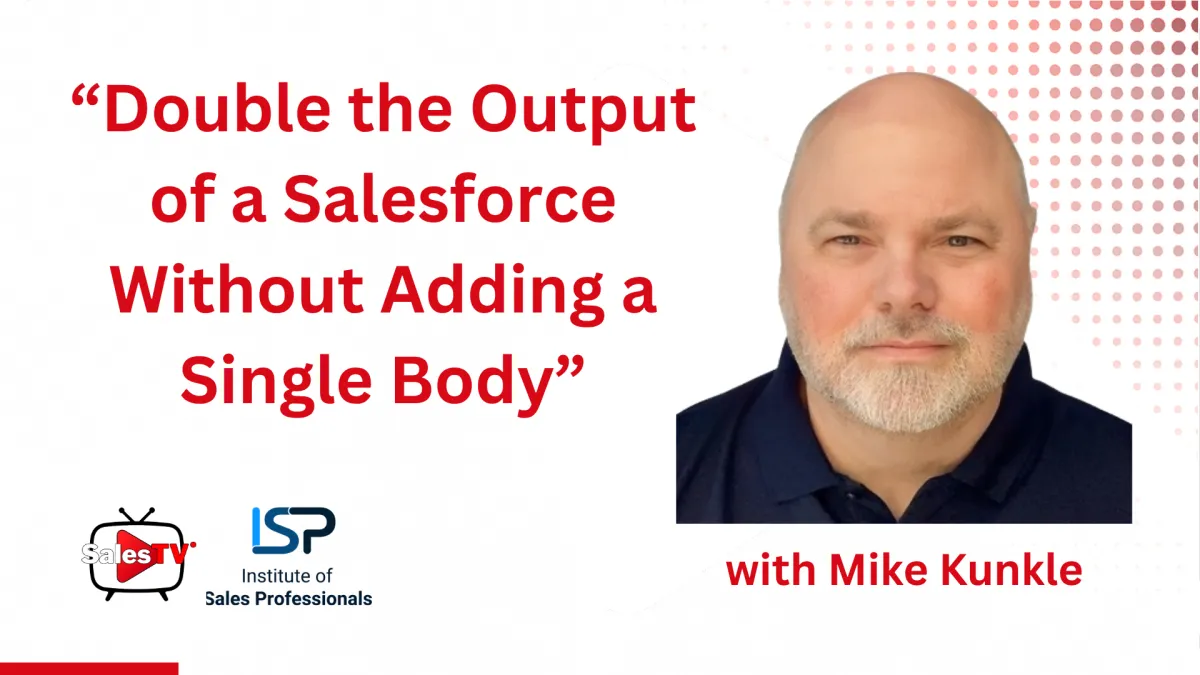
No, this isn’t another talk about AI replacing salespeople. The last time Mike Kunkle joined us on SalesTV, he shared a remarkable moment from early in his career: he saw an opportunity to “almost double the output of a Salesforce without adding a single body” - and then he delivered on it.
That story wasn’t about a gimmick or a hack. It was about diagnosing performance systems, aligning leadership, and building enablement that actually drives behavior change. And as sales leaders begin planning for 2026, that kind of strategic thinking isn’t just interesting - it’s essential.
2026 is shaping up to be a pivotal year for revenue organizations. AI-driven workflows, new buyer expectations, efficiency pressures, pipeline unpredictability, and a growing gap between high-performing and average teams are forcing sales leaders to rethink the fundamentals of how they run, enable, coach, and scale. The decisions sales leaders make now will determine whether their teams are ready for the next cycle - or caught unprepared by it.
That’s why we’ve invited Mike back - to help sales leaders rethink the systems, disciplines, and behaviors required for a modern revenue engine.
We’ll ask questions like -
* How can Sales Leaders rethink Go-To-Market strategy for 2026 based on real buyer behavior?
* How do we align Enablement, Sales, Marketing, and front-line Managers into a single system of execution?
* How do we evolve coaching, onboarding, and performance rhythms for next-generation sellers?
* What outdated sales leadership practices should be retired before 2026?
Mike has spent decades helping companies redesign how sales organizations work - structurally, behaviorally, and operationally. His expertise spans enablement strategy, performance diagnostics, sales leadership systems, and organizational alignment.
If you lead a sales team, enablement function, or revenue organization, this session will help you rethink the assumptions shaping your 2026 plans.
This week's Guest was -
Mike Kunkle, Sales Enablement industry stalwart and author of the book, "The Building Blocks of Sales Enablement"
This week's Host was -
Rob Durant, CEO of US Operations at The Institute of Sales Professionals
Transcript of SalesTV.live Mid-Day Edition 2025-11-25
Rob Durant [00:00:02]:
Hello and welcome to another edition of SalesTV. Today, we're discussing what sales leaders must rethink as we head into 2026. We're joined once again by Mike Kunkel. Mike has spent decades helping companies redesign how sales organizations work structurally, behaviorally, and operationally. His expertise spans enablement strategy, performance diagnostics, sales leadership systems, and organizational alignment. If anyone knows what's working and not working in sales, it's him. Mike, welcome back.
Mike Kunkle [00:00:44]:
Thank you, Rob, and appreciate that intro that was just like my mom wrote it. Well, yes, she had some input.
Rob Durant [00:00:54]:
Mike, let's jump right into it. The last time you were on the show, you mentioned that as a consultant, early in your career, you saw an opportunity to, and I quote, almost double the output of a salesforce without adding a single body, and then you did it. What can sales leaders teach? Take from your experience as they plan for 2026.
Mike Kunkle [00:01:25]:
Yeah, that is a timely question right now. Because when I talk to sales leaders, when I talk to sales managers, when I talk to middle market CEOs, I keep hearing about the increased pressure in sales, how it's tougher to get results, how they're struggling with revenue plan attainment, quota attainment, slipping win rates, bigger buyer committees. All of this stuff is creating an intense amount of pressure. And what we tend to do, or what I see a lot of as a result of that is what I call the harder, faster, longer, louder syndrome, where we just push harder on the market, on ourselves, on what we're doing, try to do more of it. Lately it's how do I use AI to send out as many messages as possible, even if they're to the wrong icp, and if they're horrible messaging? Right, just do more of it. Right? And I still see, Rob, I still see that potential that I saw. And you know, when the first time I realized this, probably 30 years ago, 25 years ago, but I have consistently over the years, as an employee, coming in as a practitioner or as a consultant, seen just what you've described, that there is potential to double the sales results without adding a single body. And I say it that way specifically that there's potential because so very few are willing to do the things that are necessary to get that result.
Mike Kunkle [00:03:14]:
And so I don't, I won't go deep into the past story, but when, when I started figuring out the building blocks of sales enablement, as I call them today, and back then, sales enablement wasn't even a term, right? It was just sales or sales training or performance improvement. When I started to connect Those elements in the building blocks. And when I started to put sales systems in place that would help you execute against those blocks as you go to market, that's where I started to see the biggest traction. Now, I did start out in just sales training and we did some good training, we did see some lift, but it wasn't earth shattering. But when I figured out the building blocks and we're talking about sales training, sales coaching, sales process, sales methodology, buyer acumen, all the content pieces for buyer engagement content and sales support content, I could go on. But especially the systems, the sales hiring, the sales readiness, the ongoing sales training system, the sales management system, which includes the coaching systems. When you get those things in place, you can radically move the needle on the effectiveness of your salesforce. And what I see today, Rob, is a lot of focus on trying to become more efficient.
Mike Kunkle [00:04:46]:
Can I send out more messages, but not actually even can I spend more time in front of my buyers? Because one of the puzzling pieces of research I keep seeing is that even when we free up time from the sellers to be able to spend more time engaging with their buyers and customers, they're not always doing that. And the other piece that's part of that is that I consider sales methodology to be how we are going to market, how we are selling and how well. Right. The sales process, right, you know, is more of the activity based, the stages, all of that. You know, who are we doing what with, at what levels, if it matters, when and where. But the methodology is how and how well we're doing it. And I see a lot more focus right now on efficiency so we can do even more ineffective things faster and louder rather than going to the core of how do I become as effective as possible and then make it possible to do a lot more of that. And it was when I figured some of those things out, and I know there's a lot there, right, that swirls.
Mike Kunkle [00:06:08]:
But when those things kind of came together in the building blocks and the systems and I was able to get the organization not to recognize the really great deep details of what I do. Because look, every time I've tried to explain that to a senior leader, I've almost put their eyes in the back of their heads. But enough of it, they could say, this makes sense, this is logical, I can support it. Then I would go off into the deep details and execute and build frontline sales manager capability to drive change, to coach. Right? That's the other missing piece very often is that we forget that the frontline sales managers are our true Performance lever, a force multiplier and the driver of change. And we don't work enough to develop them. And, you know, we've realized that, oh, we have to start training differently to get adoption from sales reps. But then we, we almost forget that we have to do the exact same thing and also provide coaching to our frontline sales managers.
Mike Kunkle [00:07:16]:
So that is a long, probably somewhat convoluted answer to a simple question. But it's the recognition that this is a complex system that you have to poke around on various elements to help them get good enough for now or one step better. And you have to execute with systems thinking to get hiring readiness training, sales management, sales leadership, and all those pieces, especially with the coaching sewn together in a way that supports the high level effectiveness of your salesforce. When you do that and you do that at a sustained level, you will see radically improved sales results.
Rob Durant [00:08:03]:
I can imagine any one of those things you mentioned can lead to incremental improvement.
Mike Kunkle [00:08:10]:
That's right.
Rob Durant [00:08:10]:
All of them aligned lead to exponential improvement. And that's what we're here for. All right, I'm going to introduce a new segment, new segment on sales tv. Just off the top of my hat. Let's go with ask me anything. We're gonna ask Mike some questions. He's had no advanced preparation for. Mike, how can sales leaders rethink go to market strategy based on real buyer behavior?
Mike Kunkle [00:08:47]:
Okay, so I have a term I use called buyer acumen. And buyer acumen includes some of the normal stuff around Personas. Right. You know, what are the roles and goals of, you know, this particular position or a person who holds it. You know, I don't care much for the Personas that name people. Oh, this is Bob the cfo. Right. But if you get an understanding of the roles and goals, you can go one level deeper by trying to understand what I call coin op.
Mike Kunkle [00:09:21]:
And I joke that, you know, just like salespeople, buyers are also coin operated. Coin op. But it stands for what are the challenges that they typically face or what are the opportunities that they're facing that they can capitalize on? And Rob, when I say that, I mean a strategic opportunity, like in a SWOT analysis, where there's probably a window of time that they have to capitalize on this cool thing and really get ahead. So they may have challenges, they may or may not have opportunities, but there are definitely impacts of the status quo. What happens if they don't solve that challenge or don't enable that opportunity? I'm going to jump over n for a Moment we'll come back to it and go to the desired future state. What are the outcomes that they're hoping for? What are their strategic plans and goals and, and metrics and measures and where do they want to get to? What does good look like or great look like when they get there and what are the priorities of those outcomes? So now you've got this COI in the current state and you've got this OP in the desired future state. Now you can do a gap analysis and figure out, well, what would it take to move from point A to point B and that becomes the needs or whatever it is that they need to go from point A to point B. And then lastly you can do an impact analysis.
Mike Kunkle [00:10:52]:
If you reduce the risks or resolve the impacts of the current state and get to that rosy desired future state with the outcomes they want, what does that translate to in terms of improvement? And you need to dollarize that so that you can actually see and then you can compare that to the cost of the solution later and you know, develop an roi. But that creates a compelling business case. And so if you can start with an understanding of your ICP and sales leaders, listen to this. Because I get dozens of messages a week for things that I have never bought in my entire career and I don't have a budget for. We are missing the ICP element in great targeting. So buy a acumen. The roles, the goals, the positions and the coin op. If you can get a generalized version of that and in marketing at this stage, right, and early go to market, all you can do is get a great general version.
Mike Kunkle [00:12:02]:
But then when you approach those buyers, when you do your upfront research, of course, so you have your team doing research, right? So they're researching those buyers to find out what's the difference between sort of our templated coin op and Personas with these real people and real buyers in the roles in this company. And then you create a personalized plan to go to market toward that company, toward that, those Personas. Probably a account based selling and account based marketing approach. But when you talk to the real people now you peel the onion and you go beyond the Persona to the person past what the research could tell you, into the things that they say that come out of their mouths. And when you start with that foundation of Bayer acumen and in that plan to get them to know even better and have the soft skills, the interpersonal skills to do things like acc acknowledge what this buyer is saying to you, whether it's disinterest or a concern Or a need they're describing a problem they've got. Acknowledge it with empathy, clarify it. Peel the onion further to get beyond the surface level of the water into the depths of the root cause and then confirm everything that they've said to you. That those simple three letters are so powerful because they help people feel heard and understood.
Mike Kunkle [00:13:34]:
One of the deepest seated human needs. And so I haven't said a thing about pose value stories or how you prospect or you know, what do we do to manage opportunities, how you qualify. Because it's got to start with a far deeper understanding of the market and the buyers in it and their coin up in the problems that they've got that you can solve. And if you don't start there, you are literally throwing spaghetti at the wall, hoping something will stick. You are playing what I call the superstition game. Oh, I've done this a thousand times. And look, I got a lead. Right, you got that lead by luck.
Mike Kunkle [00:14:18]:
You approach someone at exactly the right time rather than doing that, rather than saying, oh, cold calling doesn't work because you do it so poorly. Step back and better understand your market and the roles in it that have problems you can solve and approach them in a relevant way to talk about those challenges and the outcomes that you can deliver. All fueled by that coin op we talked about. That's another thing, Rob, that I've seen make an absolute massive difference. Because if you get all of that right and you do discovery with this current state desired, future state coin op framework as well, then you can mess up a lot of things from that point forward and still win. If you float past those things and work as hard as you can to try to win a deal after that, but you don't have that foundation, you will lose more than you win and you'll never reach your, your true potential. So that's my, that's my long winded answer to a pretty simple question. But that's the stuff that I have seen make a radical difference.
Rob Durant [00:15:32]:
Fantastic. It's interesting. That answer was all one side of the table and not the side that we typically focus on.
Mike Kunkle [00:15:42]:
That's right.
Rob Durant [00:15:44]:
So I have two questions, kind of a yin and yang situation here. Let's start with this one. What should sales leaders focus on first when trying to modernize their sales organization?
Mike Kunkle [00:15:59]:
Could I start with what they should focus on first?
Rob Durant [00:16:02]:
Well, you found the yang. What sales leadership practices should be retired before we go into 2026.
Mike Kunkle [00:16:11]:
Throwing more technology at the problem and harder, faster, longer, louder. Needs to be retired as a sales management Method. Those would be the two primary things. Look, I am not a Luddite. I am actually an early adopter. I love tinkering around with technology. I'm incredibly excited about the potential for AI. I'm also a Bill Gates fan or a fan of his quote where he said, people always overestimate the short term impact of new technology and underestimate the long term impact.
Mike Kunkle [00:16:50]:
And I think we're in the hype cycle right now, rising for AI where we have grossly overestimated the impact and how effective it can be. I mean, if you read the headlines, I think it was Deloitte that had to return a $400,000 check to a client because they found out that the AI generated advice that they gave them was full of hallucinations from one of the AI services that had a sting. And that is a great lesson for us that AI is a tool right now. It has massive potential, but it is not a replacement yet for us humans. And so go back to my efficiency versus effectiveness and focus on effectiveness first. Find what works. Experiment A B test if you have to, but study your top performers and not just the top producers, because to me, a top producer is somebody who's putting up the numbers, but may or may not be doing it in the way that you would want to replicate or clone. They often have been around a long time.
Mike Kunkle [00:18:08]:
They, they picked up a lot of orphan accounts, right? They have other intangible things about them that, you know, whether even as simple as charisma or, you know, easy rapport building, they've been in the industry a long time and they're known. But if you find a real top performer, you could drop that person in the middle of the Sahara desert and they would find a way to build a territory because they've got capabilities and skills and drive and all the right makeup for sales success. And so if you study them and look for what is it that they do differently than average, and out of those things, take out the fact that is, you know, the force of personality pieces and focus on the skills, the abilities, the way they execute that how and how well of the methodology that I talked about. Study those people and start to infuse what you learn into the rest of your salesforce. Get effective first and then start to find ways to do a whole lot more of that effective stuff. Otherwise, as I said earlier, you just wind up doing dumb stuff faster and more of it. So that would be the stop part. So for the yin yang there, what do you focus on? Well, you know, I go Right back to buyer acumen.
Mike Kunkle [00:19:35]:
But then I would say, you know, and you're gonna, you're gonna probably hear this later from me as well because it's such a big thing for me right now. Rob. I look at salesforces and what I see most of the time is sort of a free for all regarding sales methodology. They are pulling things from variety of sources and tips and tricks in this book, in that book and this consultant and that. And you know, if everybody were on an island and on their own, you want each individual to have the drive and try to keep learning. I'm not, I'm not dissing any of that. What I'm saying is that organizationally that doesn't work. Someone explained to me, how do you coach to a free for all sales methodology where everybody is kind of doing their own thing? And by the way, how do you protect your organization from lawsuits if you are using a piece of spin and challenger here and something else from the old Miller Hyman stuff.
Mike Kunkle [00:20:45]:
Do you realize those are copyrighted programs? Medic gets abused all the time. I feel a little sorry sometimes for the medic owners because people go and implement Medic without the medic people, right? And so basically you're stealing when you do that. And that makes me a little unpopular sometimes to say that, but I don't care, right? Because it is not legal to go implement a methodology that is copyrighted without paying them for it. Now you can build your own based on top performer analysis. You can go legally pay for it and implement it. But we've got to get away from this free for all because you can't possibly operationalize that. You can't put it into your CRM. You can't make it a part of workflow.
Mike Kunkle [00:21:38]:
You can't create forms and worksheets for it to help people prepare. You can't diagnose performance gaps with it or competency gaps to try to close them. And you can't coach to it. So you've got to find whether you build it, whether you buy it, whether you rent it, you've got to find an aligned unified sales methodology that covers your entire customer life cycle. Prospecting, opportunity management, account management. And you've got to make that the way we do things around here. And again, if I go back to that, hey, we could double results without adding a body. That's another layer on that is to get a methodology in place.
Mike Kunkle [00:22:25]:
Now, Rob, you probably know this already. There have been a minimum of five studies to show that companies with a formal process and a formal Sales methodology and high levels of adoption. In the CSO Insights study it was 75% greater than 75% adoption and statistically significant differences in performance. Specifically higher revenue plan attainment, higher individual rep, quota attainment and higher win rates. Now is there anybody out there listening who doesn't want those three things? And yet you allow on your organization this free for all approach to going to market into selling rather than having one aligned methodology that covers the entire customer life cycle that you can bet in your CRM you can create worksheets for, you can coach like crazy, you can develop mastery and you can get higher levels of adoption and get better win rates, quota attainment and revenue plan attainment. That one puzzles me that people aren't just rushing to to do that. But that's what I would suggest sales leaders think about and stop doing.
Rob Durant [00:23:54]:
I couldn't help but think when I heard you saying that. I've heard similar things. I, I've advocated similar things and the pushback I hear is. Oh, but sales is, is not just a science. It's part art and part science. What do you say to that?
Mike Kunkle [00:24:14]:
I think it's true. I think that there is. Let's, let's, let's use my pose value story. There's a problem that certain Personas or people like you face that others like you have told us about. There are outcomes that we've helped them deliver. Here's a brief mention of the solution that we did that. Hey, is that something that makes sense to explore further. Impose value story.
Mike Kunkle [00:24:39]:
Now that's a piece of methodology and that's a science that creates more relevant outbound prospecting approaches or later in an opportunity when a new person joins the buying committee. It's a great way to introduce them into how got, how, how did this all get started and how do we fit into it. But that pose value story is just a framework and a model. In a sales methodology, the art comes in when somebody named Art does it really, really well and someone named Tim can barely get a pose value story out. It's never personalized to the people that they're talking with. They don't stop and check. Is that problem relevant for what you're facing, Rob, or after the outcomes? Would those outcomes be compelling or helpful? There's not the kind of dialogue where they're using that ACC thing I talked about. It sounds like you're really under a lot of pressure now and your boss is trying to get you to tell them what are you going to do to fix it? Let me ask a question about that and you peel the onion and later you summarize it, right? It's using those kind of skills that I think really makes the difference.
Mike Kunkle [00:26:03]:
And get on another hot topic of mine. I just published something on LinkedIn about, you know, AI enabled practice and human practice. But we don't practice as a whole, as a profession, so we lose the art. And even if you've got the science of ACC's impose value stories in coin op and things that were were built based on what top performers do differently, if you execute them horribly, you're not going to get the great result. So to me, that is really the blend between the science of knowing what you should do and how you should do it, and then our human ability to execute on that to a high level of excellence. That's the art and the science, in my opinion.
Rob Durant [00:26:54]:
Let's boil it down now, Mike, if you were to emphasize the one thing you would want our audience to take away from today's episode, what would that one thing be?
Mike Kunkle [00:27:06]:
Buyer centric. We work in an other centric profession and this concept of other centricity applies to so many things in life. I first heard it 35 years ago, probably from Zig Ziglar, when he said on a tape set, we can get everything we want in life if only we'll help enough others get what they want. And I pulled off to the side of the road, back that up and replayed that because it just hit me like a ton of bricks. And that has stuck with me for years. Everything that I build is other centric. Whether it's managers working with their reps to coach them, whether it's an executive team working with their direct reports, whether it's a salesperson working with their buyers. We help them get what they want and we get results through others.
Mike Kunkle [00:28:03]:
And when you're working with buyers, of course, I call it buyer centricity, but it goes back to the buyer acumen. It goes back to understanding what are their value drivers. Maybe it's business value drivers. Maybe it is experiential, where, you know, they're trying to improve a process or a feeling or customer experience. Maybe it's aspirational to align with mission, vision, values or initiatives like DEI or sustainability. If you really understand what matters to the other person, then you become multilingual. Not French, German, Spanish and English. Right? But you have these four buyers.
Mike Kunkle [00:28:46]:
You can talk about one product in four different ways based on what you've learned about them, their value drivers, what's important to them, this other centricity and in selling, buyer centricity is the one thing that if you would change, I think you'd see a huge leap in results. Now when you step back and then you start to put other things around that if you come incredibly buyer centric, there's almost a wheel where everything you learn there with buyer acumen kind of spreads out into everything else you do. The content, you develop, the, you know, for buyer engagement content, the sales support content, the training you provide to reps. Everything you do gets better and more informed and more effective because it's seated with the buyer acumen and market acumen. So that'd be my one thing.
Rob Durant [00:29:45]:
Rob, that's fantastic. Lots of pearls of wisdom in there. How can somebody get in touch with you? What's next for you?
Mike Kunkle [00:29:59]:
Yeah, great question. Working through some of that right now. But one of the things I'm incredibly excited about is that I'm taking my sales methodology which was built with, let's see if I get this right. 16 years of top performer analysis, 12 different studies. Now that's not one longitudinal study, I really wish it were, but 12 different studies of doing this analysis to figure out what are the top do differently. My entire methodology is built around that for sales, for sales coaching and for sales management. And I've created this concept that I'm calling the Co Navigator method. Co Navigator because you're not going on a journey, your buyer's not going on a journey, you're going on this journey together.
Mike Kunkle [00:30:52]:
And when they become your customer, then you continue to go on this journey with them. So I'm writing right now the CO navigator method for B2B selling. And I plan to do a series around that concept which will include negotiation, completely separate skill set. And you have to wait till the selling or the value selling is done before you negotiate. Co Navigator method for sales coaching, Sales management, sales leadership. And I'm even going to venture into customer success or service with that. So that's something that I'm in incredibly excited about. Sometime in early 2026, I expect that book to come out.
Mike Kunkle [00:31:37]:
And it is a big part, but it's still really part of the building blocks of sales enablement. So I'm continuing to sort of expand that. Talking now about a commercial effectiveness framework that goes even larger than the building blocks, which were never really just sales enablement. If you look at them, you know, there's compensation in there, there's other elements that aren't always just sales enablement and aren't even really just revenue enablement. So even beyond revenue enablement. The commercial effectiveness framework is going to expand out and include more as well. So those are probably the two things I'm most excited about. And I you know, I don't have a lot of availability in 2026, but I've got some new openings to be able to work with new clients.
Mike Kunkle [00:32:31]:
So if anyone listening or if you know, someone who could benefit from this really wants to give a shot at that, hey, can I double results without adding a body? Maybe we can work together on that in the future.
Rob Durant [00:32:49]:
Fantastic.
Mike Kunkle [00:32:50]:
Mike.
Rob Durant [00:32:51]:
This has been great, as always. When the book comes out, we'll have to have you back. We'll talk about that too. On behalf of everyone here at SalesTV, to you and to our audience, thank you for being a part in today's conversation. Wonderful as always. If you like what you heard today, please take a moment to leave a review on Apple Podcasts, Spotify, Substack or YouTube. Let us know what you learned and what you'd like to learn more about. Your feedback helps us reach more people like you and fulfill our mission of elevating the profession of sales.
Rob Durant [00:33:28]:
Thank you all and we'll see you next time. Bye.
@SalesTVlive
#RevenueLeadership #GoToMarket #SalesStrategy #SalesEnablement #2026Planning
#Sales #SalesLeadership #LinkedInLive #Podcast
________________________________________
About SalesTV: SalesTV is a weekly talk show created by salespeople, for salespeople. Each episode explores sales, sales training, sales enablement, and social selling, bringing together sales leaders, enablement professionals, and practitioners from across the globe.
About the Institute of Sales Professionals: The ISP is the only body worldwide dedicated to raising the standards of sales. Its Sales Capability Framework, certifications, and member community are designed to address their one goal: To Elevate the Profession of Sales.

Mid-Day Edition
What Sales Leaders Must Rethink Heading Into 2026
No, this isn’t another talk about AI replacing salespeople. The last time Mike Kunkle joined us on SalesTV, he shared a remarkable moment from early in his career: he saw an opportunity to “almost double the output of a Salesforce without adding a single body” - and then he delivered on it.
That story wasn’t about a gimmick or a hack. It was about diagnosing performance systems, aligning leadership, and building enablement that actually drives behavior change. And as sales leaders begin planning for 2026, that kind of strategic thinking isn’t just interesting - it’s essential.
2026 is shaping up to be a pivotal year for revenue organizations. AI-driven workflows, new buyer expectations, efficiency pressures, pipeline unpredictability, and a growing gap between high-performing and average teams are forcing sales leaders to rethink the fundamentals of how they run, enable, coach, and scale. The decisions sales leaders make now will determine whether their teams are ready for the next cycle - or caught unprepared by it.
That’s why we’ve invited Mike back - to help sales leaders rethink the systems, disciplines, and behaviors required for a modern revenue engine.
We’ll ask questions like -
* How can Sales Leaders rethink Go-To-Market strategy for 2026 based on real buyer behavior?
* How do we align Enablement, Sales, Marketing, and front-line Managers into a single system of execution?
* How do we evolve coaching, onboarding, and performance rhythms for next-generation sellers?
* What outdated sales leadership practices should be retired before 2026?
Mike has spent decades helping companies redesign how sales organizations work - structurally, behaviorally, and operationally. His expertise spans enablement strategy, performance diagnostics, sales leadership systems, and organizational alignment.
If you lead a sales team, enablement function, or revenue organization, this session will help you rethink the assumptions shaping your 2026 plans.
This week's Guest was -
Mike Kunkle, Sales Enablement industry stalwart and author of the book, "The Building Blocks of Sales Enablement"
This week's Host was -
Rob Durant, CEO of US Operations at The Institute of Sales Professionals
Transcript of SalesTV.live Mid-Day Edition 2025-11-25
Rob Durant [00:00:02]:
Hello and welcome to another edition of SalesTV. Today, we're discussing what sales leaders must rethink as we head into 2026. We're joined once again by Mike Kunkel. Mike has spent decades helping companies redesign how sales organizations work structurally, behaviorally, and operationally. His expertise spans enablement strategy, performance diagnostics, sales leadership systems, and organizational alignment. If anyone knows what's working and not working in sales, it's him. Mike, welcome back.
Mike Kunkle [00:00:44]:
Thank you, Rob, and appreciate that intro that was just like my mom wrote it. Well, yes, she had some input.
Rob Durant [00:00:54]:
Mike, let's jump right into it. The last time you were on the show, you mentioned that as a consultant, early in your career, you saw an opportunity to, and I quote, almost double the output of a salesforce without adding a single body, and then you did it. What can sales leaders teach? Take from your experience as they plan for 2026.
Mike Kunkle [00:01:25]:
Yeah, that is a timely question right now. Because when I talk to sales leaders, when I talk to sales managers, when I talk to middle market CEOs, I keep hearing about the increased pressure in sales, how it's tougher to get results, how they're struggling with revenue plan attainment, quota attainment, slipping win rates, bigger buyer committees. All of this stuff is creating an intense amount of pressure. And what we tend to do, or what I see a lot of as a result of that is what I call the harder, faster, longer, louder syndrome, where we just push harder on the market, on ourselves, on what we're doing, try to do more of it. Lately it's how do I use AI to send out as many messages as possible, even if they're to the wrong icp, and if they're horrible messaging? Right, just do more of it. Right? And I still see, Rob, I still see that potential that I saw. And you know, when the first time I realized this, probably 30 years ago, 25 years ago, but I have consistently over the years, as an employee, coming in as a practitioner or as a consultant, seen just what you've described, that there is potential to double the sales results without adding a single body. And I say it that way specifically that there's potential because so very few are willing to do the things that are necessary to get that result.
Mike Kunkle [00:03:14]:
And so I don't, I won't go deep into the past story, but when, when I started figuring out the building blocks of sales enablement, as I call them today, and back then, sales enablement wasn't even a term, right? It was just sales or sales training or performance improvement. When I started to connect Those elements in the building blocks. And when I started to put sales systems in place that would help you execute against those blocks as you go to market, that's where I started to see the biggest traction. Now, I did start out in just sales training and we did some good training, we did see some lift, but it wasn't earth shattering. But when I figured out the building blocks and we're talking about sales training, sales coaching, sales process, sales methodology, buyer acumen, all the content pieces for buyer engagement content and sales support content, I could go on. But especially the systems, the sales hiring, the sales readiness, the ongoing sales training system, the sales management system, which includes the coaching systems. When you get those things in place, you can radically move the needle on the effectiveness of your salesforce. And what I see today, Rob, is a lot of focus on trying to become more efficient.
Mike Kunkle [00:04:46]:
Can I send out more messages, but not actually even can I spend more time in front of my buyers? Because one of the puzzling pieces of research I keep seeing is that even when we free up time from the sellers to be able to spend more time engaging with their buyers and customers, they're not always doing that. And the other piece that's part of that is that I consider sales methodology to be how we are going to market, how we are selling and how well. Right. The sales process, right, you know, is more of the activity based, the stages, all of that. You know, who are we doing what with, at what levels, if it matters, when and where. But the methodology is how and how well we're doing it. And I see a lot more focus right now on efficiency so we can do even more ineffective things faster and louder rather than going to the core of how do I become as effective as possible and then make it possible to do a lot more of that. And it was when I figured some of those things out, and I know there's a lot there, right, that swirls.
Mike Kunkle [00:06:08]:
But when those things kind of came together in the building blocks and the systems and I was able to get the organization not to recognize the really great deep details of what I do. Because look, every time I've tried to explain that to a senior leader, I've almost put their eyes in the back of their heads. But enough of it, they could say, this makes sense, this is logical, I can support it. Then I would go off into the deep details and execute and build frontline sales manager capability to drive change, to coach. Right? That's the other missing piece very often is that we forget that the frontline sales managers are our true Performance lever, a force multiplier and the driver of change. And we don't work enough to develop them. And, you know, we've realized that, oh, we have to start training differently to get adoption from sales reps. But then we, we almost forget that we have to do the exact same thing and also provide coaching to our frontline sales managers.
Mike Kunkle [00:07:16]:
So that is a long, probably somewhat convoluted answer to a simple question. But it's the recognition that this is a complex system that you have to poke around on various elements to help them get good enough for now or one step better. And you have to execute with systems thinking to get hiring readiness training, sales management, sales leadership, and all those pieces, especially with the coaching sewn together in a way that supports the high level effectiveness of your salesforce. When you do that and you do that at a sustained level, you will see radically improved sales results.
Rob Durant [00:08:03]:
I can imagine any one of those things you mentioned can lead to incremental improvement.
Mike Kunkle [00:08:10]:
That's right.
Rob Durant [00:08:10]:
All of them aligned lead to exponential improvement. And that's what we're here for. All right, I'm going to introduce a new segment, new segment on sales tv. Just off the top of my hat. Let's go with ask me anything. We're gonna ask Mike some questions. He's had no advanced preparation for. Mike, how can sales leaders rethink go to market strategy based on real buyer behavior?
Mike Kunkle [00:08:47]:
Okay, so I have a term I use called buyer acumen. And buyer acumen includes some of the normal stuff around Personas. Right. You know, what are the roles and goals of, you know, this particular position or a person who holds it. You know, I don't care much for the Personas that name people. Oh, this is Bob the cfo. Right. But if you get an understanding of the roles and goals, you can go one level deeper by trying to understand what I call coin op.
Mike Kunkle [00:09:21]:
And I joke that, you know, just like salespeople, buyers are also coin operated. Coin op. But it stands for what are the challenges that they typically face or what are the opportunities that they're facing that they can capitalize on? And Rob, when I say that, I mean a strategic opportunity, like in a SWOT analysis, where there's probably a window of time that they have to capitalize on this cool thing and really get ahead. So they may have challenges, they may or may not have opportunities, but there are definitely impacts of the status quo. What happens if they don't solve that challenge or don't enable that opportunity? I'm going to jump over n for a Moment we'll come back to it and go to the desired future state. What are the outcomes that they're hoping for? What are their strategic plans and goals and, and metrics and measures and where do they want to get to? What does good look like or great look like when they get there and what are the priorities of those outcomes? So now you've got this COI in the current state and you've got this OP in the desired future state. Now you can do a gap analysis and figure out, well, what would it take to move from point A to point B and that becomes the needs or whatever it is that they need to go from point A to point B. And then lastly you can do an impact analysis.
Mike Kunkle [00:10:52]:
If you reduce the risks or resolve the impacts of the current state and get to that rosy desired future state with the outcomes they want, what does that translate to in terms of improvement? And you need to dollarize that so that you can actually see and then you can compare that to the cost of the solution later and you know, develop an roi. But that creates a compelling business case. And so if you can start with an understanding of your ICP and sales leaders, listen to this. Because I get dozens of messages a week for things that I have never bought in my entire career and I don't have a budget for. We are missing the ICP element in great targeting. So buy a acumen. The roles, the goals, the positions and the coin op. If you can get a generalized version of that and in marketing at this stage, right, and early go to market, all you can do is get a great general version.
Mike Kunkle [00:12:02]:
But then when you approach those buyers, when you do your upfront research, of course, so you have your team doing research, right? So they're researching those buyers to find out what's the difference between sort of our templated coin op and Personas with these real people and real buyers in the roles in this company. And then you create a personalized plan to go to market toward that company, toward that, those Personas. Probably a account based selling and account based marketing approach. But when you talk to the real people now you peel the onion and you go beyond the Persona to the person past what the research could tell you, into the things that they say that come out of their mouths. And when you start with that foundation of Bayer acumen and in that plan to get them to know even better and have the soft skills, the interpersonal skills to do things like acc acknowledge what this buyer is saying to you, whether it's disinterest or a concern Or a need they're describing a problem they've got. Acknowledge it with empathy, clarify it. Peel the onion further to get beyond the surface level of the water into the depths of the root cause and then confirm everything that they've said to you. That those simple three letters are so powerful because they help people feel heard and understood.
Mike Kunkle [00:13:34]:
One of the deepest seated human needs. And so I haven't said a thing about pose value stories or how you prospect or you know, what do we do to manage opportunities, how you qualify. Because it's got to start with a far deeper understanding of the market and the buyers in it and their coin up in the problems that they've got that you can solve. And if you don't start there, you are literally throwing spaghetti at the wall, hoping something will stick. You are playing what I call the superstition game. Oh, I've done this a thousand times. And look, I got a lead. Right, you got that lead by luck.
Mike Kunkle [00:14:18]:
You approach someone at exactly the right time rather than doing that, rather than saying, oh, cold calling doesn't work because you do it so poorly. Step back and better understand your market and the roles in it that have problems you can solve and approach them in a relevant way to talk about those challenges and the outcomes that you can deliver. All fueled by that coin op we talked about. That's another thing, Rob, that I've seen make an absolute massive difference. Because if you get all of that right and you do discovery with this current state desired, future state coin op framework as well, then you can mess up a lot of things from that point forward and still win. If you float past those things and work as hard as you can to try to win a deal after that, but you don't have that foundation, you will lose more than you win and you'll never reach your, your true potential. So that's my, that's my long winded answer to a pretty simple question. But that's the stuff that I have seen make a radical difference.
Rob Durant [00:15:32]:
Fantastic. It's interesting. That answer was all one side of the table and not the side that we typically focus on.
Mike Kunkle [00:15:42]:
That's right.
Rob Durant [00:15:44]:
So I have two questions, kind of a yin and yang situation here. Let's start with this one. What should sales leaders focus on first when trying to modernize their sales organization?
Mike Kunkle [00:15:59]:
Could I start with what they should focus on first?
Rob Durant [00:16:02]:
Well, you found the yang. What sales leadership practices should be retired before we go into 2026.
Mike Kunkle [00:16:11]:
Throwing more technology at the problem and harder, faster, longer, louder. Needs to be retired as a sales management Method. Those would be the two primary things. Look, I am not a Luddite. I am actually an early adopter. I love tinkering around with technology. I'm incredibly excited about the potential for AI. I'm also a Bill Gates fan or a fan of his quote where he said, people always overestimate the short term impact of new technology and underestimate the long term impact.
Mike Kunkle [00:16:50]:
And I think we're in the hype cycle right now, rising for AI where we have grossly overestimated the impact and how effective it can be. I mean, if you read the headlines, I think it was Deloitte that had to return a $400,000 check to a client because they found out that the AI generated advice that they gave them was full of hallucinations from one of the AI services that had a sting. And that is a great lesson for us that AI is a tool right now. It has massive potential, but it is not a replacement yet for us humans. And so go back to my efficiency versus effectiveness and focus on effectiveness first. Find what works. Experiment A B test if you have to, but study your top performers and not just the top producers, because to me, a top producer is somebody who's putting up the numbers, but may or may not be doing it in the way that you would want to replicate or clone. They often have been around a long time.
Mike Kunkle [00:18:08]:
They, they picked up a lot of orphan accounts, right? They have other intangible things about them that, you know, whether even as simple as charisma or, you know, easy rapport building, they've been in the industry a long time and they're known. But if you find a real top performer, you could drop that person in the middle of the Sahara desert and they would find a way to build a territory because they've got capabilities and skills and drive and all the right makeup for sales success. And so if you study them and look for what is it that they do differently than average, and out of those things, take out the fact that is, you know, the force of personality pieces and focus on the skills, the abilities, the way they execute that how and how well of the methodology that I talked about. Study those people and start to infuse what you learn into the rest of your salesforce. Get effective first and then start to find ways to do a whole lot more of that effective stuff. Otherwise, as I said earlier, you just wind up doing dumb stuff faster and more of it. So that would be the stop part. So for the yin yang there, what do you focus on? Well, you know, I go Right back to buyer acumen.
Mike Kunkle [00:19:35]:
But then I would say, you know, and you're gonna, you're gonna probably hear this later from me as well because it's such a big thing for me right now. Rob. I look at salesforces and what I see most of the time is sort of a free for all regarding sales methodology. They are pulling things from variety of sources and tips and tricks in this book, in that book and this consultant and that. And you know, if everybody were on an island and on their own, you want each individual to have the drive and try to keep learning. I'm not, I'm not dissing any of that. What I'm saying is that organizationally that doesn't work. Someone explained to me, how do you coach to a free for all sales methodology where everybody is kind of doing their own thing? And by the way, how do you protect your organization from lawsuits if you are using a piece of spin and challenger here and something else from the old Miller Hyman stuff.
Mike Kunkle [00:20:45]:
Do you realize those are copyrighted programs? Medic gets abused all the time. I feel a little sorry sometimes for the medic owners because people go and implement Medic without the medic people, right? And so basically you're stealing when you do that. And that makes me a little unpopular sometimes to say that, but I don't care, right? Because it is not legal to go implement a methodology that is copyrighted without paying them for it. Now you can build your own based on top performer analysis. You can go legally pay for it and implement it. But we've got to get away from this free for all because you can't possibly operationalize that. You can't put it into your CRM. You can't make it a part of workflow.
Mike Kunkle [00:21:38]:
You can't create forms and worksheets for it to help people prepare. You can't diagnose performance gaps with it or competency gaps to try to close them. And you can't coach to it. So you've got to find whether you build it, whether you buy it, whether you rent it, you've got to find an aligned unified sales methodology that covers your entire customer life cycle. Prospecting, opportunity management, account management. And you've got to make that the way we do things around here. And again, if I go back to that, hey, we could double results without adding a body. That's another layer on that is to get a methodology in place.
Mike Kunkle [00:22:25]:
Now, Rob, you probably know this already. There have been a minimum of five studies to show that companies with a formal process and a formal Sales methodology and high levels of adoption. In the CSO Insights study it was 75% greater than 75% adoption and statistically significant differences in performance. Specifically higher revenue plan attainment, higher individual rep, quota attainment and higher win rates. Now is there anybody out there listening who doesn't want those three things? And yet you allow on your organization this free for all approach to going to market into selling rather than having one aligned methodology that covers the entire customer life cycle that you can bet in your CRM you can create worksheets for, you can coach like crazy, you can develop mastery and you can get higher levels of adoption and get better win rates, quota attainment and revenue plan attainment. That one puzzles me that people aren't just rushing to to do that. But that's what I would suggest sales leaders think about and stop doing.
Rob Durant [00:23:54]:
I couldn't help but think when I heard you saying that. I've heard similar things. I, I've advocated similar things and the pushback I hear is. Oh, but sales is, is not just a science. It's part art and part science. What do you say to that?
Mike Kunkle [00:24:14]:
I think it's true. I think that there is. Let's, let's, let's use my pose value story. There's a problem that certain Personas or people like you face that others like you have told us about. There are outcomes that we've helped them deliver. Here's a brief mention of the solution that we did that. Hey, is that something that makes sense to explore further. Impose value story.
Mike Kunkle [00:24:39]:
Now that's a piece of methodology and that's a science that creates more relevant outbound prospecting approaches or later in an opportunity when a new person joins the buying committee. It's a great way to introduce them into how got, how, how did this all get started and how do we fit into it. But that pose value story is just a framework and a model. In a sales methodology, the art comes in when somebody named Art does it really, really well and someone named Tim can barely get a pose value story out. It's never personalized to the people that they're talking with. They don't stop and check. Is that problem relevant for what you're facing, Rob, or after the outcomes? Would those outcomes be compelling or helpful? There's not the kind of dialogue where they're using that ACC thing I talked about. It sounds like you're really under a lot of pressure now and your boss is trying to get you to tell them what are you going to do to fix it? Let me ask a question about that and you peel the onion and later you summarize it, right? It's using those kind of skills that I think really makes the difference.
Mike Kunkle [00:26:03]:
And get on another hot topic of mine. I just published something on LinkedIn about, you know, AI enabled practice and human practice. But we don't practice as a whole, as a profession, so we lose the art. And even if you've got the science of ACC's impose value stories in coin op and things that were were built based on what top performers do differently, if you execute them horribly, you're not going to get the great result. So to me, that is really the blend between the science of knowing what you should do and how you should do it, and then our human ability to execute on that to a high level of excellence. That's the art and the science, in my opinion.
Rob Durant [00:26:54]:
Let's boil it down now, Mike, if you were to emphasize the one thing you would want our audience to take away from today's episode, what would that one thing be?
Mike Kunkle [00:27:06]:
Buyer centric. We work in an other centric profession and this concept of other centricity applies to so many things in life. I first heard it 35 years ago, probably from Zig Ziglar, when he said on a tape set, we can get everything we want in life if only we'll help enough others get what they want. And I pulled off to the side of the road, back that up and replayed that because it just hit me like a ton of bricks. And that has stuck with me for years. Everything that I build is other centric. Whether it's managers working with their reps to coach them, whether it's an executive team working with their direct reports, whether it's a salesperson working with their buyers. We help them get what they want and we get results through others.
Mike Kunkle [00:28:03]:
And when you're working with buyers, of course, I call it buyer centricity, but it goes back to the buyer acumen. It goes back to understanding what are their value drivers. Maybe it's business value drivers. Maybe it is experiential, where, you know, they're trying to improve a process or a feeling or customer experience. Maybe it's aspirational to align with mission, vision, values or initiatives like DEI or sustainability. If you really understand what matters to the other person, then you become multilingual. Not French, German, Spanish and English. Right? But you have these four buyers.
Mike Kunkle [00:28:46]:
You can talk about one product in four different ways based on what you've learned about them, their value drivers, what's important to them, this other centricity and in selling, buyer centricity is the one thing that if you would change, I think you'd see a huge leap in results. Now when you step back and then you start to put other things around that if you come incredibly buyer centric, there's almost a wheel where everything you learn there with buyer acumen kind of spreads out into everything else you do. The content, you develop, the, you know, for buyer engagement content, the sales support content, the training you provide to reps. Everything you do gets better and more informed and more effective because it's seated with the buyer acumen and market acumen. So that'd be my one thing.
Rob Durant [00:29:45]:
Rob, that's fantastic. Lots of pearls of wisdom in there. How can somebody get in touch with you? What's next for you?
Mike Kunkle [00:29:59]:
Yeah, great question. Working through some of that right now. But one of the things I'm incredibly excited about is that I'm taking my sales methodology which was built with, let's see if I get this right. 16 years of top performer analysis, 12 different studies. Now that's not one longitudinal study, I really wish it were, but 12 different studies of doing this analysis to figure out what are the top do differently. My entire methodology is built around that for sales, for sales coaching and for sales management. And I've created this concept that I'm calling the Co Navigator method. Co Navigator because you're not going on a journey, your buyer's not going on a journey, you're going on this journey together.
Mike Kunkle [00:30:52]:
And when they become your customer, then you continue to go on this journey with them. So I'm writing right now the CO navigator method for B2B selling. And I plan to do a series around that concept which will include negotiation, completely separate skill set. And you have to wait till the selling or the value selling is done before you negotiate. Co Navigator method for sales coaching, Sales management, sales leadership. And I'm even going to venture into customer success or service with that. So that's something that I'm in incredibly excited about. Sometime in early 2026, I expect that book to come out.
Mike Kunkle [00:31:37]:
And it is a big part, but it's still really part of the building blocks of sales enablement. So I'm continuing to sort of expand that. Talking now about a commercial effectiveness framework that goes even larger than the building blocks, which were never really just sales enablement. If you look at them, you know, there's compensation in there, there's other elements that aren't always just sales enablement and aren't even really just revenue enablement. So even beyond revenue enablement. The commercial effectiveness framework is going to expand out and include more as well. So those are probably the two things I'm most excited about. And I you know, I don't have a lot of availability in 2026, but I've got some new openings to be able to work with new clients.
Mike Kunkle [00:32:31]:
So if anyone listening or if you know, someone who could benefit from this really wants to give a shot at that, hey, can I double results without adding a body? Maybe we can work together on that in the future.
Rob Durant [00:32:49]:
Fantastic.
Mike Kunkle [00:32:50]:
Mike.
Rob Durant [00:32:51]:
This has been great, as always. When the book comes out, we'll have to have you back. We'll talk about that too. On behalf of everyone here at SalesTV, to you and to our audience, thank you for being a part in today's conversation. Wonderful as always. If you like what you heard today, please take a moment to leave a review on Apple Podcasts, Spotify, Substack or YouTube. Let us know what you learned and what you'd like to learn more about. Your feedback helps us reach more people like you and fulfill our mission of elevating the profession of sales.
Rob Durant [00:33:28]:
Thank you all and we'll see you next time. Bye.
@SalesTVlive
#RevenueLeadership #GoToMarket #SalesStrategy #SalesEnablement #2026Planning
#Sales #SalesLeadership #LinkedInLive #Podcast
________________________________________
About SalesTV: SalesTV is a weekly talk show created by salespeople, for salespeople. Each episode explores sales, sales training, sales enablement, and social selling, bringing together sales leaders, enablement professionals, and practitioners from across the globe.
About the Institute of Sales Professionals: The ISP is the only body worldwide dedicated to raising the standards of sales. Its Sales Capability Framework, certifications, and member community are designed to address their one goal: To Elevate the Profession of Sales.
Other Editions
What Sales Leaders Must Rethink Heading Into 2026
No, this isn’t another talk about AI replacing salespeople. The last time Mike Kunkle joined us on SalesTV, he shared a remarkable moment from early in his career: he saw an opportunity to “almost double the output of a Salesforce without adding a single body” - and then he delivered on it.
That story wasn’t about a gimmick or a hack. It was about diagnosing performance systems, aligning leadership, and building enablement that actually drives behavior change. And as sales leaders begin planning for 2026, that kind of strategic thinking isn’t just interesting - it’s essential.
2026 is shaping up to be a pivotal year for revenue organizations. AI-driven workflows, new buyer expectations, efficiency pressures, pipeline unpredictability, and a growing gap between high-performing and average teams are forcing sales leaders to rethink the fundamentals of how they run, enable, coach, and scale. The decisions sales leaders make now will determine whether their teams are ready for the next cycle - or caught unprepared by it.
That’s why we’ve invited Mike back - to help sales leaders rethink the systems, disciplines, and behaviors required for a modern revenue engine.
We’ll ask questions like -
* How can Sales Leaders rethink Go-To-Market strategy for 2026 based on real buyer behavior?
* How do we align Enablement, Sales, Marketing, and front-line Managers into a single system of execution?
* How do we evolve coaching, onboarding, and performance rhythms for next-generation sellers?
* What outdated sales leadership practices should be retired before 2026?
Mike has spent decades helping companies redesign how sales organizations work - structurally, behaviorally, and operationally. His expertise spans enablement strategy, performance diagnostics, sales leadership systems, and organizational alignment.
If you lead a sales team, enablement function, or revenue organization, this session will help you rethink the assumptions shaping your 2026 plans.
This week's Guest was -
Mike Kunkle, Sales Enablement industry stalwart and author of the book, "The Building Blocks of Sales Enablement"
This week's Host was -
Rob Durant, CEO of US Operations at The Institute of Sales Professionals
Transcript of SalesTV.live Mid-Day Edition 2025-11-25
Rob Durant [00:00:02]:
Hello and welcome to another edition of SalesTV. Today, we're discussing what sales leaders must rethink as we head into 2026. We're joined once again by Mike Kunkel. Mike has spent decades helping companies redesign how sales organizations work structurally, behaviorally, and operationally. His expertise spans enablement strategy, performance diagnostics, sales leadership systems, and organizational alignment. If anyone knows what's working and not working in sales, it's him. Mike, welcome back.
Mike Kunkle [00:00:44]:
Thank you, Rob, and appreciate that intro that was just like my mom wrote it. Well, yes, she had some input.
Rob Durant [00:00:54]:
Mike, let's jump right into it. The last time you were on the show, you mentioned that as a consultant, early in your career, you saw an opportunity to, and I quote, almost double the output of a salesforce without adding a single body, and then you did it. What can sales leaders teach? Take from your experience as they plan for 2026.
Mike Kunkle [00:01:25]:
Yeah, that is a timely question right now. Because when I talk to sales leaders, when I talk to sales managers, when I talk to middle market CEOs, I keep hearing about the increased pressure in sales, how it's tougher to get results, how they're struggling with revenue plan attainment, quota attainment, slipping win rates, bigger buyer committees. All of this stuff is creating an intense amount of pressure. And what we tend to do, or what I see a lot of as a result of that is what I call the harder, faster, longer, louder syndrome, where we just push harder on the market, on ourselves, on what we're doing, try to do more of it. Lately it's how do I use AI to send out as many messages as possible, even if they're to the wrong icp, and if they're horrible messaging? Right, just do more of it. Right? And I still see, Rob, I still see that potential that I saw. And you know, when the first time I realized this, probably 30 years ago, 25 years ago, but I have consistently over the years, as an employee, coming in as a practitioner or as a consultant, seen just what you've described, that there is potential to double the sales results without adding a single body. And I say it that way specifically that there's potential because so very few are willing to do the things that are necessary to get that result.
Mike Kunkle [00:03:14]:
And so I don't, I won't go deep into the past story, but when, when I started figuring out the building blocks of sales enablement, as I call them today, and back then, sales enablement wasn't even a term, right? It was just sales or sales training or performance improvement. When I started to connect Those elements in the building blocks. And when I started to put sales systems in place that would help you execute against those blocks as you go to market, that's where I started to see the biggest traction. Now, I did start out in just sales training and we did some good training, we did see some lift, but it wasn't earth shattering. But when I figured out the building blocks and we're talking about sales training, sales coaching, sales process, sales methodology, buyer acumen, all the content pieces for buyer engagement content and sales support content, I could go on. But especially the systems, the sales hiring, the sales readiness, the ongoing sales training system, the sales management system, which includes the coaching systems. When you get those things in place, you can radically move the needle on the effectiveness of your salesforce. And what I see today, Rob, is a lot of focus on trying to become more efficient.
Mike Kunkle [00:04:46]:
Can I send out more messages, but not actually even can I spend more time in front of my buyers? Because one of the puzzling pieces of research I keep seeing is that even when we free up time from the sellers to be able to spend more time engaging with their buyers and customers, they're not always doing that. And the other piece that's part of that is that I consider sales methodology to be how we are going to market, how we are selling and how well. Right. The sales process, right, you know, is more of the activity based, the stages, all of that. You know, who are we doing what with, at what levels, if it matters, when and where. But the methodology is how and how well we're doing it. And I see a lot more focus right now on efficiency so we can do even more ineffective things faster and louder rather than going to the core of how do I become as effective as possible and then make it possible to do a lot more of that. And it was when I figured some of those things out, and I know there's a lot there, right, that swirls.
Mike Kunkle [00:06:08]:
But when those things kind of came together in the building blocks and the systems and I was able to get the organization not to recognize the really great deep details of what I do. Because look, every time I've tried to explain that to a senior leader, I've almost put their eyes in the back of their heads. But enough of it, they could say, this makes sense, this is logical, I can support it. Then I would go off into the deep details and execute and build frontline sales manager capability to drive change, to coach. Right? That's the other missing piece very often is that we forget that the frontline sales managers are our true Performance lever, a force multiplier and the driver of change. And we don't work enough to develop them. And, you know, we've realized that, oh, we have to start training differently to get adoption from sales reps. But then we, we almost forget that we have to do the exact same thing and also provide coaching to our frontline sales managers.
Mike Kunkle [00:07:16]:
So that is a long, probably somewhat convoluted answer to a simple question. But it's the recognition that this is a complex system that you have to poke around on various elements to help them get good enough for now or one step better. And you have to execute with systems thinking to get hiring readiness training, sales management, sales leadership, and all those pieces, especially with the coaching sewn together in a way that supports the high level effectiveness of your salesforce. When you do that and you do that at a sustained level, you will see radically improved sales results.
Rob Durant [00:08:03]:
I can imagine any one of those things you mentioned can lead to incremental improvement.
Mike Kunkle [00:08:10]:
That's right.
Rob Durant [00:08:10]:
All of them aligned lead to exponential improvement. And that's what we're here for. All right, I'm going to introduce a new segment, new segment on sales tv. Just off the top of my hat. Let's go with ask me anything. We're gonna ask Mike some questions. He's had no advanced preparation for. Mike, how can sales leaders rethink go to market strategy based on real buyer behavior?
Mike Kunkle [00:08:47]:
Okay, so I have a term I use called buyer acumen. And buyer acumen includes some of the normal stuff around Personas. Right. You know, what are the roles and goals of, you know, this particular position or a person who holds it. You know, I don't care much for the Personas that name people. Oh, this is Bob the cfo. Right. But if you get an understanding of the roles and goals, you can go one level deeper by trying to understand what I call coin op.
Mike Kunkle [00:09:21]:
And I joke that, you know, just like salespeople, buyers are also coin operated. Coin op. But it stands for what are the challenges that they typically face or what are the opportunities that they're facing that they can capitalize on? And Rob, when I say that, I mean a strategic opportunity, like in a SWOT analysis, where there's probably a window of time that they have to capitalize on this cool thing and really get ahead. So they may have challenges, they may or may not have opportunities, but there are definitely impacts of the status quo. What happens if they don't solve that challenge or don't enable that opportunity? I'm going to jump over n for a Moment we'll come back to it and go to the desired future state. What are the outcomes that they're hoping for? What are their strategic plans and goals and, and metrics and measures and where do they want to get to? What does good look like or great look like when they get there and what are the priorities of those outcomes? So now you've got this COI in the current state and you've got this OP in the desired future state. Now you can do a gap analysis and figure out, well, what would it take to move from point A to point B and that becomes the needs or whatever it is that they need to go from point A to point B. And then lastly you can do an impact analysis.
Mike Kunkle [00:10:52]:
If you reduce the risks or resolve the impacts of the current state and get to that rosy desired future state with the outcomes they want, what does that translate to in terms of improvement? And you need to dollarize that so that you can actually see and then you can compare that to the cost of the solution later and you know, develop an roi. But that creates a compelling business case. And so if you can start with an understanding of your ICP and sales leaders, listen to this. Because I get dozens of messages a week for things that I have never bought in my entire career and I don't have a budget for. We are missing the ICP element in great targeting. So buy a acumen. The roles, the goals, the positions and the coin op. If you can get a generalized version of that and in marketing at this stage, right, and early go to market, all you can do is get a great general version.
Mike Kunkle [00:12:02]:
But then when you approach those buyers, when you do your upfront research, of course, so you have your team doing research, right? So they're researching those buyers to find out what's the difference between sort of our templated coin op and Personas with these real people and real buyers in the roles in this company. And then you create a personalized plan to go to market toward that company, toward that, those Personas. Probably a account based selling and account based marketing approach. But when you talk to the real people now you peel the onion and you go beyond the Persona to the person past what the research could tell you, into the things that they say that come out of their mouths. And when you start with that foundation of Bayer acumen and in that plan to get them to know even better and have the soft skills, the interpersonal skills to do things like acc acknowledge what this buyer is saying to you, whether it's disinterest or a concern Or a need they're describing a problem they've got. Acknowledge it with empathy, clarify it. Peel the onion further to get beyond the surface level of the water into the depths of the root cause and then confirm everything that they've said to you. That those simple three letters are so powerful because they help people feel heard and understood.
Mike Kunkle [00:13:34]:
One of the deepest seated human needs. And so I haven't said a thing about pose value stories or how you prospect or you know, what do we do to manage opportunities, how you qualify. Because it's got to start with a far deeper understanding of the market and the buyers in it and their coin up in the problems that they've got that you can solve. And if you don't start there, you are literally throwing spaghetti at the wall, hoping something will stick. You are playing what I call the superstition game. Oh, I've done this a thousand times. And look, I got a lead. Right, you got that lead by luck.
Mike Kunkle [00:14:18]:
You approach someone at exactly the right time rather than doing that, rather than saying, oh, cold calling doesn't work because you do it so poorly. Step back and better understand your market and the roles in it that have problems you can solve and approach them in a relevant way to talk about those challenges and the outcomes that you can deliver. All fueled by that coin op we talked about. That's another thing, Rob, that I've seen make an absolute massive difference. Because if you get all of that right and you do discovery with this current state desired, future state coin op framework as well, then you can mess up a lot of things from that point forward and still win. If you float past those things and work as hard as you can to try to win a deal after that, but you don't have that foundation, you will lose more than you win and you'll never reach your, your true potential. So that's my, that's my long winded answer to a pretty simple question. But that's the stuff that I have seen make a radical difference.
Rob Durant [00:15:32]:
Fantastic. It's interesting. That answer was all one side of the table and not the side that we typically focus on.
Mike Kunkle [00:15:42]:
That's right.
Rob Durant [00:15:44]:
So I have two questions, kind of a yin and yang situation here. Let's start with this one. What should sales leaders focus on first when trying to modernize their sales organization?
Mike Kunkle [00:15:59]:
Could I start with what they should focus on first?
Rob Durant [00:16:02]:
Well, you found the yang. What sales leadership practices should be retired before we go into 2026.
Mike Kunkle [00:16:11]:
Throwing more technology at the problem and harder, faster, longer, louder. Needs to be retired as a sales management Method. Those would be the two primary things. Look, I am not a Luddite. I am actually an early adopter. I love tinkering around with technology. I'm incredibly excited about the potential for AI. I'm also a Bill Gates fan or a fan of his quote where he said, people always overestimate the short term impact of new technology and underestimate the long term impact.
Mike Kunkle [00:16:50]:
And I think we're in the hype cycle right now, rising for AI where we have grossly overestimated the impact and how effective it can be. I mean, if you read the headlines, I think it was Deloitte that had to return a $400,000 check to a client because they found out that the AI generated advice that they gave them was full of hallucinations from one of the AI services that had a sting. And that is a great lesson for us that AI is a tool right now. It has massive potential, but it is not a replacement yet for us humans. And so go back to my efficiency versus effectiveness and focus on effectiveness first. Find what works. Experiment A B test if you have to, but study your top performers and not just the top producers, because to me, a top producer is somebody who's putting up the numbers, but may or may not be doing it in the way that you would want to replicate or clone. They often have been around a long time.
Mike Kunkle [00:18:08]:
They, they picked up a lot of orphan accounts, right? They have other intangible things about them that, you know, whether even as simple as charisma or, you know, easy rapport building, they've been in the industry a long time and they're known. But if you find a real top performer, you could drop that person in the middle of the Sahara desert and they would find a way to build a territory because they've got capabilities and skills and drive and all the right makeup for sales success. And so if you study them and look for what is it that they do differently than average, and out of those things, take out the fact that is, you know, the force of personality pieces and focus on the skills, the abilities, the way they execute that how and how well of the methodology that I talked about. Study those people and start to infuse what you learn into the rest of your salesforce. Get effective first and then start to find ways to do a whole lot more of that effective stuff. Otherwise, as I said earlier, you just wind up doing dumb stuff faster and more of it. So that would be the stop part. So for the yin yang there, what do you focus on? Well, you know, I go Right back to buyer acumen.
Mike Kunkle [00:19:35]:
But then I would say, you know, and you're gonna, you're gonna probably hear this later from me as well because it's such a big thing for me right now. Rob. I look at salesforces and what I see most of the time is sort of a free for all regarding sales methodology. They are pulling things from variety of sources and tips and tricks in this book, in that book and this consultant and that. And you know, if everybody were on an island and on their own, you want each individual to have the drive and try to keep learning. I'm not, I'm not dissing any of that. What I'm saying is that organizationally that doesn't work. Someone explained to me, how do you coach to a free for all sales methodology where everybody is kind of doing their own thing? And by the way, how do you protect your organization from lawsuits if you are using a piece of spin and challenger here and something else from the old Miller Hyman stuff.
Mike Kunkle [00:20:45]:
Do you realize those are copyrighted programs? Medic gets abused all the time. I feel a little sorry sometimes for the medic owners because people go and implement Medic without the medic people, right? And so basically you're stealing when you do that. And that makes me a little unpopular sometimes to say that, but I don't care, right? Because it is not legal to go implement a methodology that is copyrighted without paying them for it. Now you can build your own based on top performer analysis. You can go legally pay for it and implement it. But we've got to get away from this free for all because you can't possibly operationalize that. You can't put it into your CRM. You can't make it a part of workflow.
Mike Kunkle [00:21:38]:
You can't create forms and worksheets for it to help people prepare. You can't diagnose performance gaps with it or competency gaps to try to close them. And you can't coach to it. So you've got to find whether you build it, whether you buy it, whether you rent it, you've got to find an aligned unified sales methodology that covers your entire customer life cycle. Prospecting, opportunity management, account management. And you've got to make that the way we do things around here. And again, if I go back to that, hey, we could double results without adding a body. That's another layer on that is to get a methodology in place.
Mike Kunkle [00:22:25]:
Now, Rob, you probably know this already. There have been a minimum of five studies to show that companies with a formal process and a formal Sales methodology and high levels of adoption. In the CSO Insights study it was 75% greater than 75% adoption and statistically significant differences in performance. Specifically higher revenue plan attainment, higher individual rep, quota attainment and higher win rates. Now is there anybody out there listening who doesn't want those three things? And yet you allow on your organization this free for all approach to going to market into selling rather than having one aligned methodology that covers the entire customer life cycle that you can bet in your CRM you can create worksheets for, you can coach like crazy, you can develop mastery and you can get higher levels of adoption and get better win rates, quota attainment and revenue plan attainment. That one puzzles me that people aren't just rushing to to do that. But that's what I would suggest sales leaders think about and stop doing.
Rob Durant [00:23:54]:
I couldn't help but think when I heard you saying that. I've heard similar things. I, I've advocated similar things and the pushback I hear is. Oh, but sales is, is not just a science. It's part art and part science. What do you say to that?
Mike Kunkle [00:24:14]:
I think it's true. I think that there is. Let's, let's, let's use my pose value story. There's a problem that certain Personas or people like you face that others like you have told us about. There are outcomes that we've helped them deliver. Here's a brief mention of the solution that we did that. Hey, is that something that makes sense to explore further. Impose value story.
Mike Kunkle [00:24:39]:
Now that's a piece of methodology and that's a science that creates more relevant outbound prospecting approaches or later in an opportunity when a new person joins the buying committee. It's a great way to introduce them into how got, how, how did this all get started and how do we fit into it. But that pose value story is just a framework and a model. In a sales methodology, the art comes in when somebody named Art does it really, really well and someone named Tim can barely get a pose value story out. It's never personalized to the people that they're talking with. They don't stop and check. Is that problem relevant for what you're facing, Rob, or after the outcomes? Would those outcomes be compelling or helpful? There's not the kind of dialogue where they're using that ACC thing I talked about. It sounds like you're really under a lot of pressure now and your boss is trying to get you to tell them what are you going to do to fix it? Let me ask a question about that and you peel the onion and later you summarize it, right? It's using those kind of skills that I think really makes the difference.
Mike Kunkle [00:26:03]:
And get on another hot topic of mine. I just published something on LinkedIn about, you know, AI enabled practice and human practice. But we don't practice as a whole, as a profession, so we lose the art. And even if you've got the science of ACC's impose value stories in coin op and things that were were built based on what top performers do differently, if you execute them horribly, you're not going to get the great result. So to me, that is really the blend between the science of knowing what you should do and how you should do it, and then our human ability to execute on that to a high level of excellence. That's the art and the science, in my opinion.
Rob Durant [00:26:54]:
Let's boil it down now, Mike, if you were to emphasize the one thing you would want our audience to take away from today's episode, what would that one thing be?
Mike Kunkle [00:27:06]:
Buyer centric. We work in an other centric profession and this concept of other centricity applies to so many things in life. I first heard it 35 years ago, probably from Zig Ziglar, when he said on a tape set, we can get everything we want in life if only we'll help enough others get what they want. And I pulled off to the side of the road, back that up and replayed that because it just hit me like a ton of bricks. And that has stuck with me for years. Everything that I build is other centric. Whether it's managers working with their reps to coach them, whether it's an executive team working with their direct reports, whether it's a salesperson working with their buyers. We help them get what they want and we get results through others.
Mike Kunkle [00:28:03]:
And when you're working with buyers, of course, I call it buyer centricity, but it goes back to the buyer acumen. It goes back to understanding what are their value drivers. Maybe it's business value drivers. Maybe it is experiential, where, you know, they're trying to improve a process or a feeling or customer experience. Maybe it's aspirational to align with mission, vision, values or initiatives like DEI or sustainability. If you really understand what matters to the other person, then you become multilingual. Not French, German, Spanish and English. Right? But you have these four buyers.
Mike Kunkle [00:28:46]:
You can talk about one product in four different ways based on what you've learned about them, their value drivers, what's important to them, this other centricity and in selling, buyer centricity is the one thing that if you would change, I think you'd see a huge leap in results. Now when you step back and then you start to put other things around that if you come incredibly buyer centric, there's almost a wheel where everything you learn there with buyer acumen kind of spreads out into everything else you do. The content, you develop, the, you know, for buyer engagement content, the sales support content, the training you provide to reps. Everything you do gets better and more informed and more effective because it's seated with the buyer acumen and market acumen. So that'd be my one thing.
Rob Durant [00:29:45]:
Rob, that's fantastic. Lots of pearls of wisdom in there. How can somebody get in touch with you? What's next for you?
Mike Kunkle [00:29:59]:
Yeah, great question. Working through some of that right now. But one of the things I'm incredibly excited about is that I'm taking my sales methodology which was built with, let's see if I get this right. 16 years of top performer analysis, 12 different studies. Now that's not one longitudinal study, I really wish it were, but 12 different studies of doing this analysis to figure out what are the top do differently. My entire methodology is built around that for sales, for sales coaching and for sales management. And I've created this concept that I'm calling the Co Navigator method. Co Navigator because you're not going on a journey, your buyer's not going on a journey, you're going on this journey together.
Mike Kunkle [00:30:52]:
And when they become your customer, then you continue to go on this journey with them. So I'm writing right now the CO navigator method for B2B selling. And I plan to do a series around that concept which will include negotiation, completely separate skill set. And you have to wait till the selling or the value selling is done before you negotiate. Co Navigator method for sales coaching, Sales management, sales leadership. And I'm even going to venture into customer success or service with that. So that's something that I'm in incredibly excited about. Sometime in early 2026, I expect that book to come out.
Mike Kunkle [00:31:37]:
And it is a big part, but it's still really part of the building blocks of sales enablement. So I'm continuing to sort of expand that. Talking now about a commercial effectiveness framework that goes even larger than the building blocks, which were never really just sales enablement. If you look at them, you know, there's compensation in there, there's other elements that aren't always just sales enablement and aren't even really just revenue enablement. So even beyond revenue enablement. The commercial effectiveness framework is going to expand out and include more as well. So those are probably the two things I'm most excited about. And I you know, I don't have a lot of availability in 2026, but I've got some new openings to be able to work with new clients.
Mike Kunkle [00:32:31]:
So if anyone listening or if you know, someone who could benefit from this really wants to give a shot at that, hey, can I double results without adding a body? Maybe we can work together on that in the future.
Rob Durant [00:32:49]:
Fantastic.
Mike Kunkle [00:32:50]:
Mike.
Rob Durant [00:32:51]:
This has been great, as always. When the book comes out, we'll have to have you back. We'll talk about that too. On behalf of everyone here at SalesTV, to you and to our audience, thank you for being a part in today's conversation. Wonderful as always. If you like what you heard today, please take a moment to leave a review on Apple Podcasts, Spotify, Substack or YouTube. Let us know what you learned and what you'd like to learn more about. Your feedback helps us reach more people like you and fulfill our mission of elevating the profession of sales.
Rob Durant [00:33:28]:
Thank you all and we'll see you next time. Bye.
@SalesTVlive
#RevenueLeadership #GoToMarket #SalesStrategy #SalesEnablement #2026Planning
#Sales #SalesLeadership #LinkedInLive #Podcast
________________________________________
About SalesTV: SalesTV is a weekly talk show created by salespeople, for salespeople. Each episode explores sales, sales training, sales enablement, and social selling, bringing together sales leaders, enablement professionals, and practitioners from across the globe.
About the Institute of Sales Professionals: The ISP is the only body worldwide dedicated to raising the standards of sales. Its Sales Capability Framework, certifications, and member community are designed to address their one goal: To Elevate the Profession of Sales.
What Sales Leaders Must Rethink Heading Into 2026
No, this isn’t another talk about AI replacing salespeople. The last time Mike Kunkle joined us on SalesTV, he shared a remarkable moment from early in his career: he saw an opportunity to “almost double the output of a Salesforce without adding a single body” - and then he delivered on it.
That story wasn’t about a gimmick or a hack. It was about diagnosing performance systems, aligning leadership, and building enablement that actually drives behavior change. And as sales leaders begin planning for 2026, that kind of strategic thinking isn’t just interesting - it’s essential.
2026 is shaping up to be a pivotal year for revenue organizations. AI-driven workflows, new buyer expectations, efficiency pressures, pipeline unpredictability, and a growing gap between high-performing and average teams are forcing sales leaders to rethink the fundamentals of how they run, enable, coach, and scale. The decisions sales leaders make now will determine whether their teams are ready for the next cycle - or caught unprepared by it.
That’s why we’ve invited Mike back - to help sales leaders rethink the systems, disciplines, and behaviors required for a modern revenue engine.
We’ll ask questions like -
* How can Sales Leaders rethink Go-To-Market strategy for 2026 based on real buyer behavior?
* How do we align Enablement, Sales, Marketing, and front-line Managers into a single system of execution?
* How do we evolve coaching, onboarding, and performance rhythms for next-generation sellers?
* What outdated sales leadership practices should be retired before 2026?
Mike has spent decades helping companies redesign how sales organizations work - structurally, behaviorally, and operationally. His expertise spans enablement strategy, performance diagnostics, sales leadership systems, and organizational alignment.
If you lead a sales team, enablement function, or revenue organization, this session will help you rethink the assumptions shaping your 2026 plans.
This week's Guest was -
Mike Kunkle, Sales Enablement industry stalwart and author of the book, "The Building Blocks of Sales Enablement"
This week's Host was -
Rob Durant, CEO of US Operations at The Institute of Sales Professionals
Transcript of SalesTV.live Mid-Day Edition 2025-11-25
Rob Durant [00:00:02]:
Hello and welcome to another edition of SalesTV. Today, we're discussing what sales leaders must rethink as we head into 2026. We're joined once again by Mike Kunkel. Mike has spent decades helping companies redesign how sales organizations work structurally, behaviorally, and operationally. His expertise spans enablement strategy, performance diagnostics, sales leadership systems, and organizational alignment. If anyone knows what's working and not working in sales, it's him. Mike, welcome back.
Mike Kunkle [00:00:44]:
Thank you, Rob, and appreciate that intro that was just like my mom wrote it. Well, yes, she had some input.
Rob Durant [00:00:54]:
Mike, let's jump right into it. The last time you were on the show, you mentioned that as a consultant, early in your career, you saw an opportunity to, and I quote, almost double the output of a salesforce without adding a single body, and then you did it. What can sales leaders teach? Take from your experience as they plan for 2026.
Mike Kunkle [00:01:25]:
Yeah, that is a timely question right now. Because when I talk to sales leaders, when I talk to sales managers, when I talk to middle market CEOs, I keep hearing about the increased pressure in sales, how it's tougher to get results, how they're struggling with revenue plan attainment, quota attainment, slipping win rates, bigger buyer committees. All of this stuff is creating an intense amount of pressure. And what we tend to do, or what I see a lot of as a result of that is what I call the harder, faster, longer, louder syndrome, where we just push harder on the market, on ourselves, on what we're doing, try to do more of it. Lately it's how do I use AI to send out as many messages as possible, even if they're to the wrong icp, and if they're horrible messaging? Right, just do more of it. Right? And I still see, Rob, I still see that potential that I saw. And you know, when the first time I realized this, probably 30 years ago, 25 years ago, but I have consistently over the years, as an employee, coming in as a practitioner or as a consultant, seen just what you've described, that there is potential to double the sales results without adding a single body. And I say it that way specifically that there's potential because so very few are willing to do the things that are necessary to get that result.
Mike Kunkle [00:03:14]:
And so I don't, I won't go deep into the past story, but when, when I started figuring out the building blocks of sales enablement, as I call them today, and back then, sales enablement wasn't even a term, right? It was just sales or sales training or performance improvement. When I started to connect Those elements in the building blocks. And when I started to put sales systems in place that would help you execute against those blocks as you go to market, that's where I started to see the biggest traction. Now, I did start out in just sales training and we did some good training, we did see some lift, but it wasn't earth shattering. But when I figured out the building blocks and we're talking about sales training, sales coaching, sales process, sales methodology, buyer acumen, all the content pieces for buyer engagement content and sales support content, I could go on. But especially the systems, the sales hiring, the sales readiness, the ongoing sales training system, the sales management system, which includes the coaching systems. When you get those things in place, you can radically move the needle on the effectiveness of your salesforce. And what I see today, Rob, is a lot of focus on trying to become more efficient.
Mike Kunkle [00:04:46]:
Can I send out more messages, but not actually even can I spend more time in front of my buyers? Because one of the puzzling pieces of research I keep seeing is that even when we free up time from the sellers to be able to spend more time engaging with their buyers and customers, they're not always doing that. And the other piece that's part of that is that I consider sales methodology to be how we are going to market, how we are selling and how well. Right. The sales process, right, you know, is more of the activity based, the stages, all of that. You know, who are we doing what with, at what levels, if it matters, when and where. But the methodology is how and how well we're doing it. And I see a lot more focus right now on efficiency so we can do even more ineffective things faster and louder rather than going to the core of how do I become as effective as possible and then make it possible to do a lot more of that. And it was when I figured some of those things out, and I know there's a lot there, right, that swirls.
Mike Kunkle [00:06:08]:
But when those things kind of came together in the building blocks and the systems and I was able to get the organization not to recognize the really great deep details of what I do. Because look, every time I've tried to explain that to a senior leader, I've almost put their eyes in the back of their heads. But enough of it, they could say, this makes sense, this is logical, I can support it. Then I would go off into the deep details and execute and build frontline sales manager capability to drive change, to coach. Right? That's the other missing piece very often is that we forget that the frontline sales managers are our true Performance lever, a force multiplier and the driver of change. And we don't work enough to develop them. And, you know, we've realized that, oh, we have to start training differently to get adoption from sales reps. But then we, we almost forget that we have to do the exact same thing and also provide coaching to our frontline sales managers.
Mike Kunkle [00:07:16]:
So that is a long, probably somewhat convoluted answer to a simple question. But it's the recognition that this is a complex system that you have to poke around on various elements to help them get good enough for now or one step better. And you have to execute with systems thinking to get hiring readiness training, sales management, sales leadership, and all those pieces, especially with the coaching sewn together in a way that supports the high level effectiveness of your salesforce. When you do that and you do that at a sustained level, you will see radically improved sales results.
Rob Durant [00:08:03]:
I can imagine any one of those things you mentioned can lead to incremental improvement.
Mike Kunkle [00:08:10]:
That's right.
Rob Durant [00:08:10]:
All of them aligned lead to exponential improvement. And that's what we're here for. All right, I'm going to introduce a new segment, new segment on sales tv. Just off the top of my hat. Let's go with ask me anything. We're gonna ask Mike some questions. He's had no advanced preparation for. Mike, how can sales leaders rethink go to market strategy based on real buyer behavior?
Mike Kunkle [00:08:47]:
Okay, so I have a term I use called buyer acumen. And buyer acumen includes some of the normal stuff around Personas. Right. You know, what are the roles and goals of, you know, this particular position or a person who holds it. You know, I don't care much for the Personas that name people. Oh, this is Bob the cfo. Right. But if you get an understanding of the roles and goals, you can go one level deeper by trying to understand what I call coin op.
Mike Kunkle [00:09:21]:
And I joke that, you know, just like salespeople, buyers are also coin operated. Coin op. But it stands for what are the challenges that they typically face or what are the opportunities that they're facing that they can capitalize on? And Rob, when I say that, I mean a strategic opportunity, like in a SWOT analysis, where there's probably a window of time that they have to capitalize on this cool thing and really get ahead. So they may have challenges, they may or may not have opportunities, but there are definitely impacts of the status quo. What happens if they don't solve that challenge or don't enable that opportunity? I'm going to jump over n for a Moment we'll come back to it and go to the desired future state. What are the outcomes that they're hoping for? What are their strategic plans and goals and, and metrics and measures and where do they want to get to? What does good look like or great look like when they get there and what are the priorities of those outcomes? So now you've got this COI in the current state and you've got this OP in the desired future state. Now you can do a gap analysis and figure out, well, what would it take to move from point A to point B and that becomes the needs or whatever it is that they need to go from point A to point B. And then lastly you can do an impact analysis.
Mike Kunkle [00:10:52]:
If you reduce the risks or resolve the impacts of the current state and get to that rosy desired future state with the outcomes they want, what does that translate to in terms of improvement? And you need to dollarize that so that you can actually see and then you can compare that to the cost of the solution later and you know, develop an roi. But that creates a compelling business case. And so if you can start with an understanding of your ICP and sales leaders, listen to this. Because I get dozens of messages a week for things that I have never bought in my entire career and I don't have a budget for. We are missing the ICP element in great targeting. So buy a acumen. The roles, the goals, the positions and the coin op. If you can get a generalized version of that and in marketing at this stage, right, and early go to market, all you can do is get a great general version.
Mike Kunkle [00:12:02]:
But then when you approach those buyers, when you do your upfront research, of course, so you have your team doing research, right? So they're researching those buyers to find out what's the difference between sort of our templated coin op and Personas with these real people and real buyers in the roles in this company. And then you create a personalized plan to go to market toward that company, toward that, those Personas. Probably a account based selling and account based marketing approach. But when you talk to the real people now you peel the onion and you go beyond the Persona to the person past what the research could tell you, into the things that they say that come out of their mouths. And when you start with that foundation of Bayer acumen and in that plan to get them to know even better and have the soft skills, the interpersonal skills to do things like acc acknowledge what this buyer is saying to you, whether it's disinterest or a concern Or a need they're describing a problem they've got. Acknowledge it with empathy, clarify it. Peel the onion further to get beyond the surface level of the water into the depths of the root cause and then confirm everything that they've said to you. That those simple three letters are so powerful because they help people feel heard and understood.
Mike Kunkle [00:13:34]:
One of the deepest seated human needs. And so I haven't said a thing about pose value stories or how you prospect or you know, what do we do to manage opportunities, how you qualify. Because it's got to start with a far deeper understanding of the market and the buyers in it and their coin up in the problems that they've got that you can solve. And if you don't start there, you are literally throwing spaghetti at the wall, hoping something will stick. You are playing what I call the superstition game. Oh, I've done this a thousand times. And look, I got a lead. Right, you got that lead by luck.
Mike Kunkle [00:14:18]:
You approach someone at exactly the right time rather than doing that, rather than saying, oh, cold calling doesn't work because you do it so poorly. Step back and better understand your market and the roles in it that have problems you can solve and approach them in a relevant way to talk about those challenges and the outcomes that you can deliver. All fueled by that coin op we talked about. That's another thing, Rob, that I've seen make an absolute massive difference. Because if you get all of that right and you do discovery with this current state desired, future state coin op framework as well, then you can mess up a lot of things from that point forward and still win. If you float past those things and work as hard as you can to try to win a deal after that, but you don't have that foundation, you will lose more than you win and you'll never reach your, your true potential. So that's my, that's my long winded answer to a pretty simple question. But that's the stuff that I have seen make a radical difference.
Rob Durant [00:15:32]:
Fantastic. It's interesting. That answer was all one side of the table and not the side that we typically focus on.
Mike Kunkle [00:15:42]:
That's right.
Rob Durant [00:15:44]:
So I have two questions, kind of a yin and yang situation here. Let's start with this one. What should sales leaders focus on first when trying to modernize their sales organization?
Mike Kunkle [00:15:59]:
Could I start with what they should focus on first?
Rob Durant [00:16:02]:
Well, you found the yang. What sales leadership practices should be retired before we go into 2026.
Mike Kunkle [00:16:11]:
Throwing more technology at the problem and harder, faster, longer, louder. Needs to be retired as a sales management Method. Those would be the two primary things. Look, I am not a Luddite. I am actually an early adopter. I love tinkering around with technology. I'm incredibly excited about the potential for AI. I'm also a Bill Gates fan or a fan of his quote where he said, people always overestimate the short term impact of new technology and underestimate the long term impact.
Mike Kunkle [00:16:50]:
And I think we're in the hype cycle right now, rising for AI where we have grossly overestimated the impact and how effective it can be. I mean, if you read the headlines, I think it was Deloitte that had to return a $400,000 check to a client because they found out that the AI generated advice that they gave them was full of hallucinations from one of the AI services that had a sting. And that is a great lesson for us that AI is a tool right now. It has massive potential, but it is not a replacement yet for us humans. And so go back to my efficiency versus effectiveness and focus on effectiveness first. Find what works. Experiment A B test if you have to, but study your top performers and not just the top producers, because to me, a top producer is somebody who's putting up the numbers, but may or may not be doing it in the way that you would want to replicate or clone. They often have been around a long time.
Mike Kunkle [00:18:08]:
They, they picked up a lot of orphan accounts, right? They have other intangible things about them that, you know, whether even as simple as charisma or, you know, easy rapport building, they've been in the industry a long time and they're known. But if you find a real top performer, you could drop that person in the middle of the Sahara desert and they would find a way to build a territory because they've got capabilities and skills and drive and all the right makeup for sales success. And so if you study them and look for what is it that they do differently than average, and out of those things, take out the fact that is, you know, the force of personality pieces and focus on the skills, the abilities, the way they execute that how and how well of the methodology that I talked about. Study those people and start to infuse what you learn into the rest of your salesforce. Get effective first and then start to find ways to do a whole lot more of that effective stuff. Otherwise, as I said earlier, you just wind up doing dumb stuff faster and more of it. So that would be the stop part. So for the yin yang there, what do you focus on? Well, you know, I go Right back to buyer acumen.
Mike Kunkle [00:19:35]:
But then I would say, you know, and you're gonna, you're gonna probably hear this later from me as well because it's such a big thing for me right now. Rob. I look at salesforces and what I see most of the time is sort of a free for all regarding sales methodology. They are pulling things from variety of sources and tips and tricks in this book, in that book and this consultant and that. And you know, if everybody were on an island and on their own, you want each individual to have the drive and try to keep learning. I'm not, I'm not dissing any of that. What I'm saying is that organizationally that doesn't work. Someone explained to me, how do you coach to a free for all sales methodology where everybody is kind of doing their own thing? And by the way, how do you protect your organization from lawsuits if you are using a piece of spin and challenger here and something else from the old Miller Hyman stuff.
Mike Kunkle [00:20:45]:
Do you realize those are copyrighted programs? Medic gets abused all the time. I feel a little sorry sometimes for the medic owners because people go and implement Medic without the medic people, right? And so basically you're stealing when you do that. And that makes me a little unpopular sometimes to say that, but I don't care, right? Because it is not legal to go implement a methodology that is copyrighted without paying them for it. Now you can build your own based on top performer analysis. You can go legally pay for it and implement it. But we've got to get away from this free for all because you can't possibly operationalize that. You can't put it into your CRM. You can't make it a part of workflow.
Mike Kunkle [00:21:38]:
You can't create forms and worksheets for it to help people prepare. You can't diagnose performance gaps with it or competency gaps to try to close them. And you can't coach to it. So you've got to find whether you build it, whether you buy it, whether you rent it, you've got to find an aligned unified sales methodology that covers your entire customer life cycle. Prospecting, opportunity management, account management. And you've got to make that the way we do things around here. And again, if I go back to that, hey, we could double results without adding a body. That's another layer on that is to get a methodology in place.
Mike Kunkle [00:22:25]:
Now, Rob, you probably know this already. There have been a minimum of five studies to show that companies with a formal process and a formal Sales methodology and high levels of adoption. In the CSO Insights study it was 75% greater than 75% adoption and statistically significant differences in performance. Specifically higher revenue plan attainment, higher individual rep, quota attainment and higher win rates. Now is there anybody out there listening who doesn't want those three things? And yet you allow on your organization this free for all approach to going to market into selling rather than having one aligned methodology that covers the entire customer life cycle that you can bet in your CRM you can create worksheets for, you can coach like crazy, you can develop mastery and you can get higher levels of adoption and get better win rates, quota attainment and revenue plan attainment. That one puzzles me that people aren't just rushing to to do that. But that's what I would suggest sales leaders think about and stop doing.
Rob Durant [00:23:54]:
I couldn't help but think when I heard you saying that. I've heard similar things. I, I've advocated similar things and the pushback I hear is. Oh, but sales is, is not just a science. It's part art and part science. What do you say to that?
Mike Kunkle [00:24:14]:
I think it's true. I think that there is. Let's, let's, let's use my pose value story. There's a problem that certain Personas or people like you face that others like you have told us about. There are outcomes that we've helped them deliver. Here's a brief mention of the solution that we did that. Hey, is that something that makes sense to explore further. Impose value story.
Mike Kunkle [00:24:39]:
Now that's a piece of methodology and that's a science that creates more relevant outbound prospecting approaches or later in an opportunity when a new person joins the buying committee. It's a great way to introduce them into how got, how, how did this all get started and how do we fit into it. But that pose value story is just a framework and a model. In a sales methodology, the art comes in when somebody named Art does it really, really well and someone named Tim can barely get a pose value story out. It's never personalized to the people that they're talking with. They don't stop and check. Is that problem relevant for what you're facing, Rob, or after the outcomes? Would those outcomes be compelling or helpful? There's not the kind of dialogue where they're using that ACC thing I talked about. It sounds like you're really under a lot of pressure now and your boss is trying to get you to tell them what are you going to do to fix it? Let me ask a question about that and you peel the onion and later you summarize it, right? It's using those kind of skills that I think really makes the difference.
Mike Kunkle [00:26:03]:
And get on another hot topic of mine. I just published something on LinkedIn about, you know, AI enabled practice and human practice. But we don't practice as a whole, as a profession, so we lose the art. And even if you've got the science of ACC's impose value stories in coin op and things that were were built based on what top performers do differently, if you execute them horribly, you're not going to get the great result. So to me, that is really the blend between the science of knowing what you should do and how you should do it, and then our human ability to execute on that to a high level of excellence. That's the art and the science, in my opinion.
Rob Durant [00:26:54]:
Let's boil it down now, Mike, if you were to emphasize the one thing you would want our audience to take away from today's episode, what would that one thing be?
Mike Kunkle [00:27:06]:
Buyer centric. We work in an other centric profession and this concept of other centricity applies to so many things in life. I first heard it 35 years ago, probably from Zig Ziglar, when he said on a tape set, we can get everything we want in life if only we'll help enough others get what they want. And I pulled off to the side of the road, back that up and replayed that because it just hit me like a ton of bricks. And that has stuck with me for years. Everything that I build is other centric. Whether it's managers working with their reps to coach them, whether it's an executive team working with their direct reports, whether it's a salesperson working with their buyers. We help them get what they want and we get results through others.
Mike Kunkle [00:28:03]:
And when you're working with buyers, of course, I call it buyer centricity, but it goes back to the buyer acumen. It goes back to understanding what are their value drivers. Maybe it's business value drivers. Maybe it is experiential, where, you know, they're trying to improve a process or a feeling or customer experience. Maybe it's aspirational to align with mission, vision, values or initiatives like DEI or sustainability. If you really understand what matters to the other person, then you become multilingual. Not French, German, Spanish and English. Right? But you have these four buyers.
Mike Kunkle [00:28:46]:
You can talk about one product in four different ways based on what you've learned about them, their value drivers, what's important to them, this other centricity and in selling, buyer centricity is the one thing that if you would change, I think you'd see a huge leap in results. Now when you step back and then you start to put other things around that if you come incredibly buyer centric, there's almost a wheel where everything you learn there with buyer acumen kind of spreads out into everything else you do. The content, you develop, the, you know, for buyer engagement content, the sales support content, the training you provide to reps. Everything you do gets better and more informed and more effective because it's seated with the buyer acumen and market acumen. So that'd be my one thing.
Rob Durant [00:29:45]:
Rob, that's fantastic. Lots of pearls of wisdom in there. How can somebody get in touch with you? What's next for you?
Mike Kunkle [00:29:59]:
Yeah, great question. Working through some of that right now. But one of the things I'm incredibly excited about is that I'm taking my sales methodology which was built with, let's see if I get this right. 16 years of top performer analysis, 12 different studies. Now that's not one longitudinal study, I really wish it were, but 12 different studies of doing this analysis to figure out what are the top do differently. My entire methodology is built around that for sales, for sales coaching and for sales management. And I've created this concept that I'm calling the Co Navigator method. Co Navigator because you're not going on a journey, your buyer's not going on a journey, you're going on this journey together.
Mike Kunkle [00:30:52]:
And when they become your customer, then you continue to go on this journey with them. So I'm writing right now the CO navigator method for B2B selling. And I plan to do a series around that concept which will include negotiation, completely separate skill set. And you have to wait till the selling or the value selling is done before you negotiate. Co Navigator method for sales coaching, Sales management, sales leadership. And I'm even going to venture into customer success or service with that. So that's something that I'm in incredibly excited about. Sometime in early 2026, I expect that book to come out.
Mike Kunkle [00:31:37]:
And it is a big part, but it's still really part of the building blocks of sales enablement. So I'm continuing to sort of expand that. Talking now about a commercial effectiveness framework that goes even larger than the building blocks, which were never really just sales enablement. If you look at them, you know, there's compensation in there, there's other elements that aren't always just sales enablement and aren't even really just revenue enablement. So even beyond revenue enablement. The commercial effectiveness framework is going to expand out and include more as well. So those are probably the two things I'm most excited about. And I you know, I don't have a lot of availability in 2026, but I've got some new openings to be able to work with new clients.
Mike Kunkle [00:32:31]:
So if anyone listening or if you know, someone who could benefit from this really wants to give a shot at that, hey, can I double results without adding a body? Maybe we can work together on that in the future.
Rob Durant [00:32:49]:
Fantastic.
Mike Kunkle [00:32:50]:
Mike.
Rob Durant [00:32:51]:
This has been great, as always. When the book comes out, we'll have to have you back. We'll talk about that too. On behalf of everyone here at SalesTV, to you and to our audience, thank you for being a part in today's conversation. Wonderful as always. If you like what you heard today, please take a moment to leave a review on Apple Podcasts, Spotify, Substack or YouTube. Let us know what you learned and what you'd like to learn more about. Your feedback helps us reach more people like you and fulfill our mission of elevating the profession of sales.
Rob Durant [00:33:28]:
Thank you all and we'll see you next time. Bye.
@SalesTVlive
#RevenueLeadership #GoToMarket #SalesStrategy #SalesEnablement #2026Planning
#Sales #SalesLeadership #LinkedInLive #Podcast
________________________________________
About SalesTV: SalesTV is a weekly talk show created by salespeople, for salespeople. Each episode explores sales, sales training, sales enablement, and social selling, bringing together sales leaders, enablement professionals, and practitioners from across the globe.
About the Institute of Sales Professionals: The ISP is the only body worldwide dedicated to raising the standards of sales. Its Sales Capability Framework, certifications, and member community are designed to address their one goal: To Elevate the Profession of Sales.