
Previous Shows
Early Edition
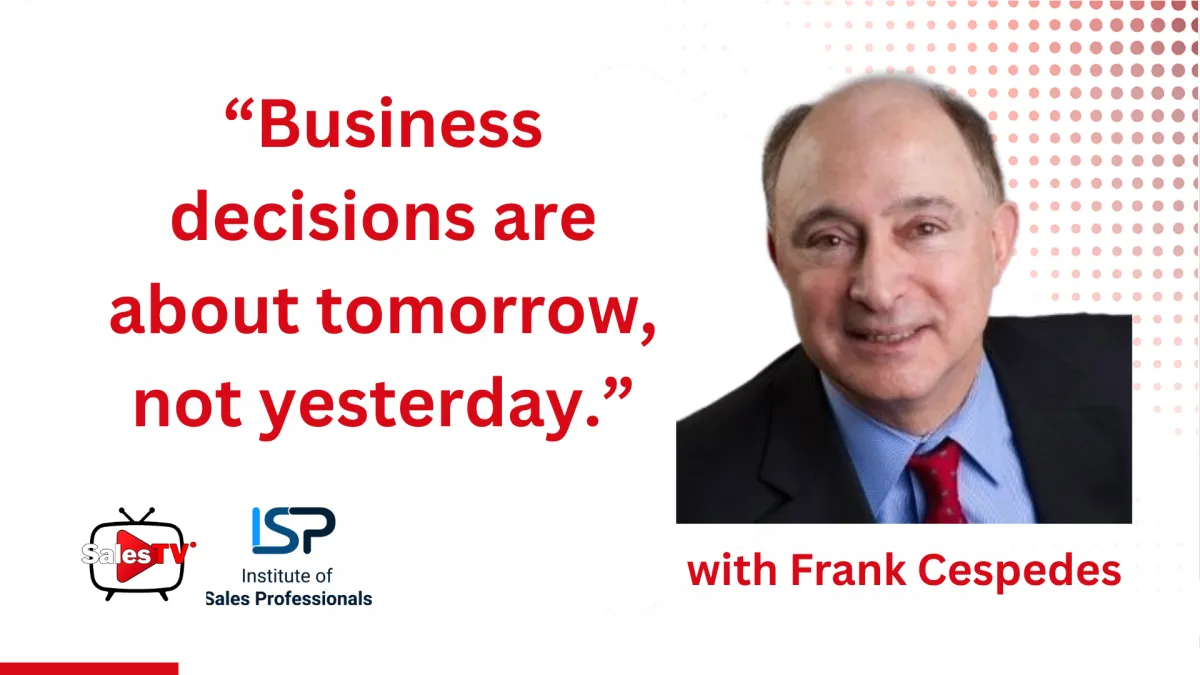
The Future of Sales Leadership Is More Human Than You Think
Effective sales leadership focuses on preparing teams for what comes next. Coaching and strengthening decision-making remain critical even as market conditions continue to shift.
In this episode of SalesTV, Harvard Business School’s Frank Cespedes explains why leadership clarity, performance management, and frontline alignment will define sales success as the future of selling continues to evolve. As AI automates more routine tasks and uncertainty becomes a permanent feature of the landscape, the leaders who succeed are those who can articulate priorities, elevate capability, and connect strategy to the daily behaviors that drive revenue.
We’ll ask questions like –
* How do Sales Leaders prepare their teams for a future where AI automates more of the selling process?
* When uncertainty becomes a permanent part of the sales environment, how do Sales Leaders strengthen decision-making and judgment?
* How should Sales Leaders align strategy and frontline behavior to improve sales execution?
* Why does performance feedback become more important as automation expands, and how do Sales Leaders deliver it effectively?
Frank Cespedes is a Senior Lecturer at Harvard Business School and the author of “Sales Management That Works” and “Aligning Strategy and Sales”. His work focuses on how organizations connect strategy to frontline sales behaviors, how leaders develop people through performance management, and how companies adapt to shifting buyer expectations. With decades of experience as an operator, board member, advisor, and researcher, he brings a rare combination of practical insight and academic rigor to the future of sales leadership.
Join us live and be part of the conversation.
This week's Guest was -
Frank Cespedes, Harvard Business School lecturer, author, and sales expert..
This week's Host was -
Rob Durant, CEO of US Operations at The Institute of Sales Professionals
Transcript of SalesTV.live Mid-Day Edition 2025-12-16
Rob Durant [00:00:02]:
Hello and welcome to another edition of SalesTV Live. Today we're discussing the future of sales leadership. It's more human than you think. We're joined once again by Frank Cesperis. Frank is a senior lecturer at Harvard Business School and the author of Sales Management that works with decades of experience as an operator, board member, advisor and researcher. He brings a rare combination of practical insights and academic rigor to the future of sales leadership. Frank, welcome back.
Frank Cespedes [00:00:38]:
Rob, my pleasure to be here. And after that gracious introduction, I can hardly wait to hear what I have to say.
Rob Durant [00:00:47]:
Me too. So let's jump right into it. Frank, in a top sales magazine article you once wrote, business decisions are about tomorrow, not yesterday. Yet all our metrics are measures of past performance. How can we resolve this apparent contradiction?
Frank Cespedes [00:01:05]:
Well, I mean, I don't think you resolve it, you know, by looking to the algorithm or some equation to do that. Data is almost by definition a lagging indicator, especially in sales. It's about outcomes, it's about stuff that has already happened. But as you said, quoting me, business decisions are about today and tomorrow. You know, it's only academics, it's only professors who get paid to talk about the past. Business people have to manage the future. But that's what you get paid for. I don't consider that a contradiction.
Frank Cespedes [00:01:48]:
I consider that the human condition, if you see what I'm getting at. And while I agree with you, salespeople and sales managers tend to complain about that a lot. You know, they'll always talk about, well, we're too short term, etc. All I can say to that, I love to quote that line that you hear in many of the gangster movies. You chose this life, that is the job, that is the task. That doesn't mean you ignore lagging data, but part of what management is, is the ability to use that experience and judgment and say, of the various stuff I have, what are the leading indicators?
Rob Durant [00:02:36]:
Excellent. So in that case, how should sales leaders align strategy and frontline behavior to improve sales execution?
Frank Cespedes [00:02:48]:
Well, I mean, you know, as with most really important things in business and life, there's no one answer to that. It's almost always a perfect storm. There are a variety of things that that are involved, but you begin with strategy. First, make sure that your business is has a business strategy as opposed to purpose, mission, values, vision, you know, all these other things that are important but are not the same as a strategy. A strategy is a set of actions and resource allocations that we believe will get us from here to there. Now you know I'll just say one more comment about that at this point in my balding career. Rob, I have been part of as many strategy discussions with companies around the world as anyone. I think I can say that with no false modesty.
Frank Cespedes [00:03:54]:
And the reality is, despite decades of publications about strategy, most executives, when you cut through the rhetoric when they talk about strategy, are basically saying, let's pick a big number and go for it. Unfortunately, it's a little more complicated than that. So first you begin by making sure that we have a business strategy. If you do have a business strategy, that strategy is making choices about where you play and where you don't play in your market and your industry. And in turn, those choices say something about who is and who is not our customer and how they buy, what their buying criteria are, etc. Those factors, those external factors, establish the key sales tasks in the business. Then the issue is how do I align my people's actual behaviors with those required tasks that flow from my strategy? And basically, managers have three levers to affect that one. And the most important one, despite AI and everything else, is still people.
Frank Cespedes [00:05:15]:
Who do we hire, why, how do we onboard them, etc. Etc. The second is the control systems. How do do we measure their performance, how do we pay them, what, what are the incentives, et cetera. And the third is, I call it the salesforce environment. But ultimately I'm talking about company culture. What are the links, if any, between sales and other important activities in the business, whether it's product, service, marketing, et cetera. What happens to sales managers in the business? You do they stay there forever or are they among the pool of candidates for general management running a line of business? That's the way I think about that topic.
Frank Cespedes [00:06:06]:
And again, it's a whole variety of things that have to be aligned, but that is the nature of any business model. And sales is part of a business model. It is not the same as a business model.
Rob Durant [00:06:21]:
I love how you brought it right back to the basics. I teach an intro to marketing course and one of the first things that we talk about is determining who is your ideal target audience and just as importantly, who is not. And as you were talking about sales strategy, nothing changed there.
Frank Cespedes [00:06:41]:
Yeah, no, two things. My background, as you know, I was an academic, left, ran a business for a decade, got lucky, came back when I left academia and actually had to do business and meet payroll every month. I was very, very impressed by how far you can get by doing the basics a little bit better than your competitors, you know. And the second thing that, that I would say about that is, I think the basics are even more important as technology in effect begins to automate some of the administrative and other things that occupy so much time in sales, management and in selling.
Rob Durant [00:07:33]:
So we've touched on technology a couple of times now. I'm going to dig into that a little bit more. How do sales leaders prepare their teams for a future where AI automates more of the selling process?
Frank Cespedes [00:07:48]:
Well, I mean, the first is you got to step back. I mean, we are in the very, very early stages of what's clearly going to be an industrial revolution. But as with any industrial revolution, there's a huge amount of uncertainty and an even huger amount of hype. And AI artificial intelligence, and is a classic example of that right now, in my experience, Rob, most executives, not just in sales, but across the C suite, they basically use AI as a very loose term for almost any digital intervention. And they do that, by the way, not only because they're not computer scientists, they, they do it because of the nature of budgeting. In organizational life, when the new hot thing comes along, managers jump on that bandwagon. No matter what they're doing, they're gonna call it whatever is the new hot thing, because that's how you get, quote, your fair share of the budget. So the first is you gotta step back.
Frank Cespedes [00:08:59]:
What is it that I'm talking about when I talk about AI? The core value proposition at the heart of these large language models that generate AI? The core value proposition is that the algorithm can do almost as good as job as people, in some cases a better job than people at certain tasks, so that it frees up time for people to do the things that they can do better than machines because of their judgment, experience, etc. Now, in sales in particular, freeing up time is a very, very big deal. I find most executives are surprised by the data I'm about to cite, but the research here is pretty good. If you ask yourself a basic question. How much time does the average sales rep spend in customer contact? And by customer contact, I don't just mean making a pitch virtually or in person. I mean all forms of customer contact, demos, webinars, email, etc. The data varies by company, but on average it's about 30 to 35%. Right now think about if you're running a sales organization and you can make that 40% or, you know, amazingly, 50% or more.
Frank Cespedes [00:10:38]:
Not only is that an enormous productivity increase, it also increases the total addressable market for your business because segments that were economically infeasible and now become feasible with better go to market utilization. What does that mean for managers in AI? Well, in some respects it gets us back to the basics. Your comment? Do not ignore the low hanging fruit. I would leave it to all these pundits to talk about how AI is going to change humanity. They know no more about that than you or I do. But in sales, what AI can help with today, not 10 years from now, content marketing, email lists, establishing a cadence for contacting customers in an omnichannel buying world. That's where the productivity improvements are today. That's where I would focus.
Rob Durant [00:11:46]:
What about in turn? Excuse me, what about in terms of performance feedback? As more AI becomes capable of assessing a recorded call and providing feedback, how much should sales leaders remain involved in that process? And if we need to free up time, can't we just outsource that to AI?
Frank Cespedes [00:12:15]:
My answer, and I'm going to say no. And this I think is a very, very strong no. First, let me explain why performance feedback is so vital and then why I think it's a huge mistake to outsource that to AI. In my experience, performance reviews, especially in sales, but not only in sales, are the most neglected lever for actually affecting behavior. People don't like to do reviews. They don't like giving the candid feedback. Every year, like clockwork, there'll be some article in Harvard Business Review about let's get rid of performance reviews. I think that's a big, big mistake.
Frank Cespedes [00:13:04]:
And it's especially big mistake in sales. Buying is changing. It's changing big time because of technology, of which AI is one component and the most important data in most companies about buying. Who buys why and how is not in the CRM system. That is notoriously noisy, unreliable data. Not because of the software, but because of the inputs. Right? Very subjective inputs, rep by rep by rep. That buying information only becomes visible and actionable when you do a good performance or account review with your people.
Frank Cespedes [00:13:51]:
So when sales managers do what I call drive by reviews, you know, I'm busy. Let me just get rid of this thing. Not only are they perpetuating a culture of underperformance, they're inhibiting the flow of vital information about the market in the organization. That's why that's important. Now why not outsource this to AI? I think for a couple of things. What is a performance review about? It's essentially about usually about compensation, evaluation, career possibilities. It's about motivation, we hope it's about professional development and making that salesperson more productive. Do you really Want to outsource that to a machine.
Frank Cespedes [00:14:49]:
So that's comment number one. Comment number two is understand what the machine does. What large, these large language models do, they scrape the data you put in there and they come back. Usually, in my experience with this, with what I would call all purpose platitudes, you know, Rob, I looked at your results. I think you should sell more, you should sell better, you know, you should improve. Wow, I never thought of that. You know, that sort of thing. And the reality in any salesforce is it's composed of very different people, people that have different strengths and weaknesses.
Frank Cespedes [00:15:31]:
You know, Rob, unlike you and me, most people are not perfect, right? They're good at certain things, they're not so good at other things. That's what a manager gets paid to do. And algorithms just simply can't do that. What the algorithm can do, I think, is assemble some of the relevant data for you, give you, the manager, things to think about. But to outsource that vital human activity to AI, I think it's just a big, big mistake.
Rob Durant [00:16:05]:
Absolutely. But you are all for AI when it comes to the administrator.
Frank Cespedes [00:16:13]:
Yeah, but by administrator, I don't just mean increasing the enormous amount of time that most salespeople these days do spend on filling out this, filling out that. I mean other parts of the marketing and sales model. I think when it comes to content marketing, to be blunt, most content marketing is platitudes. The platitude machine can generate that, it can automate the email list, it can establish a cadence for dealing with buyers. You know, the research. Think about inside sales models. For example, research tells us you've got to now spend something like seven or eight calls to contact someone who's clicked on the link. Send me the content marketing.
Frank Cespedes [00:17:03]:
And most inside sales reps give up after three calls. That's where a machine can help you. Performance reviews, that's a category mistake. That's a very, very different kind of managerial activity.
Rob Durant [00:17:20]:
So as the administrative tasks become increasingly automated, what skills will sales leaders need most as the future of selling evolves?
Frank Cespedes [00:17:31]:
Well, we once again get back to the basics. A. Not only are you likely to see those administrative tasks go the way of the machine, but a lot of transactional sales will go there. That's sort of been the history of automation for the last 30 to 40 years. This. But by the way, this is what you should expect. You know, I'm going to phrase this bluntly, and when I do, I notice that many in our audience may laugh, but when you think about it, you'll see what I'm getting at. In business, you do not compete with the dead.
Frank Cespedes [00:18:10]:
In other words, you don't compete with companies that have gone out of business. You only compete with the survivors. What does it take to survive in business? As the market changes, you have to adopt best practices. Those that do survive, those that don't, you know, they, they go away and you don't compete with them. In other words, the bar is always raising. AI is no different in that respect. And as the bar is raised, what you might call those value added skills become more and more important. Do you really understand your customer? Do you understand your customer's value proposition? Do you understand how what your customer sells generates the relevant outcomes for those customers? Who buys there? How do you establish access and, and then relationships there? Now notice nothing I just said in the last 40 seconds I think is new, but it does become not only perennially relevant, but more important as the other stuff, you know, becomes easier and easier to do.
Rob Durant [00:19:28]:
That's got me thinking. So how should sales leaders think about the future of selling when uncertainty continues to rise?
Frank Cespedes [00:19:41]:
Well, it's a good question and again, I don't think there's any one answer there. But you know, I begin always with what are the facts as opposed to, you know, geez, it's uncertain. Do you understand what is and is not changing in your marketplace? Now that is an area where the data, as much as it's a lagging indicator, can help us. Right? So, and most sales organizations these days, Rob, have no excuse. They're, they're flooded with data. That's not the issue. The issue is do they know the right questions to ask of that data. So let's begin by understanding what is changing, what is not changing.
Frank Cespedes [00:20:27]:
I'll give you an example. For many, many years, the notion was E Commerce is going to take over the world. E Commerce as a percentage of total US retail sales after 35 years and a pandemic is about 16%. In other words, most of buying has not gone online. It hasn't changed. On the other hand, just in the past year, AI has dramatically changed the nature of search. So if you're running, you know, an inbound marketing inside sales model and you depend on lead generation by, among other things, search by the buyer, that is a big change. And it is not the market's responsibility to send you an email and say, hey, guess what, we're changing.
Frank Cespedes [00:21:26]:
It's your responsibility as a manager to figure that out. Then I think the generic issue about uncertainty, it requires flexibility and that ultimately has an economic component. What in our current business model, as well as our sales model, is, is now a fixed cost that we may be able to change into a variable cost and as a result increase our flexibility in the face of uncertainty. And this is an area where, in my experience, clever and creative managers are using AI productively to turn certain fixed costs into variable costs.
Rob Durant [00:22:15]:
So, Frank, if you were to emphasize the one thing you would want our audience to take away from today's episode, what would that one thing be?
Frank Cespedes [00:22:26]:
Well, as we, as they say in the poker games, rob, I see you and raise you. Can I do two things.
Rob Durant [00:22:32]:
Have at it.
Frank Cespedes [00:22:34]:
The the first and this first thing I'm going to emphasize, you can see is a theme running through my responses to your excellent questions. Sales managers must manage. You can't punt there. You can't send the performance review to AI. You can't assume that the data or the algorithm is going to do this again. You chose this life. Sales managers must manage. Growth does not happen by accident.
Frank Cespedes [00:23:04]:
That's why we have people that we call managers. And then the second thing gets me back to that data about the percentage of time that most salespeople spend in customer contact. Increasing that percentage is not only very important for productivity, increasing the addressable market, but it is the main way you stay in touch with. You know, I wrote a book about a decade ago and I quoted a comment, the novelist John Le Carre, you may remember him, who wrote these spy novels. And in one of his spy novels, a character says something that in my opinion should be tattooed to a prominent body part of managers. And the comment is a desk is a dangerous place from which to watch the world. And that is true. And many managers think they can do it from the desk they really believe they can manage via the spreadsheet.
Frank Cespedes [00:24:13]:
That's not true. It wasn't true when Le Carre was writing his novels. It's not true today. So those would be my two takeaways. You must manage and customer contact remains as important, important as ever.
Rob Durant [00:24:28]:
Excellent, Frank. This has been great. On behalf of everyone here at Sales tv, to you and to our audience, thank you for being an active part in today's conversation.
Frank Cespedes [00:24:41]:
Well, my, my thank you to you and my best wishes for the holidays to you and our viewers and to.
Rob Durant [00:24:50]:
You as well, to our viewers. If you liked what you heard today, please take a moment to leave a review on Apple Podcasts, Spotify, Substack or YouTube. Let us know what you learned and what you'd like to learn more about your feedback helps us reach more people like you and fulfill our mission of elevating the profession of sales. Thank you all, and we'll see you next time.
@SalesTVlive
#MoreHuman #FutureOfSales #PerformanceManagement #AISales
#Sales #SalesLeadership #LinkedInLive #Podcast
________________________________________
About SalesTV: SalesTV is a weekly talk show created by salespeople, for salespeople. Each episode explores sales, sales training, sales enablement, and social selling, bringing together sales leaders, enablement professionals, and practitioners from across the globe.
About the Institute of Sales Professionals: The ISP is the only body worldwide dedicated to raising the standards of sales. Its Sales Capability Framework, certifications, and member community are designed to address their one goal: To Elevate the Profession of Sales.

Mid-Day Edition
The Future of Sales Leadership Is More Human Than You Think
Effective sales leadership focuses on preparing teams for what comes next. Coaching and strengthening decision-making remain critical even as market conditions continue to shift.
In this episode of SalesTV, Harvard Business School’s Frank Cespedes explains why leadership clarity, performance management, and frontline alignment will define sales success as the future of selling continues to evolve. As AI automates more routine tasks and uncertainty becomes a permanent feature of the landscape, the leaders who succeed are those who can articulate priorities, elevate capability, and connect strategy to the daily behaviors that drive revenue.
We’ll ask questions like –
* How do Sales Leaders prepare their teams for a future where AI automates more of the selling process?
* When uncertainty becomes a permanent part of the sales environment, how do Sales Leaders strengthen decision-making and judgment?
* How should Sales Leaders align strategy and frontline behavior to improve sales execution?
* Why does performance feedback become more important as automation expands, and how do Sales Leaders deliver it effectively?
Frank Cespedes is a Senior Lecturer at Harvard Business School and the author of “Sales Management That Works” and “Aligning Strategy and Sales”. His work focuses on how organizations connect strategy to frontline sales behaviors, how leaders develop people through performance management, and how companies adapt to shifting buyer expectations. With decades of experience as an operator, board member, advisor, and researcher, he brings a rare combination of practical insight and academic rigor to the future of sales leadership.
Join us live and be part of the conversation.
This week's Guest was -
Frank Cespedes, Harvard Business School lecturer, author, and sales expert..
This week's Host was -
Rob Durant, CEO of US Operations at The Institute of Sales Professionals
Transcript of SalesTV.live Mid-Day Edition 2025-12-16
Rob Durant [00:00:02]:
Hello and welcome to another edition of SalesTV Live. Today we're discussing the future of sales leadership. It's more human than you think. We're joined once again by Frank Cesperis. Frank is a senior lecturer at Harvard Business School and the author of Sales Management that works with decades of experience as an operator, board member, advisor and researcher. He brings a rare combination of practical insights and academic rigor to the future of sales leadership. Frank, welcome back.
Frank Cespedes [00:00:38]:
Rob, my pleasure to be here. And after that gracious introduction, I can hardly wait to hear what I have to say.
Rob Durant [00:00:47]:
Me too. So let's jump right into it. Frank, in a top sales magazine article you once wrote, business decisions are about tomorrow, not yesterday. Yet all our metrics are measures of past performance. How can we resolve this apparent contradiction?
Frank Cespedes [00:01:05]:
Well, I mean, I don't think you resolve it, you know, by looking to the algorithm or some equation to do that. Data is almost by definition a lagging indicator, especially in sales. It's about outcomes, it's about stuff that has already happened. But as you said, quoting me, business decisions are about today and tomorrow. You know, it's only academics, it's only professors who get paid to talk about the past. Business people have to manage the future. But that's what you get paid for. I don't consider that a contradiction.
Frank Cespedes [00:01:48]:
I consider that the human condition, if you see what I'm getting at. And while I agree with you, salespeople and sales managers tend to complain about that a lot. You know, they'll always talk about, well, we're too short term, etc. All I can say to that, I love to quote that line that you hear in many of the gangster movies. You chose this life, that is the job, that is the task. That doesn't mean you ignore lagging data, but part of what management is, is the ability to use that experience and judgment and say, of the various stuff I have, what are the leading indicators?
Rob Durant [00:02:36]:
Excellent. So in that case, how should sales leaders align strategy and frontline behavior to improve sales execution?
Frank Cespedes [00:02:48]:
Well, I mean, you know, as with most really important things in business and life, there's no one answer to that. It's almost always a perfect storm. There are a variety of things that that are involved, but you begin with strategy. First, make sure that your business is has a business strategy as opposed to purpose, mission, values, vision, you know, all these other things that are important but are not the same as a strategy. A strategy is a set of actions and resource allocations that we believe will get us from here to there. Now you know I'll just say one more comment about that at this point in my balding career. Rob, I have been part of as many strategy discussions with companies around the world as anyone. I think I can say that with no false modesty.
Frank Cespedes [00:03:54]:
And the reality is, despite decades of publications about strategy, most executives, when you cut through the rhetoric when they talk about strategy, are basically saying, let's pick a big number and go for it. Unfortunately, it's a little more complicated than that. So first you begin by making sure that we have a business strategy. If you do have a business strategy, that strategy is making choices about where you play and where you don't play in your market and your industry. And in turn, those choices say something about who is and who is not our customer and how they buy, what their buying criteria are, etc. Those factors, those external factors, establish the key sales tasks in the business. Then the issue is how do I align my people's actual behaviors with those required tasks that flow from my strategy? And basically, managers have three levers to affect that one. And the most important one, despite AI and everything else, is still people.
Frank Cespedes [00:05:15]:
Who do we hire, why, how do we onboard them, etc. Etc. The second is the control systems. How do do we measure their performance, how do we pay them, what, what are the incentives, et cetera. And the third is, I call it the salesforce environment. But ultimately I'm talking about company culture. What are the links, if any, between sales and other important activities in the business, whether it's product, service, marketing, et cetera. What happens to sales managers in the business? You do they stay there forever or are they among the pool of candidates for general management running a line of business? That's the way I think about that topic.
Frank Cespedes [00:06:06]:
And again, it's a whole variety of things that have to be aligned, but that is the nature of any business model. And sales is part of a business model. It is not the same as a business model.
Rob Durant [00:06:21]:
I love how you brought it right back to the basics. I teach an intro to marketing course and one of the first things that we talk about is determining who is your ideal target audience and just as importantly, who is not. And as you were talking about sales strategy, nothing changed there.
Frank Cespedes [00:06:41]:
Yeah, no, two things. My background, as you know, I was an academic, left, ran a business for a decade, got lucky, came back when I left academia and actually had to do business and meet payroll every month. I was very, very impressed by how far you can get by doing the basics a little bit better than your competitors, you know. And the second thing that, that I would say about that is, I think the basics are even more important as technology in effect begins to automate some of the administrative and other things that occupy so much time in sales, management and in selling.
Rob Durant [00:07:33]:
So we've touched on technology a couple of times now. I'm going to dig into that a little bit more. How do sales leaders prepare their teams for a future where AI automates more of the selling process?
Frank Cespedes [00:07:48]:
Well, I mean, the first is you got to step back. I mean, we are in the very, very early stages of what's clearly going to be an industrial revolution. But as with any industrial revolution, there's a huge amount of uncertainty and an even huger amount of hype. And AI artificial intelligence, and is a classic example of that right now, in my experience, Rob, most executives, not just in sales, but across the C suite, they basically use AI as a very loose term for almost any digital intervention. And they do that, by the way, not only because they're not computer scientists, they, they do it because of the nature of budgeting. In organizational life, when the new hot thing comes along, managers jump on that bandwagon. No matter what they're doing, they're gonna call it whatever is the new hot thing, because that's how you get, quote, your fair share of the budget. So the first is you gotta step back.
Frank Cespedes [00:08:59]:
What is it that I'm talking about when I talk about AI? The core value proposition at the heart of these large language models that generate AI? The core value proposition is that the algorithm can do almost as good as job as people, in some cases a better job than people at certain tasks, so that it frees up time for people to do the things that they can do better than machines because of their judgment, experience, etc. Now, in sales in particular, freeing up time is a very, very big deal. I find most executives are surprised by the data I'm about to cite, but the research here is pretty good. If you ask yourself a basic question. How much time does the average sales rep spend in customer contact? And by customer contact, I don't just mean making a pitch virtually or in person. I mean all forms of customer contact, demos, webinars, email, etc. The data varies by company, but on average it's about 30 to 35%. Right now think about if you're running a sales organization and you can make that 40% or, you know, amazingly, 50% or more.
Frank Cespedes [00:10:38]:
Not only is that an enormous productivity increase, it also increases the total addressable market for your business because segments that were economically infeasible and now become feasible with better go to market utilization. What does that mean for managers in AI? Well, in some respects it gets us back to the basics. Your comment? Do not ignore the low hanging fruit. I would leave it to all these pundits to talk about how AI is going to change humanity. They know no more about that than you or I do. But in sales, what AI can help with today, not 10 years from now, content marketing, email lists, establishing a cadence for contacting customers in an omnichannel buying world. That's where the productivity improvements are today. That's where I would focus.
Rob Durant [00:11:46]:
What about in turn? Excuse me, what about in terms of performance feedback? As more AI becomes capable of assessing a recorded call and providing feedback, how much should sales leaders remain involved in that process? And if we need to free up time, can't we just outsource that to AI?
Frank Cespedes [00:12:15]:
My answer, and I'm going to say no. And this I think is a very, very strong no. First, let me explain why performance feedback is so vital and then why I think it's a huge mistake to outsource that to AI. In my experience, performance reviews, especially in sales, but not only in sales, are the most neglected lever for actually affecting behavior. People don't like to do reviews. They don't like giving the candid feedback. Every year, like clockwork, there'll be some article in Harvard Business Review about let's get rid of performance reviews. I think that's a big, big mistake.
Frank Cespedes [00:13:04]:
And it's especially big mistake in sales. Buying is changing. It's changing big time because of technology, of which AI is one component and the most important data in most companies about buying. Who buys why and how is not in the CRM system. That is notoriously noisy, unreliable data. Not because of the software, but because of the inputs. Right? Very subjective inputs, rep by rep by rep. That buying information only becomes visible and actionable when you do a good performance or account review with your people.
Frank Cespedes [00:13:51]:
So when sales managers do what I call drive by reviews, you know, I'm busy. Let me just get rid of this thing. Not only are they perpetuating a culture of underperformance, they're inhibiting the flow of vital information about the market in the organization. That's why that's important. Now why not outsource this to AI? I think for a couple of things. What is a performance review about? It's essentially about usually about compensation, evaluation, career possibilities. It's about motivation, we hope it's about professional development and making that salesperson more productive. Do you really Want to outsource that to a machine.
Frank Cespedes [00:14:49]:
So that's comment number one. Comment number two is understand what the machine does. What large, these large language models do, they scrape the data you put in there and they come back. Usually, in my experience with this, with what I would call all purpose platitudes, you know, Rob, I looked at your results. I think you should sell more, you should sell better, you know, you should improve. Wow, I never thought of that. You know, that sort of thing. And the reality in any salesforce is it's composed of very different people, people that have different strengths and weaknesses.
Frank Cespedes [00:15:31]:
You know, Rob, unlike you and me, most people are not perfect, right? They're good at certain things, they're not so good at other things. That's what a manager gets paid to do. And algorithms just simply can't do that. What the algorithm can do, I think, is assemble some of the relevant data for you, give you, the manager, things to think about. But to outsource that vital human activity to AI, I think it's just a big, big mistake.
Rob Durant [00:16:05]:
Absolutely. But you are all for AI when it comes to the administrator.
Frank Cespedes [00:16:13]:
Yeah, but by administrator, I don't just mean increasing the enormous amount of time that most salespeople these days do spend on filling out this, filling out that. I mean other parts of the marketing and sales model. I think when it comes to content marketing, to be blunt, most content marketing is platitudes. The platitude machine can generate that, it can automate the email list, it can establish a cadence for dealing with buyers. You know, the research. Think about inside sales models. For example, research tells us you've got to now spend something like seven or eight calls to contact someone who's clicked on the link. Send me the content marketing.
Frank Cespedes [00:17:03]:
And most inside sales reps give up after three calls. That's where a machine can help you. Performance reviews, that's a category mistake. That's a very, very different kind of managerial activity.
Rob Durant [00:17:20]:
So as the administrative tasks become increasingly automated, what skills will sales leaders need most as the future of selling evolves?
Frank Cespedes [00:17:31]:
Well, we once again get back to the basics. A. Not only are you likely to see those administrative tasks go the way of the machine, but a lot of transactional sales will go there. That's sort of been the history of automation for the last 30 to 40 years. This. But by the way, this is what you should expect. You know, I'm going to phrase this bluntly, and when I do, I notice that many in our audience may laugh, but when you think about it, you'll see what I'm getting at. In business, you do not compete with the dead.
Frank Cespedes [00:18:10]:
In other words, you don't compete with companies that have gone out of business. You only compete with the survivors. What does it take to survive in business? As the market changes, you have to adopt best practices. Those that do survive, those that don't, you know, they, they go away and you don't compete with them. In other words, the bar is always raising. AI is no different in that respect. And as the bar is raised, what you might call those value added skills become more and more important. Do you really understand your customer? Do you understand your customer's value proposition? Do you understand how what your customer sells generates the relevant outcomes for those customers? Who buys there? How do you establish access and, and then relationships there? Now notice nothing I just said in the last 40 seconds I think is new, but it does become not only perennially relevant, but more important as the other stuff, you know, becomes easier and easier to do.
Rob Durant [00:19:28]:
That's got me thinking. So how should sales leaders think about the future of selling when uncertainty continues to rise?
Frank Cespedes [00:19:41]:
Well, it's a good question and again, I don't think there's any one answer there. But you know, I begin always with what are the facts as opposed to, you know, geez, it's uncertain. Do you understand what is and is not changing in your marketplace? Now that is an area where the data, as much as it's a lagging indicator, can help us. Right? So, and most sales organizations these days, Rob, have no excuse. They're, they're flooded with data. That's not the issue. The issue is do they know the right questions to ask of that data. So let's begin by understanding what is changing, what is not changing.
Frank Cespedes [00:20:27]:
I'll give you an example. For many, many years, the notion was E Commerce is going to take over the world. E Commerce as a percentage of total US retail sales after 35 years and a pandemic is about 16%. In other words, most of buying has not gone online. It hasn't changed. On the other hand, just in the past year, AI has dramatically changed the nature of search. So if you're running, you know, an inbound marketing inside sales model and you depend on lead generation by, among other things, search by the buyer, that is a big change. And it is not the market's responsibility to send you an email and say, hey, guess what, we're changing.
Frank Cespedes [00:21:26]:
It's your responsibility as a manager to figure that out. Then I think the generic issue about uncertainty, it requires flexibility and that ultimately has an economic component. What in our current business model, as well as our sales model, is, is now a fixed cost that we may be able to change into a variable cost and as a result increase our flexibility in the face of uncertainty. And this is an area where, in my experience, clever and creative managers are using AI productively to turn certain fixed costs into variable costs.
Rob Durant [00:22:15]:
So, Frank, if you were to emphasize the one thing you would want our audience to take away from today's episode, what would that one thing be?
Frank Cespedes [00:22:26]:
Well, as we, as they say in the poker games, rob, I see you and raise you. Can I do two things.
Rob Durant [00:22:32]:
Have at it.
Frank Cespedes [00:22:34]:
The the first and this first thing I'm going to emphasize, you can see is a theme running through my responses to your excellent questions. Sales managers must manage. You can't punt there. You can't send the performance review to AI. You can't assume that the data or the algorithm is going to do this again. You chose this life. Sales managers must manage. Growth does not happen by accident.
Frank Cespedes [00:23:04]:
That's why we have people that we call managers. And then the second thing gets me back to that data about the percentage of time that most salespeople spend in customer contact. Increasing that percentage is not only very important for productivity, increasing the addressable market, but it is the main way you stay in touch with. You know, I wrote a book about a decade ago and I quoted a comment, the novelist John Le Carre, you may remember him, who wrote these spy novels. And in one of his spy novels, a character says something that in my opinion should be tattooed to a prominent body part of managers. And the comment is a desk is a dangerous place from which to watch the world. And that is true. And many managers think they can do it from the desk they really believe they can manage via the spreadsheet.
Frank Cespedes [00:24:13]:
That's not true. It wasn't true when Le Carre was writing his novels. It's not true today. So those would be my two takeaways. You must manage and customer contact remains as important, important as ever.
Rob Durant [00:24:28]:
Excellent, Frank. This has been great. On behalf of everyone here at Sales tv, to you and to our audience, thank you for being an active part in today's conversation.
Frank Cespedes [00:24:41]:
Well, my, my thank you to you and my best wishes for the holidays to you and our viewers and to.
Rob Durant [00:24:50]:
You as well, to our viewers. If you liked what you heard today, please take a moment to leave a review on Apple Podcasts, Spotify, Substack or YouTube. Let us know what you learned and what you'd like to learn more about your feedback helps us reach more people like you and fulfill our mission of elevating the profession of sales. Thank you all, and we'll see you next time.
@SalesTVlive
#MoreHuman #FutureOfSales #PerformanceManagement #AISales
#Sales #SalesLeadership #LinkedInLive #Podcast
________________________________________
About SalesTV: SalesTV is a weekly talk show created by salespeople, for salespeople. Each episode explores sales, sales training, sales enablement, and social selling, bringing together sales leaders, enablement professionals, and practitioners from across the globe.
About the Institute of Sales Professionals: The ISP is the only body worldwide dedicated to raising the standards of sales. Its Sales Capability Framework, certifications, and member community are designed to address their one goal: To Elevate the Profession of Sales.
Other Editions
The Future of Sales Leadership Is More Human Than You Think
Effective sales leadership focuses on preparing teams for what comes next. Coaching and strengthening decision-making remain critical even as market conditions continue to shift.
In this episode of SalesTV, Harvard Business School’s Frank Cespedes explains why leadership clarity, performance management, and frontline alignment will define sales success as the future of selling continues to evolve. As AI automates more routine tasks and uncertainty becomes a permanent feature of the landscape, the leaders who succeed are those who can articulate priorities, elevate capability, and connect strategy to the daily behaviors that drive revenue.
We’ll ask questions like –
* How do Sales Leaders prepare their teams for a future where AI automates more of the selling process?
* When uncertainty becomes a permanent part of the sales environment, how do Sales Leaders strengthen decision-making and judgment?
* How should Sales Leaders align strategy and frontline behavior to improve sales execution?
* Why does performance feedback become more important as automation expands, and how do Sales Leaders deliver it effectively?
Frank Cespedes is a Senior Lecturer at Harvard Business School and the author of “Sales Management That Works” and “Aligning Strategy and Sales”. His work focuses on how organizations connect strategy to frontline sales behaviors, how leaders develop people through performance management, and how companies adapt to shifting buyer expectations. With decades of experience as an operator, board member, advisor, and researcher, he brings a rare combination of practical insight and academic rigor to the future of sales leadership.
Join us live and be part of the conversation.
This week's Guest was -
Frank Cespedes, Harvard Business School lecturer, author, and sales expert..
This week's Host was -
Rob Durant, CEO of US Operations at The Institute of Sales Professionals
Transcript of SalesTV.live Mid-Day Edition 2025-12-16
Rob Durant [00:00:02]:
Hello and welcome to another edition of SalesTV Live. Today we're discussing the future of sales leadership. It's more human than you think. We're joined once again by Frank Cesperis. Frank is a senior lecturer at Harvard Business School and the author of Sales Management that works with decades of experience as an operator, board member, advisor and researcher. He brings a rare combination of practical insights and academic rigor to the future of sales leadership. Frank, welcome back.
Frank Cespedes [00:00:38]:
Rob, my pleasure to be here. And after that gracious introduction, I can hardly wait to hear what I have to say.
Rob Durant [00:00:47]:
Me too. So let's jump right into it. Frank, in a top sales magazine article you once wrote, business decisions are about tomorrow, not yesterday. Yet all our metrics are measures of past performance. How can we resolve this apparent contradiction?
Frank Cespedes [00:01:05]:
Well, I mean, I don't think you resolve it, you know, by looking to the algorithm or some equation to do that. Data is almost by definition a lagging indicator, especially in sales. It's about outcomes, it's about stuff that has already happened. But as you said, quoting me, business decisions are about today and tomorrow. You know, it's only academics, it's only professors who get paid to talk about the past. Business people have to manage the future. But that's what you get paid for. I don't consider that a contradiction.
Frank Cespedes [00:01:48]:
I consider that the human condition, if you see what I'm getting at. And while I agree with you, salespeople and sales managers tend to complain about that a lot. You know, they'll always talk about, well, we're too short term, etc. All I can say to that, I love to quote that line that you hear in many of the gangster movies. You chose this life, that is the job, that is the task. That doesn't mean you ignore lagging data, but part of what management is, is the ability to use that experience and judgment and say, of the various stuff I have, what are the leading indicators?
Rob Durant [00:02:36]:
Excellent. So in that case, how should sales leaders align strategy and frontline behavior to improve sales execution?
Frank Cespedes [00:02:48]:
Well, I mean, you know, as with most really important things in business and life, there's no one answer to that. It's almost always a perfect storm. There are a variety of things that that are involved, but you begin with strategy. First, make sure that your business is has a business strategy as opposed to purpose, mission, values, vision, you know, all these other things that are important but are not the same as a strategy. A strategy is a set of actions and resource allocations that we believe will get us from here to there. Now you know I'll just say one more comment about that at this point in my balding career. Rob, I have been part of as many strategy discussions with companies around the world as anyone. I think I can say that with no false modesty.
Frank Cespedes [00:03:54]:
And the reality is, despite decades of publications about strategy, most executives, when you cut through the rhetoric when they talk about strategy, are basically saying, let's pick a big number and go for it. Unfortunately, it's a little more complicated than that. So first you begin by making sure that we have a business strategy. If you do have a business strategy, that strategy is making choices about where you play and where you don't play in your market and your industry. And in turn, those choices say something about who is and who is not our customer and how they buy, what their buying criteria are, etc. Those factors, those external factors, establish the key sales tasks in the business. Then the issue is how do I align my people's actual behaviors with those required tasks that flow from my strategy? And basically, managers have three levers to affect that one. And the most important one, despite AI and everything else, is still people.
Frank Cespedes [00:05:15]:
Who do we hire, why, how do we onboard them, etc. Etc. The second is the control systems. How do do we measure their performance, how do we pay them, what, what are the incentives, et cetera. And the third is, I call it the salesforce environment. But ultimately I'm talking about company culture. What are the links, if any, between sales and other important activities in the business, whether it's product, service, marketing, et cetera. What happens to sales managers in the business? You do they stay there forever or are they among the pool of candidates for general management running a line of business? That's the way I think about that topic.
Frank Cespedes [00:06:06]:
And again, it's a whole variety of things that have to be aligned, but that is the nature of any business model. And sales is part of a business model. It is not the same as a business model.
Rob Durant [00:06:21]:
I love how you brought it right back to the basics. I teach an intro to marketing course and one of the first things that we talk about is determining who is your ideal target audience and just as importantly, who is not. And as you were talking about sales strategy, nothing changed there.
Frank Cespedes [00:06:41]:
Yeah, no, two things. My background, as you know, I was an academic, left, ran a business for a decade, got lucky, came back when I left academia and actually had to do business and meet payroll every month. I was very, very impressed by how far you can get by doing the basics a little bit better than your competitors, you know. And the second thing that, that I would say about that is, I think the basics are even more important as technology in effect begins to automate some of the administrative and other things that occupy so much time in sales, management and in selling.
Rob Durant [00:07:33]:
So we've touched on technology a couple of times now. I'm going to dig into that a little bit more. How do sales leaders prepare their teams for a future where AI automates more of the selling process?
Frank Cespedes [00:07:48]:
Well, I mean, the first is you got to step back. I mean, we are in the very, very early stages of what's clearly going to be an industrial revolution. But as with any industrial revolution, there's a huge amount of uncertainty and an even huger amount of hype. And AI artificial intelligence, and is a classic example of that right now, in my experience, Rob, most executives, not just in sales, but across the C suite, they basically use AI as a very loose term for almost any digital intervention. And they do that, by the way, not only because they're not computer scientists, they, they do it because of the nature of budgeting. In organizational life, when the new hot thing comes along, managers jump on that bandwagon. No matter what they're doing, they're gonna call it whatever is the new hot thing, because that's how you get, quote, your fair share of the budget. So the first is you gotta step back.
Frank Cespedes [00:08:59]:
What is it that I'm talking about when I talk about AI? The core value proposition at the heart of these large language models that generate AI? The core value proposition is that the algorithm can do almost as good as job as people, in some cases a better job than people at certain tasks, so that it frees up time for people to do the things that they can do better than machines because of their judgment, experience, etc. Now, in sales in particular, freeing up time is a very, very big deal. I find most executives are surprised by the data I'm about to cite, but the research here is pretty good. If you ask yourself a basic question. How much time does the average sales rep spend in customer contact? And by customer contact, I don't just mean making a pitch virtually or in person. I mean all forms of customer contact, demos, webinars, email, etc. The data varies by company, but on average it's about 30 to 35%. Right now think about if you're running a sales organization and you can make that 40% or, you know, amazingly, 50% or more.
Frank Cespedes [00:10:38]:
Not only is that an enormous productivity increase, it also increases the total addressable market for your business because segments that were economically infeasible and now become feasible with better go to market utilization. What does that mean for managers in AI? Well, in some respects it gets us back to the basics. Your comment? Do not ignore the low hanging fruit. I would leave it to all these pundits to talk about how AI is going to change humanity. They know no more about that than you or I do. But in sales, what AI can help with today, not 10 years from now, content marketing, email lists, establishing a cadence for contacting customers in an omnichannel buying world. That's where the productivity improvements are today. That's where I would focus.
Rob Durant [00:11:46]:
What about in turn? Excuse me, what about in terms of performance feedback? As more AI becomes capable of assessing a recorded call and providing feedback, how much should sales leaders remain involved in that process? And if we need to free up time, can't we just outsource that to AI?
Frank Cespedes [00:12:15]:
My answer, and I'm going to say no. And this I think is a very, very strong no. First, let me explain why performance feedback is so vital and then why I think it's a huge mistake to outsource that to AI. In my experience, performance reviews, especially in sales, but not only in sales, are the most neglected lever for actually affecting behavior. People don't like to do reviews. They don't like giving the candid feedback. Every year, like clockwork, there'll be some article in Harvard Business Review about let's get rid of performance reviews. I think that's a big, big mistake.
Frank Cespedes [00:13:04]:
And it's especially big mistake in sales. Buying is changing. It's changing big time because of technology, of which AI is one component and the most important data in most companies about buying. Who buys why and how is not in the CRM system. That is notoriously noisy, unreliable data. Not because of the software, but because of the inputs. Right? Very subjective inputs, rep by rep by rep. That buying information only becomes visible and actionable when you do a good performance or account review with your people.
Frank Cespedes [00:13:51]:
So when sales managers do what I call drive by reviews, you know, I'm busy. Let me just get rid of this thing. Not only are they perpetuating a culture of underperformance, they're inhibiting the flow of vital information about the market in the organization. That's why that's important. Now why not outsource this to AI? I think for a couple of things. What is a performance review about? It's essentially about usually about compensation, evaluation, career possibilities. It's about motivation, we hope it's about professional development and making that salesperson more productive. Do you really Want to outsource that to a machine.
Frank Cespedes [00:14:49]:
So that's comment number one. Comment number two is understand what the machine does. What large, these large language models do, they scrape the data you put in there and they come back. Usually, in my experience with this, with what I would call all purpose platitudes, you know, Rob, I looked at your results. I think you should sell more, you should sell better, you know, you should improve. Wow, I never thought of that. You know, that sort of thing. And the reality in any salesforce is it's composed of very different people, people that have different strengths and weaknesses.
Frank Cespedes [00:15:31]:
You know, Rob, unlike you and me, most people are not perfect, right? They're good at certain things, they're not so good at other things. That's what a manager gets paid to do. And algorithms just simply can't do that. What the algorithm can do, I think, is assemble some of the relevant data for you, give you, the manager, things to think about. But to outsource that vital human activity to AI, I think it's just a big, big mistake.
Rob Durant [00:16:05]:
Absolutely. But you are all for AI when it comes to the administrator.
Frank Cespedes [00:16:13]:
Yeah, but by administrator, I don't just mean increasing the enormous amount of time that most salespeople these days do spend on filling out this, filling out that. I mean other parts of the marketing and sales model. I think when it comes to content marketing, to be blunt, most content marketing is platitudes. The platitude machine can generate that, it can automate the email list, it can establish a cadence for dealing with buyers. You know, the research. Think about inside sales models. For example, research tells us you've got to now spend something like seven or eight calls to contact someone who's clicked on the link. Send me the content marketing.
Frank Cespedes [00:17:03]:
And most inside sales reps give up after three calls. That's where a machine can help you. Performance reviews, that's a category mistake. That's a very, very different kind of managerial activity.
Rob Durant [00:17:20]:
So as the administrative tasks become increasingly automated, what skills will sales leaders need most as the future of selling evolves?
Frank Cespedes [00:17:31]:
Well, we once again get back to the basics. A. Not only are you likely to see those administrative tasks go the way of the machine, but a lot of transactional sales will go there. That's sort of been the history of automation for the last 30 to 40 years. This. But by the way, this is what you should expect. You know, I'm going to phrase this bluntly, and when I do, I notice that many in our audience may laugh, but when you think about it, you'll see what I'm getting at. In business, you do not compete with the dead.
Frank Cespedes [00:18:10]:
In other words, you don't compete with companies that have gone out of business. You only compete with the survivors. What does it take to survive in business? As the market changes, you have to adopt best practices. Those that do survive, those that don't, you know, they, they go away and you don't compete with them. In other words, the bar is always raising. AI is no different in that respect. And as the bar is raised, what you might call those value added skills become more and more important. Do you really understand your customer? Do you understand your customer's value proposition? Do you understand how what your customer sells generates the relevant outcomes for those customers? Who buys there? How do you establish access and, and then relationships there? Now notice nothing I just said in the last 40 seconds I think is new, but it does become not only perennially relevant, but more important as the other stuff, you know, becomes easier and easier to do.
Rob Durant [00:19:28]:
That's got me thinking. So how should sales leaders think about the future of selling when uncertainty continues to rise?
Frank Cespedes [00:19:41]:
Well, it's a good question and again, I don't think there's any one answer there. But you know, I begin always with what are the facts as opposed to, you know, geez, it's uncertain. Do you understand what is and is not changing in your marketplace? Now that is an area where the data, as much as it's a lagging indicator, can help us. Right? So, and most sales organizations these days, Rob, have no excuse. They're, they're flooded with data. That's not the issue. The issue is do they know the right questions to ask of that data. So let's begin by understanding what is changing, what is not changing.
Frank Cespedes [00:20:27]:
I'll give you an example. For many, many years, the notion was E Commerce is going to take over the world. E Commerce as a percentage of total US retail sales after 35 years and a pandemic is about 16%. In other words, most of buying has not gone online. It hasn't changed. On the other hand, just in the past year, AI has dramatically changed the nature of search. So if you're running, you know, an inbound marketing inside sales model and you depend on lead generation by, among other things, search by the buyer, that is a big change. And it is not the market's responsibility to send you an email and say, hey, guess what, we're changing.
Frank Cespedes [00:21:26]:
It's your responsibility as a manager to figure that out. Then I think the generic issue about uncertainty, it requires flexibility and that ultimately has an economic component. What in our current business model, as well as our sales model, is, is now a fixed cost that we may be able to change into a variable cost and as a result increase our flexibility in the face of uncertainty. And this is an area where, in my experience, clever and creative managers are using AI productively to turn certain fixed costs into variable costs.
Rob Durant [00:22:15]:
So, Frank, if you were to emphasize the one thing you would want our audience to take away from today's episode, what would that one thing be?
Frank Cespedes [00:22:26]:
Well, as we, as they say in the poker games, rob, I see you and raise you. Can I do two things.
Rob Durant [00:22:32]:
Have at it.
Frank Cespedes [00:22:34]:
The the first and this first thing I'm going to emphasize, you can see is a theme running through my responses to your excellent questions. Sales managers must manage. You can't punt there. You can't send the performance review to AI. You can't assume that the data or the algorithm is going to do this again. You chose this life. Sales managers must manage. Growth does not happen by accident.
Frank Cespedes [00:23:04]:
That's why we have people that we call managers. And then the second thing gets me back to that data about the percentage of time that most salespeople spend in customer contact. Increasing that percentage is not only very important for productivity, increasing the addressable market, but it is the main way you stay in touch with. You know, I wrote a book about a decade ago and I quoted a comment, the novelist John Le Carre, you may remember him, who wrote these spy novels. And in one of his spy novels, a character says something that in my opinion should be tattooed to a prominent body part of managers. And the comment is a desk is a dangerous place from which to watch the world. And that is true. And many managers think they can do it from the desk they really believe they can manage via the spreadsheet.
Frank Cespedes [00:24:13]:
That's not true. It wasn't true when Le Carre was writing his novels. It's not true today. So those would be my two takeaways. You must manage and customer contact remains as important, important as ever.
Rob Durant [00:24:28]:
Excellent, Frank. This has been great. On behalf of everyone here at Sales tv, to you and to our audience, thank you for being an active part in today's conversation.
Frank Cespedes [00:24:41]:
Well, my, my thank you to you and my best wishes for the holidays to you and our viewers and to.
Rob Durant [00:24:50]:
You as well, to our viewers. If you liked what you heard today, please take a moment to leave a review on Apple Podcasts, Spotify, Substack or YouTube. Let us know what you learned and what you'd like to learn more about your feedback helps us reach more people like you and fulfill our mission of elevating the profession of sales. Thank you all, and we'll see you next time.
@SalesTVlive
#MoreHuman #FutureOfSales #PerformanceManagement #AISales
#Sales #SalesLeadership #LinkedInLive #Podcast
________________________________________
About SalesTV: SalesTV is a weekly talk show created by salespeople, for salespeople. Each episode explores sales, sales training, sales enablement, and social selling, bringing together sales leaders, enablement professionals, and practitioners from across the globe.
About the Institute of Sales Professionals: The ISP is the only body worldwide dedicated to raising the standards of sales. Its Sales Capability Framework, certifications, and member community are designed to address their one goal: To Elevate the Profession of Sales.
The Future of Sales Leadership Is More Human Than You Think
Effective sales leadership focuses on preparing teams for what comes next. Coaching and strengthening decision-making remain critical even as market conditions continue to shift.
In this episode of SalesTV, Harvard Business School’s Frank Cespedes explains why leadership clarity, performance management, and frontline alignment will define sales success as the future of selling continues to evolve. As AI automates more routine tasks and uncertainty becomes a permanent feature of the landscape, the leaders who succeed are those who can articulate priorities, elevate capability, and connect strategy to the daily behaviors that drive revenue.
We’ll ask questions like –
* How do Sales Leaders prepare their teams for a future where AI automates more of the selling process?
* When uncertainty becomes a permanent part of the sales environment, how do Sales Leaders strengthen decision-making and judgment?
* How should Sales Leaders align strategy and frontline behavior to improve sales execution?
* Why does performance feedback become more important as automation expands, and how do Sales Leaders deliver it effectively?
Frank Cespedes is a Senior Lecturer at Harvard Business School and the author of “Sales Management That Works” and “Aligning Strategy and Sales”. His work focuses on how organizations connect strategy to frontline sales behaviors, how leaders develop people through performance management, and how companies adapt to shifting buyer expectations. With decades of experience as an operator, board member, advisor, and researcher, he brings a rare combination of practical insight and academic rigor to the future of sales leadership.
Join us live and be part of the conversation.
This week's Guest was -
Frank Cespedes, Harvard Business School lecturer, author, and sales expert..
This week's Host was -
Rob Durant, CEO of US Operations at The Institute of Sales Professionals
Transcript of SalesTV.live Mid-Day Edition 2025-12-16
Rob Durant [00:00:02]:
Hello and welcome to another edition of SalesTV Live. Today we're discussing the future of sales leadership. It's more human than you think. We're joined once again by Frank Cesperis. Frank is a senior lecturer at Harvard Business School and the author of Sales Management that works with decades of experience as an operator, board member, advisor and researcher. He brings a rare combination of practical insights and academic rigor to the future of sales leadership. Frank, welcome back.
Frank Cespedes [00:00:38]:
Rob, my pleasure to be here. And after that gracious introduction, I can hardly wait to hear what I have to say.
Rob Durant [00:00:47]:
Me too. So let's jump right into it. Frank, in a top sales magazine article you once wrote, business decisions are about tomorrow, not yesterday. Yet all our metrics are measures of past performance. How can we resolve this apparent contradiction?
Frank Cespedes [00:01:05]:
Well, I mean, I don't think you resolve it, you know, by looking to the algorithm or some equation to do that. Data is almost by definition a lagging indicator, especially in sales. It's about outcomes, it's about stuff that has already happened. But as you said, quoting me, business decisions are about today and tomorrow. You know, it's only academics, it's only professors who get paid to talk about the past. Business people have to manage the future. But that's what you get paid for. I don't consider that a contradiction.
Frank Cespedes [00:01:48]:
I consider that the human condition, if you see what I'm getting at. And while I agree with you, salespeople and sales managers tend to complain about that a lot. You know, they'll always talk about, well, we're too short term, etc. All I can say to that, I love to quote that line that you hear in many of the gangster movies. You chose this life, that is the job, that is the task. That doesn't mean you ignore lagging data, but part of what management is, is the ability to use that experience and judgment and say, of the various stuff I have, what are the leading indicators?
Rob Durant [00:02:36]:
Excellent. So in that case, how should sales leaders align strategy and frontline behavior to improve sales execution?
Frank Cespedes [00:02:48]:
Well, I mean, you know, as with most really important things in business and life, there's no one answer to that. It's almost always a perfect storm. There are a variety of things that that are involved, but you begin with strategy. First, make sure that your business is has a business strategy as opposed to purpose, mission, values, vision, you know, all these other things that are important but are not the same as a strategy. A strategy is a set of actions and resource allocations that we believe will get us from here to there. Now you know I'll just say one more comment about that at this point in my balding career. Rob, I have been part of as many strategy discussions with companies around the world as anyone. I think I can say that with no false modesty.
Frank Cespedes [00:03:54]:
And the reality is, despite decades of publications about strategy, most executives, when you cut through the rhetoric when they talk about strategy, are basically saying, let's pick a big number and go for it. Unfortunately, it's a little more complicated than that. So first you begin by making sure that we have a business strategy. If you do have a business strategy, that strategy is making choices about where you play and where you don't play in your market and your industry. And in turn, those choices say something about who is and who is not our customer and how they buy, what their buying criteria are, etc. Those factors, those external factors, establish the key sales tasks in the business. Then the issue is how do I align my people's actual behaviors with those required tasks that flow from my strategy? And basically, managers have three levers to affect that one. And the most important one, despite AI and everything else, is still people.
Frank Cespedes [00:05:15]:
Who do we hire, why, how do we onboard them, etc. Etc. The second is the control systems. How do do we measure their performance, how do we pay them, what, what are the incentives, et cetera. And the third is, I call it the salesforce environment. But ultimately I'm talking about company culture. What are the links, if any, between sales and other important activities in the business, whether it's product, service, marketing, et cetera. What happens to sales managers in the business? You do they stay there forever or are they among the pool of candidates for general management running a line of business? That's the way I think about that topic.
Frank Cespedes [00:06:06]:
And again, it's a whole variety of things that have to be aligned, but that is the nature of any business model. And sales is part of a business model. It is not the same as a business model.
Rob Durant [00:06:21]:
I love how you brought it right back to the basics. I teach an intro to marketing course and one of the first things that we talk about is determining who is your ideal target audience and just as importantly, who is not. And as you were talking about sales strategy, nothing changed there.
Frank Cespedes [00:06:41]:
Yeah, no, two things. My background, as you know, I was an academic, left, ran a business for a decade, got lucky, came back when I left academia and actually had to do business and meet payroll every month. I was very, very impressed by how far you can get by doing the basics a little bit better than your competitors, you know. And the second thing that, that I would say about that is, I think the basics are even more important as technology in effect begins to automate some of the administrative and other things that occupy so much time in sales, management and in selling.
Rob Durant [00:07:33]:
So we've touched on technology a couple of times now. I'm going to dig into that a little bit more. How do sales leaders prepare their teams for a future where AI automates more of the selling process?
Frank Cespedes [00:07:48]:
Well, I mean, the first is you got to step back. I mean, we are in the very, very early stages of what's clearly going to be an industrial revolution. But as with any industrial revolution, there's a huge amount of uncertainty and an even huger amount of hype. And AI artificial intelligence, and is a classic example of that right now, in my experience, Rob, most executives, not just in sales, but across the C suite, they basically use AI as a very loose term for almost any digital intervention. And they do that, by the way, not only because they're not computer scientists, they, they do it because of the nature of budgeting. In organizational life, when the new hot thing comes along, managers jump on that bandwagon. No matter what they're doing, they're gonna call it whatever is the new hot thing, because that's how you get, quote, your fair share of the budget. So the first is you gotta step back.
Frank Cespedes [00:08:59]:
What is it that I'm talking about when I talk about AI? The core value proposition at the heart of these large language models that generate AI? The core value proposition is that the algorithm can do almost as good as job as people, in some cases a better job than people at certain tasks, so that it frees up time for people to do the things that they can do better than machines because of their judgment, experience, etc. Now, in sales in particular, freeing up time is a very, very big deal. I find most executives are surprised by the data I'm about to cite, but the research here is pretty good. If you ask yourself a basic question. How much time does the average sales rep spend in customer contact? And by customer contact, I don't just mean making a pitch virtually or in person. I mean all forms of customer contact, demos, webinars, email, etc. The data varies by company, but on average it's about 30 to 35%. Right now think about if you're running a sales organization and you can make that 40% or, you know, amazingly, 50% or more.
Frank Cespedes [00:10:38]:
Not only is that an enormous productivity increase, it also increases the total addressable market for your business because segments that were economically infeasible and now become feasible with better go to market utilization. What does that mean for managers in AI? Well, in some respects it gets us back to the basics. Your comment? Do not ignore the low hanging fruit. I would leave it to all these pundits to talk about how AI is going to change humanity. They know no more about that than you or I do. But in sales, what AI can help with today, not 10 years from now, content marketing, email lists, establishing a cadence for contacting customers in an omnichannel buying world. That's where the productivity improvements are today. That's where I would focus.
Rob Durant [00:11:46]:
What about in turn? Excuse me, what about in terms of performance feedback? As more AI becomes capable of assessing a recorded call and providing feedback, how much should sales leaders remain involved in that process? And if we need to free up time, can't we just outsource that to AI?
Frank Cespedes [00:12:15]:
My answer, and I'm going to say no. And this I think is a very, very strong no. First, let me explain why performance feedback is so vital and then why I think it's a huge mistake to outsource that to AI. In my experience, performance reviews, especially in sales, but not only in sales, are the most neglected lever for actually affecting behavior. People don't like to do reviews. They don't like giving the candid feedback. Every year, like clockwork, there'll be some article in Harvard Business Review about let's get rid of performance reviews. I think that's a big, big mistake.
Frank Cespedes [00:13:04]:
And it's especially big mistake in sales. Buying is changing. It's changing big time because of technology, of which AI is one component and the most important data in most companies about buying. Who buys why and how is not in the CRM system. That is notoriously noisy, unreliable data. Not because of the software, but because of the inputs. Right? Very subjective inputs, rep by rep by rep. That buying information only becomes visible and actionable when you do a good performance or account review with your people.
Frank Cespedes [00:13:51]:
So when sales managers do what I call drive by reviews, you know, I'm busy. Let me just get rid of this thing. Not only are they perpetuating a culture of underperformance, they're inhibiting the flow of vital information about the market in the organization. That's why that's important. Now why not outsource this to AI? I think for a couple of things. What is a performance review about? It's essentially about usually about compensation, evaluation, career possibilities. It's about motivation, we hope it's about professional development and making that salesperson more productive. Do you really Want to outsource that to a machine.
Frank Cespedes [00:14:49]:
So that's comment number one. Comment number two is understand what the machine does. What large, these large language models do, they scrape the data you put in there and they come back. Usually, in my experience with this, with what I would call all purpose platitudes, you know, Rob, I looked at your results. I think you should sell more, you should sell better, you know, you should improve. Wow, I never thought of that. You know, that sort of thing. And the reality in any salesforce is it's composed of very different people, people that have different strengths and weaknesses.
Frank Cespedes [00:15:31]:
You know, Rob, unlike you and me, most people are not perfect, right? They're good at certain things, they're not so good at other things. That's what a manager gets paid to do. And algorithms just simply can't do that. What the algorithm can do, I think, is assemble some of the relevant data for you, give you, the manager, things to think about. But to outsource that vital human activity to AI, I think it's just a big, big mistake.
Rob Durant [00:16:05]:
Absolutely. But you are all for AI when it comes to the administrator.
Frank Cespedes [00:16:13]:
Yeah, but by administrator, I don't just mean increasing the enormous amount of time that most salespeople these days do spend on filling out this, filling out that. I mean other parts of the marketing and sales model. I think when it comes to content marketing, to be blunt, most content marketing is platitudes. The platitude machine can generate that, it can automate the email list, it can establish a cadence for dealing with buyers. You know, the research. Think about inside sales models. For example, research tells us you've got to now spend something like seven or eight calls to contact someone who's clicked on the link. Send me the content marketing.
Frank Cespedes [00:17:03]:
And most inside sales reps give up after three calls. That's where a machine can help you. Performance reviews, that's a category mistake. That's a very, very different kind of managerial activity.
Rob Durant [00:17:20]:
So as the administrative tasks become increasingly automated, what skills will sales leaders need most as the future of selling evolves?
Frank Cespedes [00:17:31]:
Well, we once again get back to the basics. A. Not only are you likely to see those administrative tasks go the way of the machine, but a lot of transactional sales will go there. That's sort of been the history of automation for the last 30 to 40 years. This. But by the way, this is what you should expect. You know, I'm going to phrase this bluntly, and when I do, I notice that many in our audience may laugh, but when you think about it, you'll see what I'm getting at. In business, you do not compete with the dead.
Frank Cespedes [00:18:10]:
In other words, you don't compete with companies that have gone out of business. You only compete with the survivors. What does it take to survive in business? As the market changes, you have to adopt best practices. Those that do survive, those that don't, you know, they, they go away and you don't compete with them. In other words, the bar is always raising. AI is no different in that respect. And as the bar is raised, what you might call those value added skills become more and more important. Do you really understand your customer? Do you understand your customer's value proposition? Do you understand how what your customer sells generates the relevant outcomes for those customers? Who buys there? How do you establish access and, and then relationships there? Now notice nothing I just said in the last 40 seconds I think is new, but it does become not only perennially relevant, but more important as the other stuff, you know, becomes easier and easier to do.
Rob Durant [00:19:28]:
That's got me thinking. So how should sales leaders think about the future of selling when uncertainty continues to rise?
Frank Cespedes [00:19:41]:
Well, it's a good question and again, I don't think there's any one answer there. But you know, I begin always with what are the facts as opposed to, you know, geez, it's uncertain. Do you understand what is and is not changing in your marketplace? Now that is an area where the data, as much as it's a lagging indicator, can help us. Right? So, and most sales organizations these days, Rob, have no excuse. They're, they're flooded with data. That's not the issue. The issue is do they know the right questions to ask of that data. So let's begin by understanding what is changing, what is not changing.
Frank Cespedes [00:20:27]:
I'll give you an example. For many, many years, the notion was E Commerce is going to take over the world. E Commerce as a percentage of total US retail sales after 35 years and a pandemic is about 16%. In other words, most of buying has not gone online. It hasn't changed. On the other hand, just in the past year, AI has dramatically changed the nature of search. So if you're running, you know, an inbound marketing inside sales model and you depend on lead generation by, among other things, search by the buyer, that is a big change. And it is not the market's responsibility to send you an email and say, hey, guess what, we're changing.
Frank Cespedes [00:21:26]:
It's your responsibility as a manager to figure that out. Then I think the generic issue about uncertainty, it requires flexibility and that ultimately has an economic component. What in our current business model, as well as our sales model, is, is now a fixed cost that we may be able to change into a variable cost and as a result increase our flexibility in the face of uncertainty. And this is an area where, in my experience, clever and creative managers are using AI productively to turn certain fixed costs into variable costs.
Rob Durant [00:22:15]:
So, Frank, if you were to emphasize the one thing you would want our audience to take away from today's episode, what would that one thing be?
Frank Cespedes [00:22:26]:
Well, as we, as they say in the poker games, rob, I see you and raise you. Can I do two things.
Rob Durant [00:22:32]:
Have at it.
Frank Cespedes [00:22:34]:
The the first and this first thing I'm going to emphasize, you can see is a theme running through my responses to your excellent questions. Sales managers must manage. You can't punt there. You can't send the performance review to AI. You can't assume that the data or the algorithm is going to do this again. You chose this life. Sales managers must manage. Growth does not happen by accident.
Frank Cespedes [00:23:04]:
That's why we have people that we call managers. And then the second thing gets me back to that data about the percentage of time that most salespeople spend in customer contact. Increasing that percentage is not only very important for productivity, increasing the addressable market, but it is the main way you stay in touch with. You know, I wrote a book about a decade ago and I quoted a comment, the novelist John Le Carre, you may remember him, who wrote these spy novels. And in one of his spy novels, a character says something that in my opinion should be tattooed to a prominent body part of managers. And the comment is a desk is a dangerous place from which to watch the world. And that is true. And many managers think they can do it from the desk they really believe they can manage via the spreadsheet.
Frank Cespedes [00:24:13]:
That's not true. It wasn't true when Le Carre was writing his novels. It's not true today. So those would be my two takeaways. You must manage and customer contact remains as important, important as ever.
Rob Durant [00:24:28]:
Excellent, Frank. This has been great. On behalf of everyone here at Sales tv, to you and to our audience, thank you for being an active part in today's conversation.
Frank Cespedes [00:24:41]:
Well, my, my thank you to you and my best wishes for the holidays to you and our viewers and to.
Rob Durant [00:24:50]:
You as well, to our viewers. If you liked what you heard today, please take a moment to leave a review on Apple Podcasts, Spotify, Substack or YouTube. Let us know what you learned and what you'd like to learn more about your feedback helps us reach more people like you and fulfill our mission of elevating the profession of sales. Thank you all, and we'll see you next time.
@SalesTVlive
#MoreHuman #FutureOfSales #PerformanceManagement #AISales
#Sales #SalesLeadership #LinkedInLive #Podcast
________________________________________
About SalesTV: SalesTV is a weekly talk show created by salespeople, for salespeople. Each episode explores sales, sales training, sales enablement, and social selling, bringing together sales leaders, enablement professionals, and practitioners from across the globe.
About the Institute of Sales Professionals: The ISP is the only body worldwide dedicated to raising the standards of sales. Its Sales Capability Framework, certifications, and member community are designed to address their one goal: To Elevate the Profession of Sales.