
Coming Up
Early Edition

Register to Get LinkedIn Notification of Our Next Episode!
Mid-Day Edition
Register to Get LinkedIn Notification of Our Next Episode!
Special Edition

Register to Get LinkedIn Notification of Our Next Episode!
SalesTV.live is a weekly talk show about the world of Sales by salespeople for salespeople.
How To Communicate With Confidence In Sales Conversations
From presenting ideas clearly to communicating confidently with senior decision makers and navigating high-pressure business discussions, sales communication skills drive successful sales outcomes.
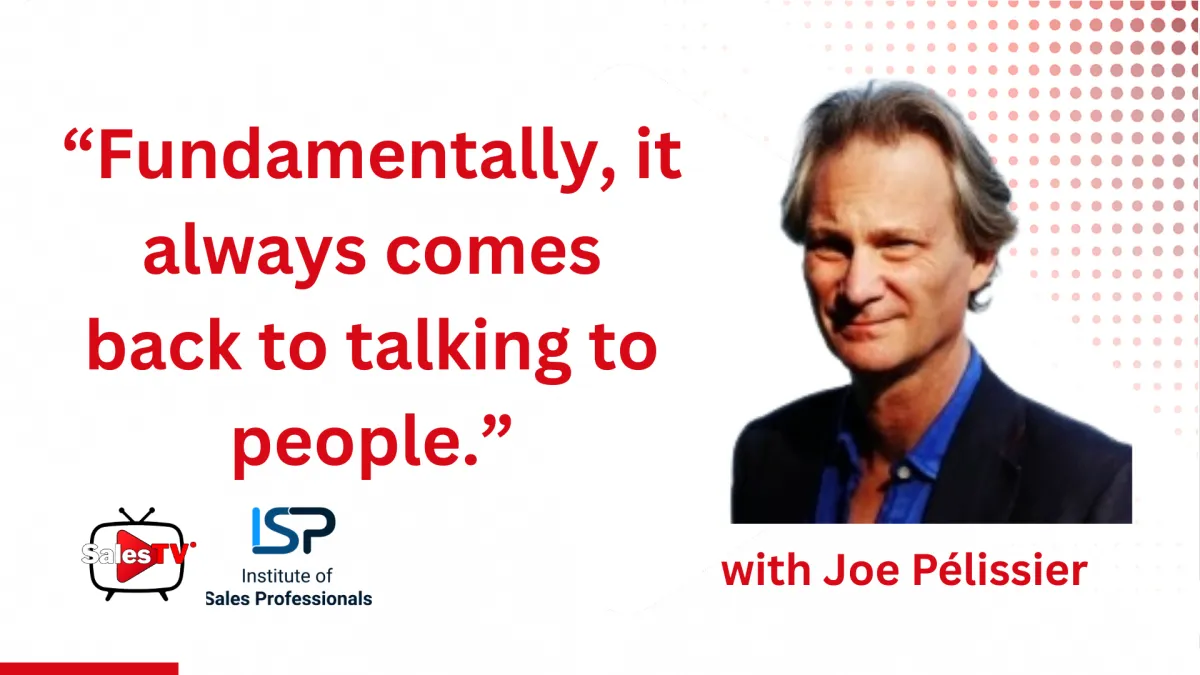
In this episode of SalesTV, Joe Pelissier, communications advisor, training designer, and tutor at the University of Oxford’s Department for Continuing Education, discusses the communication skills that shape successful sales conversations. Drawing on decades of experience helping organizations improve branding, marketing, and client communication, Joe explains how sales professionals can present ideas clearly, communicate confidently with senior decision makers, and navigate high-pressure business discussions.
We’ll ask questions like -
* How do great communicators make complex ideas easy to understand?
* What communication habits help professionals build trust quickly?
* How can I improve my communication skills at work?
* What communication skills matter most when working across cultures or industries?
His work focuses on helping professionals communicate clearly, build strong relationships, and convey ideas effectively in high-stakes business conversations.
Joe has spent more than three decades helping organizations improve how they convey ideas, build brands, and communicate with their audiences. Through his consultancy, Pélissier Communications, he has advised senior leaders and trained professionals across industries, including work with global brands such as Nespresso, Louis Vuitton, and Gucci. He also teaches communication and branding through the University of Oxford’s Department for Continuing Education.
Join us Tuesday at Noon ET/ 9am PT.
This week's Guest was -
Joe Pelissier, communications advisor, training designer, and tutor at the University of Oxford’s Department for Continuing Education
This week's Host was -
Rob Durant, CEO, ISP US
Transcript of SalesTV.live Mid-Day Edition 2026-03-24
Rob Durant [00:00:02]:
Hello and welcome to another edition of Sales TV. Today we're learning how to communicate with confidence in sales conversations. We're joined by Joe Pellissier, who's a communications advisor, training design, and tutor at the University of Oxford's Department of Continuing Education. Through his consultancy Polissier Communications, he has advised senior leaders and trained professionals across industries, including works with global brands such as Nespresso, Louis Vuitton, and Gucci. Joe, welcome.
Joe Pelissier [00:00:41]:
Rob, thank you very much, and thank you for that wonderful, very flattering introduction. I, I, when everybody says, says things like that, I suddenly think, well, I need to live up to the expectation on things. Was In effect, they're just names, and as you know, we're just communicating with people, whatever the big brand names are.
Rob Durant [00:00:58]:
I have no doubt you will live up to it. So, Joe, let's jump right into it. How can I communicate with confidence in a sales conversation?
Joe Pélissier [00:01:09]:
I think whenever somebody gets into a situation and they don't necessarily know the lie of the land, I think there is quite often a tendency to to talk, to actually want to say what's on your mind, whereas in fact the most important thing is just to go in relaxed and to listen, because if people have something which is important to them, once you've done the introductions, it very, very quickly comes to the surface. So the idea about talking with confidence is actually not to be talking immediately, but actually to be listening.
Rob Durant [00:01:45]:
Oh, I like that. So along those lines, how do great communicators make complex ideas easy to understand?
Joe Pélissier [00:01:56]:
I think, well, first of all, it goes back to listening. They have to listen very, very carefully to what's going on, and then they have to be able to start paraphrasing. So rather than listening for a long period period of time, as soon as there is a break in the natural flow of conversation, it's a matter of saying, well, if I understand you correctly, the problem you're struggling with is this, or what you need help with is— and then what you're starting to do is introduce open and closed questions in order to try and control the conversation in order to extract as much useful information as you can in order to understand how you want to propose to them the solution that you—
Rob Durant [00:02:48]:
I understand what you mean by open and closed communications, but can you expound upon that a little bit? And more importantly, help us understand when we should be applying each, because often I believe we get them mixed up.
Joe Pélissier [00:03:07]:
Yes, we do. It's a very good point. I look upon open and closed questions rather like gears on a car, in that you actually move them around in the way that you're going from, you know, first to second to third to fourth, hopefully not in a sort of grinding through the gears. But when you're talking to somebody, an open question is a question which literally opens up the question. And you're saying, well, what do you think of that? How does that make you feel? Why would you want to be exploring this? And it allows people to say what they think and what's on their mind. The closed questions are the ones where you want to get a yes or a no answer. They may also start with a modal verb such as would or should, so you might say 'Would this make— would this speed up the— would this speed up the sales process for you? Would this make your customers happy? Should we try and organize this slightly differently?' And so what you're trying to do is get them to open up, but then actually you get them to open up with the open question, but then close down to confirm your understanding with the closed question. And it takes practice, I think.
Joe Pélissier [00:04:24]:
I think people have to, to learn how to use these. And quite often I actually run exercises where you can give somebody a mystery identity and the other, the other person has to try and find out what the identity of that person is by asking a whole variety of open and closed questions.
Rob Durant [00:04:45]:
And what happens when I find myself in the wrong position? I've tried to learn more about you, Joe, but I just asked you a closed-ended question. How do I recover?
Joe Pélissier [00:05:01]:
Well, you have to sort of step back from it. You have to actually not, not, not panic, and then you probably have to find the right question in order to open up the situation again. A lot of this is actually thinking on your feet, isn't it? But I think in terms of communication and communication skills, it's about having the right things in your kit bag in order to adapt accordingly to the situation. And the more you do it, the more confident you become and the more relaxed you are. And I think we've all been in those awkward situations where somebody's asked us a question, we don't necessarily know the answer to it. And you know, I think one of the best answers to say, do you know, Rob, I don't know, I need to think about that. And I tell you a story. I was once working on a, with a client on a project, and I said to him, it was a French chap, I said, Nicolas, do you know, I don't know how to solve this problem.
Joe Pélissier [00:06:05]:
And he said, Joe, do you know, neither do I. But together we'll work it out. And so sometimes you have to be what I would call be comfortable with being in uncomfortable situations.
Rob Durant [00:06:20]:
I would agree with that. As you may know, I worked at Disney for almost a decade, and we were trained that I don't know is never an appropriate answer to a question. But we can't be expected to know everything. We were allowed to say, I don't know, but— I don't know, but here's somebody that could help you with that. I don't know, but I'm happy to find the answer to that and follow up with you to provide you the information you're seeking. So I like the fact that you're giving us permission to say, I don't know. In a sales conversation as well?
Joe Pélissier [00:07:03]:
I think it's very, very important. I think what happens is that quite often in a sales, particularly if there's pressure to close the sale or to make a good impression, you want to sound positive about everything, but in fact, we're human, we don't know everything, and I think if you show the human side of who you are and a vulnerability, psychologically, people, people like that. I think people respect that, the honesty and this honesty and integrity. But the fact that you say, well, let's look into it, let me go back and do a little bit of research and then I'll come back to you, is absolutely fine.
Rob Durant [00:07:42]:
Along those lines, what communication habits help professionals build trust quickly?
Joe Pélissier [00:07:51]:
Trust, very, very important. I think it also goes back to listening. I think it goes back to not interrupting. I think we've already touched on paraphrasing. I think also it's to do with body language, it's to do with eye contact, and I think if you're relaxed and you're looking at somebody and you're doing the sort of eye, you're looking them properly in the eye, then I think that formulates a kind of trust. There's also, in terms of how you hold your hands, where you're sitting, because if you're very clenched up and everything and anxious, that's going to make the other person feel a little bit uneasy. So you have to work at actually being, being relaxed. All of those things communicate trust.
Joe Pélissier [00:08:46]:
I think Well, I don't think I know. We have to try and avoid hyperbole. There's also a cultural thing here as well, interestingly. In, in Europe, we tend to be a little bit reserved and kind of resist hyperbole, whereas in the US, hyperbole is sometimes more acceptable because it communicates energy, optimism, and impact. So you've also got a cultural nuance which you have to be be aware of. But trust is, in spoken communication, it also comes back to knowing who you are and actually recognizing the— we can talk about that in a minute— recognizing personal characteristics in other people so you can adapt your own behavior towards them.
Rob Durant [00:09:34]:
There are two things I want to pick up on there. First, let's dig into the culture. Bit, a little bit more. What communication skills matter most when working across cultures, or even across industries, which can be cultures unto themselves?
Joe Pélissier [00:09:51]:
I think this is increasingly important, and I'm very fortunate I work with lots of different cultures. Often, if I'm working with a large group of people, I will make a point of knowing what all the different cultures are. Whether a lot of people from Northern Europe, whether there's some Americans, whether they're Southern Europe, whether they're Asians. Because when— if you've got some Asians, you may have different religions. You may have some Muslims working with you who may want time out for prayer. There are certain things. It's very important to be aware of this, but not to get too hung up about it. Because what I found time and time again no matter what the culture is, people still communicate in the same way.
Joe Pélissier [00:10:39]:
Everybody still has the same anxieties, nervousness, worries, or things they struggle with. And when you're with lots of people and you recognize that, it's actually fine, but you have to be aware of it. You have to be mindful of it. Let me give you an example. And these are generalizations, and it's always very, very, very dangerous. But Germanic cultures tend to be a lot more black and white, and they say what they, they think. Latin cultures will be a lot more enthusiastic and open-minded about things. They won't necessarily be quite so strict on time matters.
Joe Pélissier [00:11:23]:
And they will chat away. And once you recognize these in different cultures, you just adapt your own style to it, as opposed to saying, well, why are they being quite aggressive to me? They're not being aggressive to you, they're just saying no, because no means no. Or if they turn up a little bit late, it's not because they're disrespecting you, it's because they've just been having a coffee and they're having a chat and they're here now. What's the problem? So we have to be adaptive to those sort of things.
Rob Durant [00:11:57]:
So that leads me to the second question. You alluded to being aware of personalities as well. How does personalities, personal style, impact the way that you as a seller are communicating with your audience?
Joe Pélissier [00:12:15]:
This is very, very important. On one level, you've got a sense of your own personality. So let's say I'm a very extrovert person and I like talking. We all have extrovertism and introvertism. I have to be aware that I might be very talkative, very open, and come across very self-confident. And the buyer, the person I'm meeting, I recognize that they are quiet, they're more of the thinking spectrum, and so rather than me exuding my personality, I have to suddenly think, well, let me— I need to just tone it down a little bit. I need to be a little bit more gentle in terms of how I speak to them in order to try and establish rapport, because I think this is what we're leading to, in fact. A lot of sales and communication and trust is about establishing that rapport.
Joe Pélissier [00:13:13]:
And by having a sense of your own personality and recognizing their personality— and of course you don't know them well because it's at a superficial level— I think that helps the whole sales and communication process.
Rob Durant [00:13:29]:
That makes sense. So in your opinion, what makes a business conversation effective?
Joe Pélissier [00:13:39]:
Well, I go back to the rapport word. You're having a rapport with somebody, and so when you start talking to them, it's not necessarily— it's about finding connections, and it's about being curious. So when you start talking to somebody, and we talked about open and closed questions, you're trying to make that connection. With the person, and it could be to do with what soccer team you support, it could be to do with children, it could be to do where you went on holiday, it could be to do with skateboarding. It doesn't actually matter what it is, but you kind of want to get that tiny little connection. Could be the book you read or the film you've seen, and those things put everything on a natural level, on a communications communications rapport so that we're not worrying necessarily about the sales. We're actually communicating as human to human, and then we can go on to it. And you know, once we meet for the first time, there's quite often that preamble of, you know, did you have a good drive? Did you get here? All that sort of thing.
Joe Pélissier [00:14:50]:
That is really, really important. And if you suddenly jump straight in and avoid all of that The person you're talking to thinks, well, this, this guy's just on a mission, he just wants to do it. But we need to establish those reports, and I think that the more you pay attention to that, the more important it potentially can, can be. Because if you have long, long-term relationships with clients, it's invariably because you've got a good rapport with them, not necessarily because you've got the best product. But because they actually like doing business with you, and they don't want to actually go and work and find somebody else.
Rob Durant [00:15:31]:
Joe, I believe you and I are in, uh, strong agreement there, but I know you've trained all types of personalities. What do you do when you encounter somebody in a training class who's more of the 'Joe, I don't have time for holding hands and kumbaya. I'm here for business.' How do you work with them?
Joe Pélissier [00:16:00]:
First of all, I will anticipate whether those people are going to be in the class or not by asking somebody, and so I will have made a mental note of who they are. And very early on, I'll see how they behave. But slowly I will start to introduce them to doing things and communicating. So let's say they don't want to get involved with any open and closed questions or any listening exercises or any role play or anything, and I will instinctively pair them with somebody who they will probably get on well with, but I won't make any expectation of them. And do you know, Rob, what's quite interesting? So long as you don't push it and then they see other people learning and enjoying from it, they invariably get involved by the end. So that's just my experience. But of course, there are some people who say, well, no, this is a complete waste of time. And they, they have a, have a distance to it and they don't want to get involved.
Joe Pélissier [00:17:06]:
And that's fine. You can't do that. It's also about recognizing— and this comes back to rapport and conversation— people who have an open mindset and a closed or a fixed mindset. And sometimes people do have fixed mindsets. They say, well, why are we doing this? It's a complete waste of time. But you have to change that fixed mindset to the open mindset, which we all need to develop. And we all can be a little bit closed at times.
Rob Durant [00:17:37]:
I want to pivot to your most recent experiences. How might these communication principles apply to something as radically different as fashion or luxury?
Joe Pélissier [00:17:54]:
I know where you're coming from there. Yes, I am. I'm involved on a business which is called Made in Italy, which is about marketing and branding and understanding the art of Italian branding and marketing. The thing with luxury and fashion and all those sort of things is that they pay a lot of attention to how people feel, how you make somebody feel. And so in these instances, tone of voice is very important, both in written and spoken communication. Not necessarily in a fawning, super polite way, but in a very respectful way, in a very open way, in a very relaxed way. And they use slightly different language to it. And it comes back to different sectors.
Joe Pélissier [00:18:52]:
So let's say if you're working in a sort of technical sector or an IT one, you may not worry too much about it because the people you're dealing with there are more on the thinking spectrum, they're more on data and detail, whereas the people you're dealing with in fashion luxury are more on a feeling spectrum. And so then you adapt your language accordingly. And I think this is what makes sales and communication so fascinating, is that you always have to be aware with different people, different sectors or groups you're working with, you're going to have different personality types.
Rob Durant [00:19:29]:
I want to dig into that just a little bit more. What can sales professionals learn from how luxury brands communicate value?
Joe Pélissier [00:19:41]:
Luxury brands are very, very good at understanding the needs of their customers. In terms of what's important to them. They're very good at going into the very, very small details because sometimes— I'll give you an example— somebody might buy a belt, might buy a, say, Gucci belt or something. It's not going to be cheap cheap, but it's not going to be expensive in relation to everything. They will value that purchase and the approach that that somebody the reason somebody has taken that purchase, the reason somebody has decided to make that purchase very, very seriously, because they know that if they have a good experience and they become— have more disposable income in the future, they may buy a handbag, they may buy some shoes. So they actually have a whole sense of scale of how they move people through the various levels. So they treat purchasers extremely well. I'll give you an example.
Joe Pélissier [00:20:47]:
This is to do with Louis Vuitton. In terms of the sales of some of their bags, I can't remember a specific brand name for it at the moment, but I can visualize one. That brand was very, very popular and was quite often the first bag that a young person might aspire to buy., and it might be for their birthday, their 18th or their 21st. But all what they found from the research is that over years, the family or the individual had actually saved money in order to buy this bag, this one, one bag. And so they understood their customer, they understood how important it was, and they would actually find out when they were purchasing it, whether it was a birthday, whether it was a celebratory present. And so they would be treated accordingly so that when they made that purchase and the sale was made, they would feel that it was super special.
Rob Durant [00:21:48]:
Joe, we're almost out of time, but I wanted to ask one last question. Joe, if you were to emphasize the one thing you would want our audience to take away from today's episode, what would that one thing Curiosity.
Joe Pélissier [00:22:05]:
I think curiosity is fundamental to sales and communication, because when you meet somebody and if you can demonstrate that you're curious, not just in terms of their business, but who they are and what's important to them, curiosity means you're asking the right questions. It then leads on to rapport, and then rapport then leads on to trust. And then if you've got the trust, hopefully you'll be able to start making those sales.
Rob Durant [00:22:37]:
Fantastic. Thank you, Joe. This has been great. On behalf of everyone at Sales TV, thank you for today's conversation. A replay and full transcript of today's episode along with contact information can be found at SalesTV.Live/SalesCommunication
Rob Durant [00:22:58]:
Thank you all, and we'll see you next time.
Joe Pélissier [00:23:01]:
Thank you, Rob. I've really enjoyed the conversation.
Rob Durant [00:23:04]:
As did I. Goodbye.
@SalesTVlive
#SalesCommunication #SalesSkills #SalesConversations #SalesTips #CommunicationSkills
#Sales #SalesLeadership #LinkedInLive #Podcast
________________________________________
About SalesTV: SalesTV is a weekly talk show created by salespeople, for salespeople. Each episode explores sales, sales training, sales enablement, and social selling, bringing together sales leaders, enablement professionals, and practitioners from across the globe.
About the Institute of Sales Professionals: The ISP is the only body worldwide dedicated to raising the standards of sales. Its Sales Capability Framework, certifications, and member community are designed to address their one goal: To Elevate the Profession of Sales.


Monday

Register to Get LinkedIn Notification of This Episode!
Tuesday

Register to Get LinkedIn Notification of This Episode!
Wednesday

Register to Get LinkedIn Notification of This Episode!
Thursday

Register to Get LinkedIn Notification of This Episode!
Friday

Register to Get LinkedIn Notification of This Episode!