
Coming Up
Early Edition

Register to Get LinkedIn Notification of Our Next Episode!
Mid-Day Edition
Register to Get LinkedIn Notification of Our Next Episode!
Special Edition
Register to Get LinkedIn Notification of Our Next Episode!
SalesTV.live is a weekly talk show about the world of Sales by salespeople for salespeople.
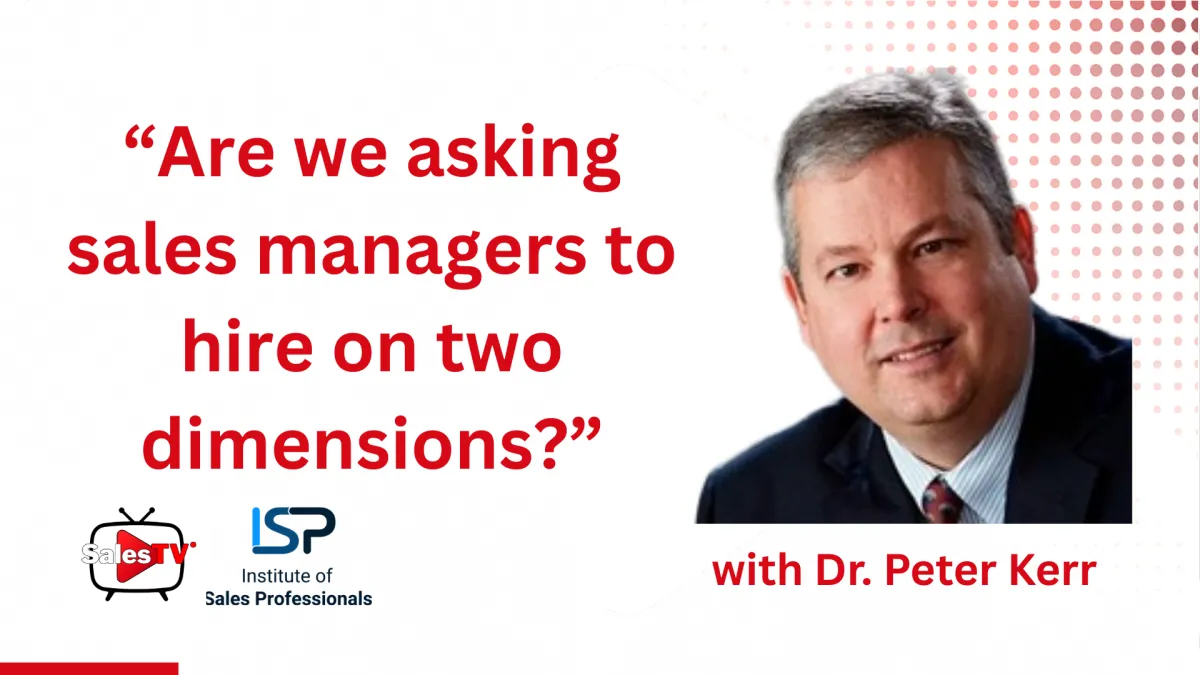
Are We Hiring the Wrong Salespeople for the AI Era?
In a data-rich, AI-accelerated world, the traditional sales candidate hiring profile may not be fit for the future.
In this episode of SalesTV, we’re joined by Dr. Peter Kerr, sales performance researcher and Chair of Applied Research in Sales at the University of New Brunswick, to examine what the data actually says about the skills driving results in modern B2B selling. Drawing on large-scale job market analysis and performance research, Peter challenges the long-held assumption that personality alone predicts success.
We’ll ask questions like -
* Are we hiring for the skills that truly drive performance?
* What sales skills are most important in an AI-driven sales environment?
* In Sales, is working harder more important than working smarter?
* Why do so many sales leaders default to gut instinct rather than measurable skills when making hiring decisions?
Peter Kerr is a sales performance researcher and consultant whose work bridges academic insight and practical hiring strategy. With deep experience analyzing how people perform - and why - Peter helps leaders understand the skills and behaviors that differentiate average from exceptional performance.
Join us live and be part of the conversation.
This week's Guest was -
Dr. Peter Kerr, sales performance researcher and Chair of Applied Research in Sales at the University of New Brunswick
This week's Host was -
Rob Durant, CEO, ISP US
Transcript of SalesTV.live Mid-Day Edition 2026-02-24
Rob Durant [00:00:02]:
Hello and welcome to another edition of Sales TV Live. Today we're asking, are we hiring the wrong salespeople for the AI era? We're joined by Dr. Peter Cur— Peter is the chair of applied research in sales at the University of New Brunswick. Peter, welcome.
Dr. Peter Kerr [00:00:26]:
Thanks, Rob. Appreciate it. Glad to be here.
Rob Durant [00:00:28]:
Absolutely. Peter, let's jump right to it. Are we hiring the wrong salespeople for the AI era?
Dr. Peter Kerr [00:00:37]:
Well, it's an important question, Rob, and actually, I think it's a, it's a, it's a really loaded question because I think, first of all, you know, you've got to ask yourself when you're, when you're, you know, when you try to hire the right, the right example, the right salespeople, the right skills. And what are you hiring them to do? Right. And what does performance look like in your organization? And sometimes it sounds trite when you have that discussion with sales leaders because they say, well, I want, you know, I want them to sell. That's what they're there for. I'm looking for— I'm looking for them to retire quota and so on. And I think it's important that we realize that, you know, whatever we, we, we measure and we reward, that's what we're going to get. Sometimes that's all we get, right? So, I mean, I have some great I've had some great interviews over the last couple of years with— and having that same conversation with sales leaders. And, you know, you find out people that are necessarily the best at retiring quota, you know, leave— and this is a quote— leaving bleeding bodies in their wake.
Dr. Peter Kerr [00:01:33]:
Right. And so, you know, I think when you're— when you— the first time you ask the question about are we hiring the right people and the right skills, you really got to define what success looks like. What do you want? To, you know, what does performance look like for your organization?
Rob Durant [00:01:50]:
So along those lines, especially these days, what do you believe are the skills that truly drive performance?
Dr. Peter Kerr [00:02:01]:
So it's a great— I think that's, that's important. And so, if we think about, narrow the scope a little bit and just talk about kind of a professional sales role, where the product sales cycles are a little bit longer and, you know, more complex sale where there's an opportunity to kind of build a custom or a solution as opposed to just product off the shelf type, type thing. You know, first, I would say the traditional, the traditional skills that we've all recognized continue to be important. So I think that's, that's a good thing, right? I mean, the soft skills around interpersonal skills, Listening skills, verbal communication continue to be incredibly important. But one of the things that we've just identified recently, which is— which we couldn't find anywhere in the research before this, and we have 100 years of sales research out there that's been conducted, is salesperson analytical skills, which may be surprising to, to our listeners and to yourself.
Rob Durant [00:03:06]:
Absolutely. Uh, I know when I was in a hiring role for a, um, tech startup, we identified 4 criteria. Uh, we were looking for people that had, in addition to, uh, sales skills, those, those soft skills as you say, we were looking for things like, um, Grit and fit. Now, fit is— that can be a third rail kind of— it's not so much they look just like me, it's more amount of— about, um, as a startup we operate fast and loose and, and everyone contributes and so on. Are they accustomed to that, or are they accustomed to an enterprise organization? That kind of thing. But we also looked at communication skills and business acumen. Where would AI fit in those? Is, is this now a fifth pillar that we're looking at?
Dr. Peter Kerr [00:04:06]:
Yeah, so I mean, I think, um, honestly, I think it's, I think it's a little early to say. Um, we know AI is starting to permeate across all the steps in the, in the selling process up front. Um, you know, by sending out communication on, on seller's behalf to start to kind of build build up an interest there with the buyer. Um, it's, it's helping in do qual— in qualifying and so on and developing profiling. Um, and it's in some extent, in some, in some areas, it's helping obviously to build, build solutions and so on. So I think, I think, um, I think the importance is there, but its relative position I think is still hard to say. Um, the second comment I would make on that, my comment about analytical skills, and I could talk about the research we did in that area in, in a minute, But, um, those of— those are the listeners who are familiar with using just kind of the early, you know, early AI versions that are out there realize that, look, it doesn't always give you 100% results, right? You get— sometimes you get it— sometimes it hallucinates, right, and just gives you garbage. Um, and so you think about it, let's say you're using it for proofreading.
Dr. Peter Kerr [00:05:16]:
Um, if you're not a, a half-decent writer yourself, you're not going to catch the mistakes it makes. Okay. So I would say the same thing if we think AI is going to take over more of the analytical pieces of the job, which is kind of taking all these data that's now available today that wasn't, you know, a decade or two decades ago, and to summarize that data on behalf of the salesperson so that they can curate it and offer value to the customer. They need to understand that as well, right? Because they need to catch— they need to catch AI when it goes off, goes off kilter. So I would say, um, you know, the skills I'm gonna talk about a minute around analytical skills are going to continue to be important for quite a while because it's almost a— if you're not going to be doing it yourself, you're going to be checking the AI tool you're using to make sure it's done its job properly. Hopefully you do that because that's pretty critical, right?
Rob Durant [00:06:10]:
Yeah, you're supposed to be checking it, that's for sure.
Dr. Peter Kerr [00:06:13]:
Exactly, exactly. Yeah.
Rob Durant [00:06:16]:
So, talk to me more about the analytical skills. How does analytical skill affect sales performance?
Dr. Peter Kerr [00:06:25]:
Yeah, so, so great question. So, right, right after COVID, we started looking at, hey, have skills changed, right? We've— we're really in a digital environment. This is still pre-AI, I would say, a digital environment heavily influenced by COVID. Everybody moved online. Everything was, you know, the whole idea of digitizing the sales job went into overdrive, right, during COVID And we wanted to get a sense of, hey, are the skills important? Have they changed at all? And so we first wanted to take a look at, well, what are, what are sales leaders even hiring for at the moment? Right. So we were lucky that LinkedIn was able to give us 2 years of, of job data, basically. So basically any sales position that had been advertised over the last 2 years, So obviously stripping out who, you know, is anonymous, we're stripping out the confidentiality of, of the names of the companies and so on. But they were able to basically strip out and look at what are the skills that are actually being identified in these ads.
Dr. Peter Kerr [00:07:24]:
And, um, you know, most of the top 5 would be nothing you'd be— well, I should say the top 4 would be nothing you'd be surprised about. So, you know, they would wrap around the, the, um, the skills you would normally see in a sales process— qualifying, prospecting, presentation skills. We're like, yep, yep, you know, of course. But number 2, believe it or not, was analytical skills. And we're like, what? Like, where did this come from? We're very surprised that this came out of the, out of the LinkedIn data. And so we quickly shifted gears. We started doing qualitative interviews directly with sales leaders and saying, hey, what are you hiring for? Unaided. And again, analytical skills started bubbling to the top.
Dr. Peter Kerr [00:08:04]:
So This, this surprised us immensely. So we wanted to get a sense, hey, is this even a good skill to be hiring for, or is this just— is just a fad? And so we decided we want to do some quantitative research to see if there's any relationship between analytical skills and salesperson performance. But boy, we were starting from scratch. There was no scale that had been developed to measure what does a salesperson's analytical skills even look like? So we had to go right from the beginning. We had to build a scale that we could use and demonstrate that it was measuring what it purported to measure, which was salesperson analytical skills, and then try to link it to performance. And we did that. And what we found was that there was actually two relationships. There's a direct relationship between salesperson analytical skills and sales performance, and that relationship actually increases as the scope of the salesperson's job increases.
Dr. Peter Kerr [00:08:58]:
So if you're not only responsible for selling yourself, but maybe you're, you're mentoring junior salespeople as well, the more scope creep in your job, the more important analytical skills is to, to sales performance. And then the second thing, which I think is even more interesting, is it's influencing the relationship between effort and performance. So it's it's strengthening that relationship. And I think the reason for that, it really comes down to the— how analytical skills turns out to be measured, which is two things. One, it's around understanding the customer better than you ever could. So using these abilities to take data and slice and dice data that, that's available to all of us and really understanding the customer, what their problems are, and so on. So that's one dimension. The other dimension is pipeline management.
Dr. Peter Kerr [00:09:54]:
In other words, what are the customers I should be working with? You know, what activity should be— I be working on at a particular time? Really understanding your funnel and managing your time and, you know, and your effort, basically. So, you know, you're using analytical skills to allocate your effort to the right people, you know, to the right customers, to the right activities.
Rob Durant [00:10:14]:
Okay. We have a, um, Question from the audience. Let's bring it on screen. Sam Palazzolo asks, uh, communication skills for Gen Z and Gen Alpha are lacking. How can you effectively test when hiring? Any ideas would be greatly appreciated. Thank you, Sam.
Dr. Peter Kerr [00:10:32]:
Yeah, that's a great question. So there's probably two ways of doing that. I mean, there are tests, commercial tests out there you can use that you can have— you can have, um, applicants go through. You can ask them to do this prior to or during an interview, or obviously just in, you know, establishing scenarios during the interview process that requires them to, you know, whatever communication skills you think are important, you know, role-playing actually right in an interview. I think people are so fixated on doing a traditional, you know, I ask a question, you answer it format, they don't recognize there are other things that you can do. You could bring in, you know, bring in your assistant to come in and ask them to do a role play with this individual and so on. So I think that we need to be more creative in how we interview to look at some of these soft skills and how people are— because let's face it, some of us interview really well and they say what you want to hear, but they can't actually apply that on the job, right? So I think those types of things would be really helpful.
Rob Durant [00:11:37]:
So one of the things we used to do was a case study, a very minimal lift, but it did require candidates to review some material and then, um, prepare a response. Will AI replace these an— analytical skills in the sales interview process, and more importantly, in the sales process itself?
Dr. Peter Kerr [00:12:03]:
Well, that's a good question. And I, I'm sure if you talk to an AI developer, they'll say, you bet, right? Like that, that'll be definitely something that they'll sell it to me. Yes, of course. And I actually think that that's going to, that's going to come about. I mean, we say it, see it in the job hiring process right now. I personally think, you know, it's, you know, it's a mistake. I think that you need to be involved. I think you need to— I mean, we're, we're at a point now where the, the, the salesperson really can be a differentiator for a company, right? They talk about the fact that, you know, we can't all be— our products can't all be sales leaders, or, you know what I mean, share leaders.
Dr. Peter Kerr [00:12:43]:
And so obviously, the differentiation often comes from the salesperson and how they, how they listen, how they, you know, adapt to the conversation and so on. And I think you need to be listening for those things. I'm not sure AI anytime soon may pick up, you know, those subtleties that I think we need to see as, as hiring leaders, frankly.
Rob Durant [00:13:06]:
So we've talked about analytical skills and we've talked about the soft skills. Should we be hiring for somebody who ticks both of these boxes?
Dr. Peter Kerr [00:13:21]:
You'd think, right? And I think one of the things that's challenging right now is that, you know, I think you and I, we had a conversation. We talked about the fact that, boy, sales leaders use their gut an awful lot when they're hiring. Right. And I think that's for a couple of reasons. Right. I think, first of all, they recognize that jobs are situ— situationally dependent. So my sales job is different from your sales job. And so, you know, part of that has to come into the conversation.
Dr. Peter Kerr [00:13:50]:
I think the industry and maybe even academics have, have, you know, hurt ourselves in the sense that there's just too many remedies out there, too many silver bullets you should be looking for when you're hiring, you know, in terms of what skills. And I think that's just created noise. And I'm not sure people know what advice they should be— they should be looking at, or people are just hiring a mirror image of themselves. Right. Generally, good salespeople end up sales managers in many situations. So you figure I'm going to just hire someone like me, they should do well. And so I think that's kind of where the hiring is at right now. Right.
Dr. Peter Kerr [00:14:27]:
And let me talk about the one scenario, which is there's these remedies and I'm told I should hire for this and I'm told I should hire for that. And, and Peter Kurjas said, now I've got to add analytical skills to my list of things I hire for. Right. Here's the challenge. And if we— let's take two dimensions, right? If we take soft skills on the left, okay? And then we take hard skills on the right. So scoff— soft skills, you know, interpersonal skills, um, interorganizational skills, or your ability to network and politic and advocate for your customer, listening, all of those skills on the one side. And on the right, we'll talk about technical skills. So analytical skills, um, maybe even your cognitive aptitude, right? So we'll throw in some of the IQ stuff and and then the EQ stuff's on the other side.
Dr. Peter Kerr [00:15:12]:
So we have these two dimensions, and I think the natural thing North Americans do is, uh, they're going to want to try to optimize both of those, right? And I think what happens is, if you think about it on a, on a two-dimensional scale, of course we all want to be in the top right-hand corner. We want the highest of both. And the reality is, um, you can't find those people easily. You're certainly not going to find an entire team of them. Right? You can't afford them and you probably can't retain them. Right. So I think that's, that's a problem. So the reality is we have to deliver extraordinary sales results with probably an average team.
Dr. Peter Kerr [00:15:48]:
Okay. We just can't— we're not going to have a whole team of superstars in the top right-hand corner. Conversely, we obviously don't want the bottom left, which is low on both of those things. So what happens as a sales leader? Ultimately, you have to make a trade-off. You have to decide, do you want high on one skill and low on the other, or vice— or vice versa. But we don't do that. What we do is we try to maximize both and we end up with what I call the compromise candidate, somebody in the middle. They're kind of just average at both because you're, you're basically trying to hire for both and that's where you end up.
Dr. Peter Kerr [00:16:19]:
And I think the problem with that, frankly, is you're not going to have a differentiated selling experience. It's just not— it's not going to happen. You're going to have a mediocre candidate. And so I think it's really up to the, the sales leader to decide for this particular job and what I think is important, which one do I want to try to maximize? Do I want for this role to focus on the hard skills and not the soft skills? And so I'm going to consciously be bad at one and be better at the other and allow that trade-off to take place. And then what happens is you really got to make sure the rest of the job is designed to minimize or mitigate the fact that you're not going to have someone who's super high on the other skill, right? You can also tailor your training against that particular dimension and so on. And we've seen this more in the service research where this is the number one predictor of, of service excellence, which is organizations prepared to make the tradeoff right from the top of their strategy all the way through to their hiring. And, and you know what I mean? As opposed to trying to be good at everything, you end up being good at nothing, right? You're— and, and so that would be my suggestion here, would be identifying, um, you know, which one is you're prepared to trade off, essentially, if that makes sense.
Rob Durant [00:17:36]:
Absolutely.
Dr. Peter Kerr [00:17:37]:
Yeah.
Rob Durant [00:17:38]:
Uh, we have another question from the audience. Anthony O'Hare— and Anthony, I apologize if I've got the last name wrong— asks, uh, with Salesforce and Power BI, is it not the responsibility of sales leadership to provide their team with funnel analytics and dashboards? So they're not wasting time on non-sales activities regardless of analytical ability. And with dashboards, then every sales team member is measured according to the same metrics.
Dr. Peter Kerr [00:18:09]:
Yeah, great comment. So I would say yes, I think the organization needs to provide, you know, is responsible for sales enablement, which includes, you know, performance measurement systems, dashboard systems and so on. You do need salespeople who can interpret that data, right? And, and make some decisions based on, on that data. Which activity should I be working on today? Which customer should I be focused on today? So there's a requirement to be able to take that data and know what to do with it and apply it, I think, is particularly important for, for salespeople that, that not everybody's just— some people just see it as noise and they get overwhelmed. And you need people that can literally drill down, understand what the data says and know how to act on it. Okay. And that— keep in mind, that's just one half of what we're talking about is analytical skills. The other half is making sense of all this customer and industry data out there and being able to bring it together and, you know, to understand the customer situation better and provide that information back to the customer in a curated form so that I can have a good consultative conversation with them.
Rob Durant [00:19:17]:
So let me ask you this. In sales, is working harder Still more important than working smarter?
Dr. Peter Kerr [00:19:26]:
I don't think so, because I mean, what I do is I like to take that analogy and take it to its furthest extremes, right? I mean, I could run around in a circle and I'm expelling all kinds of effort. So I am, you know, and I'm not getting anywhere. And so I think working smarter, which is knowing what activities I should expel my effort on, I think that's significantly more critical. I mean, salespeople matter the most. And that's one of the biggest differentiators we see in the marketplace is those, you know, salespeople who know where to spend their, their limited amount of time on.
Rob Durant [00:20:07]:
So Peter, if you were to emphasize the one thing you would want our audience to take away from today's episode, what would that one thing be?
Dr. Peter Kerr [00:20:16]:
Well, the number one thing I think for me, and within the limitations of kind of the research I've been doing recently, is salesperson analytical skills are important. Okay. And but what's more important is they're trainable. Okay. When I talk about skills, skills are things that are job tasks that people can learn, okay, as opposed to traits. So earlier in the conversation, we talked a little bit about grit. Talked about EQ, IQ. Those are all innate traits that you're born with.
Dr. Peter Kerr [00:20:47]:
Okay. Skills aren't— skills are trainable. Analytical skills are trainable. Okay. So I think, A, that's, that's important. And I said the second piece of that is when you're hiring, you've got to decide whether or not that piece of, you know, that dimension is something you want to optimize for or whether you want to continue to optimize more for softer skills, essentially, and make that— be prepared to make be prepared to make that tradeoff and redesign the rest of the job to offset the area you've chosen to tradeoff against, basically.
Rob Durant [00:21:21]:
So we can't have everything.
Dr. Peter Kerr [00:21:25]:
Well, let's— we could put you all— we're all going to have one or two superstars on our team, right? You're just not going to be able to— it's— I think it's unrealistic to think you're going to build an entire team of superstars and hang on to them. And so I think We need to be prepared to deliver, you know, strong results with an average team overall, right? So—
Rob Durant [00:21:44]:
That's a powerful thought. You're not wrong. But most of us don't think of it that way. We're going to try and have the superstar team, the all-star team, and then get the results accordingly. Thank you for that. Peter, this has been great. On behalf of everyone at Sales TV, to you and to our audience. I want to thank you all for being an active part of today's conversation.
Rob Durant [00:22:10]:
Uh, we now have a newsletter. Don't miss an episode. Get show highlights, beyond-the-show insights, and reminders of upcoming episodes. You can visit us at salesTV.live, and at the top, click on newsletter. Thank you all, and we'll see you next time.
Dr. Peter Kerr [00:22:30]:
Thanks, Rob.
Rob Durant [00:22:32]:
Bye..
@SalesTVlive
#SalesAnalytics #AnalyticalSkills #SalesPerformance #AISales
#Sales #SalesLeadership #LinkedInLive #Podcast
________________________________________
About SalesTV: SalesTV is a weekly talk show created by salespeople, for salespeople. Each episode explores sales, sales training, sales enablement, and social selling, bringing together sales leaders, enablement professionals, and practitioners from across the globe.
About the Institute of Sales Professionals: The ISP is the only body worldwide dedicated to raising the standards of sales. Its Sales Capability Framework, certifications, and member community are designed to address their one goal: To Elevate the Profession of Sales.


Monday
Register to Get LinkedIn Notification of This Episode!
Tuesday

Register to Get LinkedIn Notification of This Episode!
Wednesday
Register to Get LinkedIn Notification of This Episode!
Thursday

Register to Get LinkedIn Notification of This Episode!
Friday

Register to Get LinkedIn Notification of This Episode!