
Coming Up
Early Edition

Register to Get LinkedIn Notification of Our Next Episode!
Mid-Day Edition
Register to Get LinkedIn Notification of Our Next Episode!
Special Edition

Register to Get LinkedIn Notification of Our Next Episode!
SalesTV.live is a weekly talk show about the world of Sales by salespeople for salespeople.
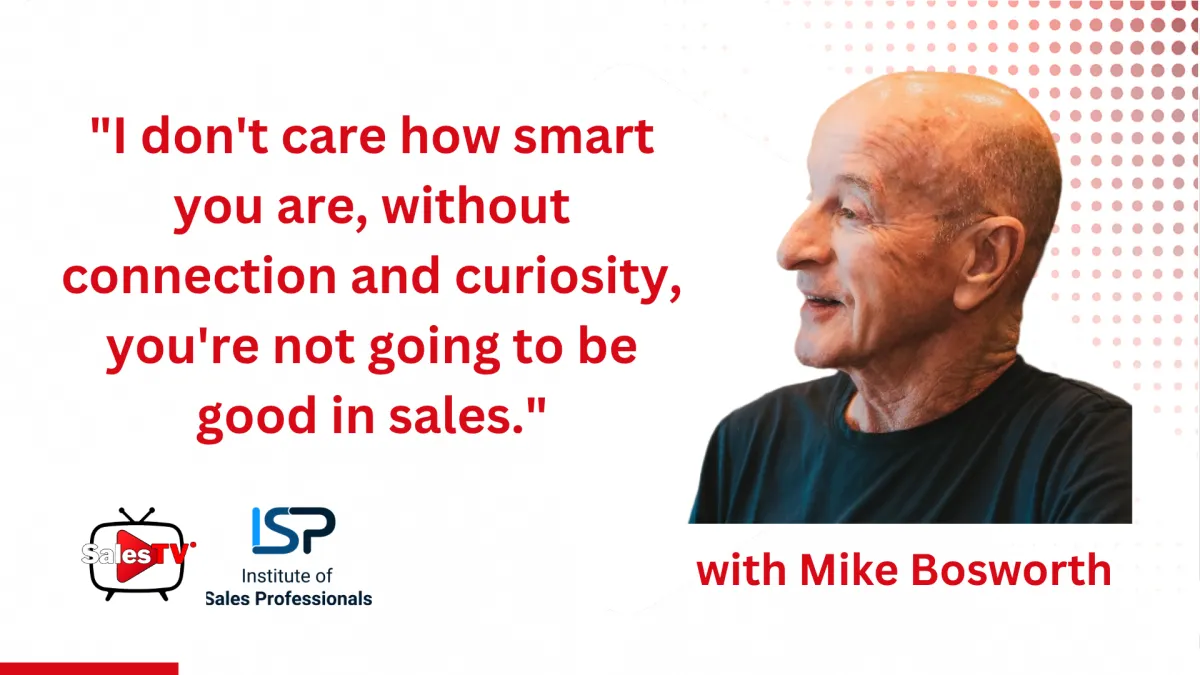
Why Discovery Calls Fail Before They Begin
Most sales methodologies focus on what happens during discovery. But the real challenge is getting buyers to open up in the first place. Discovery questions, qualification frameworks, and sales processes only work when a buyer is willing to engage in a conversation.
In this episode of SalesTV, Mike Bosworth, creator of Solution Selling and founder of Story Seekers, explores why even the most widely adopted sales methodologies often fail to create meaningful buyer engagement. Drawing on decades of experience in sales leadership, training, and consulting, Mike argues that trust, emotional connection, and curiosity must be established before discovery questions, qualification frameworks, or sales processes can be effective.
We’ll ask questions like -
* Why do buyers resist discovery questions even when they're experiencing the problem I solve?
* How do I build trust with a prospect before starting discovery?
* Why do discovery calls stall even when I'm following a proven sales methodology?
* What happens before discovery in a successful sales process?
Mike Bosworth is the creator of Solution Selling, one of the most influential sales methodologies of the past several decades, and the author of multiple books on sales, communication, and customer engagement. Over a career spanning more than 50 years, he has trained sales professionals, sales leaders, and organizations around the world. Having helped shape the way modern sales teams approach discovery and qualification, Mike now focuses on the role that trust, emotional connection, curiosity, and storytelling play in creating meaningful buyer conversations.
Join us Tuesday at Noon ET/ 9am PT.
This week's Guest was -
Mike Bosworth, creator of Solution Selling and founder of Story Seekers
This week's Host was -
Rob Durant, CEO of US Operations at The Institute of Sales Professionals
This week's Panelist was -
Matthew Nicolle, Chief Executive Officer at Sales Training Experts and President & CEO, ISP Canada
Transcript of SalesTV.live Mid-Day Edition 2026-06-30
Rob Durant [00:00:00]:
Hello, and welcome to another edition of SalesTV. Today, we're exploring why discovery calls fail before they begin. On the panel with me today is my colleague from the Institute of Sales Professionals, Matthew Nicole. Hi, Matt. And we're joined by Mike Bosworth. With a career spanning more than 50 years, Mike has trained sales professionals, sales leaders, and organizations around the world. He is the creator of Solution Selling, one of the most influential sales methodologies of the past several decades, and the author of multiple books on sales, communication and customer engagement. Mike, welcome.
Mike Bosworth [00:00:50]:
I'm happy to be here with you guys.
Rob Durant [00:00:53]:
Oh, it's great to have you back, Mike.
Mike Bosworth [00:00:55]:
It feels good to get dipped in academia once in a while, you know, for me.
Rob Durant [00:01:00]:
There we go, Mike. Let's jump right into it. Why do buyers resist discovery questions even when they're experiencing the problem I solve? Why do some salespeople constantly get buyers talking while others struggle?
Mike Bosworth [00:01:20]:
Because from the buyer's point of view, pretty much universally, the sales profession doesn't come with a lot of trust. It's not as bad as being a lawyer or a politician, but it's pretty dang bad. And most human beings, or certainly most Americans, have come away from an encounter with a previous salesperson where they felt pushed, pressured, coerced, cheated, taken advantage of. I bet you well over 90% of people have those kind of emotional reactions to salespeople. So your question was, why do they resist solid diagnostic discovery questions from salespeople who have a lot of character? And that is, you don't know me good enough to ask me all those questions. That emotional reaction is what causes the discovery resistance to salespeople that most people have. If you go in and see a doctor for the first time, that doctor can start asking you discovery questions 10 seconds into that call. If you go in for a lawyer consultation or a therapist consultation, where you're going to decide, am I going to use this person, this professional? They can start asking you immediate discovery questions with no issue.
Mike Bosworth [00:03:08]:
But if that other person has salesperson on their business card, you have to live with all the sins committed on that human being by previous salespeople in their life. And there's typically a shit ton of them. So that's. Does that answer your question?
Rob Durant [00:03:31]:
Most definitely. So I'm paying for the mistakes of others. Fair enough.
Mike Bosworth [00:03:35]:
Yes.
Rob Durant [00:03:38]:
So, Mike, in preparing for this episode, you were telling me that it used to be that 20% of a sales team accounted for 80% of revenue, and now that's even worse. What's going on? Why does the bottom 80% struggle?
Mike Bosworth [00:03:55]:
Well, the bottom 80% struggles because it's not just 80% of salespeople. It's 80% of humanity struggles with emotionally connecting and building trust with strangers, with other people they don't know. They're just not born with it. And the reason that 20% of the salespeople out there are so much better than the other 80% is their EQ, their intuitive ability to emotionally connect and build Trust with strangers. 20% of the population has it, 80% don't. And you can see the difference in teachers, you can see the difference in politicians, you can see the difference in any person who has to on a regular basis, carry on intelligent conversations. And it's just a gift that you have. You don't your eq.
Mike Bosworth [00:05:05]:
So as a sales trainer, what I have to figure out is how do I help the 80% who don't have that natural ability, that EQ, that natural ability to emotionally connect and build trust? How can we help them get over discovery Resistance?
Rob Durant [00:05:27]:
That's interesting. So it's not simply a salesperson issue. It's a human issue. It's just exacerbated in a sales situation.
Mike Bosworth [00:05:38]:
It's exacerbated by all the previous unpleasant experiences people have had with salespeople.
Rob Durant [00:05:48]:
Makes sense. Yeah.
Matthew Nicolle [00:05:50]:
If I could just make a comment on this one, Rob. You know, Hollywood doesn't do us any favors. You know, the movies like Wolf of Wall Street, Gary Glen Ross, Wall street itself as a movie, Boiler Room, Tommy Boy, there's been all this promotion or a culture of the wrong sales behavior. They're putting on display, you know, a vision of selling which is completely against what professionals do when they engage with buyers. There's no cajoling and pressuring and it's really helping, you know, buyers. So Hollywood does not help us in our culture.
Mike Bosworth [00:06:34]:
Hollywood does not help. There's only one movie I know that helps the sales profession and that was the one. The story of sales done by Salesforce, like in 2018.
Matthew Nicolle [00:06:45]:
That's a gem I actually show my graduate students. So I teach in an MBA that's focused on sales and we use that eight part documentary and Mr. Mike Bosworth is in that. In many of the segments, we use that as a learning tool. And you're absolutely right. Thanks for bringing that up, Mike.
Rob Durant [00:07:04]:
Well, it makes sense that I like to say I blame Hollywood because in sales you aren't the hero. And it's really easy to portray sales as the villain, but really what we are is the mentor, the guide, the sherpa, the Obi Wan Kenobi and that's not a great story. We want to focus on the hero, we want to focus on the villain. And Sails doesn't fit in either of those roles except in Hollywood. It makes it very convenient to be the villain. Matt, I wanted to turn to you for a moment and talk about sales methodologies. Tell me about Challenger, tell me about Sandler and what Mike is telling us. Where does this fit in with what you know about sales methodologies?
Matthew Nicolle [00:08:00]:
Well, I've had the pleasure of being coached a bit with Mike and really appreciate his wisdom and guidance. And one thing, there was a blind spot and I'll call it out directly when I look at sales methodologies. And I've been certified in pretty much every one of the mainstream whether it's Miller Hyman, whether it's power based selling with Holden the Fox, whether it's Neil Rackham, Spin Medic, Medic. Pick Challenger. Now of course when you look at all those methodologies, the gap that they have is that we can't entertain a quality diagnostic and discovery with the customer to help them get to that better desired outcome unless we deal with this very human element which Mike has described as discovery resistance. So he's really challenged the way that I think about a sales methodology and it's, it's a bit of a gap and you know, I'm calling this out to any practitioner out there that if we cannot get through, know like and trust and make that emotional connection with the buyer, forget about it. Any methodology is not going to work. We need to deal with the mammalia part of our species.
Matthew Nicolle [00:09:18]:
Humans still make decisions based on emotion and justify with logic and we have to deal with that. And Mike is teaching and coaching me on this element. And Mike, you explain it better than anyone does as it's your discovery. So I'll let you, you speak to it, Mike.
Mike Bosworth [00:09:37]:
Well, for the people who don't do it intuitively, the lucky top 20% who bring in 80% of the revenue, they're the ones that are driving fancy cars and buying big houses and taking elaborate vacations and cruises because if you have that talent, if you have a IQ over 120 and you have high EQ, you can make a ton of money in B2B selling if you have those two things. When. Yeah, I don't know if you have. I told you guys the primary reason I wrote customer centric selling.
Rob Durant [00:10:25]:
I don't recall, but I bet our audience would like to hear.
Mike Bosworth [00:10:28]:
Well, it's because solution selling with the nine boxes and the pain sheet according to a PhD recruiter, human HR recruiter in Chicago in the 90s in order to sell. Innovative new technology, new way, new ways of improving productivity to corporate committees made up of finance and IT and user departments that he said you need a minimum 120 IQ and anytime in the late 90s when non IT companies, in other words, my niche as a sales trainer was B2B corporate sales, at least 300,000 on up sold to committees in many cases intangible, conceptual, difficult to sell stuff. When the market started pulling me into simpler to sell stuff like working in a Verizon store and selling iPhones for instance. The degree of difficulty there is not the same as B2B it, right? And we found that the nine boxes that the average IQ of these guys is about 100, not 120. And we created customer centric selling for the body temperature iq because you don't have to understand the impact part another department, you don't have to understand any of that silo interdependence and politics and ROIs and all that stuff. It's just a much simpler sale. And so we had to make customer centric selling easy to teach to somebody who's got an average iq.
Rob Durant [00:12:52]:
Mike, I've heard the term discovery resistance and I've heard you talk about trust or lack thereof. How do I build trust with the prospect before starting my discovery?
Mike Bosworth [00:13:08]:
Well, first of all, it's a must, it's a requirement. It's more than a how to, it's if you don't, you won't. You have to build trust as a salesperson order to do discovery. You don't as a doctor, you don't as an attorney, you don't as a therapist, but as a salesperson because of their history with the people in your profession. And it took me many, many years to come to this. I think I've told both of you over the 20 year period of doing Solution selling and customer centric selling, my vice president of sales clients who are my primary champions when I was doing Solution Selling training, they call me after about six months and say Mike, my top 20% love solution selling, but the bottom 80% quit using it within two weeks of the workshop. And for many years my own intellectual arrogance along with my VP of sales who's really ready to fire these people who aren't succeeding. You know, we didn't really get to the root of the problem, but the root of the problem eventually was somebody we train them in how to integrate a pain sheet in the nine boxes.
Mike Bosworth [00:14:57]:
We role play them in it. We teach them connective listening. We think, we prepare them. But when they go out on a call, especially if it's a lead given by marketing or they didn't drum up the lead themselves, they get out on that call and they their own life history of being a geek, their own life history of being a nerd. That's why they're a double E or a chemical engineer. I mean, we've got some really smart intellectual people out there, but they don't have a lot of eq. So how do we teach them to connect with strangers when they do not have the intuitive ability to connect with strangers? And the answer is the power of story. We teach them how to.
Mike Bosworth [00:16:00]:
And it takes practice and multiple role plays and iteration, but we teach them how to tell a pure curiosity story in 60 seconds or less on an emotional level as well as intellectual as well as a KPI level. And then we have them practice that story until they can do it naturally, conversationally and comfortably before we let them call, call on prospects. And so, and this is what I did intuitively as a rookie salesperson at the age of 28, 1974, I go out and call on a materials manager. He'd immediately, as soon as he sees the age difference between my 28 and his 48, they look at their watch, I mean, showing me clearly that, oh, now I committed myself, I have to be nice to you for the next 10 minutes or you're going to think I work for a lousy company. And. But they come out that way. And I did this intuitively that I said, so, Rob, you're the materials manager here. Can I share with you a story about another materials manager I've been working with for the last 18 months? Guess how many times that story got turned down in my first year in sales?
Rob Durant [00:17:34]:
I'm gonna guess zero.
Mike Bosworth [00:17:36]:
Zero. No. They're pure curiosity. Find me somebody who works for a corporation who isn't curious about how one of their peers, job title peers in a similar corporation has solved a problem you can't. So peer curiosity gets them to give you 60 seconds, which you did not have before you offered them that story. Because when I first met them, they were looking at their watch. I had nothing. Huge age discrepancy.
Mike Bosworth [00:18:19]:
At the end of that story, 60 seconds later, I pull a plug on the story and say, but enough about about me. What's going on here? And they'd say, God, I'm having the same problem. I'm having the shortage problem. Do you want to come in and look around after a one minute story. They did miss pain to me and bring me back to the factory. So that story about their peer removed, the discovery resistance. And we can teach chemical engineers and double Es and finance majors and anal retentive MBAs. We can teach all these high IQ smart people who have no people skills.
Mike Bosworth [00:19:13]:
We can teach them how to tell pure curiosity stories. They can't build them, but they can. They can learn practice the ones we write for them.
Matthew Nicolle [00:19:29]:
Rob, if I may chime in for a quick moment. What I wanted to draw attention to and the gap that I saw in reviewing the sales methodologies. Mike had shared with me the original work because he was involved. Obviously Mike, you tell the story the best with Dr. Rackham and documenting what good looks like in the Xerox Corporation when they got in trouble, which spin was the output of that. But one of the things that I learned for Mike is that they were only looking at the top 20% and the framework was based on the top performers. But to Mike's point, the top performers already have that intuitive way to walk in the door. So Mike, you tell it best.
Matthew Nicolle [00:20:12]:
Can you put a little more color on that? I thought that was fascinating when you told me.
Mike Bosworth [00:20:16]:
Well, they wanted to make it economical. They're hiring a behavioral researcher because senior Xerox management was baffled where year after year after year, 20% of the people on quota brought in 80% of the revenue. And so they promote every top sales rep to be a sales manager and then they go ruin four or five more people. So it was really costing them a lot of money. And that's why they hired Neil Rackham not as a sales expert. They hired him as a behavioral researcher to go out and let's only study the good ones. Let's just do a study on the top 20% and then we can figure out enough commonality in their behavior that we can teach it to the other 80%. That was the whole idea.
Mike Bosworth [00:21:18]:
But the problem wasn't that he was only studying the top 20%. I think had I been Xerox management, I would have only hired him to top hire the top 20 or study the top 20%. I don't need them studying the rest of them. Right. They're not doing anything right. So. But a couple of problems. One, the good thing he did is he mapped on a research form, here's what the buyer is doing behaviorally and here's what the seller is doing behaviorally and how that can progress in a call, which I thought was brilliant.
Mike Bosworth [00:22:05]:
And. But all the sales calls Neil Rackham studied, the buyer already knew how to use the product because the. The only sales calls he was studying were people selling copy machines, typewriters and fax machines. Rob, do you know how to use a copier? Yes, I do. So when they gave me that model to pilot Xerox computer services, where we're selling first generation, full corporate integration, silo integration, manufacturing and accounting systems, our prospects had no clue how our system works or how what their life would be like if they had it. And so we took that model out and we watched our salespeople irritate the buyers by asking them situation questions, problem questions, implication questions, need payoff questions. They went out and just started asking these discovery questions. And the end in spin for need payoff was the weakest question.
Mike Bosworth [00:23:25]:
That was the, well, Matt, would you like to find a solution to this shortage problem? Matt says, oh, yes, I would. What did I gain from that? It was a disaster. The model was a disaster. But thus the birth of solutions. Only because Sven taught me about problem questions, implication questions, and instead of need payoff questions, solution questions. If you knew this one week sooner, this could you solve that problem? That's a solution question, giving the buyer an idea of what it might take. And if you said yes, if I had that information a week sooner, I could solve that problem, I can then say my product can give you that capability. And don't take my word for it, make me prove it to you.
Rob Durant [00:24:32]:
Excellent insight there. The difference between selling something known to the buyer and something unknown to the buyer.
Mike Bosworth [00:24:38]:
Yeah. You think?
Rob Durant [00:24:39]:
Takes the entire process. In retrospect, you think, well, that's obvious, but obviously in the moment it wasn't obvious.
Mike Bosworth [00:24:48]:
It's still not obvious. It's still not obvious. They're just sales of sales. And yeah, and I think Matt, the last time Matt and I were talking about, we were talking about difference between hunters and farmers. But if I were running a privately held company and I was looking to build out my sales force, I would go on college campuses and I would look for high EQ people. You can interview for them, you can look for them. And then I would make them farmers for a year. And my take on farmers is farmers.
Mike Bosworth [00:25:36]:
Their mission is to improve customer usage of our products and services. So there, for instance, when Xerox made me a farmer, first I had to go out and renew the guy who the salesman closed a year ago at 1200amonth in his bills. Now 3000amonth. Okay? Now the only way I'm going to get him to be happy with 3000amonth when the salesman promised him 1200amonth is if I can get him to realize that his customer usage of our product is far more valuable than that difference. And so we as farmers quarterly, we were mandated by our branch manager to go out and gather KPIs that show customer usage. So we go out quarterly and now what's your inventory? What's your past due level? What's your this and what's your this and what's your that? And so when they got, when the CEO of a small company say, mike, you know, we like your product, but God, you promised us 1,200amonth and now it's 3,000amonth, I can say, well, Rob, a year ago you had 8 million in inventory. Now you have 2.7. So I guess the difference if we, if we get our pencils out, I don't think the difference is going to bother you that much.
Mike Bosworth [00:27:14]:
But that's what a farmer does. Farmer has to get them successfully using and documenting. So if I hire young, smart people out of college who want a career in sales, I make them farmers for a year, I make them in charge of customer, successful customer usage for a year, I hire them with high eq and a year later I got, I got somebody who's gonna go out there and kill it. Does that make sense? Oh, absolutely. Yeah.
Rob Durant [00:27:51]:
Mike, as we come to an end, I wanted to ask one last question. If you were to emphasize the one thing you would want our audience to take away from today's episode, what would that one thing be?
Mike Bosworth [00:28:15]:
Connect before you converse.
Rob Durant [00:28:22]:
Okay, I think I know what you mean by that, but tell me a little bit more.
Mike Bosworth [00:28:30]:
Meaning that you don't want anybody ever going, you don't know me well enough to ask me all those questions. You've got to earn enough trust that they will admit a problem to you when you get called at salespeople at home. Question for both of you. How many of you say, oh God, I was worried. I was just here thinking about how my phone doesn't have enough space storage, and you called. It's a miracle. I mean, you don't admit pain to salespeople that you don't trust. You don't think about your own encounters with salespeople.
Mike Bosworth [00:29:14]:
You do not admit pain to somebody you don't trust. And if you're selling a big ticket, productivity improving product, corporate system, they got to be able to trust you enough to put their pain on the table that you can now ask all the discovery questions you really need to ask. Just Like a doctor has to ask certain discovery questions, A financial planner has to ask certain discovery questions, a lawyer has to ask certain discovery questions, but they're not going to answer those questions until they trust you. And if your card says salesperson and you're in the bottom 80% of humanity that does not have high EQ, then you're going to have to get a workaround. The workaround are pure curiosity stories.
Matthew Nicolle [00:30:12]:
And what I felt, Rob, just jumping in, what I felt so compelling about what Mike had shared with me and what I'm learning with Mike is, you know, human beings for millennia, right, we've been passing down knowledge, tribal knowledge, from one tribe to another tribe to another tribe. And that's how we're transitioning knowledge throughout the beginning of time. The power of storytelling is the ability for us to transform knowledge to gain commonality. And that's what I'm learning. And this is what Mike has shared with me. We can't. Doesn't matter what methodology if we don't make that connection. Storytelling being the vehicle, we can't help the customer get to where they want.
Mike Bosworth [00:31:01]:
No, they have to trust us to allow us to do discovery. And if you're in the bottom 80% that does not have high EQ, the only way I know is with a really juicy, pure curiosity story.
Rob Durant [00:31:20]:
Makes sense. Mike, this has been great. On behalf of Matt, myself and everyone at SalesTV, thank you for today's conversation. For our audience, a full replay and transcript of today's episode along with contact information can be found at Sales SalesTV Live. Discovery Resistance. Thank you all and we'll see you next time on SalesTV.
@SalesTVlive
#DiscoveryResistance #SalesMethodology #SalesDiscovery #B2BSales
#Sales #SalesLeadership #LinkedInLive #Podcast
________________________________________
About SalesTV: SalesTV is a weekly talk show created by salespeople, for salespeople. Each episode explores sales, sales training, sales enablement, and social selling, bringing together sales leaders, enablement professionals, and practitioners from across the globe.
About the Institute of Sales Professionals: The ISP is the only body worldwide dedicated to raising the standards of sales. Its Sales Capability Framework, certifications, and member community are designed to address their one goal: To Elevate the Profession of Sales.


Monday
Register to Get LinkedIn Notification of This Episode!
Tuesday

Register to Get LinkedIn Notification of This Episode!
Wednesday
Register to Get LinkedIn Notification of This Episode!
Thursday
Register to Get LinkedIn Notification of This Episode!
Friday
Register to Get LinkedIn Notification of This Episode!