
Buyers Hire Sellers to Reduce the Risk of Choosing Wrong
Most sales conversations assume buyers want to be persuaded, pitched, or “handled.” But in reality, experienced buyers are trying to do something far more basic and far more difficult: Make a decision they can live with.
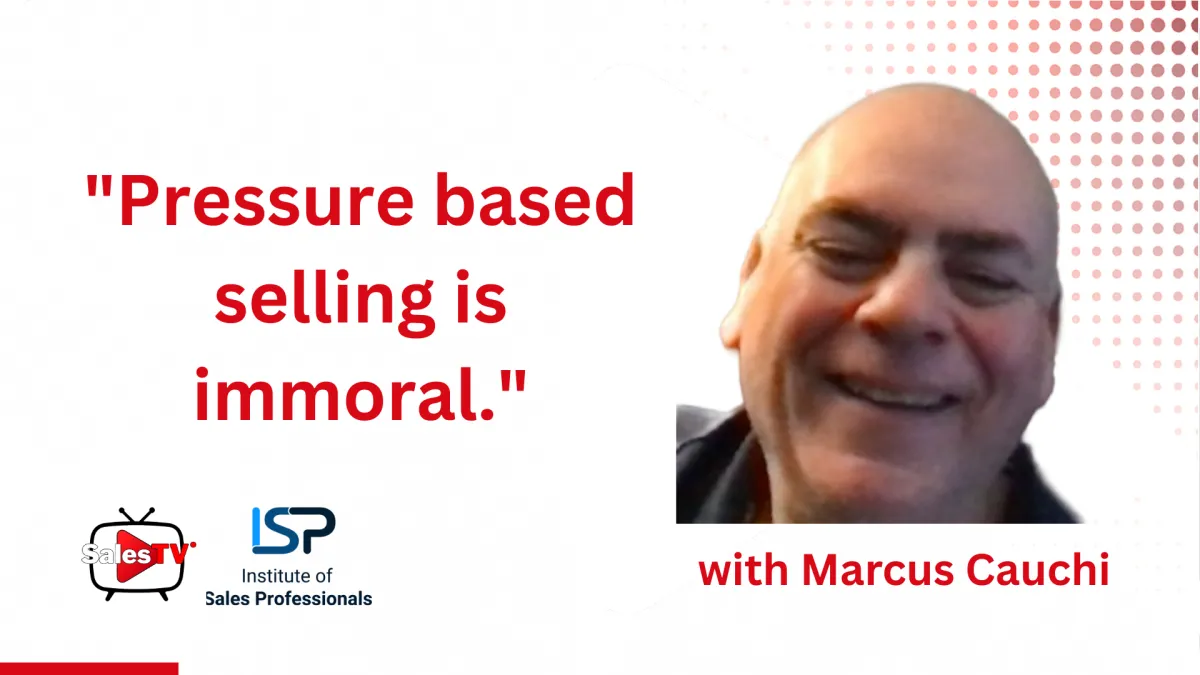
In this episode of SalesTV, Marcus Cauchi, founder of Principled Selling and creator of The Ally Method, joins us as we dig into what buyers are actually hiring salespeople to do, why pressure-based selling backfires, and how sellers unintentionally create buyer anxiety instead of clarity. In complex B2B environments, the real risk isn’t price or features. It’s political fallout, reputational damage, internal vetoes, and the fear of choosing wrong when the consequences last for years. That’s why so many deals stall, go dark, or end in no decision even when the solution looks “right.”
We’ll ask questions like -
* How do buyers use salespeople to reduce personal and organizational risk?
* How do buyers really decide which sellers to trust?
* Why do sellers underestimate reputational risk?
* Why do so many sales opportunities end in no decision - even late-stage deals?
Marcus Cauchi is a leading voice on decision safety and buyer risk in complex sales environments. He has spent over 35 years working at the messy end of sales - where trust, politics, fear, and incentives shape outcomes long before a proposal is written. Marcus is also the host of The Inquisitor Podcast, with over 500 long-form conversations exploring how real decisions get made under pressure.
Join us Tuesday at Noon ET/ 9am PT.
This week's Guest was -
Marcus Cauchi, founder of Principled Selling and creator of The Ally Method
This week's Host was -
Andy Hough, Founder & Director of The Institute of Sales Professionals
Transcript of SalesTV.live Mid-Day Edition 2026-01-27
Andy Hough [00:00:02]:
Hi and welcome to another edition of SalesTV. It's great to have you back. I am so delighted to do the first one for 2026. I am joined by somebody I've been kind of, I want to say, riffing with. It sounds as if I'm the musician of the. I'm not, but I've been chatting with for quite a while, a great guy called Marcus who's going to introduce himself in a second. He's introduced me to some really other interesting people in his network and who've got some fascinating views on sales like Todd over in the us. But before we dive into what we're going to talk about, Marcus, introduce yourself, tell us a little bit about you.
Marcus Cauchi [00:00:42]:
Hello, I'm Marcus Cauchi. My wife and I run Principled Selling. We're effectively trust architects. We coach, we write about sales, we build systems, we use AI to help people create decision safety in the buying process. And the thing that really gets my goat is pressure based selling, especially in enterprise and where buyers have to live with the outcome for a very long time. I feel it's not only disingenuous but it's immoral that salespeople are putting buyers under pressure. And I've spent the last 35 years learning my craft, the last 25 working with or 20 working with customers who run go to market teams, operators who meet customers. And I was influenced by people like Charlie Green who wrote the Trusted Advisor, came up with a trust equation and the best book on sales that's ever been and trust based selling.
Marcus Cauchi [00:01:53]:
Bob Mester who wrote Demand Side Sales 101, Mark Gston who wrote Just Listen. And all of these people have steered me gently in their own way to focusing on being buyer centric. And that doesn't mean you have to subordinate your needs as a seller, but you always put the customer's outcome first. And that's what we, that's what we do for a living.
Andy Hough [00:02:22]:
It's really interesting you should say that. And I'm busily trying to find it on my phone now. I bought a book. My wife sent me off to Waterstones in John Lewis to get some books for a friend, unfortunately who's not very well. And I still like the old stuff of walking into a bookshop and touching things. And I bought one called the Trust and why Trust is the scarcest resource and the most important. Trust is your superpower. And it's written by the guy that basically founded Wikipedia.
Andy Hough [00:02:57]:
And the concept obviously of Wikipedia, as you start to read this, Marcus, is that nobody you have to get the world to trust each other and put fact on there and trust the fact that it is fact and it regulates itself. And the reason I mentioned that is you mentioned the word trust. And I think in sales, we kind of just keep skirting over it. It's almost like that in inverted commas, you know, customer centricity. You know, we all leap on it and say, yes, if we can say it, then we obviously know what it means and we know how to behave. And so I find that to me, you know, and obviously in the ISP and the sales tv, is that how do we focus on really helping people understand how to be trustworthy? I know you know Brett Adamson, and you know, I'm a Matt Dixon groupie. You've mentioned some great books. I love his jolt effect.
Andy Hough [00:03:48]:
I love the fact you have to be seen as the trusted advisor if you're going to risk and help people and actually help the buyer. And that really drives my first question for you, which is, what is the job that a buyer and I love this buyer hires a salesperson for?
Marcus Cauchi [00:04:07]:
Okay, so it's a great question. This speaks to what Bob Mester and Clay Christiansen talk about. In Jobs to be Done. People don't buy a product or a service outright. They rent it. And they rent it only for as long as it's fit for purpose. So buyers hire sellers for one job, I believe, which is to help them make a decision that they can live with, to make the right decision and to be able to defend and justify it internally and to themselves. It's not to learn about a product.
Marcus Cauchi [00:04:40]:
It's not to be convinced. It's not to be closed. And specifically, buyers hire sellers to reduce the risk of choosing wrong, make sense of a messy situation, understand what changes if they act or if they don't. Test whether a real decision exists. Because quite often they're presented with stuff, and actually the status quo is the safest bet. There's no need to change. But what most salespeople overlook is the second room. They have to navigate the internal politics without being exposed.
Marcus Cauchi [00:05:21]:
And Bob Mester talks about four push, pull, inertia, and anxiety. And inertia is the magnetic gravitational pull of do nothing. And anxiety is where the buyer's brain goes to what happens if I buy and it backfires? And 60% of sales end up in no decision. So we need to create the conditions where they can exit safely if the decision isn't ready. And when a seller does all those things, buyers invite them in. When a seller adds pressure, the Buyers protect themselves. And that's really the job of a salesperson in my book.
Andy Hough [00:06:04]:
I think that's absolutely fascinating when you talk about obviously their, you know, helping people. And I don't know whether you've noticed this over the last two years in the enablement functions in organizations, but there's this kind of theme of enabling the buyer, buyer enablers. And I think it's directionally right. But then I'm not sure shareholders and organizations understand the conditions.
Marcus Cauchi [00:06:34]:
You beat me to the punch.
Andy Hough [00:06:36]:
Yeah, well, talk to me about that. What, what are the conditions companies need to be thinking about if a salesperson is going to be able to do that?
Marcus Cauchi [00:06:45]:
Well, the first thing you have to do is ident. If we're talking about the vendors, are we talking about the vendor side or the buyer side?
Andy Hough [00:06:54]:
Vendor side, yeah. In terms of what the shareholders doing to stop?
Marcus Cauchi [00:06:58]:
Well, shareholders have typically got a quarterly reporting cycle. That quarterly reporting cycle requires them to publish numbers. And it doesn't matter whether those numbers are real or not to a large extent, because the valuation target, if it's hit, is a bit like chip wrapper and it's out of date by 8:00 clock that evening. And so what they're doing is through their, who they hire, who they promote, how they measure, how they reward, they're driving supply side behavior, which means that we're fixated on volume. I'll give you a good example. I was doing a project last year and about 18 months before we started working together, the CEO had plowed a load of money into marketing and the top of the funnel was generating roughly a thousand leads a month. And you could see a steady decline from that moment in sales performance because sales were spread so thin and because marketing was ticking the box in terms of hitting their metrics. And they were happy.
Marcus Cauchi [00:08:29]:
The CEO was happy because it looked like they were busy. The shareholders were happy because the top of the funnel looked full. But most of the time the salespeople were spending their time talking to non prospects, non buyers, non ICP, anti ICP, you know, Mr. Bean in attacks, the false positives. And so by the time we started working with them four months into the year, they were only 34% of where they should have been against quota. Now problems symptoms show themselves in the moment, causes happen upstream. And I think boards need to look at the causal impact of bad decisions that are short term and selfishly self interested. If you know, Buffett says you can see he's been swimming naked when the tide goes out.
Marcus Cauchi [00:09:29]:
Well, you're seeing a Lot of that at the moment. There are plenty of companies that are making their number, but you look at the number of salespeople who are hitting that number. Dave Brock's recent book is Good Enough, Good Enough. And Carl Schmitt, who I had on my podcast, I've had both of them recently. They're both pointing to only 30% of salespeople or thereabouts are hitting quota or hit quota in 2025. So some things are wrong because if the CFO and the CEO are clinking their champagne glasses, but 70% of the people who are doing the work are failing in role, you got to look in the mirror as a leader. And I think what they need to start doing is identify and understand the key organizational roles in buyers and buyer organizations. They've got to help salespeople.
Marcus Cauchi [00:10:35]:
And this is where RevOps can really make a difference. If you fix the other stuff first is in navigating political, reputational and operational exposures in deals, managing the invisible influences and silent vetoes in the buying process, having strategies for early role and exposure mapping in their prospecting. So SDRs aren't just wildly interrupting people who they've done no research on. They lie to, they put under pressure because they are targeted on meetings. Well, if you target someone on generating meetings, you'll get meetings, but there'll be crap. And the impact of internal role dynamics on how deals progress that actually defines whether someone's successful in sales. Carl Schmidt talks about in the frame making sale, a sale to a surgeon for a piece of equipment, and it was absolutely what they wanted. They needed.
Marcus Cauchi [00:11:47]:
It went to the allocation committee. And then the four deadly words it turns out that came back. It turns out that marketing was vetoing the purchase of clinical devices because patients, even when coming to A E, had to park 10 or 15 minutes away. So they were going to spend the money on a parking garage. And salespeople don't really pay that much attention because they don't care about the second room. What they care about is showing their boss that they got the meeting or when it went well, when it didn't, because they haven't made it safe for the other person to take that conversation into the second room and for it not to be shut down.
Andy Hough [00:12:39]:
And so when you talk about safe is it, how do the people basically go into the other element of the organisation that's looking at parking garage versus clinical and then go, okay, I think you might be making the wrong decision for a parking garage. Great that it would help people, but actually they probably want a more clinical outcome than just a shorter walk.
Marcus Cauchi [00:13:01]:
Well, if the salesperson had been aware of it, they could have talked about the revenue generative opportunities of being able to do this and not have to send patients off to other hospitals to get this particular type of treatment. And it's in the us, so obviously there's a massive premium to even a blink. So they could have probably paid for the parking garage in about a year, but by creating that additional revenue stream, they'd have secured something that not only would have improved clinical outcomes and prevented deaths, which certainly in the uk, the NHS league tables seem to be very keen on. You've got to think about the second and the third room. The second room is taking it to the boss or to the cfo, and the third room is the allocation committee. And the allocation committee can veto anything as well. So this is where I think when it comes to prospecting, most sales organizations or go to market functions aren't really thinking about the buyer as an organism. They're thinking of them as a few silos.
Marcus Cauchi [00:14:19]:
And if we can call at the top and get a champion, then miraculously, everything else will happen. But that's not the case. Because if my anxiety is, will I look stupid or am I going to spend political capital on something that's only a 6 out of 10 for me, I'm not going to take it any further because it's not safe for me to do so. If I am vying for the same pot of money that everyone else is vying for and it is finite, then I need to be smarter than my competition, because my competition is going to come in and say, hi, Andy, have I got a deal for you? Huh? And SDRs will try and book a meeting. The AE will try and pitch their tedious product and the demo. I look at how salespeople AES turn up and do demos, they just show up and vomit features and functions. Well, the demo should be a discovery process. Your questions need to deliver insight so that you advance the person in front of you in the buying organization towards making the right decision at the right time for themselves, not so that you can meet your quota.
Marcus Cauchi [00:15:45]:
And I think one of the huge problems here is that almost nobody seems to give a damn about the customer. They're a forgotten afterthought at the end of a long chain of abuse. And you've got to understand that you have a problem owner, you have process owners, you have risk avoiders, very often CFO procurement, you have your sponsor, mobilizer or champion, you have an outcome owner and Then there are all these invisible influences and they've got beliefs in their head. There are stakes that they're trying to manage, there's tension, structural tension, political tension. Then they're looking for a solution and they want to stay credible, all whilst managing their pain today, move towards the better future that they're looking for, overcome the inertia of the status quo and their anxiety and fear of change. And the thing that flabbergast me is how often salespeople create anticipatory buyer's remorse. They create the conditions where the salesperson says something or does something or fails to say or do something and the buyer imagines everything turning to shit. And now they've created a future memory that didn't exist before because the salesperson failed to put themselves in the buyer's shoes.
Marcus Cauchi [00:17:12]:
They didn't think about the political fallout, they didn't think about what could go wrong. They just said, have I got a deal for you.
Andy Hough [00:17:19]:
I think it's quite interesting. Again, I've just. I got my phone out here because it's. I'm seminally awful with names, but when you were talking about the second and the third rooms, it brought me back to Matthew Sinek, the great author of Bounce. I don't know if you've read the book, but what he talks about, and I'm a huge rugby fan, which the bound you should. You know, everyone says never let a rugby ball bounce because you have no idea where it's going. Whereas in football it's a lot easier. But the interesting thing about that he's.
Andy Hough [00:17:49]:
He talks about, everybody knows where the first Bounce is going to be. The smart thing is to anticipate where the second bounce is going to be. That that's where the thinking is. Nate. It reminded me of that second route. And as you talk about that, what makes me feel a little disappointed is the cognitive ability of salespeople seems to have been chipped away at. And you talked about it in terms of marketing Funnel. Here's hundreds of stuff.
Andy Hough [00:18:18]:
We just want you to go and talk to 100 people today. And that ability to think about quality, that ability to think about things and anticipate them and do your proper research about all of these things, seems to have vanished. It seems to be, you know, we're going to teach you about the six P's in sales. So we're going to teach about product price, you know, processes, platforms, place and people. Never really people about you, but people about your customers. Then we're going to train the hell out of you. On certain things which are prescriptive. So margins are down.
Andy Hough [00:18:54]:
Therefore you're all really, really bad at negotiating. So we're going you to show cheap dip you in negotiation skills. And then this, this really bit about elevation of a human being to thinking, as you say, what is the second room and the third room? How is if I'm selling to you, how is Marcus going to go and actually position this somewhere else? And that's again the great Matt Dixon, isn't it? The, the challenger customer in terms of if do you think about these Personas, who is the stakeholder group that you're actually going to be working with? It really upsets me, Marcus, that that seems that free will of thinking and ethical capability and smart seems to have gone or be far smaller.
Marcus Cauchi [00:19:37]:
Well, I think what you're pointing to is haste over speed. There is far too much emphasis on speed but it turns into haste and everyone's in a hurry and as a result they don't do their research. Our job is to be timely, to be relevant and to deliver real insight and value to the person we're engaging. My wife Suzanne wrote a piece before Christmas which got a lot of pushback from traditional sellers saying, how dare you practice on me and it must be awful if you could. I had a fractional CRO role for a couple of years and because of that my inbox even to this day is flooded with between 20 and 50 spam messages on LinkedIn. I stopped using email to a large extent because it just made it impossible. I was getting 500 a day. Now if you're trying to work your way through that wall of noise when a salesperson phones you up and they use the standard pitch and it's all me, me, me, me, me and it's selfish selling, your instinct is just no thanks, not interested, send me something.
Marcus Cauchi [00:21:08]:
And then you wonder why it's soul destroying and why depression is so rife within the sales profession, why turnover is so high. I mean you've got better stats than I do. But if I remember rightly, the average salesperson lasts less than 12 months, the average manager less than 14. The average CRO is I think was last I saw, 16 months. Well, Phil McGowan, when he was doing his PhD in sales, he found that the average salesperson will only hit their full stride in year 3.2. Now if you never get to even half stride, is it any wonder that we are behind on quota? Is it any wonder that we struggle? Well, how dare you practice on your customers. Why are you not practicing with your Manager with your peers. Well, the reason is I don't have time to coach.
Marcus Cauchi [00:22:15]:
Yes, you do, but you're choosing to spend it on reporting on pointless meetings, on being the hero manager. And I don't blame managers for doing this because they are products of what leadership is inflicting on them. Have you seen that cartoon of the golden eagle shitting on a big crow that's crapping on a magpie that's crapping on a sparrow and there's a little robin at the bottom just covered in bird shit?
Andy Hough [00:22:44]:
No, I haven't.
Marcus Cauchi [00:22:45]:
Okay, well, that is basically the go to market function. And, you know, shit rolls downhill and excuses and blame roll uphill. Well, if we don't start taking ownership, if we don't start by mapping the buyer's journey. And again, we need to understand that buyers don't suddenly wake up one morning and say, you know, what I really want is a widget. There have been centers of dissatisfaction that existed months or even years beforehand. I recommend going on to the JTBD podcast and look up the mattress interview. Bob interviews a guy who. Excuse me.
Marcus Cauchi [00:23:33]:
Bob interviews a guy who is caught on CCTV in Costco and he walks past a mattress and he runs his hand against it and then he stops and he turns to his wife and they have a conversation, no sound, and he disappears. And five minutes later he comes back with a flatbed trolley and they put this mattress on the back. And to all intents and purposes, that looks like a spontaneous purchase. Bob interviews the guy and it turns out that the problem began four years ago when he was getting backache because their mattress was knackered. And so they spent two grand on a very expensive mattress topper. And after six months, because of his body weight, I guess, and as someone who's too short for my weight, you know, that didn't work. And it took another three years before his wife started getting backache. But he spent three years researching every type of mattress, every type of structure of mattress, every type of filler, you know, what NASA had done and everything else.
Marcus Cauchi [00:24:43]:
So it wasn't a spontaneous purchase. There was a buyer's journey. And Bob Meston maps it beautifully. You make space when you realize there's a problem, then you go into a period of passive looking where you're trying to understand the problem. Then you move into active looking and you move from learning how to exploring what your options are. When you move into the tail end of active looking and deciding, what you do is you make trade offs. And so what you're trading off is do we need four bedrooms or five, do we need a second bathroom, do we need a dining room, do we need a garden? What are the transport links and the schools and how close to London are we? All of those things are trade offs. So what you're doing is you're taking stuff away when you make the decision.
Marcus Cauchi [00:25:37]:
That's when anxiety is at its highest. And if they don't believe that you're going to deliver exactly what is promised, the brain's default setting to uncertainty is the worst case scenario. So now what we do is we imagine everything turning to shit and before you know it, what we've got to do is protect ourselves. So that's the point. We start getting people say, you know, I'm going to have to go and run this past my committee, I'm going to have to run it up the flagpole and other tropes and cliches and then you get ghosted. But the buyer's journey is incredibly messy. They're not making a linear decision as your CRM suggests, they're doing anything. But the buyer's journey is made up of problem identification, solution exploration, requirements, building.
Marcus Cauchi [00:26:41]:
And the least important part is supplier selection before the purchase. And so in the frame making sale, which again is a high, a strong recommend that Carl Schmitt and Brent Adamson wrote that spun off out of the difficulties that people found with Challenger, because Challenger, I mean, one of the interesting things about Challenger is when they first brought it out, they found in a study that 50% of top performers had a Challenger style to their selling. Later, another survey was done which said 50% of top performers had a challenge of style to their selling, but so did 50% of bottom performers. Now what that tells you is people can use it as a shield or as a weapon. And you see the same with other methodologies. You know, pain discovery should be a shield. It should be moving the customer forward by helping them gain insight, not telling them what to do, not creating pain, but advancing them one step at a time towards making the right choice. Instead, what it is is jabbing them with a pointy stick and then pouring salt on the wound in the hope that you can amplify their pain.
Marcus Cauchi [00:28:10]:
Well, no one wants to be pressured, put into pain, lied to, handled, closed. I mean, if you're listening to this, ask yourself as a buyer, when someone does that to you, what is your reaction? So why on God's earth do you think any of your buyers want that to be the experience that you inflict on them?
Andy Hough [00:28:35]:
And I think on that note, we are a fantastic conversation and I think that's the key takeaway, which is brilliantly and I protagonize this, which is actually, as salespeople, we are all buyers and we behave in a different way, and yet we don't take that bit of our brain and go, what do I look for for a buyer, as a buyer, and actually how do I therefore deliver that to people who are clearly looking for the same thing as a salesperson? You've really covered some, some wide ranging things here, Mark, and it's been an absolute joy. Just give, before we go, a little plug. What's your podcast called?
Marcus Cauchi [00:29:18]:
My podcast is called the Inquisitor Podcast with Marcus Kauke and it's the Inquisitor, all one word. And we've got 560 plus episodes in the back catalog. So we cover everything from sales, marketing, LinkedIn, management leadership, organizational change, trust channels, the whole caboodle. And we've had some amazing guests on. I mean, it's actually the piece of work that I think we're proudest of because we've brought together some amazing minds. But the big question there is we're always looking for the blind spots. We're always looking for the frequently unasked questions and the things that we do that we have sovereignty and agency over so we can do something about it. So I've got several people.
Marcus Cauchi [00:30:18]:
Eddingham, for example, has built his entire career off listening to the podcast and you know, he's quite vocal about it, which is I'm always very grateful for. And what I love about that piece of work is that it takes no prisoners. It's deeply uncomfortable. It's not American tv, so people can say what they like. And Stacker and Waldorf, the two guys who heckle the Muppets from the the box, they're the muse for it. And it's, it's fun.
Andy Hough [00:30:54]:
We'll get that out as part of the link as well. So, Marcus, thank you so much. You've covered so much and I've enjoyed this so much. We'd love to get you back, maybe do a joint one with your, with your, with your podcast and get the power of both going. But thank you so much and we'd love to hear the comments of everybody that has been listening and watching this out there. And this has been Marcus. And thank you again.
Marcus Cauchi [00:31:19]:
My pleasure. Thank you.
@SalesTVlive
#BuyerRisk #WhyDealsStall #NoDecisionDeals #B2BBuyingProcess #TrustInSales
#Sales #SalesLeadership #LinkedInLive #Podcast
________________________________________
About SalesTV: SalesTV is a weekly talk show created by salespeople, for salespeople. Each episode explores sales, sales training, sales enablement, and social selling, bringing together sales leaders, enablement professionals, and practitioners from across the globe.
About the Institute of Sales Professionals: The ISP is the only body worldwide dedicated to raising the standards of sales. Its Sales Capability Framework, certifications, and member community are designed to address their one goal: To Elevate the Profession of Sales.
